Tag Archives: 787

Boeing list prices increases vs. discounts increases (update for 2014)

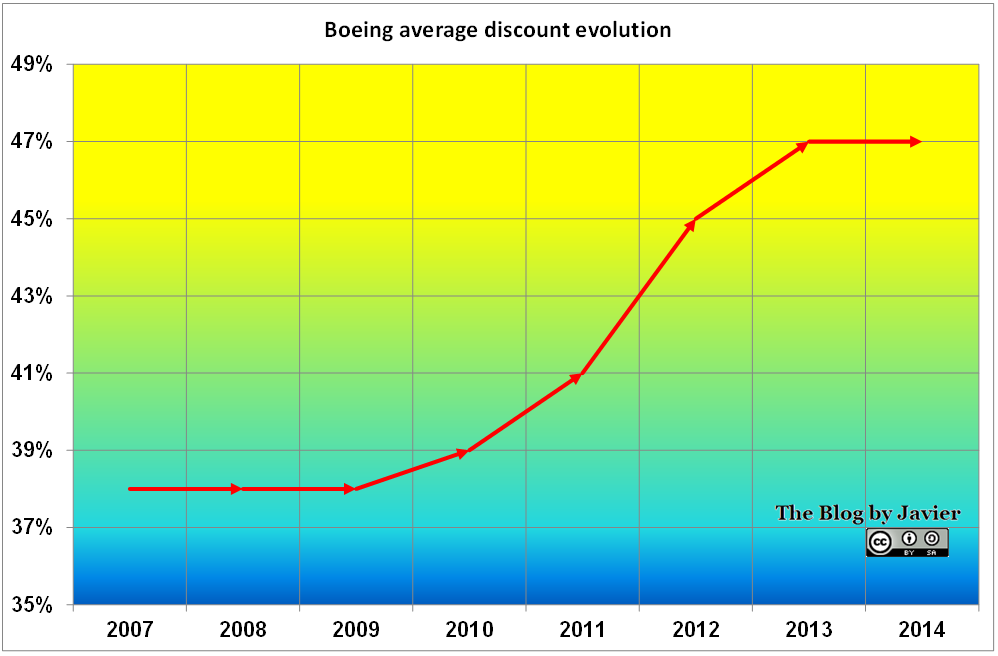
In a previous post I updated the estimate of what is the average discount Boeing applies when selling its commercial airplanes using 2014 data of list prices, deliveries and reported revenues. The figure I came up with was a 47% discount. I included the following graphic showing the discount evolution:
Boeing Average Discount Evolution, through 2014.

Boeing Average Discount Evolution, through 2014.

Last year, seeing the increasing trend of average discount together with knowing the fact that Boeing regularly increases list prices triggered the following question: Have Boeing airplane discounted prices increased, decreased or stayed constant in the recent years? I set out to answer this question using the estimated average discount of each year (1) from the graphic above.

The Boeing list prices (LP) (2) can be found here. I have been recording those prices for years and thus have a table with the evolution of list prices for each model year by year. The following step is to apply the average discount estimated for each year to then-year list prices, to get the estimated discounted prices (EDP) (2) per model. Thus, a table can be built for the last 6 years.

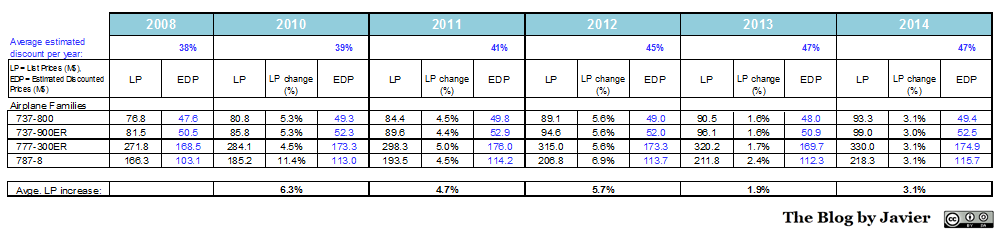
You can find below the result for the best-selling aircraft during previous years: 737-800, 737-900ER, 777-300ER and 787-8. Together these 4 models amounted to over 640 deliveries in 2014 or 89% of the total 723 airplanes Boeing delivered in 2014.
Boeing List and discount Prices evolution table, 2008-2014.

Boeing List and discount Prices evolution table, 2008-2014.

In the table above I included in black figures what have been Boeing list prices of these models in the past years (as reported in their website) while I marked in blue the figures which are estimated, using as a departure point the calculated averages discounts per year (also included in blue in the table). I included as well the list prices year-on-year change as a % of the previous year list prices, per model.

The average list price increase included at the bottom line is computed with the information of all Boeing models (19 in 2008 and 20 in 2014, though different ones (e.g. last year addition of 777-8X and 777-9X), a total of 26 different models along this period), not only the 4 included in this table.

You may see in the table above that after not increasing prices in 2009, Boeing has steadily increased them in 2010 (6.3%), 2011 (4.7%), 2012 (6.7%), 2013 (1.9%) and 2014 (3.1%). However, if you take a look at the blue figures in the same table you will notice that prices of 2014 are between 2010 and 2011 price levels for all 4 models! That is, the widely announced yearly list prices increase has been yearly offset by a discreet (not-announced) increase in the discounts applied to the sales of airplanes. Thus, the pricing power of Boeing has remained barely constant during the last 5 years. You may see it better in the graphic below:
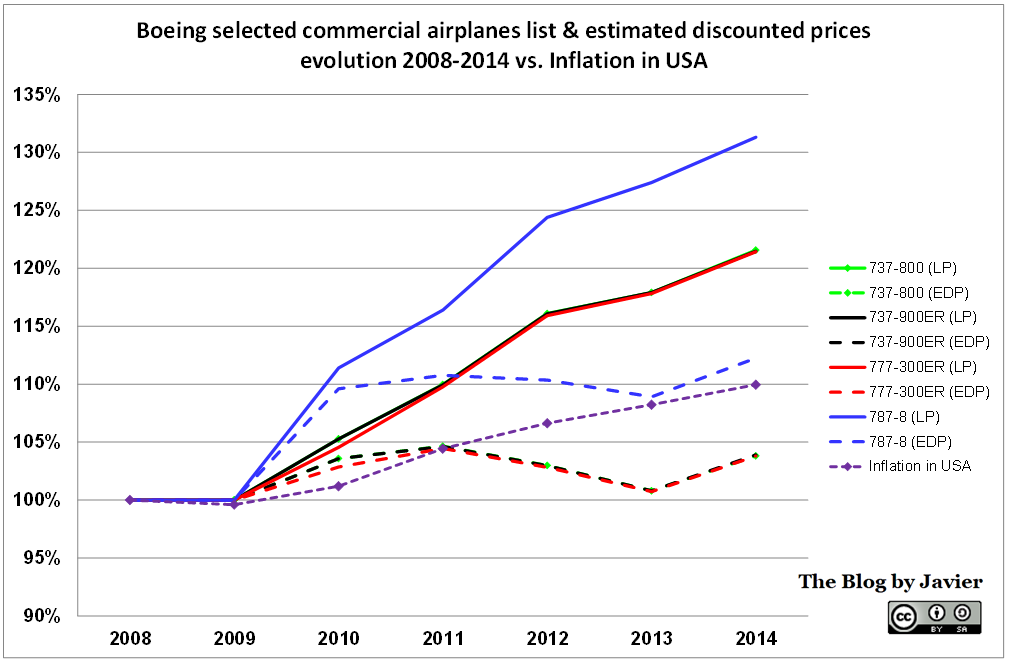
Boeing List & discount Prices evolution graphic vs. inflation in USA (through 2014).

Boeing List & discount Prices evolution graphic vs. inflation in USA (through 2014).

The graphic shows the price evolution for each of the 4 airplane models selected, taking as a reference their list and estimated discounted prices in 2008 (indicated as 100%) and also the evolution of inflation in the USA (3) in purple, to reflect the evolution of real prices (i.e. accounting for inflation). List prices are shown with straight lines, versus dashed lines used for estimated prices. Each pair of prices for each aircraft is presented in the same color for easier identification. Some comments to the graphic:

  • Through continuous increases, 2014 list prices were between 21% (737 and 777) and 31% (for the 787) higher than in 2008.
  • However, due to increasing discounts from 38% in 2008 to 47% in 2014, the increase in list prices is almost entirely offset (especially for 737 and 777, just 4% above 2008 levels).
  • 2014 discounted prices are below 2011 discounted prices for all models except 787.
  • If compare the evolution of prices vs. the US inflation (general prices in 2014 being 10% higher than in 2008), we see that:
    • Boeing actually lost pricing power in both the 737 and 777, which are cheaper in real (inflation-adjusted) discounted terms in 2014 than they were in 2008 (about 6% cheaper).
    • Only the 787 has been able to keep up the pace of discount escalation and inflation.

(1) There is no way to know the real price and discount that Boeing applies in each sale, as it will depend from customer to customer (American Airlines -AMR- or Fedex) and from model to model (737-800 or 787-8). There where competition is tougher, discounts will be higher. However, the estimates I have made are an average of all Boeing aircraft sold in a given year.

(2) Both list prices (LP) and estimated discounted prices (EDP) are expressed in then-year dollars.

(3) US inflation series since 2008: -0.4% (2009), 1.6% (2010), 3.2% (2011), 2.1% (2012), 1.5% (2013) and 1.6% (2014).
1 Comment

Filed under Aerospace & Defence

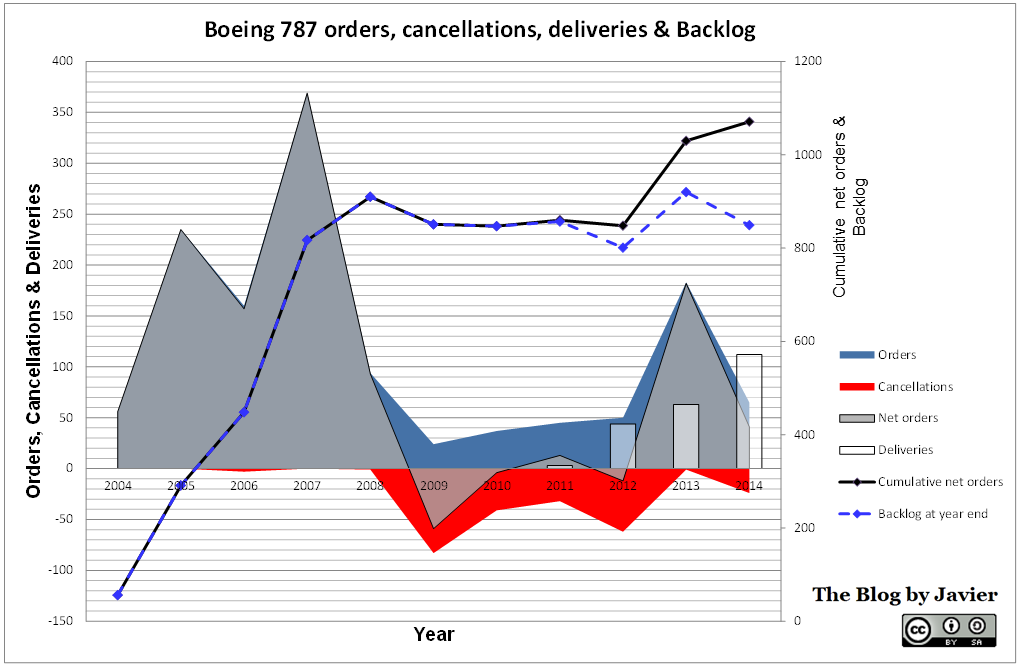
Boeing 787 orders, cancellations, deliveries & backlog through 2014

The year 2014 seems to have been another complex for the Boeing 787 program.

There were no major operational hick-ups such as the 2013 grounding of the fleet due to the lithium-ion batteries heat runaway issues, but commercially just 65 new orders were received (main ones from Air Europa and ANA) with up to 24 cancellations. Production ramped up to 112 deliveries (almost double than 2013’s 63). This increase is positive in relation to revenue recognition and cash inflow, however the cost per unit enjoyed a lower improvement than expected. As a result of previous figures, the so-called book-to-bill on the program was below 0.6, making the backlog to shrink slightly (leaving it practically at the same level since 2007).

An image is worth a thousands words:

787 orders, cancellations, deliveries and backlog through 2014.

787 orders, cancellations, deliveries and backlog through 2014.

1 Comment

Filed under Aerospace & Defence

Learning Curves: Boeing 787 case (from Dec 2012 to Dec 2014)

Last year, I wrote in a couple of posts an introduction to the concept of the learning curve and provided a the case of the Boeing 787 in 2013 (based on figures disclosed by Boeing CFO, Greg Smith). In the first of those posts, I discussed that:

Boeing does not disclose outright what is the actual learning curve it is achieving in its program. Nevertheless, in its investor relations conferences it provides information here and there of cost savings achieved, etc. This can be interpreted as derived from learning curve effects, and would permit to build a model, even if based on scarce information.

This year again, let me quote again one of those excerpts from Boeing executives in order to update the exercise:

On the 787-8, we’ve seen a decline in unit cost of approximately 30% over the last 175 deliveries and on 787-9, we’ve seen declines of 20% since the first delivery. Based on this progress, our production schedule and planned productivity investments, we continue to expect the 787 to be cash positive during 2015 and we still anticipate deferred production to decline shortly after we’ve achieved the 12 per month production rate in 2016. No change to these fundamental milestones.” Greg Smith, Boeing EVP – CFO at Q4 2014 Earnings Conference

As I mentioned last year, to the avid reader, and knowledgeable and savvy analyst, this paragraph is enough to deduce an actual learning curve achieved by the 787 for each aircraft model, provided that information reported by Boeing CFO, Greg Smith, was accurate.

Through the end of 2014, Boeing had delivered 212 787-8 and 10 787-9. The 787-9 were all delivered in 2014. The 212 787-8 were delivered as follows:

  • 2011: 3 aircraft.
  • 2012: 44 a/c.
  • 2013: 63 a/c.
  • 2014: 102 a/c.

Greg Smith is mentioning a cost reduction of 30% over the last 175 deliveries. As he was talking at the 2014 earnings call, we can safely assume that the figures were put up for him using deliveries and costs only through the end 2014 (and not counting info from January 2015 deliveries). That means that the cost improvements are measured theoretically from the aircraft 37th through the 212th (175). You can extract a report from Boeing website of the complete 787 deliveries here. I did it. Analysing it you see that between the beginning of December 2012 and the end of December 2014 176 787-8 were delivered (1).

Thus, the exercise to find out what learning curve Boeing achieved during that time span is as simple as to see what learning curve yields an “approximately 30% unit cost improvement” from the unit 36th (2) to the unit 212th. The beauty is that we do not even need to know the initial unit cost to perform the calculation, as the relative improvements in terms of percentages are independent of the starting point. All the information has indeed been provided by Boeing.

As I did in the blog post of the last year, in this first graph below I just plotted some generic learning curves, from 95% to 75%. This form of representation provides a good view of how learning is intense at the beginning of the production process and it stabilizes later on. It also shows well how learning is more intense and cost reductions are bigger for a 75% curve than for a 95% curve.

Generic learning curves.

Generic learning curves.

However, in the previous curves it is difficult to distinguish the 36th and the 212th units which are needed for the calculation. Thus, I plotted the same curves in a log scale for the numbers of units produced in the graphic below:

Boeing 787 learning curve over 176 units through Dec 2014 calculation, delta unit cost between 36th & 212th units.

Boeing 787 learning curve over 176 units through Dec 2014 calculation, delta unit cost between 36th & 212th units.

In this second graphic I added the information of what relative cost reduction is achieved between the 36th and the 212th units for each of the curves (3).

To make sure that readers are not lost, let’s take the 87% curve (in red). Following that curve, the unit cost of the 36th unit produced is a 48.7% of the 1st unit cost, whereas the unit cost for the 212th unit produced is a 34.1% of the 1st unit cost. The difference is then 48.7% – 34.1% = 14.6%, which represents a 30.0% cost reduction from the 36th unit cost. If you follow the same calculation for each of the curves, you will obtain the following unit cost improvements between 36th and 212th units:

  • 95% curve: -12.3% unit cost improvement
  • 90% curve: -23.6% unit cost improvement
  • 87% curve: -30.0% unit cost improvement
  • 85% curve: -34.0% unit cost improvement
  • 80% curve: -43.5% unit cost improvement
  • 75% curve: -52.1% unit cost improvement

Thus, from the information provided by Boeing of units delivered and unit cost improvement (“approximately 30%″, Greg Smith) we can deduce that from December 2012 through December 2014 the average learning curve that the 787 program has achieved is about 87%. Thus, in line with aerospace average indicated by NASA (85%), or in line with the reported 84% achieved in the 777. Though a bit lower than that calculated for 2013 (see here last year’s post). We can interpret that mismatch as either as a minimum error inherent of these estimates (85% vs. 87%) or that indeed the rate of improvement has somehow slowed down in 2014 in comparison to 2013.

Had Boeing been able to achieve effectively a 85% curve in the last 175 deliveries, bear no doubt that the message from Greg Smith would have been along the lines of an approximate 35% cost reduction (being the mathematical result 34%), instead of the reported 30%.

All these numbers refer to the 787-8. Now, remember that Boeing CFO also indicated that “on 787-9, we’ve seen declines of 20% since the first delivery”. 

Here, the calculation that needs to be done is the same. 787-9 deliveries started in 2014. If we assume that Greg’s comment referred only to 2014 deliveries (not 2015 ones), then the calculation must be made on 10 787-9 delivered between June and December 2014.  Here the learning curve obtained is a 93.5% ~87-88% (5) (6).

(1) I guess Greg Smith rounded to 175, but his “decline in unit cost of approximately 30% over the last 175 deliveries” refers to actually some fixed internal monthly reports and is based on 176 deliveries (not 175). (4)

(2) Taking into account the note (1), I will use 176 aircraft and deliveries from the 36th aircraft through the 212th.

(3) Bear in mind what a relative cost reduction is in contrast to the fact of relative costs represented in the vertical axis as percentages of the initial cost (100%).

(4) The taking of 175 instead of 176 aircraft practically does not change the result. For the same 87% curve the calculated cost reduction in one case is 30% and in the other 29.6%.

(5) This is in line with the slow down of the learning curve for the 787-8 comparing 2013 result with the result along the time span December 2012-December 2014.

(6) I initially calculated 93.5% as a result of a 20% cost reduction between the 1st and 10th units produced. However, as Matt B pointed, the first 3 787-9 have not been delivered (though they are units produced from which there was a learning effect). When you calculate what is the result for a 20% cost reduction between units 4th and 13th (the first 10 delivered), you get a curve between 87-88%, more or less the same one than for 787-8. Thus, it seems than at the beginning of the 787-8 production they went along a 85% curve that has slowed to a 87% for both models.

7 Comments

Filed under Aerospace & Defence

Boeing real prices (accounting for inflation) after discount

In a previous post I compared for some Boeing airplanes (737-800, 737-900ER, 777-300ER and 787-8) what had been the evolution from 2008 to 2013 of the published list prices against the estimated discounted prices. In that post, I arrived to the following conclusions:

[…] the pricing power of Boeing had remained barely constant during the last 5 years.

  • Through continuous increases, 2013 list prices were between 18% (737 and 777) and 27% (for the 787) higher than in 2008.
  • However, due to increasing discounts from 38% in 2008 to 47% in 2013, the increase in list prices is almost entirely offset.
  • 2013 discounted prices are below 2010 discounted prices for all models.
  • 2013 discounted prices are almost back at 2008 levels for the 737 and 777, only the 787 seems to have stayed at 2010 levels.

I, then, received one interesting comment from a reader, ikkeman, pointing at the fact that if the estimated discounted prices are expressed in then-year dollars (1), if real prices had not increased since 2010, that meant that they had indeed decreased.

See below the graphic I included in the a previous post updated adding the data of US inflation after 2008. [The series is: -0.4% (2009), 1.6% (2010), 3.2% (2011), 2.1% (2012) and 1.5% (2013)]

Boeing List & discount Prices evolution graphic vs. inflation in USA,

Boeing List & discount Prices evolution graphic vs. inflation in USA.

With the information of the inflation (purple line) the following 2 conclusions apply:

  • 787 real price (accounting for inflation) after discount has simply kept up with inflation rate since 2008.
  • 737 and 777 real prices after discounts, however, have lost ground with respect to inflation since 2008. On average they have lost about 8.5% in total or about 1.6% per year.

(1) That is the case as estimated discounted prices have been estimated year by year from the financial reports and list prices of the year, thus, using then-year US dollars.

Leave a comment

Filed under Aerospace & Defence

Learning Curves: Boeing 787 case in 2013

In the previous two posts I introduced the concept of learning curve and provided a case in point (based on figures attributed to A350 FAL by Leeham News). In the first of those posts, I discussed that:

Boeing does not disclose outright what is the actual learning curve it is achieving in its program. Nevertheless, in its investor relations conferences it provides information here and there of cost savings achieved, etc. This can be interpreted as derived from learning curve effects, and would permit to build a model, even if based on scarce information.

Let me quote again one of those excerpts from Boeing executives:

“We continue to see progress in key operational performance indicators and unit costs, as we further implement production efficiencies and stabilize the overall production system on the 787 program. Unit cost has improved approximately 20% over the past year on the 787-8 […]“Greg Smith, Boeing EVP – CFO at Q4 2013 Earnings Conference.

To the avid reader, and knowledgeable and savvy analyst, this paragraph is enough to deduce the actual learning curve achieved by the 787 during 2013, provided that information reported by Boeing CFO, Greg Smith, was accurate.

During 2013 Boeing delivered 65  787s, from the 50th to the 114th units (in previous years it had delivered already 3 in 2011 and 46 in 2012).

Thus, the exercise to find out what learning curve Boeing achieved in 2013 is as simple as to see what learning curve yields an “approximately 20% unit cost improvement” from the unit 50th to the unit 114th. The beauty is that we do not even need to know the initial unit cost to perform the calculation, as the relative improvements in terms of percentages are independent of the starting point. All the information has indeed been provided by Boeing.

In the first graph below I just plotted some generic learning curves, from 95% to 75%. This form of representation provides a good view of how learning is intense at the beginning of the production process and it stabilizes later on. It also shows well how learning is more intense and cost reductions are bigger for a 75% curve than for a 95% curve.

Generic learning curves.

Generic learning curves.

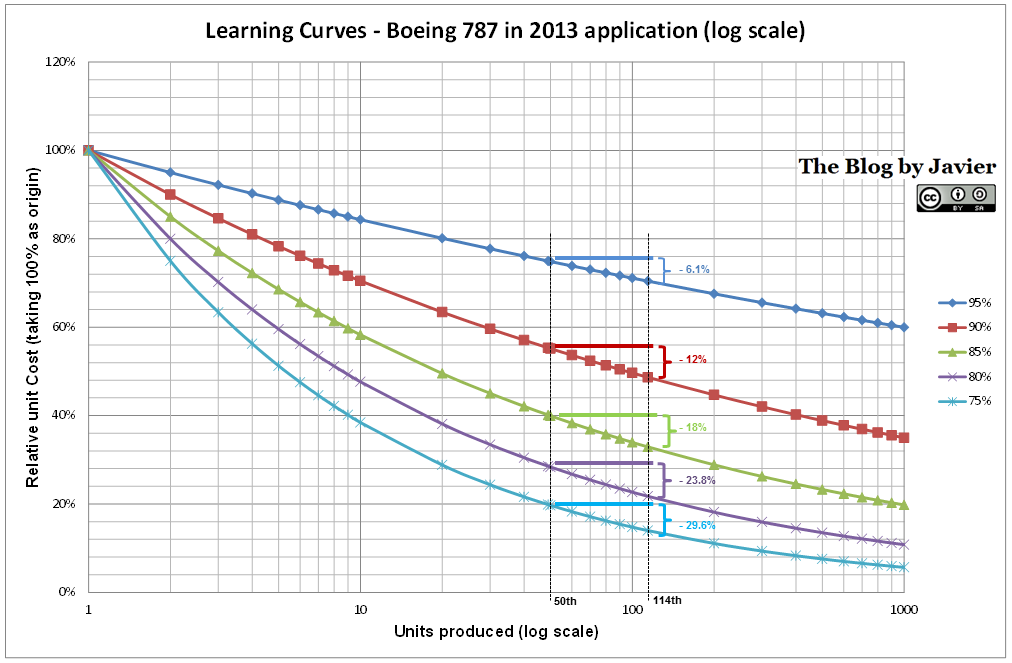
However, in the previous curve it is difficult to distinguish the 50th and the 114th units which are needed for the calculation. Thus, I plotted the same curves in with a log scale for the numbers of units produced in the graphic below:

Boeing 787 learning curve in 2013 calculation, delta unit cost between 50th & 114th units.

Boeing 787 learning curve in 2013 calculation, delta unit cost between 50th & 114th units.

In this second graphic I added the information of what relative cost reduction is achieved between the 50th and the 114th units for each of the curves (1).

To make sure that readers are not lost, let’s take the 85% curve. Following that curve, the unit cost of the 50th unit produced is a 40.2% of the 1st unit cost, whereas the unit cost for the 114th unit produced is a 32.9% of the 1st unit cost. The difference is then 40.2% – 32.9% = 7.2%, which represents a 18.0% cost reduction from the 50th unit cost. If you follow the same calculation for each of the curves, you will obtain the following unit cost improvements between 50th and 114th units:

  • 95% curve: -6.1% unit cost improvement
  • 90% curve: -12.0% unit cost improvement
  • 85% curve: -18.0% unit cost improvement
  • 80% curve: -23.8% unit cost improvement
  • 75% curve: -29.6% unit cost improvement

Thus, from the information provided by Boeing of units delivered and unit cost improvement (“approximately 20”, Greg Smith) we can deduce that during 2013 the learning curve that the 787 program has achieved is between 85% and 80%. Thus, in line with aerospace average indicated by NASA (85%), or in line with the reported 84% achieved in the 777.

If we wanted to know what learning curve yields exactly that 20% unit cost improvement, it is now trivial to calculate it: the 83.3% learning curve.

Having made these numbers, and taking into account the words used by Boeing CFO, “unit cost has improved approximately 20% over the past year on the 787-8″, I take it as that the improvement has been close to 20% though probably not reaching it; thus, I understand that the learning curve was rather between 83.3-85% instead of down to 83.3%.

(1) Bear in mind what a relative cost reduction is in contrast to the fact of relative costs represented in the vertical axis as percentages of the initial cost (100%).

2 Comments

Filed under Aerospace & Defence

Introduction to Learning Curves

Let me introduce the learning curve effect by quoting directly from the Wikipedia:

“The rule used for representing the learning curve effect states that the more times a task has been performed, the less time will be required on each subsequent iteration. This relationship was probably first quantified in 1936 at Wright-Patterson Air Force Base in the United States, where it was determined that every time total aircraft production doubled, the required labour time decreased by 10 to 15 percent.” […]

“Learning curve theory states that as the quantity of items produced doubles, costs decrease at a predictable rate.”

I used the concept of learning curve in a blog post in which I discussed whether and when the Boeing 787 would break even. In that post I referred to Boeing’s target of reaching a 75% learning curve on the 787 program, much more difficult to reach than the 84% that Boeing reportedly achieved in the 777 program.

Why is a curve of 75% more difficult to achieve than a 84% curve? The meaning of the figure “84%” attached to the learning curve is that each time that the number of units produced is doubled, the cost is reduced in 16%, or the 2*nth unit cost is 84% of the unit cost of the nth unit. Thus, a 75% curve would imply that the cost is reduced in 25%, which is a higher cost reduction than 16%, and, thus, more difficult to achieve.

On the other hand, NASA, in its Learning Curve Calculator, offers some guidance on learning curves for different industries and mixes of hand labor and machining work:

  1. Aerospace 85%
  2. Shipbuilding 80-85%
  3. Complex machine tools for new models 75-85%
  4. Repetitive electronics manufacturing 90-95%
  5. Repetitive machining or punch-press operations 90-95%
  6. repetitive electrical operations 75-85%
  7. Repetitive welding operations 90%
  8. Raw materials 93-96%
  9. Purchased Parts 85-88%

How is the concept of learning curve calculated? (from Wikipedia: )

 Now the equation for the unit curve is given by:

Y_x = K x^{\log_2 (b)}

where

  • K is the number of direct labour hours to produce the first unit
  • Yx is the number of direct labour hours to produce the xth unit
  • x is the unit number
  • b is the learning percentage (expressed as a decimal)

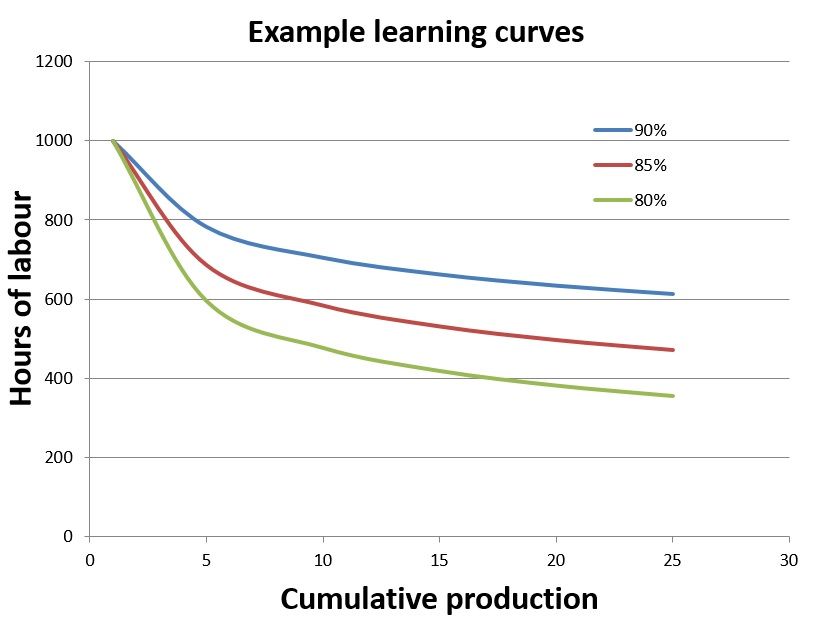
How does a learning curve look like? (from Wikipedia) Actual examples of curves in both linear and logarithmic scales would be:

Experience curve (from Wikimedia, by Apdevries).

The concept of learning curve is indeed used in aerospace, however, coming back to the 787 program, Boeing does not disclose outright what is the actual learning curve it is achieving in its program. Nevertheless, in its investor relations conferences it provides information here and there of cost savings achieved, etc. This can be interpreted as derived from learning curve effects, and would permit to build a model, even if based on scarce information.

See some of the hints that Boeing provides:

“We continue to see progress in key operational performance indicators and unit costs, as we further implement production efficiencies and stabilize the overall production system on the 787 program. Unit cost has improved approximately 20% over the past year on the 787-8 […]”, Greg Smith, Boeing EVP – CFO at Q4 2013 Earnings Conference.

“[…] as we continue to make improvements 787 unit cost […]”Greg Smith, Boeing EVP – CFO at Q4 2013 Earnings Conference.

“when you look at flow-time, you look at unit cost at Charleston whether it’s final, mid, or (aft) it made great progress there. And the team has been very focused on continuing that progress going forward. We have experienced a higher number of jobs behind schedule in the mid-body section, and that’s really due to, if you think about it, you are introducing the Dash-9 at the same time going to 10 a month. […], we’ve applied additional resources. We know how to do this and we’ll get those jobs back to what we view as a more acceptable level. So we got mitigation plans.” Greg Smith, Boeing EVP – CFO at Q4 2013 Earnings Conference.

“This morning we announced plans to increase 787 production beyond the 10 per month we’re on track to achieve this year to 12 per month in 2016 and then 14 per month, before the end of the decade. […], capture productivity and learning improved profitability […]” Jim McNerney, Boeing Chairman, President and CEO at Q3 2013 Earnings Conference.

“We’ve added another line or sorry, a position within the line, where we’re doing the wing, body joint earlier in the process and this is through experience after 134 airplanes, the teams are really coming up with better ideas or improvements on how to increase flow and that’s going to require some upfront investment. But obviously in the units to come after we’ll see that improvement again in flow and productivity.” Greg Smith, Boeing EVP – CFO at Q3 2013 Earnings Conference.

“[…] the flow time reductions, we’ve had in our factories, the hours per unit, the productivity per whatever are increasing significantly on all of our programs.” Jim McNerney, Boeing Chairman, President and CEO at Q3 2013 Earnings Conference.

5 Comments

Filed under Aerospace & Defence

Boeing 787 orders, cancellations, deliveries & backlog through 2013

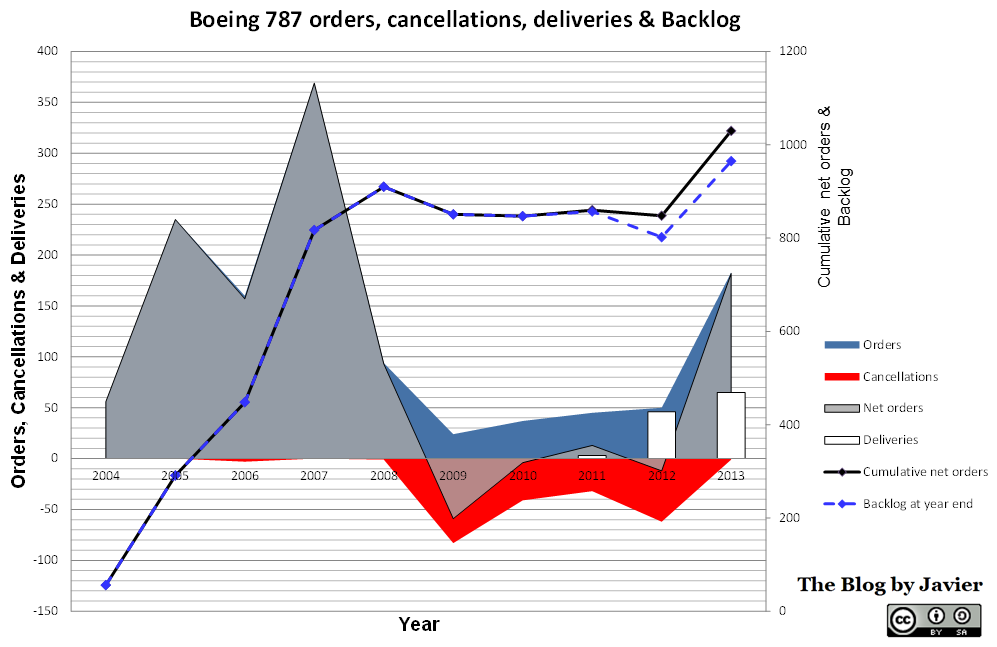
At first sight the year 2013 may seem to have been an annus horribilis for the Boeing 787 program with the months-long grounding of the fleet due to the lithium-ion batteries heat runaway issue, the fires that some of the aircraft in the operating fleet suffered, etc. On the other hand, after 4 years of sales impasse (from 2009 to 2012, inclusive), in which the cumulative net orders of those 4 years stood at a negative 62 aircraft cancelled, in 2013 Boeing recorded 183 new orders against just a single cancellation. Thus, 182 net orders. That is the 3rd best year in sales since the program was launched in 2004.

Last year, I wrote a post wondering whether the grounding of the fleet could be translated into some cancellations. Well, it didn’t so far. Quite the contrary, it got some big contracts from American Airlines, Singapore Airlines, Etihad, British Airways and GECAS.

In last year’s post I included a graphic that I have updated for this post, in order to reflect this recovery and have in one snapshot a view of the orders, cancellations, (net orders), deliveries and backlog.

787 orders, cancellations, deliveries and backlog through 2013.

787 orders, cancellations, deliveries and backlog through 2013.

Leave a comment

Filed under Aerospace & Defence

Boeing list prices increases vs. discounts increases…

In a previous post I updated the estimate of what is the average discount Boeing applies when selling its commercial airplanes using 2013 data of list prices, deliveries and reported revenues. The figure I came up with was a 47% discount. I included the following graphic showing the discount evolution:

Boeing Average Discount Evolution, 2013.

Boeing Average Discount Evolution, 2013.

Seeing the increasing trend of average discount together with knowing the fact that Boeing regularly increases list prices triggered the following question: Have Boeing airplane real prices increased, decreased or stayed constant in the recent years? I set out to answer this question using the estimated average discount of each year (1) from the graphic above.

The Boeing list prices (LP) can be found here. I have been recording those prices for years and thus have a table with the evolution of list prices for each model year by year. The following step is to apply the average discount estimated for each year to then-year list prices, to get the estimated discounted prices (EDP) per model. Thus, a table can be built for the last 5 years.

You can find below the result for the best-selling aircraft during previous years: 737-800, 737-900ER, 777-300ER and 787-8. Together these 4 models amounted 560 deliveries in 2013 or over 86% of the total 648 airplanes Boeing delivered in 2013.

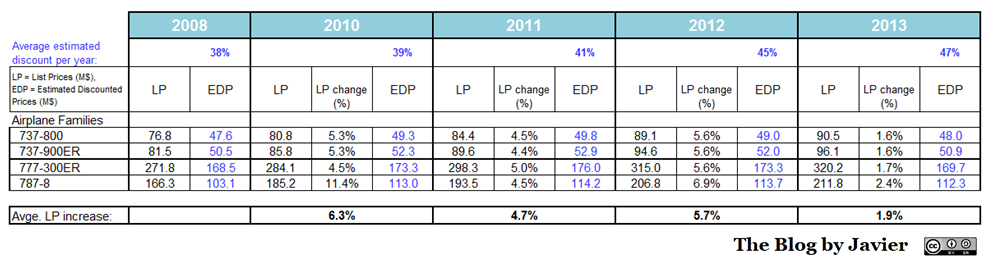
Boeing List and discount Prices evolution table, 2008-2013.

Boeing List and discount Prices evolution table, 2008-2013.

In the table above I included in black figures what have been Boeing list prices of these models in the past years (as reported in their website) while I marked in blue the figures which are estimated, using as a departure point the calculated averages discounts per year (also included in blue in the table). I included as well the list prices year-on-year change as a % of the previous year list prices, per model.

The average list price increase included at the bottom line is computed with the information of all Boeing models (19 in 2008 and 18 in 2013, though different ones, a total of 24 different models along this period), not only the 4 included in this table.

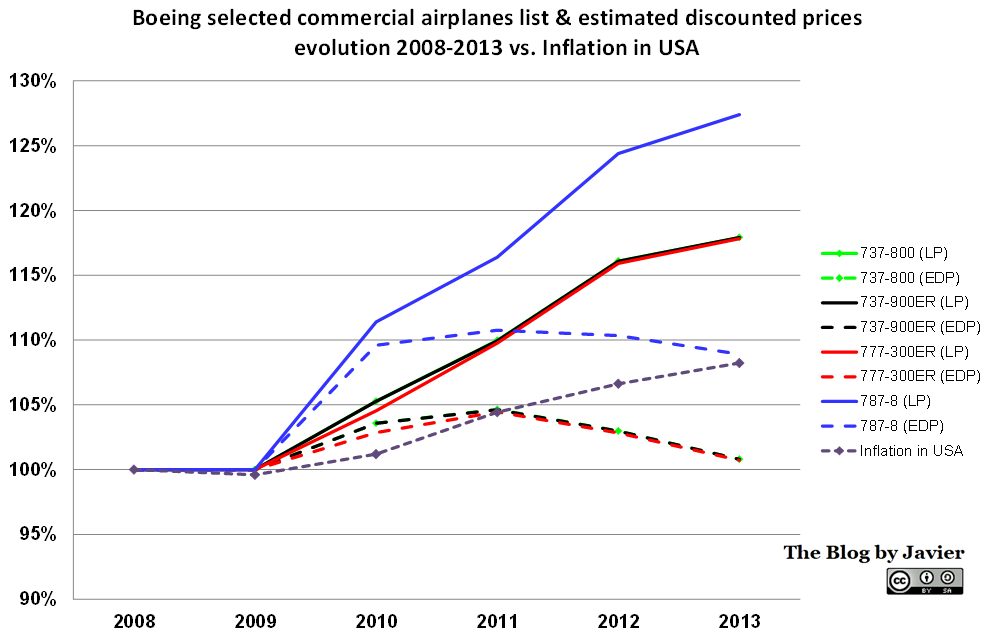
You may see in the table above that after not increasing prices in 2009, Boeing has steadily increased them in 2010 (6.3%), 2011 (4.7%), 2012 (6.7%) and 2013 (1.9%). However, if you take a look at the blue figures in the same table you will notice that prices of 2013 are between 2008 and 2010 price levels for all 4 models! That is, the widely announced yearly list prices increase has been yearly offset by a discreet (not-announced) increase in the discounts applied to sales of airplanes. Thus, the pricing power of Boeing has remained barely constant during the last 5 years. You may see it better in the graphic below:

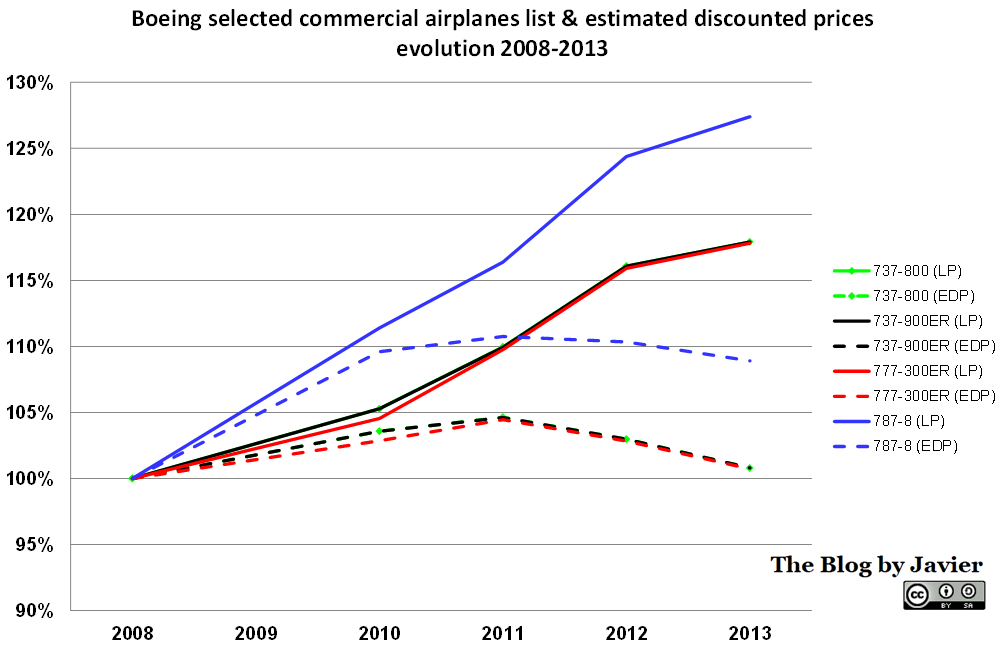
Boeing List and discount Prices evolution graphic, 2008-2013.

Boeing List and discount Prices evolution graphic, 2008-2013.

The graphic shows the price evolution for each of the 4 airplane models selected, taking as a reference their list and estimated discounted prices in 2008 (indicated as 100%) . List prices are shown with straight lines, versus dashed lines used for estimated prices. Each pair of prices for each aircraft is presented in the same color for easier identification. Some comments to the graphic:

  • Through continuous increases, 2013 list prices were between 18% (737 and 777) and 27% (for the 787) higher than in 2008.
  • However, due to increasing discounts from 38% in 2008 to 47% in 2013, the increase in list prices is almost entirely offset.
  • 2013 discounted prices are below 2010 discounted prices for all models.
  • 2013 discounted prices are almost back at 2008 levels for the 737 and 777, only the 787 seems to have stayed at 2010 levels.

(1) There is no way to know the real price and discount that Boeing applies in each sale, as it will depend from customer to customer (American Airlines -AMR- or Fedex) and from model to model (737-800 or 787-8). There where competition is tougher, discounts will be higher. However, the estimates I have made are an average of all Boeing aircraft sold in a given year.

3 Comments

Filed under Aerospace & Defence

Twin-aisle aircraft deliveries 20-year forecast

I read in the following article “Airbus seeks to increase Washington State supply business; aims for 13 A350s/mo” (from Leeham News) how from a presentation of a A350 supplier (ElectroImpact) at an aerospace suppliers event in Washington State, it was concluded that the Airbus aimed at building 13 A350s per month, as the mentioned supplier had built its factory with capacity to extend production rates up to those 13 aircraft.

This would be news because in its presentations Airbus talks about a production ramp-up up to 10 a/c per month (as does Boeing for the 787, which 10 aircraft/month should be reached by the end of 2013).

Having analyzed several times Airbus’ Global Market Forecast (GMF) and Boeing’s Current Market Outlook (CMO), I believe that those production rates of above 10 aircraft per month should be expected by industry followers just by seeing the numbers included in those forecasts.

In 2012, the GMF forecasted about 6,500 twin-aisle to be delivered in the next 20 years. The CMO indicated 7,210 aircraft. In 2013, Boeing CMO slightly reduced the figure to 7,130 a/c.

Comparison of Airbus GMF and Boeing CMO 2012-2031.

Thus, both companies expect between 6,500 to 7,200 twin-aisle passenger aircraft to be delivered in the following 20 years (excluding freighters, 747 and A380 – these 2 considered as Very Large Aircraft in the studies).

1st approach. If we were to take the mid-point of both forecasts, about 6,850 a/c, and simply divided by 20 years, we would reach to an average figure of 343 twin-aisle aircraft to be delivered per year between the 2 manufacturers, or 28 a/c per month. If Airbus wanted to maintain the long-term 50% market share, it would have to aim at delivering 14 a/c per month between all its twin-aisle products, which soon will be A330 and A350.

2nd approach. However, current twin-aisle production levels are in no way close to those 343 a/c per year. In 2012 there were 258 deliveries thanks to the introduction of 787s, but in the previous decade the average was about ~165 a/c per year. Thus, manufacturers must have a deliveries’ ramp up to accommodate those 6,850 in the next 20 years. Not knowing what that ramp-up is, I just linearized from where we are today and what is to be delivered.

I plotted in the graphic below all the deliveries of twin-aisle (excluding Very Large Aircraft) from the 1970s to 2012, and then what a forecast could be departing from 2012 deliveries’ figure to accommodate ~6,850 a/c in the next 20 years.

Taking a look at the graphic, one can already understand that if we take the GMF and CMO forecasts as good ones, the manufacturing rhythm will have to accelerate in the following years, especially in the second decade. In the late 2020s, over 400 twin-aisle would have to be delivered per year (over 33 per month), thus manufacturers will have to churn above 16 a/c per month each, that is the double of what they produced during the last decade.

Twin-aisle deliveries: historic series (1970s-2012) and forecast (excludes VLA -A380  & 747).

Twin-aisle deliveries: historic series (1970s-2012) and forecast (excludes VLA -A380 & 747).

Market shares. One could wonder whether this growth will favour more one company or the other. I compared market shares (excluding VLA):

  • in 2012: Boeing delivered 155 twin-aisle (26 767s, 83 777s, 46 787s) vs. Airbus 103 a/c (101 A330s, 2 A340s)… 60% / 40%.
  • in 2003-2012: Boeing delivered 839 twin aisle (148 767s, 642 777s, 49 787s) vs. Airbus 880 a/c (44 A300s, 687 A330s, 149 A340s)… 48% / 51%.
  • in 1993-2012: Boeing delivered 1,687 twin aisle (572 767s, 1,066 777s, 49 787s) vs. Airbus 1,521 a/c (175 A300s, 31 A310s, 938 A330s, 377 A340s)… 50% / 45%.

[The shares in the past decades include marginal deliveries from Ilyushin models and McDonnell Douglas models, which share I kept out of Boeing even after the merger in august 1997, these are ~30 a/c to be added to the 1,687]

Seeing that market shares have been fluctuating but always around 40-60% for each company, they could expect to have to at least deliver 40% of those 6,850 a/c in 20 years, or of those above 400 a/c in the late 2020s.

Backlog. Finally, just to see how the twin-aisle mix for each company is going to be, let’s look at the aircraft on order (backlog) that each company has as of today (end June 2013):

  • Airbus (43%):
    • A330: 260 a/c to be delivered.
    • A350: 678 a/c to be delivered.
  • Boeing (57%):
    • 767: 56 a/c to be delivered.
    • 777: 339 a/c to be delivered.
    • 787: 864 a/c to be delivered.

Thus, of the 6,850 twin-aisle to be delivered in the next 20 years, about 2,200 are already contracted as of today (plus the above 130 a/c delivered within the first half of 2013), thus 33% of those 6,850 a/c is more or less secured and among those the split is 57 / 43 for Boeing.

2 Comments

Filed under Aerospace & Defence

Boeing 787s parked in Paine Field

During our visit to Boeing wide-bodies final assembly lines in Everett, one thing was striking to the eye: the amount of Boeing 787s that were parked all around Paine Field. This is a view I was expecting to see since (a) at the time we travelled there (May 2013) the final fix to the 787’s batteries problem had not yet been approved by the Federal Aviation Administration (FAA) nor implemented in the already built aircraft, and (b) Boeing had kept churning 787s out of the assembly line thus provoking the mounting of them around the place.

See some of the pictures I took of them (not many pictures, nor very good ones as within the factory limits photo cameras were prohibited):

This slideshow requires JavaScript.

A collector’s gallery of a (luckily) rare event.

Leave a comment

Filed under Aerospace & Defence, Travelling