Tag Archives: aircraft

Dear Congressman, send the C-27Js to The Boneyard

I read yesterday the following article from Aviation Week & Space Technology: “U.S. Coast Guard Patrol Aircraft May Fall To Cuts“. Part of the article stated the obvious, that the Coast Guard modernization programs may fall also victims of the budgetary pressures faced elsewhere in the Department of Defense or Department of Homeland Security. However, the following passage caught my attention:

“While the results of the portfolio review, started in April, remain to be seen, the Coast Guard has not given up on gaining new equipment. Obama administration officials are looking at transferring at least 14 newly built Finmeccanica C-27J transports from the Air Force, which has controversially declared them “excess” to its needs. As CRS reported, if the Coast Guard were to receive 14 or more C-27s, it could stop procurement of EADS HC-144A maritime patrol aircraft (MPA) at the halfway point, with 18 aircraft, saving $887 million.”

I was amazed, since:

The rationale behind was the potential saving of up to 800M$ in acquisition costs (not buying the remaining 18 out of 36 aircraft which originally made up the Deepwater program) and getting some 14 C-27J instead…

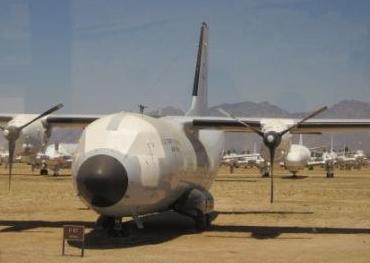
If I were an US Congressman looking for savings across the US Armed Services, I would have it clear: instead of interfering with sound acquisition programs, I would simply get those C-27Js already acquired, send a couple of them to museums and the rest to The Boneyard in Davis-Monthan Air Force Base, to lay there forever close to their older brothers the C-27As and avoid any cost-ineffective operating and maintenance expenses on them…

The only cost-effective C-27s are in the desert (or already scrapped).

The only cost-effective C-27s are in the desert (or already scrapped).

2 Comments

Filed under Aerospace & Defence

Wide-body mix in 15 years of Boeing CMOs

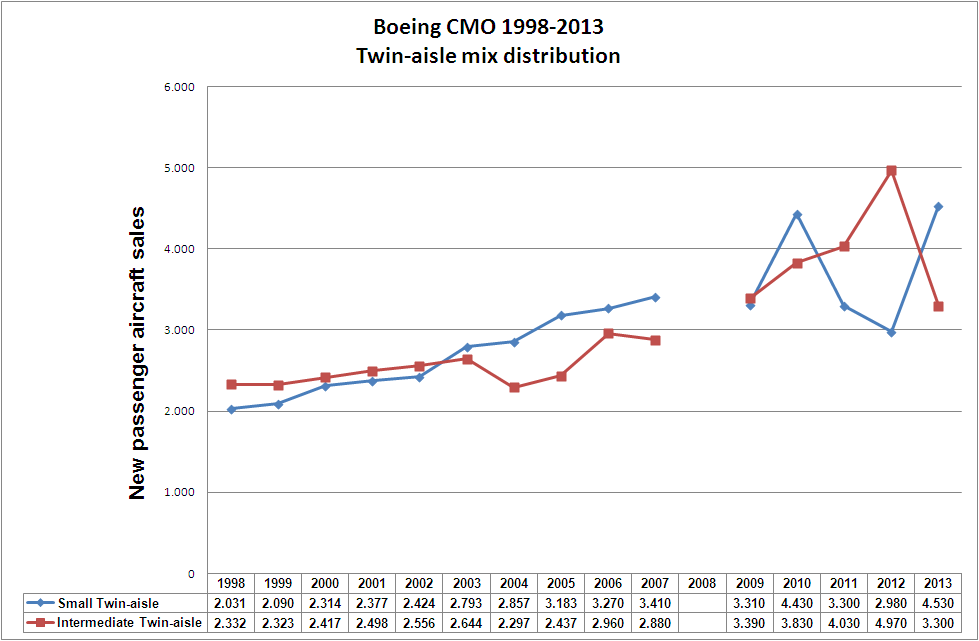
A couple of days ago I wrote about the publishing by Boeing of its Current Market Outlook for 2013-2032. In that post I made a very brief review of it, and mentioned that I was puzzled by the change in the predicted mix of twin-aisle sales, between small and medium wide-bodies. To recall the numbers:

  • small wide-bodies: from 2,720 a/c in CMO2012 to 4,320 a/c in CMO2013, whereas,
  • medium wide-bodies: from 4,490 a/c in CMO2012 to 2,810 a/c in CMO2013.

Since I keep a collection of CMOs from years back, I decided to compare the figures of this wide-bodies mix along the last 15 years…

Twin-aisle mix distribution (Boeing CMO 1998-2013).

Twin-aisle mix distribution (Boeing CMO 1998-2013).

Seeing at the graphic (made using Boeing figures):

  • During the first 5 years (1998-2003) the trends are quite constant.,
  • From 2003 to 2007, the mix is reverted, possibly to favour the launch of the 787.
  • In 2008 the CMO did not provide the split.
  • From 2009 to 2013, you can see that both trends in the forecasts are erratic… why? Only Boeing knows.

9 Comments

Filed under Aerospace & Defence

Review of Boeing Current Market Outlook 2013

Last week, just ahead of Le Bourget air show, Boeing Commercial published its yearly update of the Current Market Outlook (CMO) for the next 20 years of commercial aircraft market (2013-2032).

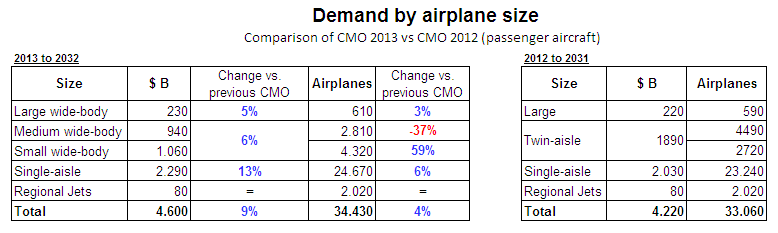
I just compared the figures for passenger aircraft of the last two years’ CMOs:

CMO 2013 vs 2012 comparison.

CMO 2013 vs 2012 comparison.

Some comments to it:

  • You can see that the total number of new aircraft delivered has slightly increased from 33,060 to 34,430, a 4%, which is consistent with the constant 5% traffic increase that Boeing predicts.
  • The volume (Bn$) increases by a larger percentage, 9% (380 Bn$)… this is due mainly to the double increase in:
    • (1) single-aisle aircraft expected sales 6,2% (+1,430 aircraft), and
    • (2) the average price list with which the list is computed, another 6.3% (from 87.3m$ to 92.8m$)
  • I am puzzled to see the the sudden change in the predicted mix of twin-aisle sales, between small and medium wide-bodies…
    • small wide-bodies: from 2,720 a/c in CMO2012 to 4,320 a/c in CMO2013, whereas,
    • medium wide-bodies: from 4,490 a/c in CMO2012 to 2,810 a/c in CMO2013
    • as you can see the combined figure slightly changes (7,130 vs. 7,210), however the distribution among the two categories is drastically changed. Why is that? A question to Randy Tinseth that he did not address in his blog when the CMO was unveiled.

I would tend to think that the move is done to push some market development based on some models (787) instead of others (777), but given that it is precisely now when the upgraded versions of the 777 are supposed to be pushed into the market I fail to see the logic behind this.

Find below the nice infographic that the guys from Boeing have put up together:

Boeing Commercial Aviation Market Forecast 2013-2032 infographic.

As always, I recommend going through the CMO, as you can learn a lot about the business: from global numbers, to growth, traffic figures, fleet distributions, forecasts, etc… You may find the presentation [PDF, 9.6 MB], the booklet [PDF, 3.0 MB] and the file [XLS, 0.4 MB] with all the data.

For a comparison between this CMO and the respective Airbus’ GMF we will have to wait until after the summer, when Airbus publishes its update. Until then, find here the comparison based on 2012 market studies.

9 Comments

Filed under Aerospace & Defence

The Boneyard

The US Air Force’s 309th Aerospace Maintenance and Regeneration Group (AMARG), known as “The Boneyard”, is one of the places that I had wanted to visit since many years ago. Luca and I visited it a couple of weeks ago.

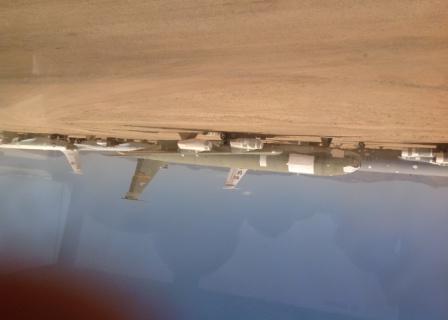
The Boneyard is an aircraft and equipment storage facility located at Davis-Monthan AF Base near Tucson (Arizona). The are over 4,000 military aircraft stored at the place. Most of them come from the USA (not only from the air force, but from other services as well) but there are some aircraft from foreign countries. The aircraft are stored for several reasons and in different conditions.

  • Some of them are maintained waiting for a possible future use of them (be it with US armed forces or through some foreign military sale, that is the case of several old versions of C-130, F-16).
  • Other aircraft are kept so their parts can be used as spare parts for other active flying aircraft (e.g. C-130, KC-135).
  • Finally, there are aircraft which are stored waiting to be scrapped so the metal can be reused somewhere else.
KC-135 partly scrapped.

KC-135 partly scrapped.

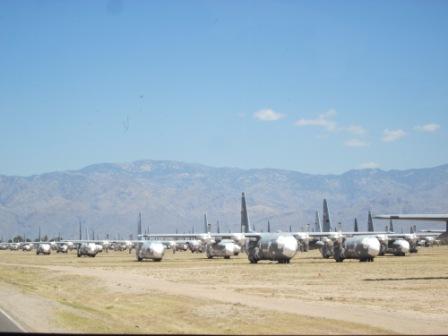
Hundreds of C-130.

Hundreds of C-130.

There are whole fleets of retired aircraft: C-141 Starlifter (retired once the C-17 took over their role), half of the C-5 Galaxy fleet (the A versions, due to budget constrains and fleet strategic decisions), the Vietnam-era helicopters Hueys and Cobras

The Boneyard can be visited with a guided tour organised by the Pima Air and Space Museum (I will write about this museum in another post).  The tour is made with a bus which goes through the Boneyard very slowly and making several stops (though guests cannot exit the bus). The guides are veterans from the US armed forces, who have flown or maintained some of those models that you get to see. The wealth of knowledge that they have about them, the anecdotes and stories that they tell during the tour are worth much more than the 7$ that the tour costs.

The place is impressive, overwhelming. Not only there are thousands of aircraft but the seeing of them fully aligned, whole fleets of different models helps you put things into perspective:

  • World commercial airliner fleet (over 100 pax) has about 16,000 aircraft vs. the 4,000 at The Boneyard.
  • The largest airline fleets have about 1,200 aircraft.
  • Spanish AF has 14 C-130 Hercules vs. the hundreds of them you see at The Boneyard.
  • The dozens of retired Lockheed C-5A Galaxy that you can see there have a combined payload capacity of over 5,000 tonnes… which is more than the complete payload capability of any other air force in the world except the US one…

You may want to take a look at satellite images from the Boneyard here:

6 Comments

Filed under Aerospace & Defence, Travelling

Boeing commercial aircraft discounts (update for 2012)

A week ago, Boeing released 2012 results [PDF, 223KB]. The company reported revenues of almost 81.7bn$601 commercial deliveries and 1,203 net orders for its commercial aircraft. All these were widely reported by the media and mean a great year 2012 for Boeing (with increases in these metrics from 20 to 30%).

Last years, I wrote in some posts what was my estimate of Boeing discounts: the relation between what is announced by the press, what appears in its list prices and sometimes as backlogs and what it is indeed computed into the profit and loss account. In this post I wanted to update, if necessary, the figure I calculated for the average discount of Boeing.

Most of the necessary information can be found in its website. Boeing list prices can be found here.

The number of gross and net orders (after cancellations) year by year can be found here.

Last year deliveries can be found in the report of financial results (or here). From there we can also deduct the figure of Boeing Commercial’s sales of services. That is not directly reported but can be deducted (all Boeing services-related sales are reported as well as Boeing Capital Corporation division and Boeing Defense’s “Global Services & Support” unit)

As in the post of last year:

  • I needed to make one assumption: new orders come with a 3% down payment in the year of the booking, while the remaining cost I assumed that was paid on the year of delivery (for simplicity I didn’t consider more intermediate revenue recognition milestones linked to payments, the 3% figure was taken from the AIAA paper “A Hierarchical Aircraft Life Cycle Cost Analysis Model” by William J. Marx et al.). [1]

Having put all the figures together, the calculation is immediate. Boeing Commercial Aircraft revenues in 2012 (49,1bn$) are the sum of:

  • the discounted prices times the delivered aircraft in the year (including possible penalties from delays),
  • less the down payment of the current year delivered aircraft, as the down payment was included in previous years results,
  • plus the down payment of current year net orders (this year’s calculation has been again a bit tricky as it included 737NG deliveries and 737 MAX orders),
  • plus services revenues (about 1.4bn$ from the commercial aircraft unit – calculated, not reported).

The discount figure that minimized errors last year was 41%. Using this figure, the error obtained this year in relation to Boeing Commercial Aircraft reported revenues is 7.5%, much too high. The best estimate for last years average discounts were: 41% for 2011, 39% for 2010 and 38% for 2009.

The updated figure (which minimize errors for 2012 down to 0.4%) for the discount for Boeing commercial aircraft is 45% [2].

The explanation I can find for that increase shall be linked the built-in penalties for 787 (net orders for 2012 being -12 a/c) and 747 delays (1 single net order) into revenues plus the launch of a new aircraft, 737 MAX (forced by A320neo sales success in 2011).

[1] Two years ago, I received a comment from the analyst Scott Hamilton on the level of downpayments. He mentioned they could reach up to 30%. I tried this time to compute the calculation using that input, though the figures of discounts to be applied each year to minimize errors would have to be even higher, over 50% (!), thus I stayed with the 3% used in the above-mentioned published paper to stay on the conservative side.

7 Comments

Filed under Aerospace & Defence

World commercial aircraft fleet: forecast vs. actual

Some weeks ago I made a comparison about Airbus and Boeing aircraft market forecasts. Last week I published a couple of posts about the evolution in the forecasted aircraft average size and on the accuracy of these market forecasts. For this, I looked for old issues of Boeing Current Market Outlook from as back as 1990.

The next step then it was obvious, I compiled the following graphic showing with the data available information over a 40-year span on:

  • The evolution of world commercial aircraft fleet year by year (blue line) from 1995 to 2011,
  • The forecasted world aircraft fleets by Boeing CMO (red line) from 2000 to 2031 (with some gap years). For 2015 to 2031 the forecast was made 20 years ahead; for 2010-13 it was made 15 years ahead; for 2005-2008, 10 years ahead and for 2000-2003, 5 years ahead.
  • The published 20-year aircraft market forecast year by year.

World commercial aircraft fleet: forecast vs. actual (data source: Boeing CMO).

As you can fleets, forecasted fleets and market fleets have all been increasing year by year. The compounded annual growth rate (CAGR) for each one has been:

  • Actual fleet growth: 3.73% from 1995 to 2011 (2.88% from 2000 to 2011).
  • Forecasted fleet growth: 3.55% from 2000 to 2031 (3.69% from 2000 to 2011).
  • 20-year market forecast: 5.07% from 1992 to 2012 (3.43% from 2001 to 2012).

It is interesting to see that in those years when there is both figures for actuals and forecasted fleets the figures are close (-3.3% average deviation) and so is the trend, though forecasted fleet was lower at the beginning of that period (-7.2% in 2000) and grew at a higher rate until almost matching the numbers in 2011 (+1.2%).

Even though, the 20-year market forecasts have grown at a higher rate than fleets, it is mainly because the first data that I could retrieve come from the economic crisis of the beginning of the 1990’s, when Boeing trimmed down its forecasts. From the 2000’s the figures for market forecast have grown at a similar rate than those of fleets. And so will be the growth of forecasted fleet from 2011 to 2031: 3.5%.

****

Notes:

  • 1990 CMO long-term market forecast is made for 15 years, not 20.
  • Forecast of fleet for the periods 2000-2003, 2005-2008 and 2010-2013 does not come from CMOs published 20 years before, but from 5, 10 and 15-year fleet forecasts included in the CMOs of 1996, 1997, 1998 and 1999.
  • Boeing does not publish 5, 10 and 15-year fleet forecasts anymore.
  • It would be interesting to have a per-segment graphic, however there is not consistent data to produce it for the same time span. Boeing changed singe-aisle cut-off seat size from 1999-2000, in 1996-1997 and 2008 didn’t report the split within twin-aisle, in 2008 it also didn’t report the split within single-aisle.

2 Comments

Filed under Aerospace & Defence

Airbus vs. Boeing, comparison of market forecasts (2012)

Yesterday, John Leahy, Airbus COO Customers, unveiled at a press conference in London the new figures of the 2012-31 Airbus’ Global Market Forecast (GMF, PDF 5.6MB).

The last two years, I already published comparisons of both Airbus’ and Boeing’s forecasts (Current Market Outlook, CMO, PDF 3.0MB). You can find below the update of such comparison with the latest released figures from both companies.

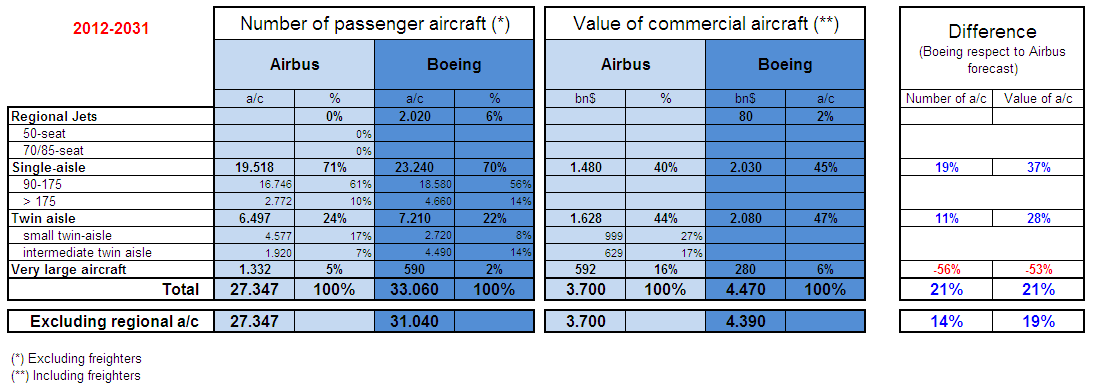
Comparison of Airbus GMF and Boeing CMO 2012-2031.

Some comments about the comparison:

  • Boeing sees demand for 14% more passenger aircraft (excluding regional a/c) with a 19% more value (including freighters).
  • Boeing continues to play down A380 niche potential (56% less a/c than Airbus’ GMF), though for second year in a row it has slightly increased its Very Large market forecast, this time by 20 a/c, or 3.5%.
  • On the other hand, Boeing forecasts about 200 twin-aisle and 4,200 single-aisle more than Airbus, clearly pointing to its point-to-point strategy versus the connecting mega-cities rationale presented by Airbus.
  • In terms of RPKs (“revenue passenger kilometer”), that is, the number of paying passenger by the distance they are transported, they see a similar future: Airbus forecasts for 2031 ~12.8 RPKs (in trillion) (a ~4% increase vs last year GMF) while Boeing forecasts 13.8 (also increased about 3%).

The main changes from last year’s forecasts are:

  • Both manufacturers have increased their passenger aircraft forecast in about 500 a/c, less dramatically than last year’s change.
    • In the case of Airbus it has increased the single aisle segment, probably reflecting the success of the A320neo launch.
    • In the case of Boeing, they decreased both single aisle (130 a/c) and small twin aisle (300 a/c), but increased the intermediate twin-aisle in 900 a/c… selling internally a new version of the 777?
  • Both manufacturers have increased the value of RPKs in 2031.
  • Both manufacturers have increased the volume (trn$) of the market in this 20 years, 12% Airbus (to 3.7trn$) and 10% Boeing (to 4.4trn$).

Some catchy lines for those who have never seen these type of forecasts:

  • Passenger world traffic (RPK) will continue to grow about 4.7% per year (5.0% according to Boeing). This is, doubling every ~15-20 years.
  • Today there are about 15,500 passenger aircraft around the world, this number will more than double in the next 20 years to above 32,500 a/c in 2031.
  • The A380 market equation: Urbanisation + Mega-cities + Wealth = VLAs (Very Large Aircraft, i.e. A380 and B747).
  • Emissions of aviation industry amount to 2% of man-made CO2 emissions.
  • Centre of gravity of world travel will have moved from the Atlantic Ocean (in 1971) to the Middle East (2031).
  • A key driver here is the propensity to fly of the people as the economies of their countries grow. This is captured well by the graphic below, a classic in the industry. This time, Airbus mentioned in the GMF that it has carried out a survey during summer asking 10,000 people around the world whether they expected to fly more in the future. This was true especially in China and India.

Trips per capita vs. GDP per capita (source: Airbus GMF).

Again, I strongly recommend both documents (GMF and CMO) which, differences apart, provide a wealth of information of market dynamics. The complete book from Airbus will be published online next week according to Chris Emerson (SVP for Future Programmes & Market Strategy).

In case you find it tough, to read those kind of booklets, you may take a look at the video of the press conference, a great class on global economy, world aviation, forecasting, trend spotting…

http://www.youtube.com/watch?v=ohtHBPZI5R0

11 Comments

Filed under Aerospace & Defence

Reconstruction of AF447 accident

The accident of the flight Air France 447 was deadliest in the history of the airline and, since it happened almost 3 years ago, has appeared every now and then in the media. Today, while having lunch with two colleagues I learnt about a documentary about it that was shown in French TV channel France 5 last Wednesday.

The documentary, produced by Bernard Vaillot, is titled “Vol Rio-Paris, les raisons d’un crash“,  lasts about 50 minutes, and the programme in which it was emitted included an interview afterwards (complete programme duration 1h08′).

The documentary includes as main attraction a reconstruction of the last 4 minutes of the flight. This reconstruction is built from the cockpit voice recorder (CVR) and the flight data recorder (FDR), often referred as black box. A complete transcription, with comments, interpretation and an exhaustive description of the events can be found in the different interim reports, briefings and releases made by the French BEA (Bureau d’Enquêtes et d’Analyses), the body in charge of the accident investigation.

In the BEA reports [PDF, 10.3MB, New Findings, pgs. 77-78] some facts were established: such as the loss of correct speed indication due to the icing of the pitot probes, the disconnection of the autopilot and the subsequent reaction from the pilot, pulling the stick towards him nosing up the aircraft, increasing the angle of attack until the aircraft enters in stall.

Other interesting features of the documentary are the testimonies of different pilots, including a real stall exercise performed by a flight instructor (from minute 25). He first shows how to recover from a stall, then he simulates the wrong reaction from the AF447 pilot, pulling the stick towards him, pitching up, while the stall alarm was still sounding.

You may see the following trailer below before venturing to see the whole programme.

EDIT: The trailer video has been deleted from Youtube, however, now the full video is available:

Unfortunately, I haven’t yet seen a subtitled or doubled version of it.

5 Comments

Filed under Aerospace & Defence

Weight and balance

As part of the preparation of a flight, the pilot shall make sure that the total weight of the aircraft (including fuel and passengers) is at or below the limits, and that the center of gravity is within a certain area. This is what is called weight and balance.

Some months ago, in our private pilot licence course we had a class where we reviewed this. I remember that one pupil asked “is it possible that the aircraft gets knocked over backwards on ground?” (imagine the aircraft “sitting” on its tail).

This question led me to make the numbers to see whether this was possible with the aircraft we are using for our lessons, a Robin DR 400.

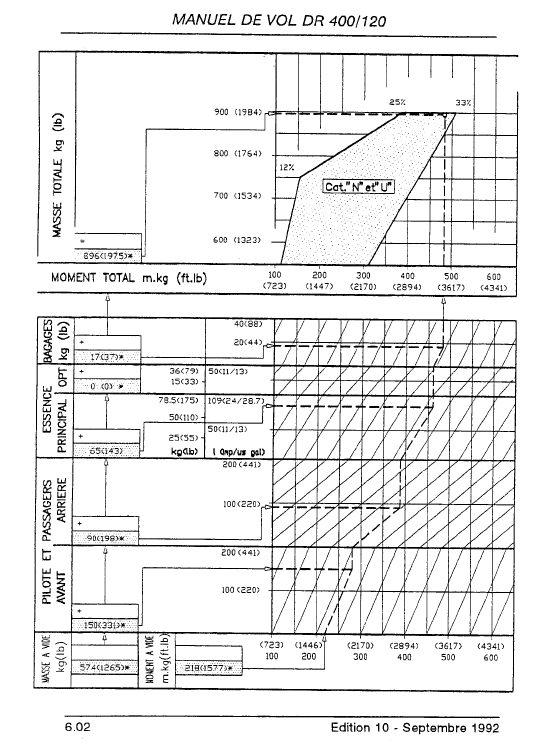
Centrogram for a DR400-120.

For this purpose we use a centrogram, which is nothing but a small “map” where the different possible weights that can be loaded into the aircraft and its momentum are already drawn so the center of gravity can be easily calculated and checked whether it falls or not in the allowed area. This centrogram is included in the flight manual of the aircraft.

I found that, carrying 2 pilots (~154kg) plus 2 passengers (~154kg), you could never load much weight into the rear compartment reserved for baggage. As that area is the one behind the main landing gear, you wouldn’t knock over the aircraft on ground.

If instead of 2 pilots and 2 passengers, you had only 1 pilot and you would load the same weight (~231kg) as baggage, the aircraft would be unbalanced but still wouldn’t fall backwards and sit on its tail. Even if the center of gravity of the baggage compartment is behind the landing gear, the weight of the empty aircraft with a center of gravity between the nose and main landing gear over compensates our trick.

Once I had calculated this, I went one step further: in which cases being under the maximum take-off weight (MTOW, 1,000 kg for a DR400-140) given by the designer could the aircraft be unbalanced? That is, what is required to get the centre of gravity out of the allowable range?

I found that to get the aircraft unbalanced basically you would need to load it in two different ways that at first seemed quite bizarre to me:

  1. You would need to carry only 1 pilot and 2 passengers (plus at least 25 kg of baggage and bearing in mind not to exceed the MTOW), but instead of two of them occupying the front positions and one sitting at the back, you would have a single adult piloting the aircraft and the other two at the back. I’ve never seen that.
  2. You would need to have 1 or 2 adults piloting the aircraft, no passenger at the back plus at least 100 kg of baggage at the back. Why would one person carry so much baggage for a short trip with a Robin DR 400? Here I would add that the designer of the aircraft placed a small plaque indicating that no more than 40kg should be loaded in the baggage compartment.

Well, the two cases can be referred respectively to the following situations:

  1. A couple formed by future groom and bride flying alone with a pilot. Maybe that flight was used by the man to propose the marriage. Well, now you know it, that’s not a good idea, it could make the aircraft unstable (takeaway: no proposals in small aircraft).
  2. Drug-trafficking. I can imagine such small aircraft being used to carry as many drugs as possible… well, apart from being illegal, if someone would carry too much (that is over 100kg), even when below the maximum allowed weight, would make it unstable.

2 Comments

Filed under Aerospace & Defence

Boeing commercial aircraft discounts (update for 2011)

Some weeks ago, Boeing released 2011 results [PDF, 252KB]. The company reported revenues of almost 69bn$477 commercial deliveries and 805 net orders for its commercial aircraft. All these were widely reported by the media and mean a good year for Boeing.

Last years I wrote in some posts what was my estimate of Boeing discounts: the relation between what is announced by the press, what appears in its list prices and sometimes as backlogs and what it is indeed computed into the profit and loss account. In this post I wanted to update, if necessary, the figure I calculated for the average discount of Boeing.

Most of the necessary information can be found in its website. Boeing list prices can be found here.

The number of gross and net orders (after cancellations) year by year can be found here.

Last year deliveries can be found in the report of financial results. From there we can also deduct the figure of Boeing Commercial’s sales of services. That is not directly reported but can be deducted (all Boeing services-related sales are reported as well as Boeing Capital Corporation division and Boeing Defense’s “Global Services & Support” unit)

As in the post of last year:

  • I needed to make one assumption: new orders come with a 3% down payment in the year of the booking, while the remaining cost I assumed that was paid on the year of delivery (for simplicity I didn’t consider more intermediate revenue recognition milestones linked to payments, the 3% figure was taken from the AIAA paper “A Hierarchical Aircraft Life Cycle Cost Analysis Model” by William J. Marx et al.). [1]

Having put all the figures together, the calculation is immediate. Boeing Commercial Aircraft revenues in 2011 (36,2bn$) are the sum of:

  • the discounted prices times the delivered aircraft in the year (including possible penalties from delays),
  • less the down payment of the current year delivered aircraft, as the down payment was included in previous years results,
  • plus the down payment of current year net orders (this year’s this calculation was a bit trickier as it included 737NG deliveries BUT 737 MAX orders),
  • plus services revenues.

The discount figure that minimized errors last year was 41%. Using this figure, the error obtained this year in relation to Boeing Commercial Aircraft reported revenues is 0.1%. That is a little higher discount than previous years (39% for 2010 and 38% for 2009). The only explanation for that would be the built-in penalties for 787 and 747 delays into revenues plus the launch of a new aircraft, 737 MAX.

Thus, the updated discount for Boeing commercial aircraft is 41% (!).

[1] Last year, I received a comment from the analyst Scott Hamilton on the level of downpayments. He mentioned they could reach up to 30%. I tried this time to compute the calculation using that input, but the figures of discounts to be applied each year to minimize errors are not consistent, thus I stayed with the 3% used in the above-mentioned published paper.

6 Comments

Filed under Aerospace & Defence