My 2012 reading list

At the beginning of the year I set as a personal objective to read at least 15 books. This will be a low number for some of you and a high one for others. To me it looked challenging but achievable… though, I did not achieve it. I completed 10 books and started other 4 which I have not yet finished (they’ll be included in the next year reading list).

See below the list with a small comment for each one, the link to a post about the book in the blog (when applicable), links to Amazon (in case you want to get them) and sometimes to the authors. I have also included a small rating from one to three “+” depending on how much do I recommend its reading:

  1. This time is different” (by C. Reinhart and K. Rogoff) (++): very interesting book offering a comprehensive book to economic and financial crises since 8 centuries ago. The book is full of graphics, statistics, example, anecdotes… I already wrote three posts about it: “The Republic of Poyais“, “The march toward fiat money” and “¿Cómo le ha ido a España en esta crisis?“. 
  2. Le Petit Prince” (by Antoine de Saint-Exupéry) (++): even if narrated as a children’s book, it contains several idealistic messages, fine criticisms of how adults behave, etc. The teachings are mainly transmitted through conversations between a child and the prince and encounters with other characters… I wrote a post about it “Le Petit Prince“.
  3. The consequences of the peace” (by John M. Keynes) (+++): the book was written at the time of the Versailles Conference after the World War I, which he attended as a delegate from the British Treasury. In the book, Keynes explained how the disaster in the making was being produced, due to lack of communication between representatives from USA, UK, France and Italy, and the intention from Clemenceau of taking as much as possible from Germany. Keynes makes a series of estimates of Germany’s production capabilities and that of the regions being taken from it and comparing them with the pretensions that were being included in the negotiations of the treaty. In the book, he warns well in advance the economic and social disaster that the treaty is going to send Germany into. (I have not yet written a specific review of the book, but since I had underlined several passages I don’t discard writing it).
  4. Le bal des ambitions” (by Véronique Guillermard and Yann le Galès) (+): the book tells the story behind the creation of EADS and its first years. Very much like in a thriller, it gives account about the characters involved, the battles for power, etc. I wrote a post about it “Le Bal des ambitions“.
  5. Desolé, nous avons raté la piste” (by Stephan Orth and Antje Blinda) (+): The book consists of a series of awkward situations in a flight described by passengers, pilots and cabin crew, mainly miscommunications between the crew and passengers or funny messages received from the cockpit. The book originated after a collection of the anecdotes posted by readers of the online version of Der Spiegel. . See the review I wrote about it “Sorry, I missed the runway“.
  6. Poor Charlie’s Almanack: The Wit and Wisdom of Charles T. Munger” (by Charlie Munger, compiled by Peter D. Kaufman) (+++): the book is a compilation of Munger’s speeches, quotes, interviews, articles, letters, etc. Some of his speeches are available in Youtube (e.g. this one given for the commencement of USC Law in 2007). One of the main takeaways is the use of several mental models to analyze situations we live in our lives (instead of being stalled in the few models which we are more comfortable with). Another recurring topic is the lack of training in psychology that we get (or even his criticism of how psychology is taught in faculties). I haven’t written a post about the book, but I think I should, if only to share more of his wit and wisdom with you.
  7. The Peter Principle: Why Things Go Wrong” (by Laurence J. Peter) (+++): the book is a hilarious account of situations that arise in companies and institutions of why and how people are promoted, cornered, etc., or in his words is a treatise on hierarchology. The name of the book comes from the Peter Principle which says: “In a hierarchy, every employee tends to rise to his level of incompetence”. I already wrote about it here.
  8. 2010 Odyssey Two” (by Arthur C. Clarke) (++): the book is a sequel to the famous “2001: A Space Odyssey“, and there is a movie as about this book. The story starts with doctor Heywood Lloyd travelling in a combined Soviet-American mission to Jupiter in order to find the spaceship Discovery One from the previous mission and what went wrong with it… I won’t tell more of the plot to avoid spoiling it for someone. I would say that I liked more this book (and movie) than the first one.
  9. The Litigators” (by John Grisham) (++): this novel is very much like most of John Grisham. In this one the plot is about a star young lawyer graduated from Harvard Law School who cannot stand the pressure from a big firm and quits it to join a mediocre small firm with two partners who chase victims of small accidents to help them get some  compensation from insurance companies, with the hope of reaching the big class action which could make the rich.
  10. Soccernomics” (by Simon Kuper and Stefan Szymanski) (+++): the authors use economics’ techniques, plenty of data, statistics, citing several papers, studies, etc., in order to bring up uncovered issues about football (such as transfer market, what makes some nations more successful in football…) or refocus the attention about other ones. See the review I wrote about it.

I also completed two other partial objectives: to read at least 2 books in French and 2 about politics/economy. And as always, on the learning side from reading there is Twitter (a source of information or distraction?), the subscriptions delivered to home of the weekly The Economist and the two monthly magazines Scientific American and Toastmasters.

15 Comments

Filed under Books

Online education

At the beginning of the year I started some online courses: Coding with Codecademy, Valuation and Corporate Finance with Coursekit (which was later acquired by Lore), and Game Theory and Model Thinking with Coursera.

Together with other life and work commitments, it became tough to follow the courses and in the end I dropped them.

In autumn I received an email from a friend pointing to another online course: “Finance” from Venture Lab platform. I took a look at it… In the end I subscribed to 3 course from that platform: “Finance”, “Technology Entrepreneurship” and “A Crash Course on Creative Thinking”.

They were simultaneous and finishing them has been quite challenging; but this time, yes, I completed all of them.

I wanted to share with you some thoughts about the courses:

Finance: we could say that this was the more boring course for the general public (even though 32,500 students from all over the world subscribed to it… I don’t know how many completed it, probably less than 10%). It started with basic theory of interest and time value of money to get more into the fine details of term structure, building bond portfolios, risk measures, CAPM.

Every week there were about 1h30′ of videos to watch (some quite dull) and exercises to complete (not so easy to solve). On top of that, at mid-way through the course there was a project on bond portfolio (term structure calculation, immunization against rates changes, portfolio building) to be completed between teams.

Team working with different time-zones proved difficult in this project. But the possibility to discuss ideas and results, coupled with the online forum with dozens of students posting questions, problems, hints, etc., proved very valuable for the learning process.

A part from that, there was a textbook (“Investment Science” [PDF, 7MB], by David G. Luenberger) that could be consulted and, of course, Google ready to be posed all kinds of questions.

What did I learn? On the finance side: CAPM, time value of money, etc., were things I had already studied in the past, but not so the term structure, immunization and creation of bond portfolios, the detail and theory behind CAPM, etc. Other take away has been learning to use Microsoft Excel Solver Add-in to solve systems of equations (I hadn’t use it in the past).

Technology Entrepreneurship: Above 34,600 people from all corners of the world subscribed to this course. So many people with good ideas dream with setting up a company. I believe that is the best thing out of this course. You can feel the energy and passion in some of the teams.

The course consists of some weekly videos by the instructor (Chuck Eesley) and some assignment. The videos are great. Full of models, studies, cases, interviews to entrepreneurs, VCs, etc. Very rich content can be found there. The whole set of videos is available in Youtube, starting with the first video here.

This course was 100% practical and very fast-paced. You had to form a team and really get into launching a real product if you wanted to get the best out of the course. Assignments were due very one or two weeks, and included creating a business model canvas, identifying an opportunity, building a low-fidelity prototype of the product, testing the value proposition with customers, building a higher fidelity prototype, creating a marketing page and testing it… At the end of the course mentors for the team were also available.

Our team started out quite well. We all had a similar idea and completed the first steps (I posted about it), but later on we lost some momentum. It was a pity, but it also reflect how difficult is to form and work in a team in a start-up, especially as we were not seeing each other (based in the USA, France and UK). I guess that is one take-away of the course. Another lesson is related to the time you’re willing to commit to it. If carrying out the exercises took some time, starting a company will be a totally different undertaking… a full-time job.

From this perspective, it is good also the last assignment of the course, the “Personal Business Plan”. With it you can reflect on personal priorities, what you’re willing to do, how do you see yourself in some years time, etc.

A Crash Course on Creative Thinking: As I already explained in a previous post, I joined this course because I thought it could be fun and it consisted mainly on forcing yourself to be creative, to do things that you would normally never do. I was surprised to see that almost 41,600 students subscribed to it (more than to any of the previous 2 courses.

This course was light on videos and reading materials. It mainly consisted on completing the assignments. For that you had to break your comfort zone some times and always be on the look out for ideas. Some of the exercises included: observation of shops, filming a video combining objects to create a new sport, brainstorming for 100 solutions to a given problem, creating stories…

What did I learn? From the learning side I could mention the innovation engine model of the instructor,  Tina Seelig, or the 6 thinking hats from de Bono. But more important than that was the idea of combining solutions, setting wild objectives such as coming up not with 10 ideas, but 100!

General reflections:

  • Videos need to be engaging. It would be also good if the materials were available for reading in all cases.
  • Team working proved difficult online: different time zones, tight deadlines, not being able to meet each other…
  • Feedback from other students: some exercises required other groups to rate your work. This was a two-sided sword. Sometimes you would get good insightful comments and others a bad rating without feedback.
  • Time: “online” doesn’t mean easy, nor short, quick… If there are exercises to complete, videos to film and edit, projects to prepare… it will require time (the same as if the instruction was given offline).
  • Certificates: all three courses are not official Stanford courses, though the instructors send a “Statement of Accomplishment” after satisfactory performance and completion of the course. I guess that with time more institutions will go towards this model. I even think that official certificates will be delivered for these kind of online education.
  • Market place: One of the courses included a survey after course completion. Among the questions two caught my attention: they were related to the reasons behind having taken the course. Was it the topic only? The teacher? The institution? Once you can have access to the best teachers, the best universities, the most innovative courses from your home, some things will change. When laboratories or practical exercises are still needed the old system may still have an edge. But who would pay thousands of dollars to study finance from the best Harvard teacher when you can get it free from Stanford or Columbia. The certificate, yes… and what is more: what will be the place in this market for smaller universities without a name in the global market place?

5 Comments

Filed under Education

The best (and the worst) of the first 300 posts

This post is a classic of the blog: A hundredth post dedicated to show which were the most and least read of the first 300 posts. (I wrote two just posts when I reached the first 100 and 200 posts in the blog).

Since I started the blog in February 2010, the blog has received over 65,000 visits and hundreds of comments.

Find below the list of the top 10 and bottom 10 posts:

1. Will Boeing 787 ever break-even?
2. Impuestos en Francia vs. España
3. 787 Break Even for Dummies
4. Airbus vs. Boeing, comparison of market forecasts (2011)
5. Patek Philippe Caliber 89
6. Mi adiós a Ibercaja
7. Airbus vs. Boeing, comparison of market forecasts
8. Beluga vs. Dreamlifter
9. More on Boeing 787 break even
10. FC Barcelona copying Real Madrid

290. The origin of football in Spain
291. Opera with subtitles
292. “Caimaneando”
293. Resist the bias to act
294. Studios are more profitable than flats
295. Casablanca
296. De Feria en Feria
297. From climbing to merely walking
298. International Day of the Book
299. Book review: Pirate Latitudes

Comparing the lists to the previous 2 years ones: 7 posts of the 10 most read ones in 2011 are still there while only 2 remain from the most read after the first 100 posts. On the least read ones: 6 were in the list after 200 while only 3 in the list after 100.

Let’s see what I’ll write in the next 100 posts…

NOTE: the box in the right showing “Current Top Posts” shows the most read ones in the last two days, not the all-time most read ones (the ones above).

6 Comments

Filed under Miscellanea

Ulysses S. Grant on micro management

I loved the candid and at the same time generous description of Union’s general Warren problem with micro management given by Ulysses S. Grant in his “Personal Memoirs”:

Warren’s difficulty was twofold: when he received an order to do anything, it would at once occur to his mind how all the balance of the army should be engaged so as properly to co-operate with him. His ideas were generally good, but he would forget that the person giving him orders had thought of others at the time he had of him. In like manner, when he did get ready to execute an order, after giving most intelligent instructions to division commanders, he would go in with one division, holding the others in reserve until he could superintend their movements in person also, forgetting that division commanders could execute an order without his presence. His difficulty was constitutional and beyond his control. He was an officer of superior ability, quick perceptions, and personal courage to accomplish anything that could be done with a small command.

Well intentioned, with good ideas, forgetting the bigger picture, wanting to keep everything under control, uncapabale of delegating and empowering… evidently, general Warren must had been an excellent officer of a lower rank (“with a small command“) who was raised to his level of incompetence (“His difficulty was constitutional and beyond his control“) following “The Peter Principle” :-).

Leave a comment

Filed under Books

Was Orville Wright’s the first flight ever?

Last Monday, December 17, it was 109 years since the first flight of the Wright brothers at Kitty Hawk. However, there was some skepticism in Europe about the flight. I had already read about that skepticism in the book “The Airplane: How ideas gave us wings“(1) (by Jay Spencer (2))

In the book, the reader gets the idea of the skepticism, of how in France there was also a race for performing the first flight and how it was not until the Wright brothers flew in Europe years later (1908) that people got convinced of that first flight in 1903. When I read about that, the idea that came to my mind was French chauvinism.

Let me now start connecting the dots…

Flyer I (picture by 350z33, available at Wikimedia)

  • Visiting the National Air & Space Museum, in Washington D.C., you could see a real scale Flyer I, the aircraft with which the brothers first flew. When you see the aircraft you first notice that the surface controls are at the front of the airplane, or that the airplane has no independent ailerons but the wing is bent at the tip…
  • Reading the book “The Airplane” there is chapter dedicated to the evolution of each configuration item of the aircraft. One of them is dedicated to the landing gear. In relation to the Flyer…

[…] European experimenters put the Wrights to shame by adopting wheeled undercarriages from the outset. The Wrights stuck with skids far too long, perhaps because they viewed their airplanes as scientific proof-of-concept vehicles first and practical machines second.

  • Last summer, when we visited the Aviodrome (3) museum in The Netherlands, we found another Flyer model of the Wrights. This one was a bit more complete: it showed the skids and how the airplane was propelled into the air thanks to a system composed of rails and a kind of catapult.
  • Finally, when reading about French aviation pioneers for the previous post in this blog, I got to read in the Wikipedia article about the Brazilian residing in France Santos-Dumont the following passage:

The Wrights used a launching rail for their 1903 flights and a launch catapult for their 1904 and 1905 machines, while the aircraft of Santos-Dumont and other Europeans had wheeled undercarriages. The Wright Brothers continued to use skids, which necessitated the use of a dolly running on a track. The Fédération Aéronautique Internationale, founded in France in 1905 to verify aviation records, stated among its rules that an aircraft should be able to take off under its own power in order to qualify for a record. Supporters of Santos-Dumont maintain that this means the 14-bis was, technically, the first successful fixed-wing aircraft.

Thus, it was not just simple French chauvinism as the more simple explanation given either in “The Airplane” or Wikipedia article about the Wright brothers may point to, but there was at the time a discussion about the way in which the aircraft were indeed propelled into the air. That is a legitimate discussion, not chauvinism. (4)

Since I am not invested in either position, to me the first flight will always be the generally accepted of Orville Wright on December 17, 1903. That is the one I celebrate (see tweet below). However, you can see how sometimes to get a clearer picture and connect some dots it takes visiting 2 museums in DC and The Netherlands, reading a book and serendipity researching in the Wikipedia. 🙂

(1) “The Airplane” is a terrific book of which one day I hope to write a review. By the way I purchased the book at Boeing HQ in Chicago almost 2 years ago.

(2) Jay Spencer is also coauthor of “747” another great aviation book of which I wrote a review here.

(3) Aviodrome is a great museum north of Amsterdam, at the height of the Smithsonian institution National Air & Space Museum… if only it had free entrance as well. I will have to write about this museum too.

(4) That same federation did not accept as a first flight one made by the French Clément Ader in 1890, because it was an un-controlled flight.

5 Comments

Filed under Aerospace & Defence

French aviation history through the life of its pioneers…

I moved to France about two years ago to work for Airbus in its Blagnac offices. Blagnac is a small village close to Toulouse. The place radiates passion for aviation (I once shared the geek outlook of my dentist’s waiting room).

My office is located at the avenue Didier Daurat, to get there I cross two roundabouts: Maurice Bellonte and Émile Dewoitine… these names probably do not ring a bell to most of you. Neither did to me. But then the back street is called Charles Lindbergh. It is then that you realize what might be going on and wonder who the previous names were.

Many months ago I collected the names of some of the streets of Blagnac and Colomiers (the village at the other side of the airport were Airbus is also located), and then, with the help of Google and Wikipedia, I searched who they were. I started a trip into French aviation history through the life of its pioneers…

Didier Daurat (EN):

Daurat was a fighter pilot during World War I, distinguishing himself by spotting the Paris Gun which was pounding Paris.

After the war, he joined Latécoère’s airline company, (which later became the Compagnie générale aéropostale – Aéropostale, then Air France) where he was a pilot and later operations director.

From this time, the legend of the man with the iron will made Didier Daurat a boss admired by many, feared by all and hated by some. He did not hesitate to dismiss those who showed the slightest sign of weakness, questioned his methods or did not adhere to the ‘spirit of the mail’ (l’esprit du courrier).

Many of his pilots began their careers as grease monkeys, taking apart, cleaning and reassembling engines. According to Daurat, this formed character and taught pilots to respect their machines. But he knew when he saw a talented pilot. When Jean Mermoz presented himself in Toulouse and made a dazzling display of piloting skill, Daurat told him “I don’t need circus artists but bus drivers.” (“Je n’ai pas besoin d’artistes de cirque mais de conducteurs d’autobus”). Nevertheless, he engaged him to clean the engines. […]

Dewoitine D.333 assembly (public domain image).

Émile Dewoitine (EN, FR):

[…] Émile Dewoitine entered the aviation industry by working at Latécoère during World War I. In 1920, he founded his own company, but facing little success at home, went to Switzerland where his Dewoitine D.27 fighter was accepted for operational service.

In 1931, Dewoitine went back to France and founded Société Aéronautique Française – Avions Dewoitine. During the 1930s, several noteworthy aircraft rolled out of the Toulouse-based Dewoitine factories including the Dewoitine D.500, the French Air Force’s first fully metallic, monoplane fighter, as well as the Dewoitine D.338 airliner.

In 1936, part of the French aviation industry was nationalized and Dewoitine’s factories were absorbed by the state-owned SNCAM. During the Battle of France in 1940, the Dewoitine D.520 turned out to be France’s best fighter aircraft. […]

Maurice Bellonte (FR):

Maurice Bellonte […] est un aviateur français. Associé à Dieudonné Costes, il a réussi en 1930, à bord du Breguet XIX “Point d’interrogation”, la première traversée de l’Atlantique Nord d’est en ouest. […]

Dieudonné Costes (EN, FR):

Dieudonné Costes […] was a French aviator who set flight distance records. He was also a fighter ace during World War I. […]

On 26 September 1926 he flew 4,100 km (2,546 miles) from Paris to Assuan, with René de Vitrolles, attempting at breaking a world distance record. He broke the world distance record on 28 October 1926, flying 5,396 km (3,351 miles) from Paris to Jask, Persia, with J. Rignot, as a part of 19,625-km (12,187-mile) Paris-India-Paris flight.

Between 10 October 1927 and 14 April 1928 Costes and Joseph Le Brix flew 57,410 km (35,652 miles) around the world, in Breguet 19GR named Nungesser-Coli, from Paris through Argentina, Brazil, the United States, Japan, India, and Greece, although they traveled across the Pacific Ocean from San Francisco, California, to Tokyo, Japan, by ship.

On 1–2 September 1930, Costes with Maurice Bellonte, flew the Breguet 19 Super Bidon “?” from Paris to New York, as the first heavier-than-air aircraft to cross the North Atlantic in the more difficult westbound direction between the North American and European mainlands. They covered either 5,850 km (3,633 miles) or 6,200 km (3,850 miles), according to different sources, in 37 hours 18 minutes. While flying over Portsmouth, New Hampshire, they lost their navigational map out of an open window of the plane. Two children saw the map falling from the sky while they were watching for the flight to cross over their farm. The children, Louise Stef and her brother John, returned the map to Costes, who had asked for its return through the media.

Joseph Le Brix (EN, FR):

Joseph Le Brix est d’abord un officier de marine, atteignant le grade de lieutenant de vaisseau, avant de se tourner vers l’aviation.

Avec Dieudonné Costes, il réussit, sur un Breguet 19 baptisé Nungesser et Coli en l’honneur des deux aviateurs français disparus dans l’Atlantique nord à bord de l’Oiseau blanc, la traversée de l’Atlantique sud entre Saint-Louis du Sénégal et Natal (Brésil) où ils arrivent le 15 octobre 1927.

Henri Potez (EN, FR):

Henry Potez […] was a French aircraft industrialist.

He studied in the French aeronautics school Supaéro. With Marcel Dassault, he was the inventor of the Potez-Bloch propeller which after 1917, have been set on most of all Allied planes of World War I.

In 1919, he founded his own company Aviations Potez that between the wars built many planes and seaplanes in factories at that time considered the most modern in the world. He bought the Alessandro Anzani company in 1923. Many Potez planes such as the Potez 25, 39, 54, 62, 63 were an international success, with world records. […]

Santos Dumont (EN):

Alberto Santos-Dumont […] was a Brazilian aviation pioneer. The heir of a wealthy family of coffee producers, Santos Dumont dedicated himself to aeronautical study and experimentation in Paris, France, where he spent most of his adult life.

Santos-Dumont designed, built, and flew the first practical dirigible, demonstrating that routine, controlled flight was possible. This “conquest of the air”, in particular his winning the Deutsch de la Meurthe prize on October 19, 1901 on a flight that rounded the Eiffel Tower, made him one of the most famous people in the world during the early 20th century. […]

Alberto Santos Dumont flying the Demoiselle (1909) (public domain image).

Santos-Dumont described himself as the first “sportsman of the air.” He started flying by hiring an experienced balloon pilot and took his first balloon rides as a passenger. He quickly moved on to piloting balloons himself, and shortly thereafter to designing his own balloons. In 1898, Santos-Dumont flew his first balloon design, the Brésil.

[…] his primary interest soon turned to heavier-than-air aircraft. By 1905 he had finished his first fixed-wing aircraft design, and also a helicopter. He finally achieved his dream of flying an aircraft on October 23, 1906 by piloting the 14-bis before a large crowd of witnesses for a distance of 60 metres (197 ft) at a height of about five meters or less (15 ft). This well-documented event was the first flight verified by the Aéro-Club de France of a powered heavier-than-air machine in Europe and won the Deutsch-Archdeacon Price for the first officially observed flight further than 25 meters. On November 12, 1906, Santos-Dumont set the first world record recognized by the Federation Aeronautique Internationale by flying 220 metres in 21.5 seconds.

[…]

The Wrights used a launching rail for their 1903 flights and a launch catapult for their 1904 and 1905 machines, while the aircraft of Santos-Dumont and other Europeans had wheeled undercarriages. The Wright Brothers continued to use skids, which necessitated the use of a dolly running on a track. The Fédération Aéronautique Internationale, founded in France in 1905 to verify aviation records, stated among its rules that an aircraft should be able to take off under its own power in order to qualify for a record. Supporters of Santos-Dumont maintain that this means the 14-bis was, technically, the first successful fixed-wing aircraft.

[…]

The wristwatch had already been invented by Patek Philippe, decades earlier, but Santos-Dumont played an important role in popularizing its use by men in the early 20th century. Before him they were generally worn only by women (as jewels), as men favoured pocket watches.

Clément Ader (EN, FR):

Clément Ader […] was a French inventor and engineer born in Muret, Haute Garonne, and is remembered primarily for his pioneering work in aviation.

Ader was an innovator in a number of electrical and mechanical engineering fields. He originally studied electrical engineering, and in 1878 improved on the telephone invented by Alexander Graham Bell. After this he established the telephone network in Paris in 1880. In 1881, he invented the “théâtrophone”, a system of telephonic transmission where listeners received a separate channel for each ear, enabling stereophonic perception of the actors on a set; it was this invention which gave the first stereo transmission of opera performances, over a distance of 2 miles (3 km) in 1881. In 1903, he devised a V8 engine for the Paris-Madrid race, but although three or four were produced, none were sold.

Following this, he turned to the problem of mechanical flight and until the end of his life gave much time and money to this. Using the studies of Louis Pierre Mouillard (1834–1897) on the flight of birds, he constructed his first flying machine in 1886, the Éole. It was a bat-like design run by a lightweight steam engine of his own invention, with 4 cylinders developing 20 horsepower (15 kW), driving a four-blade propeller. The engine weighed no more than 4 kg/kW (7 pounds per horsepower). The wings had a span of 14 metres and were equipped with a system of warping. All-up weight was 300 kg (650 pounds). On 9 October 1890, Ader attempted a flight of the Éole. It is accepted that the aircraft took off, reaching a height of 20 cm, and flew uncontrolled for approximately 50 m (160 ft), 13 years before the Wright Brothers.

Ader undertook the construction of a second aircraft he called the Avion II, also referred to as the Zephyr or Éole II. Most sources agree that work on this aircraft was never completed, and it was abandoned in favour of the Avion III. Ader’s later claim that he flew the Avion II in August 1892 for a distance of 100 metres in Satory near Paris, was never widely accepted.

[…] In 1909 he published L’Aviation Militaire, a very popular book which went through 10 editions in the five years before the First World War. It is notable for its vision of air warfare and its foreseeing the form of the modern aircraft carrier, with a flat flight deck, an island superstructure, deck elevators and a hangar bay. His idea for an aircraft carrier was relayed by the US Naval Attaché in Paris[8] and were followed by the first trials in the United States in November 1910.

An airplane-carrying vessel is indispensable. These vessels will be constructed on a plan very different from what is currently used. First of all the deck will be cleared of all obstacles. It will be flat, as wide as possible without jeopardizing the nautical lines of the hull, and it will look like a landing field.

—Clément Ader, L’Aviation Militaire, 1909

Marcel Doret (FR):

En 1910, il est apprenti mécanicien. Il s’engage à 18 ans, dès le début de la Grande Guerre dans l’artillerie et combat à Verdun. Il est blessé 3 ans plus tard et reçoit la médaille militaire. Une fois guéri, il demande son transfert dans l’aviation et rejoint Dijon puis Chartres. Lâché seul après moins de deux heures de vol en double commande, il est breveté pilote militaire en 1918, à l’âge de vingt-deux ans, et il poursuit sa formation à l’École de chasse et d’acrobatie de Pau après un court passage à Avord. À la fin de la guerre, il est ouvrier chez Renault, mais Émile Dewoitine le remarque dans un meeting aérien. Le 1er juin 1923, Doret entre comme pilote d’essai dans ses usines à Toulouse, et devient rapidement chef pilote d’essai. Jusqu’en 1939, il met au point quarante-trois prototypes d’appareils très différents, ce qui lui donne une maîtrise presque totale du pilotage. Avec la production des appareils de ligne, comme le D.332 Émeraude, il est amené à les convoyer dans des pays de plus en plus lointains et devient un des premiers pilotes de ligne.

Roland Garros (public domain image).

Roland Garros (EN):

[…] He started his aviation career in 1909 flying Alberto Santos-Dumont’s Demoiselle monoplane, an aircraft that only flew well with a small lightweight pilot. In 1911 Garros graduated to flying Bleriot monoplanes and entered a number of European air races with this type of machine, such as the 1911 Paris to Madrid air race.

He was already a noted aviator before World War I, having visited the U.S. and South America. By 1913 he had switched to flying the faster Morane-Saulnier monoplanes, and gained fame for making the first non-stop flight across the Mediterranean Sea from Fréjus in the south of France to Bizerte in Tunisia. The following year, Garros joined the French army at the outbreak of World War I. […]

In the early stages of the air war in World War I the problem of mounting a forward-firing machine gun on combat aircraft was considered by a number of individuals. The so-called interrupter gear did not come into use until Anthony Fokker developed a synchronization device which had a large impact on air combat; however, Garros also had a significant role in the process of achieving this goal.

As a reconnaissance pilot with the Escadrille MS26, Garros visited the Morane-Saulnier Works in December 1914. Saulnier’s work on metal deflector wedges attached to propeller blades was taken forward by Garros; he eventually had a workable installation fitted to his Morane-Saulnier Type L aircraft. Garros achieved the first ever shooting-down of an aircraft by a fighter firing through a tractor propeller, on 1 April 1915; two more victories over German aircraft were achieved on 15 and 18 April 1915.

On 18 April 1915, either Garros’ fuel line clogged or, by other accounts, his aircraft was downed by ground fire, and he glided to a landing on the German side of the lines. Garros failed to destroy his aircraft before being taken prisoner: most significantly, the gun and armoured propeller remained intact. Legend has it that after examining the plane, German aircraft engineers, led by Fokker, designed the improved interrupter gear system. In fact the work on Fokker’s system had been going for at least six months before Garros’ aircraft fell into their hands. With the advent of the interrupter gear the tables were turned on the Allies, with Fokker’s planes shooting down many Allied aircraft, leading to what became known as the Fokker Scourge.

L’escadrille Normandie Niemen (EN):

[…] was a fighter squadron, later regiment (of three squadrons) of the French Air Force. It served on the Eastern Front of the European Theatre of World War II with the 1st Air Army. The regiment is notable for being one of only two air combat units from an Allied western European country to participate on the Eastern Front during World War II, the other being the British No. 151 Wing RAF, and the only one to fight together with the Soviets until the end of the war in Europe.

[…] It fought in three campaigns on behalf of the Soviet Union between 22 March 1943, and 9 May 1945, during which time it destroyed 273 enemy aircraft and received numerous orders, citations and decorations from both France and the Soviet Union, including the French Légion d’Honneur and the Soviet Order of the Red Banner. Joseph Stalin awarded the unit the name Niemen for its participation in the Battle of the Niemen River (1944).

Georges Guynemer 1917 (public domain image).

Georges Guynemer (EN):

Georges Guynemer […] was a top fighter ace for France during World War I, and a French national hero at the time of his death. […]

He was originally rejected for military service, but was accepted for training as a mechanic in late 1914. With determination, he gained acceptance to pilot training, joining Escadrille MS.3 on 8 June 1915. He remained in the same unit for his entire service. He experienced both victory and defeat in the first plane allocated to him, a Morane-Saulnier L monoplane previously flown by Charles Bonnard, and accordingly named Vieux Charles (Old Charles). Guynemer kept the name and continued to use it for most of his later aircraft.

[…] Flying the more effective plane, Guynemer quickly established himself as one of France’s premier fighter pilots. He became an ace by his fifth victory in February 1916, and was promoted to lieutenant in March. At the year’s end, his score had risen to 25. Capitaine Brocard, commander of Escadrille N.3 (Storks), described Guynemer at that time as “…my most brilliant Stork.” Less than a year later, Guynemer was promoted to captain and commander of the Storks squadron.

[…] as described by one of his flying comrades (name withheld due to security reasons):

Guynemer sighted five machines of the Albatros type D-3. Without hesitation, he bore down on them. At that moment enemy patrolling machines, soaring at a great height, appeared suddenly and fell upon Guynemer. There were forty enemy machines in the air at this time, including Baron von Richthofen and his circus division of machines, painted in diagonal blue and white stripes. Toward Guynemer’s right some Belgian machines hove in sight, but it was too late. Guynemer must have been hit. His machine dropped gently toward the earth, and I lost track of it. All that I can say is that the machine was not on fire.

Only 22 at his death, he continued to inspire the nation with his advice, “Until one has given all, one has given nothing.”

René Fonck (EN, FR):

René Paul Fonck […] was a French aviator who ended the First World War as the top Allied fighter ace, and when all succeeding aerial conflicts of the 20th and 21st centuries are also considered, Fonck still holds the title of “all-time Allied Ace of Aces”. He received confirmation for 75 victories (72 solo and three shared) out of 142 claims. Taking into account his probable claims, Fonck’s final tally could conceivably be nearer 100 or above. […]

Yet for all his skill and success, Fonck never captured the heart of the French public as Guynemer had. Fonck was ascetic and withdrawn. Instead of drinking or socializing with the other pilots, he planned his flying missions and tactics, ironed his uniforms, and stayed physically fit through calisthenics. He seemed to overcompensate for his shyness by constantly mentioning his exploits. As a result, he seemed distant, arrogant, even abrasive. His comrades respected his skills, but even one of his few friends, Marcel Haegelen, considered him a braggart and shameless self-promoter. Fonck may have resented the fact that Georges Guynemer remained more popular in the French press even after he surpassed him in victories. […]

Fonck returned to civilian life after World War I, and published his war memoirs Mes Combats, prefaced by Marechal Foch, in 1920.

During the 1920s, Fonck persuaded Igor Sikorsky to redesign the Sikorsky S-35 for the transatlantic race or Orteig Prize. On 21 September 1926, Fonck crashed on takeoff when the landing gear collapsed, killing two of his three crew members. Charles Lindbergh shortly afterward won the prize in 1927. […]

Charles Lindbergh (EN):

As a 25-year-old U.S. Air Mail pilot, Lindbergh emerged suddenly from virtual obscurity to instantaneous world fame as the result of his Orteig Prize-winning solo non-stop flight on May 20–21, 1927, made from Roosevelt Field located in Garden City on New York’s Long Island to Le Bourget Field in Paris, France, a distance of nearly 3,600 statute miles (5,800 km), in the single-seat, single-engine purpose built Ryan monoplane Spirit of St. Louis. Lindbergh, a U.S. Army Air Corps Reserve officer, was also awarded the nation’s highest military decoration, the Medal of Honor, for his historic exploit. […]

Henri Guillaumet (EN):

[…] He was a pioneer of French aviation in the Andes, the South Atlantic and the North Atlantic. He contributed to the opening up of numerous new routes and is regarded by some as the best pilot of his age. “Je n’en ai pas connu de plus grand” (I’ve never known a greater one), said Didier Daurat, owner of Aéropostale.

Guillaumet carried the mail between Argentina and Chile. On Friday 13 June 1930, while crossing the Andes for the 92nd time, he crashed his Potez 25 at Laguna del Diamante in Mendoza, Argentina, because of bad weather. He walked for a week over three mountain passes. Though tempted to give up, he persisted while thinking of his wife, Noëlle, until June 19 at dawn when he was rescued by a 14-year-old boy named Juan García. He reached a village whose inhabitants could not believe his story. This exploit made him stand out among the ‘stars’ of Aéropostale.

To his friend Antoine de Saint-Exupéry, who had come to find him, he said, “Ce que j’ai fait, je te le jure, aucune bête ne l’aurait fait.” (What I have done, I swear to you, no other animal would have done.) Saint-Exupéry tells the adventure of Guillaumet in his 1939 book Terre des Hommes (published in English as Wind, Sand and Stars).

After a number of south Atlantic crossings, he was appointed managing director of Air France. […]

In 1995, Futuroscope paid homage to Guillaumet with a 3D IMAX film by Jean-Jacques Annaud, Wings of Courage (les Ailes du Courage). […]

Saint-Exupéry (EN, FR):

[…] French aristocrat, writer, poet, and pioneering aviator. He became a laureate of several of France’s highest literary awards and also won the U.S. National Book Award. He is best remembered for his novella The Little Prince (Le Petit Prince) and for his lyrical aviation writings, including Wind, Sand and Stars and Night Flight.

Saint-Exupéry was a successful commercial pilot before World War II, working airmail routes in Europe, Africa and South America. At the outbreak of war, he joined the Armée de l’Air (French Air Force), flying reconnaissance missions until France’s armistice with Germany in 1940. After being demobilized from the French Air Force, he traveled to the United States to convince its government to enter the war against Nazi Germany quickly. Following a 27-month hiatus in North America, during which he wrote three of his most important works, he joined the Free French Air Force in North Africa, although he was far past the maximum age for such pilots and in declining health. He disappeared over the Mediterranean on his last assigned reconnaissance mission in July 1944, and is believed to have died at that time.

Jean Dabry (FR):

Jean Dabry […] est un pilote français de l’Aéropostale puis d’Air France.

D’abord officier au long cours, il entre à l’Aéropostale dès 1928 comme navigateur. Deux ans plus tard avec Jean Mermoz comme pilote et Léopold Gimié à la radio, il participe au record de distance en circuit fermé sur Latécoère 28.

Les 12 et 13 mai 1930, le même équipage effectue la première traversée postale de l’Atlantique Sud sur l’hydravion Laté 28 “Comte de la Vaulx”.

Lucien Servanty (FR):

[…] fut l’un des plus célèbres ingénieurs de l’histoire de l’aviation française.

Diplômé des Arts et Métiers, Servanty débuta en 1931 chez Breguet, puis entra en 1937 à la SNCASO lors de la création de celle-ci. Pendant la Seconde Guerre mondiale, Servanty continua son activité sous le contrôle des autorités d’occupation mais réalisa aussi en secret l’étude du SO.6000 Triton, le premier avion à réaction français, qui effectua son premier vol en novembre 1946.

Par la suite, Servanty dirigea les études de plusieurs avions militaires d’importance tels que le SO.6020 Espadon et le SO.9000 Trident, prototype très innovateur d’un intercepteur à propulsion mixte turboréacteur-fusée. C’est toutefois grâce à une œuvre à vocation civile que Servanty acquit sa notoriété : la direction technique du programme Concorde pour la partie française. L’amitié nouée entre Servanty et son homologue anglais Bill Strang permit en particulier au projet de surmonter les nombreuses difficultés d’une collaboration franco-britannique pas toujours évidente au niveau politique.

Servanty mena à bien la totalité du programme d’essais mais, subitement décédé en 1973 à 64 ans, ne put assister au premier vol commercial de sa création en 1976. […]

Leon Bourrieau (FR):

Bourrieau eut l’honneur d’être le premier à faire voler le Fouga « Sylphe ” modèle probatoire, le 14 juillet 1949. Il mit au point cet appareil ainsi que les bancs volants Fouga « Gémeaux ” pour le réacteur Turbomeca. Finalement, le 23 juillet 1952, il y a trente-cinq ans, il décolla le prototype du « Magister “, dessiné par Robert Castello et Mauboussin (d’ou l’appellation C.M. 170), consacré par 871 exemplaires dont beaucoup volent toujours! Léon Bourrieau fut d’abord militaire. La finesse de son pilotage lui valut d’appartenir à la « Patrouille acrobatique d’Etampes ” et d’assumer les responsabilités de moniteur.

Pierre Nadot (FR):

Le 27 mai 1955, la Caravelle effectue son premier vol, décollant à 19 h 15, pilotée par Pierre Nadot secondé par André Moynet et accompagné de Jean Avril et Roger Béteille, pour un vol de 22 minutes. Pour ce premier essai, l’avion restant à basse vitesse, les volets de bord de fuite ne sont pas sollicités. […]

Yves Brunaud (FR):

Le 30 Janvier 1959, le Br-1150 Atlantic motorisé par des turbopropulseurs Rolls-Royce Tyne fut sélectionné par l’OTAN parmi 21 projets. Le 2 Octobre 1961, la SECBAT (Société Européenne pour la Construction du Breguet Atlantic) fut crée.

Les sociétés suivantes prirent part au programme :

  • Breguet & Dassault-Aviation (France).
  • Fokker (Pays-Bas).
  • Dornier & Siebel (Allemagne)
  • SABCA, Fairey & Fabrique Nationale Herstal (Belgique).

Les turbopropulseurs Tyne étaient fournis par Rolls-Royce, SNECMA-Hispano, FN et MTU; les équipements électroniques par des sociétés Américaines. Les chaînes de production ont été installées dans les usines Breguet de Toulouse.

Quatre prototypes furent construits. Le premier effectua son vol initial le 21 Octobre 1961 avec Bernard Witt, Roméo Zinzoni et René Périneau aux commandes. Le second vola le 23 Février 1962, piloté par Yves Brunaud, M. Raymond et René Périneau.

Franz Joseph Strauss (EN):

Franz Josef Strauss […] was a German politician. He was the chairman of the Christian Social Union, member of the federal cabinet in different positions and long-time minister-president of the state of Bavaria.

As an aerospace enthusiast, Strauss was one of the driving persons to create Airbus in the 1970s. He served as Chairman of Airbus in the late 1980s, until his death in 1988 […]. Munich’s new airport, the Franz Josef Strauss Airport, was named after him in 1992.

This list is far from covering all pioneers, nor all the great engineers that built French aviation during the past century. This is just a random walk through Blagnac streets.

While looking for these characters I stumbled upon a great site with a good collection of French aviation characters: “L’Aviation Française: des Hommes et des Ailes“.

PD1: Be sure that not all streets are named after aviation pioneers… I got to meet several doctors, writers, etc. 😉

PD2: Emphasis are mine. Most of the excerpts come from Wikipedia articles.
5 Comments

Filed under Aerospace & Defence, France

The Cosmonaut: date of release and update

I became an investor (for 100€) and producer (by buying a T-shirt) of the movie “El Cosmonauta (“The Cosmonaut”) about a year ago. I wrote then a post (in Spanish) about it as I had done when I first learnt about the movie in a TEDx conference two years ago.

Last week a received an update of the project via email. The team confirmed that the movie will be released in April 2013 and what it’s more important, it showed the update of “The Plan [PDF, 3.9 MB, in Spanish], a revision of the budget and the cash-flows to date. The Plan is 50-page document where the team explains the strategy for the product, which in this case is not just a movie.

My brother uses to remind me “it will only be success if the movie is good, no matter how fancy or novel the project behind is”. It might be true. But the project behind is indeed fancy and novel.

Reading the update of The Plan, one can see the variety of activities that have gone and go with the movie, the breadth of contents, formats, etc., to name a few:

  • The use of crowdfunding: to raise up to nearly 400k€ from over 4,500 investors (equity, almost 500 of them) and producers (buyers of merchandising prior to movie release).
  • Creation of a community: having organized several meet-ups and parties with investors. Planning to organize a big event with them for the release of the movie.
  • The use of Creative Commons: releasing the movie free for the viewer under Creative Commons licence.
  • One single release of the movie: which will be available at the same time in cinemas, TVs, free online, DVD…
  • Awareness: having appeared in dozens of media, hundreds of blogs and several festivals.
  • Case of study: in universities, business schools, subject of PhDs…
  • Prizes: having won several prizes for its innovation, entrepreneurial side, etc.
  • 4 classes of content: free to use, creative commons, under subscription, branded.
  • Webisodes: the movie will be accompanied by 37 short episodes showing secondary pieces, which will not be part of the main movie.
  • Documentaries: about the process of filming the movie from the perspective of a hummingbird and a crude making off.
  • Facebook profiles of the movie characters which will interact with fans at the time of the movie release.
  • Poetry book about cosmonauts.
  • Educational materials: developed for cinema schools and students.
  • Workbook manual of cinema.

If you want to know more, take a look at The Plan :-).

The project is really fresh and captivating, I wish the movie matches it. I leave you for now with the trailer of the movie:

Leave a comment

Filed under Investing, Twitter & Media

First football match in Spain?

In the previous post I explained how I looked for some museum about the origin of football in Spain, which is regarded to have taken place in the province of Huelva, Spain.

The village of Rio Tinto claims such origin and it may well be so as it was there where the British colony working for Rio Tinto Company Limited established (at “Bella Vista” neighborhood).

The oldest football team in Spain is regarded to have been the Recreativo de Huelva (according to the Wikipedia originally known as Huelva Recreation Club), founded at the end of 1.889 by workers of the Rio Tinto mines and based in the city of Huelva, some 70 kilometres from Minas Rio Tinto.

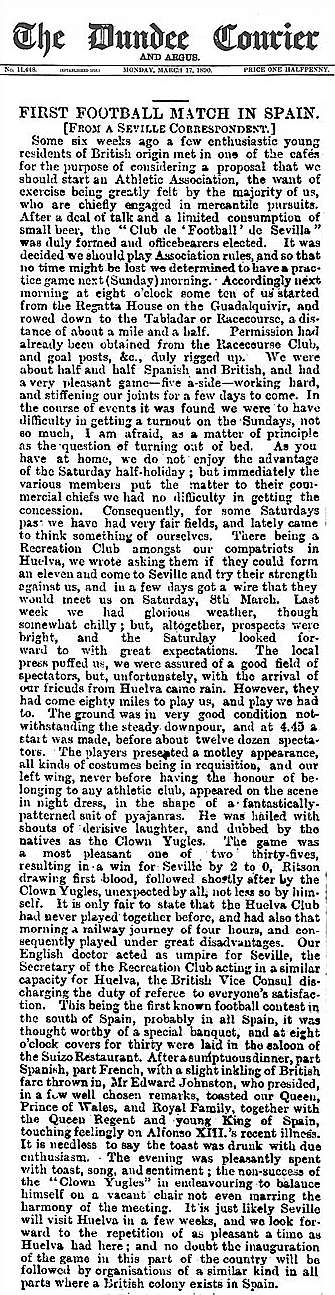
I found some months ago, in the Spanish sports newspaper Marca, the following picture from an article of the The Dundee Courier” (Monday, March 17, 1.890) covering the “first football match in Spain”.

It was supposedly played in Seville, at the Tabladar (close to Airbus Military factory nowadays), between the above mentioned Huelva Recreation Club and “Club de Football de Sevilla” (not related to the current Sevilla F.C.).

The article is an interesting read for its historic touch.

However:

  1. having been that Recreation Club from Huelva founded only in 1.889, by Rio Tinto workers,
  2. living many of the company workers at the village of Minas Rio Tinto, some 70 km from Huelva,
  3. having the workers other social clubs in Minas Rio Tinto (including Bella Vista) and
  4. being the company established in 1.873.

I’m afraid that probably the first match would have been played at Rio Tinto, not in Seville, and much earlier than in 1890.

At the mining museum of Minas de Rio Tinto, there is a small one-page text about the introduction of football by Rio Tinto Company Ltd. workers. In fact, in that text there is a mention of the celebration of a football match in 1.873 to celebrate the festivities of the local patron, San Roque.

But I am no historian, and thus would love to see some historian diving into that history and putting up the nice results in a museum in Rio Tinto :-).

Article of the “The Dundee Courier” (Monday, March 17, 1.890) covering the “first football match in Spain”.

Leave a comment

Filed under Sports

The origin of football in Spain

One of the sports introduced by the British working at the mine of Rio Tinto (post about the visit to it I made the last week here), was football.

Welcome to Minas Riotinto (“Birthplace of Spanish football”).

I didn’t expect anything special as I had not researched the topic beforehand but I hoped there would be something knowing that the origin was there. This was immediately confirmed as there is a signpost at the entrance of the village about the relation of it with football.

But then, there was nothing else but the statue you can find below in front of the local football club field (playing in who knows which division).

I asked at the mining museum whether there was something to be visited about football and its origin in Spain. There wasn’t. “The town hall has a project of building a local museum of football, but today there is nothing”. What a pity. I guess I am not the only person who when travelling is searching for this kind of places and memorabilia, thus I guess it could have some potential.

Statue celebrating the origin of Spanish football in Minas de Rio Tinto (Huelva).

It is not the first time that I get this disappointment. You may remember that I had the same feeling when searching for the roots of football at the Freemasons in London. I would love to see such museum like the one about golf in St. Andrews, I hope that one day I will be able to do so. To date, the closest to that is the one-page text below, found at the mining museum:

Page about the introduction of football in Rio Tinto by British RTCL workers.

4 Comments

Filed under Sports, Travelling

Rio Tinto

Rio Tinto is a river flowing through the South of Spain opening to the Atlantic ocean at Huelva. I had wanted to visit it since long time ago. It is not just any river: it is especially acidic (pH2), it has a high content in heavy metals and as its name points out, it is red (“tinto”), due the iron dissolved in the water.

The Rio Tinto area has been a mining site since ancient times, and it is there that the British mining company, bearing that name, was founded in 1873, when some international investors bought the site to the Spanish government. The mining activity grew so much that at some time it was reported as the biggest mining site in the world (especially for copper).

The influence of the operation in the area reached every corner of life:

  • The ancient village of Minas de Rio Tinto was brought down in order to exploit the underground below it and had to be displaced.
  • A huge train system (over 300km of rails), only second to the national state train system, was built to bring metals to the port of Huelva.
  • The British colony formed by the company workers and managers brought by the owners introduced all kinds of changes in the society: from religion to the introduction of several sports (football, tennis, polo, criquet…).
  • The Mediterranean forest in the area was completely destroyed. Today, the a forest of pine trees, more resistant to the acidic conditions has been planted.

At first, several dozens of children were employed (about 50 under age 10!), salaries would be paid out in coupons to exchange for food from the company, work conditions were deplorable. Years later, partly due to the pressure of organized unions led the company to improve the standards of workers and to provide several social benefits. A major cornerstone was the strike that occurred in the first days of February of 1.888 which ended in the killing of over hundred demonstrators (“Año de los Tiros“).

In 1.955 the Spanish State bought back a majority stake of the operation to the Rio Tinto Company Ltd., which was kept ongoing for some decades, but today is closed.

Today, Rio Tinto has a very different interest, as it serves scientists from NASA to study the bacteria living in the extreme conditions of the river. This helps them in studying the plausibility of life in Mars under similar conditions.

The landscape is unique, striking. We took several pictures of it and I share some of them below:

This slideshow requires JavaScript.

The village has a wonderful mining museum, a train tour through the mining complex (11km route and back) along the river, a small mine can be visited (entering 200m into it) and a typical British house of the time is also open for tourism. It is a very interesting tour for a day (different packages starting from 10€; just ~60 km from Seville).

We also recorded some 5 videos along the train tour. See the first one here (you may find the rest at my Youtube channel):

3 Comments

Filed under Travelling