A day in DC

Two years ago, in December 2008, I came for the 1st time to Washington DC. That was the first time I came to the USA and even though it was on a business trip, I managed to take some 4 hours in 2 days to do some sightseeing. I loved it.

Yesterday we arrived again to DC. This time Luca and me, on holidays, again just for 2 days. We checked in our hotel, The Quincy, in L Street NW, not very far from the White House… though I acknowledge that distances are misleading in this city: why wouldn’t you walk from Lincoln memorial to Washington memorial if “it’s just over there”, and from that to that other museum in The Mall, and for that matter to the Capitol. In the end you walk many kilometres. The hotel was a success. For just 100 dollars a night, we’ve got a room of rank of the best ones I get in business trips with the company, so the start of this stay was promising.

Today has been a long but entertaining day. I woke up without alarms at 5:30am. I checked the time and enjoyed the fact of having 45 more minutes of sleep. At 6:15am I got up, dressed in running gear and went out for a morning run. Only to discover that it was way hotter and more humid than I expected and dressed for. I didn’t come back to leave the sweater and paid for it later on. I was amazed by the dozens even hundreds of people I saw running before 7am around the city, especially in the Mall. I knew Americans love to run and do wake up early. Still, what I saw was beyond expectations. I went from the hotel to the Washington memorial passing by the White House (2 km), then to Capitol (other 2km) and back rounding the Washington memorial. In total 8.6 km. The plan was to round the capitol from behind and pass by the Jefferson memorial (4 more km) but I was way too overheated for that.                            

Back in the hotel I did some stretching, took a shower, washed clothes and got dressed to continue hitting the streets of DC. We went for breakfast at a cafeteria close to the hotel, then to a store to buy a new photo camera and at 9am we were at the Lincoln memorial ready to start a day of reflections (though the reflecting pool was empty and under construction).

We then headed to the World War II and the Washington memorials. Then to the American History museum. This one is one of the 19 museums of the Smithsonian. All of them admission-free, all of them wonderfully arranged. It is almost impossible to overstate the quality of those museums. In each one you could spend a week if you had it for each. There are hundreds of materials to read, to watch, to listen to… in each room. In this one we paid special attention to the rooms dedicated to the flag and the song that would become the American anthem, to the gowns of the First Ladies, to the presidents and Abraham Lincoln. By 11:45 we had to leave for the next appointment in the day.

This time we had booked a guided tour through The Capitol, which houses the Senate and the House of Representatives. We had to wait rather long as expected long queues weren’t such, so we took the extra 30 minutes we had in the schedule to have lunch in the restaurant within the building. The visit was funny and the guide entertaining, but I expected more of it. With that visit you don’t get to actually see the chambers. I guess that deal in Spain is better. However, as we were about to exit, Luca saw a sign for the Library of the Congress and there we went.

The visit of the LoC is wonderful as well. You get to see two bibles from the XV century, one made by Gutenberg, what is left from Jefferson’s library (a third from the original, but still over 6,000 books – including some from Cervantes) bought by the Congress, and one of the reading rooms, which anyone could access provided the she would get the card by filling a form and paying 2 bucks (that‘s not so easy in Madrid with the national library).

Afterward, we headed for the American Indian museum. Another one from the Smithsonian institution. By then I was exhausted and overloaded by information, so I paid attention to one of each 10 signs to read, but still enjoyed the museum.

As we went out it was already 17:20, time for museums to close… but as we passed by the Air and Space museum I saw a sign saying that that particular museum would open today till 19:30. There we went. We needed something relaxing so we bought a couple of tickets for the 3D movie “Legends of the Sky”, a splendid documentary of 50’ which has the 787 program as the main theme and covers some basic principles of flight such as propulsion, materials, structures, etc. It also reviews a b it of aviation history from the Lockheed Constellation to the A380. I especially liked the final line telling children that everything is not yet invented in aviation, we’ve just started. Then we entered the replica of the Spacelab, the gallery of the Apollo programme and the room dedicated to interactive explanations and games of the principles of flight: wonderful again. This was the second time I visited this museum… it won’t be the last.

By the time we left the museum, Luca and I were completely worn out by the rhythm of the day, with just some strength to walk back to the hotel and take some pictures in front of the White House on the way. We stopped at the Irish terrace close to the hotel to enjoy an American dinner composed of buffalo rings, hamburgers and 4 large beers to call it for the day.

Two years later, I continue to be more than delighted with DC.

2 Comments

Filed under Travelling

Historias del Fútbol Mundial

Tengo la costumbre de, siempre que paso por un aeropuerto, visitar la tienda de libros y revistas, a ver si encuentro algún libro. Siempre que vuelo ya llevo algo de lectura conmigo y estas visitas a la tienda de turno las hago por si encuentro algo interesante. A veces lo encuentro.

El año pasado antes de emprender un viaje a Holanda, cuando se estaba jugando la Copa del Mundo en Sudáfrica, encontré en Barajas el libro “366 Historias del Fútbol Mundial”, de Alfredo Relaño. Tras ojearlo un poco, lo compré pensando que estaría bien como complemento al evento futbolístico del momento que tan bien acabó para España. Digamos que para imbuirme un poco más del espíritu futbolístico.

El libro no tiene un hilo argumental, sino que está estructurado a modo de calendario. Ordenadas según los meses del año, el libro tiene una historia por cada uno de los días del mismo. Cada historia una hoja, dos páginas. Perfecto para tener en la mesilla y leer unas pocas historias de vez en cuando.

Muchas de las historias son muy conocidas, algunas casi contemporáneas, y otras tantas no tanto. Por ejemplo, en estas semanas de abril y principios de mayo, cuando se van a vivir tantos partidos entre Real Madrid y Barcelona, en el libro aparece una historia con bronca entre ambos equipos en las semifinales de copa de 1916 tras la cual estarían hasta 10 años sin volver a enfrentarse. ¿Qué diría la prensa durante 10 años sin un partido del siglo cada semana?

Otras historias de estas semanas:

  • El plante del Barcelona en la vuelta de la semifinal de Copa del Rey contra el Atlético de Madrid en el año 2000.
  • La victoria de España en la Copa del Mundo Sub-20 en Nigeria, con Xavi y Casillas. Preludio de lo que ocurriría 10 años después un poco más al sur.
  • El nacimiento de la expresión del “miedo escénico” del Bernabéu en la final a doble partido de la UEFA contra el Colonia en 1986.
  • El accidente que acabó con el Torino en el monte de Superga en 1949.
  • El nacimiento de la Copa en 1902, cuya primera edición duró 3 días y ganó un equipo conjunto formado por jugadores del Athletic y el Vizcaya de Bilbao (que más tarde se fusionarían); o del Scudetto en Italia, cuya primera edición duró 1 día y ganó el Génova.
  • La derrota del Barcelona en la final de la Copa de Europa en Sevilla frente al Steaua de Bucarest.
  • La aparición de las tarjetas amarillas.

Y así hasta 366…

Todavía no he terminado de leer todas las historias del libro, pero las que llevo leídas (algunas releídas) ya me permiten recomendar el libro sin miedo a equivocarme.

3 Comments

Filed under Books, Sports

Turboprops market different dynamic

In the last post I discussed about the dynamics of commercial aircraft orders and its correlation with air traffic growth and GDP growth.

In the previous post, I had discussed about turboprops. Today, I want to connect the two dots in a particular way.

I want to show how civil turboprop market is unrelated to the larger and more known turbofan civil aircraft market and how its dynamics are completely unrelated to World GDP growth and thus world air traffic growth.

For this purpose I studied the numbers of ATR (using the info available in its website from yearly news releases discussing results).  I proceeded in the same way as before, analysing the correlation between the different variables.

In order to take a larger time span, I used ATR deliveries instead of orders, as I found a larger data set for deliveries (obviously aircraft delivered were previously ordered, lag in between is not that obvious, today’s backlog is about 3 years production).

In the following graphic I plotted ATR deliveries, GDP growth and oil price:

ATR deliveries vs. GDP growth and oil price.

When calculating correlation between the different variables, I discovered that the correlation between GDP and deliveries is rather low, despite of the time lag applied (be it 2, 3, 4 years…). However I found that the oil prices and deliveries did correlate very well with a lag of 5-6 years, yielding coefficients of 0.55-.65, which are rather high.

This different behaviour of the turboprop market compared to the bigger turbofan market could be explained by the oil price forecasts that airlines shall make each time the oil price goes up.

Again, I can imagine some C-suite executive of a regional airline demanding an oil price forecast/report with which to substantiate his gut-feeling that prices will continue to go up and thus turboprops,  which are more fuel-efficient than turbofans, will be best suited for their short-haul routes.

3 Comments

Filed under Aerospace & Defence, Economy

Air traffic growth vs. aircraft orders

Taking the topic of the headline of this post I want to share some reflections on the commercial aircraft market.

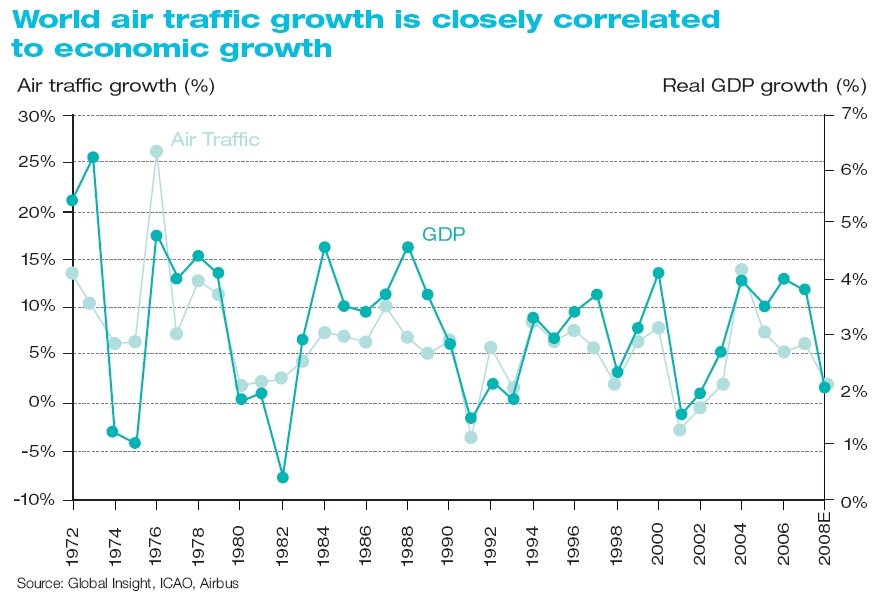
The first is how closely air traffic growth is correlated to world economic growth. This sentence and the following graphic are taken directly from the Global Market Forecast [PDF, 7.9MB] produced by colleagues at Airbus.

Air traffic growth vs GDP growth (source: Airbus).

You may see in the graphic the correlation (correlation coefficient above 0.7) and how the air traffic growth is however much more volatile than the economic growth. This is very intuitive. The better the economic situation the more business trips, family visits and holiday trips will take place. Nevertheless Airbus explains that in some situations and regions this is not enough to forecast traffic and thus they produce hybrid models.

Then, I wondered: how do airlines translate this growth in traffic into airplane orders?

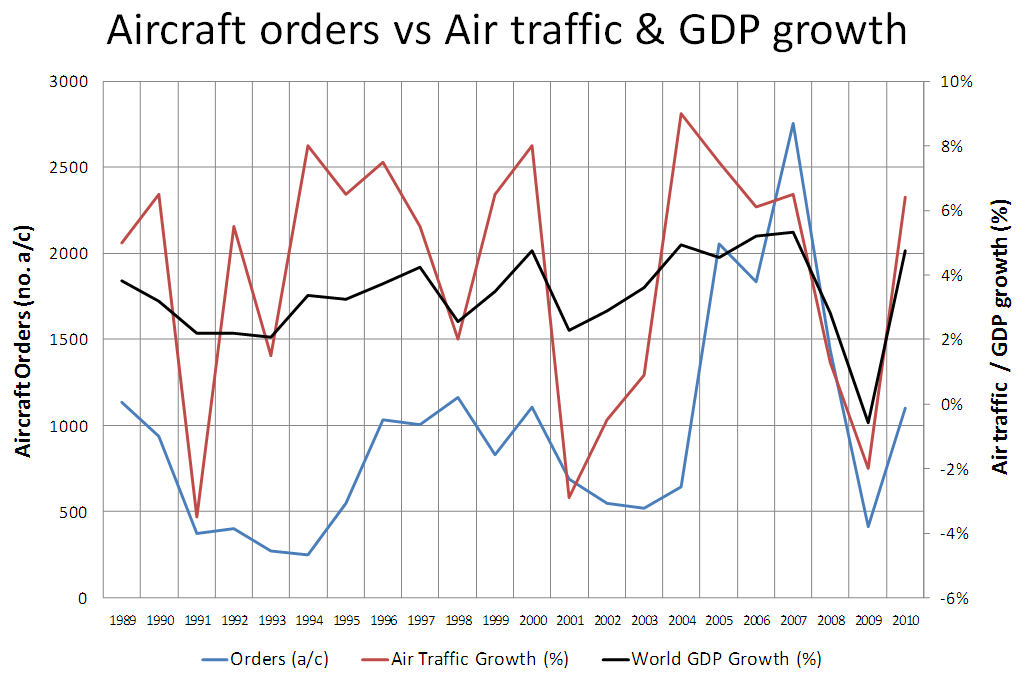
I made some numbers and played with them. I gathered aircraft orders for both Boeing and Airbus in the last ~20 years, plus air traffic and GDP growth over the same period of time. Then, I tried to connect one with another and see how best they would correlate with each other. Even though correlation does not imply causation, it may indicate existence of such causal relations that it’s why I searched for such results.

Here I plotted GDP growth (IMF), traffic growth (ICAO) and aircraft orders:

Aircraft orders vs. air traffic and GDP growth.

One could expect that airlines, after collecting first hand data of traffic growth plus the aggregate demand from industry sources (IATA, ICAO) and after applying their complex planning models would order aircraft from manufacturers. Thus, a correlation might be expected between traffic growth and aircraft orders. What we don’t know is whether airlines would place orders in the same year where the traffic growth actually takes place or there would be a lag (due to the airline analysis process, the negotiation with the manufacturer, arranging the financing, waiting for the next air show…).

The correlation results I got between these 2 variables are satisfactory though not that high. Matching data of the same year yields a 0.35 correlation coefficient. If however, we apply a 1-year lag in between air traffic growth data and orders the correlation is better, 0.44 (a lag of 2 years would worsen it down to 0.27 and so forth).

I found it curious that correlation between orders and GDP growth is much better! Matching data of the same year yielded a 0.61 correlation coefficient (which is rather high). A lag of a year would produce a still high 0.56 (2-year lag, 0.41; 3-year, 2.6…).

This was a striking result for me. After all, even though individual airlines do have complex models and experienced analysts behind them, taking the aggregate of the market, it seems that orders are placed less on data of traffic and more relying on data of economic growth, and rather soon, acting within the same year or a year later!

Who knows how the process within the airlines actually works… I can imagine thoroughly thought and thick studies coming from planning & analysis departments being put aside in the board room where one or two directors (more assertive than the average) convince the rest of the soundness of an operation based half in broad economic prospects (world GDP growth) and half in gut-feeling… wouldn’t surprise me much.

Leave a comment

Filed under Aerospace & Defence, Economy

Turboprops

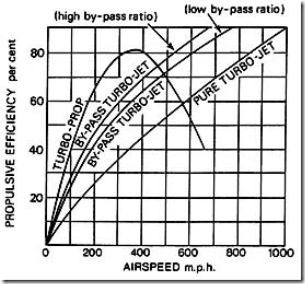
Since some time ago I wanted to write a small entry just to show the following graphic to point a very basic issue to non-engineers:

Efficiency vs. airspeed.

I have very often heard remarks about turbo propellers referring them as old or old technology, etc. I guess that this comes from seeing images of old aircraft with propellers and reciprocating engines, and now people being used to fly in turbofan engines.

However, turbo propellers are neither old nor a worse technology. As almost everything in engineering it all depends on what the requirements are and the price to pay for the solution. Then come the trade-offs. As you may find in the Wikipedia entry [turboprops] “they are mostly used where high-performance short-takeoff and landing (STOL) capability and efficiency at modest flight speeds are required”.

The first requirement is among the ones explaining why some military transport aircraft such as the C-295, the C-130 or the most modern A400M are equipped with turboprops.

The second requirement explains why some regional airlines employ turboprops for short-haul flights, when the distance can be covered at a bit lower speed without a big impact in the flight time.

If you take a look at the picture above, you could start roughly guessing what type of engine you would choose depending at what speed you would normally fly (then more requirements would come into play).

Leave a comment

Filed under Aerospace & Defence

The 7 Minute Star (book review)

Some weeks ago I read “The Seven Minute Star”, by Florian Mueck. Florian is a fellow Toastmaster from one of the clubs in Barcelona who I met some years ago in a division conference in Madrid.

He is a very energetic speaker and I remember that he came in 2nd in the International Speech contest in that division conference. I have seen him some other times along these years. In one of those occasions, I believe in Porto, he mentioned that he was writing a book. I remember him mentioning something about some stairs, a way to the top, etc. And about a year later here I am, having read the book and writing the review.

The book is a quick guide to become a proficient public speaker by following 15 steps (confidence, transparency, first sentence, eye contact, voice, body language, visual aids, structure, rhetoric, anecdotes, quotations, humor, enthusiasm, passion, and smile). It is a very easy and enjoyable read (~100 pgs.) with lots of stories and examples. If you have no previous experience in public speaking, the book is a very informative guide.

If you are a member of Toastmasters, you may have noticed that the Toastmasters program covers many of those steps in the book, though he adds some more tips: for example, the smile (then you recall having always seen Florian smiling!) or the stress in the use of quotations (though I may disagree in the approach! I would say “read a lot and pick some quotes out of what you’ve read” instead of learning some quotes right away).

Another good point is that in the book he presents some tools he has developed, for example the “speech development template”. I recommend you to pay a visit to his website, where other tools (speech evaluation template) and analysis are available.

If you would like to know more about Toastmasters and you happen to live in or nearby Madrid, take the opportunity to attend the Division Conference of Toastmasters next Saturday May 7th in Madrid.

Leave a comment

Filed under Books, Personal development, Toastmasters

For Living or Investing

"Pour Vivre ou Investir", seen in Toulouse.

This is an ad I see every day on my way to the office: “For Living or Investing”. They sell villas and apartments up to 4 rooms.

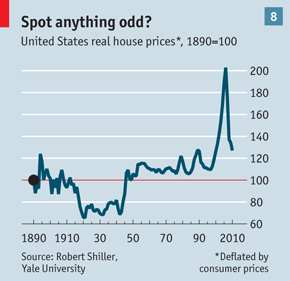
I have often defended the position that a house cannot be considered an investment. Recently I read yet another article at The Economist, in which they showed the latest graphic of the Case-Shiller index (below). I showed this graphic in a post last year. Now the prices have decreased some percentage points more. Most importantly, the curve and the article point that a further decrease will come. Down to the point where the prices stay stable along the last 130 years once inflation is adjusted.

Case-Shiller index.

Taking that into account, when I see that ad in the morning I can only smile and think of that other story which I included in another post about a message from the future describing how the housing craze continues to go on in Spain for decades… (extremely funny – in Spanish).

I have only one complain to the promoter of these houses in the ad: they are using land so close to the city to build houses for investing… if these houses are just meant for investing, and not necessarily for living, they could have built them under the sea and leave the land in Toulouse for living, public parks, roads, etc…

1 Comment

Filed under Economy, Investing

The end of private property

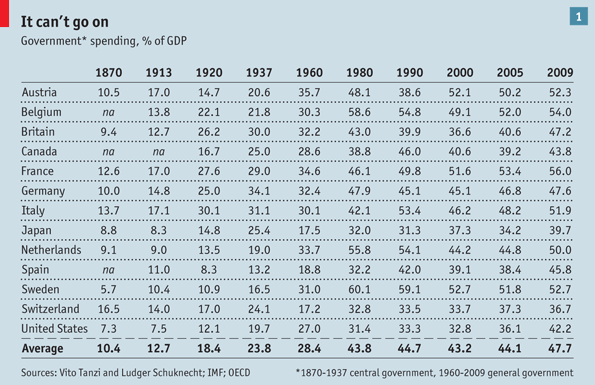
Last Saturday, while reading the last issue of The Economist at home, I found the following table with the evolution of government spending for some countries:

Government spending as % of GDP, source: The Economist

You can see that the trend is upwards for all countries.

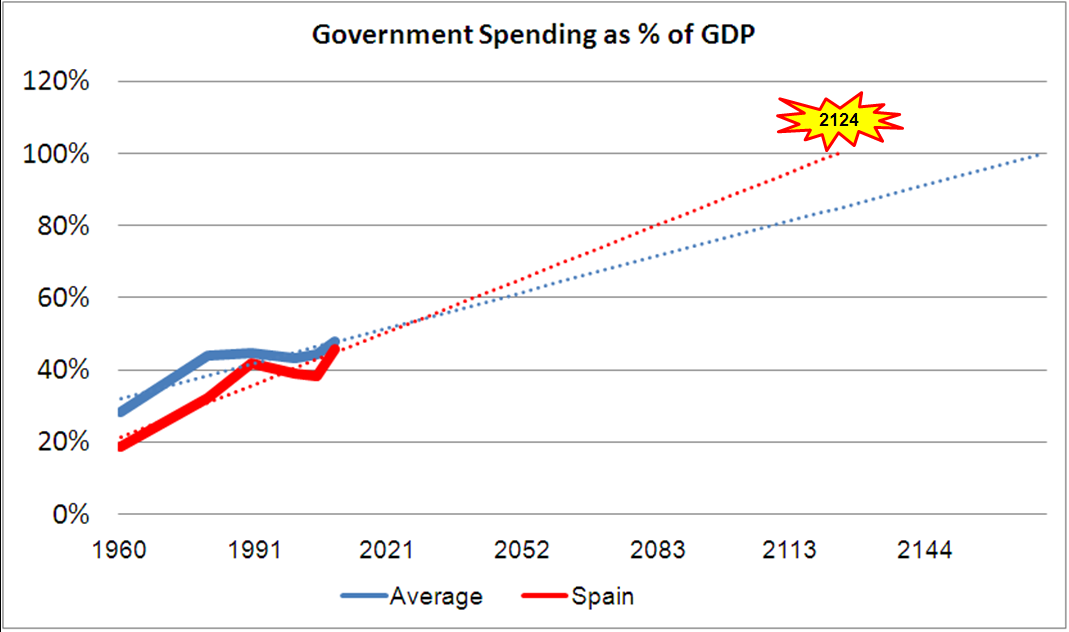
In one of my favourite books, “Augustine’s Laws“, the author goes on extrapolating several trends in the defense and aerospace industry. I did the same with this table for the average of these countries and the particular case of Spain, for obvious reasons.

When will government spending reach 100% of GDP?

Extrapolating the trend, this would occur in Spain  the year 2124 (for the average of the countries in the table it would happen in 2171). What would that mean? By 2124 every euro spent in Spain would be spent by the government (local and central), not a dime spent by individuals. The end of private property.

Government Spending as % of GDP, extrapolation

That is not necessarily worrisome: we would be provided a home by the state, food to eat (the trend doesn’t say whether we would have to eat in public canteens or we would receive vouchers to get stuff from grocery shops), clothing, etc… We would become a kind of communist country in the end. Don’t worry, United States would join us some years later. I guess the last country in joining this pan communist block would be Switzerland, but its time would come, too. No Cold War this time.

In case you wanted to start-up a business, you’d better do it soon: I guess some years before the doomed 2124 it would be prohibited to launch such kind of initiatives. Good luck with your venture! I’ll just look forward to a pleasant and quiet 9-13 position in such an administration. 🙂

Leave a comment

Filed under Economy

Lamentable entrevista de Ana Pastor a Mahmud Ahmadineyad

El pasado día 15 leí varios tweets haciendo referencia a una entrevista que la periodista de TVE Ana Pastor había hecho a Mahmud Ahmadineyad. Así que la vi.

Debo ser muy raro, porque no he dejado de leer elogios a la periodista y a mí me parece que la entrevista, el papel que hizo como entrevistadora, es lamentable. Sin paliativos.

Me explico:

Se pasa la entrevista interrumpiendo las respuestas del entrevistado o apresurándole con frases del tipo “déjeme estamos terminando, me dicen que se me acaba el tiempo”.

En ocasiones contradice al entrevistado. Aunque éste diga cosas que no sean ciertas, ¿interesa acaso lo que piense la entrevistadora?.

Sonríe mostrando desinterés por las respuestas del entrevistado. Por ejemplo, cuando Ahmadineyad le dice que las armas que usa Libia son vendidas por Occidente. Quizá no le guste escucharlo, pero antes de hacer la entrevista podría haberse informado y habría visto que es cierto.

Esto último me es fácil de comprobar porque he visitado las fuentes anteriormente. Dejo a continuación un par de ejemplos fácilmente demostrables:

  • España. Fuente: el ministerio de industria [PDF]. Las exportaciones en 2009 NO fueron de defensa ni armas como la prensa ha dicho en varias ocasiones, sino lo que se llama material de doble uso, como radares para navegación y control de tráfico aéreo. En total fueron 12.7 millones de €. Habría luego que ver el uso que finalmente se le da.
  • Francia e Italia. Fuente: el Stockholm International Peace Research Institute (SIPRI), autoridad internacional en la materia. En la siguiente herramienta, se puede hacer una búsqueda de exportaciones de armas con destino Libia en los últimos 20 años. Aparece un registro por valor de ~168M€ de exportación de misiles anti-tanque MILAN por parte de Francia, y otro por valor de ~80M€ de exportación de helicópteros por parte de Italia.
  • Estados Unidos. Fuente: el Departamento de Defensa. En su informe anual de 2009 [PDF] muestra como Libia, que había estado bajo embargo durante años, desde 2006 comenzó a recibir exportaciones comerciales de armas desde Estados Unidos, aunque por un valor muy bajo, menos de 1M$ en 2009.

Si la gente vitorea la entrevista porque le ha plantado cara a Ahmadineyad, me parece bien, pero le podría haber tirado un zapato o una estatuilla de Il Duomo a la cara, en vez de hacer una entrevista.

Si TVE quería incordiar y molestar a Ahmadineyad, podría haber hecho muchas otras cosas, en vez de una entrevista.

Si querían presentar una imagen deplorable o ridícula de Ahmadineyad podrían haber hecho un documental, en vez de una entrevista.

A mi ese hombre también me parece detestable. Pero es que Ana Pastor termina la entrevista diciendo “creemos que es bueno escuchar todas las opiniones”, y precisamente eso es lo que no ha hecho. Si desde TVE, no lo querían hacer que no le hubiesen puesto un micrófono delante para empezar.

Lamentable.

Lo único bueno que me pareció que tuvo la entrevista fue el saludo final en farsi.

5 Comments

Filed under Aerospace & Defence, Twitter & Media

Bin Laden hidden in a football field

Some weeks ago I read in the newspaper one of these mistakes that you may find so often with some journalists (apologies for journalist friends who may feel criticized). I checked some weeks later and it hasn’t been corrected, so I’ll let you know.

The article is about a plan to capture Bin Laden. It says that he is hidden in a region of 11.585 square meters up in the mountains… I checked the cables (6) mentioned in the article and in no one it says the size of the region. I haven’t been there in Waziristan, but I know the figure is wrong. I say I know, not I suspect. That’s the problem with some journalists they just don’t know nevertheless they write about it.

11.585sqm is the size of the garden of my parents’ neighbour. It is a square of 107 by 107 meters, a football field so to say. Do you believe that Bin Laden is succeeding in hiding himself in a football field from an army of thousands? Then he could have just titled it “Bin Laden hidden in a football field!”, a much more catchy headline to attract readers.

I am sure that in your respective fields of knowledge you have seen plenty of similar cases that make you doubt about everything you read in papers.

I believe the guy took the info from the Wikipedia. There it says 11.585 square kilometres (a region the size of Madrid region) and he just copied it wrongly… don’t know what is worse: whether copying without understanding or copying without caring about mistakes, you name it.

5 Comments

Filed under Twitter & Media