San Silvestre 2010 (pics)

Last week I, together with 8 friends, ran the popular San Silvestre Vallecana as a farewell event for 2010 year.

The first time I took part in it was back in 1998. In the 1999 edition I ran together with my brother, that year we were less than 9,000 runners inscribed. This year there were 34,000 inscriptions available (though we did not inscribe ourselves). It took us 45 minutes to start running, by then the winner had finished long before (the winner finished in 29 minutes).

I believe that this has been the time have gathered more friends to run it; 9 of us. Also this year was different in that some of us were using Twitter till the last minute, smartphones to track the route, meters to check heart rate… quite a tech sport event.

The time: around 1h 5’ for 10km.

Enjoy the pictures:

This slideshow requires JavaScript.

3 Comments

Filed under Sports

La prairie des Filtres

Today, I found in the mailbox the first issue of The Economist to arrive at my new place. I took it and went for a walk to read it in a park by the river.

The park I went to is called “La prairie des Filtres”, named after the infiltration galleries used to purify muddy water pumped from the river Garonne, cleaned and brought up to the water tower of Toulouse. The system was first established back in 1821.

This park was also the place that served as the first field for the rugby matches of the Stade Toulousain, the local team which happens to be the most laureate club in France and Europe (having won 4 European Cups, more than any other club). The team now plays sometimes at the Stadium of Toulouse, just across the river, though most of the times plays at the Ernest Wallon stadium at the other side of the city. I guess I’ll have to pay a visit to one of its matches.

Now… the park is where I read the paper and run by the riverside…

Enjoy the pictures:

This slideshow requires JavaScript.

4 Comments

Filed under France, Sports

New Year’s resolutions vs. goal setting

During the Table Topics session of last week’s Toastmasters Madrid meeting, a friend asked one of the members whether he was the type of person that used to set goals for himself or have New Year’s resolutions.

The member was very determined in his answer: “yes, I am definitely a fan of goal-setting”. He cited a study in Harvard Business School where they found that the 3% of graduates who had written goals, and plans to accomplish them, ten years later were earning ten times as much as the other 97% put together… (it doesn’t say whether within that 3% there was a single individual, the kind of Bill Gates, who made himself just those ten times of the remaining 97%).

Then I saw a Facebook status update by another friend: “85% of my personal goals for this year – achieved.” (Bear in mind that this fellow is an outstanding individual).

Finally, two days ago I found in Twitter  a retweet of another post by Sid Savara about how to undertake a personal year-end review.

… Why not?

I decided that this year I’ll start writing down my goals and attaching a detailed plan to achieve them, instead of just thinking on January 1st of a few well-intentioned resolutions such as “learn languages”, “lose some pounds”, etc., and forgetting them by the 3rd of January. (By the way, thanks to Sergio, Javier, Alex & Conor for their inspiration).

If by 2021 I am making ten times as 97% of the readers of this blog combined, don’t tell me I didn’t warn you well in advance!

4 Comments

Filed under Education, Toastmasters, Twitter & Media

My investment fund

After two years of investing for fun, I was troubled because neither the ING internet banking tool nor Google Finance enabled me to correctly monitor the profitability of our investments.

  • Google Finance shows each new addition of capital as an increase of assets (price) in the same way as if a particular stock had increased its market price. So after a year our portfolio showed an increase of 97%… but most of it was due to new additions of capital.
  • While with ING, each time we added some cash it lowered the profitability as it went directly to the denominator of the equation (the same happens with Google Finance “gain”).

I discussed this with Luca, read a little bit and then I found out that the best way would be to treat ourselves as a mutual open-ended fund (fondo de inversión). I had to define a net asset value per share (valor liquidativo de la participación) at the beginning of the period and then treat each addition of capital as an issue of new shares to ourselves.

After spending sometime digging in the files and emails of the past two years, reading a bit about how to treat these values, etc., from now on we can readily compare at any moment our “J&L investment fund” with any other fund, stock or index. So did I…

If we had a commercial mutual fund we would announce ourselves with something like:

  • In the year 2010 the gains of the fund were +22.8% compared to
    • S&P 500 ~ +13% (target index)
    • Dow Jones ~ +11%
    • NASDAQ ~ +17%
    • IBEX 35 ~ -17%
    • Euro Stoxx 50 ~ -10%
  • The gains of the fund since its creation in January 2009 have been +86.6%, with a compounded annual gain of +37.6%.

Not bad.

Nevertheless, if we compare it to the leading Spanish value investing fund managers from Bestinver, in 2010:

  • Bestinfond ~ +19%;
  • Bestinver Internacional ~ +26%;
  • Bestinver Bolsa ~ +5%

Since January 2009 both Bestinfond and Bestinver Internacional have fared better than “J&L”, though not Bestinver Bolsa.

Today, now that is already defined, the net asset value per share is 57.19€… however “J&L fund” is not yet that open-ended: it’s open to our own additions to the fund but not to third-party capital… maybe in a couple of years we go and set up an investment club or fund :-).

After reading Ben Graham’s book “Intelligent Investor” I wanted to give it a try with investing, this is why I invest in stocks myself, but, clearly, if you are tempted to follow third-party advice, rumours, tips, etc., you’ll be better off just investing in a low-cost index fund (a strategy described by Burton G. Malkiel’s book “A Random Walk Down Wall Street”) or take a look at the above-mentioned value investing managers.

NOTE: “J&L fund” numbers are pre-tax of capital gains, include dividends (after-tax) and are net of transaction costs & commissions.

10 Comments

Filed under Investing

Summary of 2010

Let me share with you a brief recap of my 2010.

This was a heavy learning year, to name a few learning experiences:

  • I continued to study French,
  • Toastmasters: I delivered some speeches at Toastmasters, received the CL and ALB awards, and attended 2 District 59 conferences and 1 Division H conference.
  • I went to several EOI conferences and others, including one with the economist Robert E. Lucas who was awarded the Nobel Prize in 1995 and the TEDx Madrid event.
  • I read over a dozen books, many of which I commented here (being the 3 ones I liked the most these ones: first, second and third). At the end of the year I was given an eBook so I expect this trend to continue.
  • I continued to enjoy the subscription to The Economist (frankly, one of the best decisions I’ve taken in recent years) and subscribed to Scientific American for a dime.

I also had lots of fun reading and learning things related to aerospace & defence, to investments, and enjoyed supporting some charities and especially seeing some friends starting to support them as well.

Travelling. Either we together or I visited for the first time Porto, Morocco, Tunisia, Poland and Egypt. We also spent some time in Luxembourg, Brazil, Netherlands, Sevilla and France. Travelling well over 65,000 km last year (equivalent to 1.6 rounds to the Earth). Of all the places we visited, the view that I liked the most was the falls of Iguaçu, no doubt.

Javi 2.0 Encouraged by Luca and some friends I started this blog in February 2010 and a twitter account shortly afterwards. I reckon that my twitter account has become one of my biggest hobbies and sources of information apart from a communication channel with friends. I even saw some friends (here and here) and my sister starting their own blogs!

In the sports side… even though this has been a great year for Spanish sportsmen, it hasn’t been so for Real Madrid: not for the football or basketball section (being the last year I attended with the season ticket). On the personal side I competed in two championships of Minifutbol but won neither one, the same applies to paddle tournaments… the best sports moment was completing once again the San Silvestre race.

Other reasons for joy have been:

  • our friends Amalia & Paco, María & Alberto, Janine & Rients, Leyre & German got married,
  • we saw the newborns Paula and Javier, while two of our friends are pregnant today (that we know),
  • my sister finished her bachelor and continued studying a master; my brother finished his MBA and joined my company; my mother continued to take several courses.

To close the year, I got a new position within the same company in another country, where I moved a month ago. This will allow me to continue learning and experiencing new things!

I use to tell my friends and family that since long ago I feel that I enjoy more and more each coming year and am happier with time; this year, with a few bad moments included (including some sad losses), has been no exception to the trend. Thanks to all of you who contributed to it. As I say, if it continues like this, I may explode one of these years :-).

Now it’s time to make some few resolutions for 2011 as well… I have thought of 5, that if I manage to fulfill, next year’s account will be even shinier. I wish you the same: keep learning and enjoying your time.
18 Comments

Filed under Personal development

Impact of an AdWords campaign (cont.)

After my previous post was published, I had a conversation about it and received some comments. These made me think that it could be interesting to comment on the other 2 campaigns to gain more insight about how AdWords works and how useful it can or cannot be. First, let me share some data of the 3 campaigns:

  • Al Andalus club (Rota, Cadiz): had a cost of 29.68€ for 250 clicks, thus 0.12€ per click (CPC). It appeared in the screens 208,520 times. It used 72 words or combination of words, restricted to a circular area about 90km around Rota.
  • Standing Ovation club (Madrid): had a cost of 16.56€ for 59 clicks, thus 0.28€ per click (CPC). It appeared in the screens 166,291 times. It used 49 words or combination of words and was restricted to Madrid region.
  • Blog: had a cost of 51.96€ for 1,410 clicks, thus 0.04€ per click (CPC). It appeared in the screens 3,685,521 times. It used 41 words or combination of words and was not geographically restricted.

Even though I am not an expert in AdWords, from what I have experienced and as you can see above:

  • The more clicks it has the lower the price per click will be.
  • You may set a maximum amount of money you want to spend per day (I normally didn’t spend more than 1.5€ euro per day per campaign), this means that once that amount is reached your campaign is de-activated until the next day (ads won’t appear for some hours).
  • Using more words does not necessarily translate into more clicks. You need to find adequate words, related to the website, so it appears and appears high enough in the web. Also, some words are more expensive than others, though the price varies with the number of clicks.
  • The ads themselves need to be attractive, as it may appear many times but still needs to make people click on it. In that sense, the most successful one was that of Al Andalus (people clicked on it 0.12% of the times it appeared; 3 times more effective than the other 2 campaigns).
  • You need to focus the campaign in the segment you want to target. E.g., I first centered the area for Al Andalus campaign, until I found out that some clicks (consuming campaign money) came from Tanger and other Moroccan cities… I had to move the target area, as no one from Morocco would go to the club on a weekly basis.

I didn’t measure any kind of conversion rate as I am not selling anything through my blog nor could I check how many guests went to Al Andalus or Standing Ovation meetings thanks to ads (I was not attending those clubs); and that would be an extremely interesting indicator for any business.

Finally, my friend got the 75€ from a special offer from Google. In the Iberia in-flight magazine (“Ronda”), I have also seen some months ago codes for 50€ to be used in AdWords campaigns. So, be aware of possible next opportunities and give it a try (and you can always spend some little money as a learning experience – everything is very well explained inside AdWords tool).

4 Comments

Filed under Marketing

Impact of an AdWords campaign

Some months ago, my friend Nacho gave me as a gift 75€ to be used in AdWords campaigns. I set up 3 of them: 2 of them promoting 2 Toastmasters clubs, the third one promoting this blog.

According to the campaign report the blog received 1,410 visits from the advertisements. The campaign ended in July and cost 51.96€; thus the average cost per click (CPC) was 0.037€.

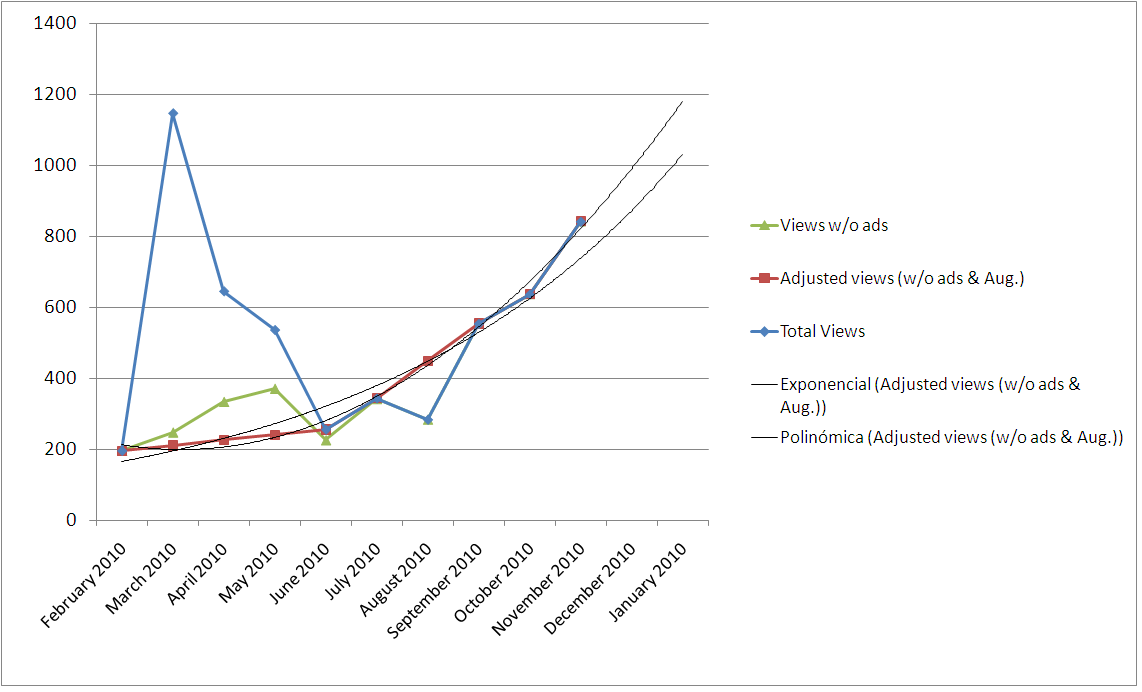
I plotted in the following graphic what the total visits per month have been (blue line) and the total visits less the ones that originated from AdWords ads (green line).

Evolution of the blog.

You can see the big impact of the campaign: so far 26% of the visits came from it (since February, when I started the blog, to the end of November the blog received 5,434 visits), while the campaign was active up to 48% of the visits came from it.

Discounting the campaign (green line) we can still see that the pattern of the growth is not as smooth as we would expect. That is why I linearly interpolated visits from March to June (and in August, where you see that due to the low activity of the blog – holidays – there were less visits than the trend) and plotted the red line (adjusted).

Finally, I tried to see what trend line adjusted better to the growth of the blog, using the adjusted red line, and even though now it seems that follows closely a second grade polynomial I guess the evolution of the blog should follow an exponential (if any).

From this analysis I conclude that:

  • The real impact of the AdWords campaign is the difference between blue and red lines, instead of blue vs. green ones. This would mean 243 extra click for free; this would have had a cost of ~9€, not much but a whole 17% extra than what I paid. Where did those extra clicks come from? E.g. people who saw the ad but didn’t click on it and did enter the blog, people who enter in the blog more times than the initial click…
  • It could be predicted that the blog should have ~850 visits in December, and in January ~1,000, a year after it started (if indeed it follows the exponential pattern of evolution)… we’ll see.

7 Comments

Filed under Marketing

Big Mac in Aswan

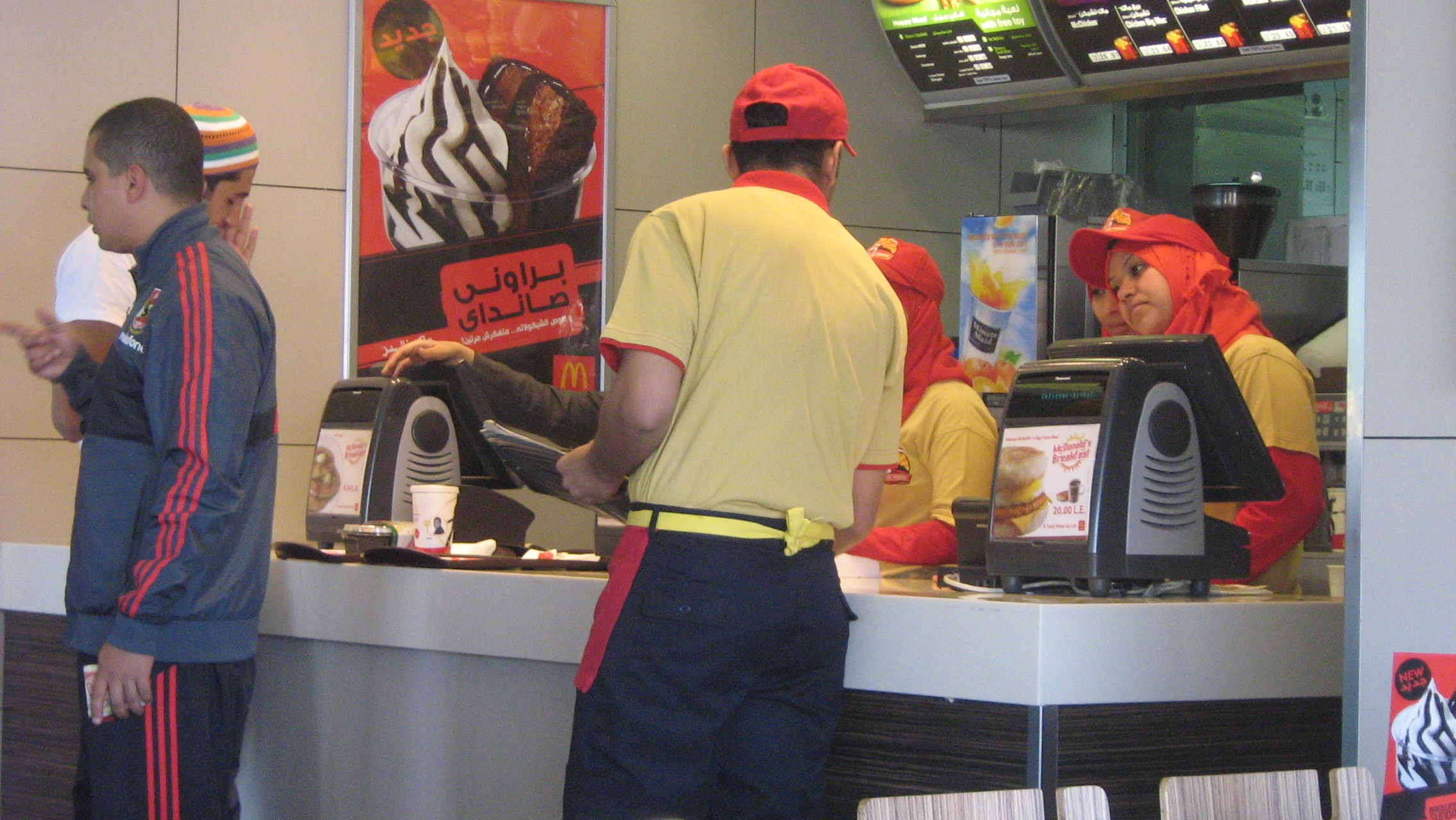
While in Aswan, Egypt, I went to a McDonald’s restaurant. When I finished my meal I went to the counter to ask “What is the price of a single Big Mac?”, “16.5 Egyptian pounds”.

I wanted to check The Economist‘s Big Mac index, their exchange-rate scorecard (see a detailed explanation), for the case of Egypt.

Already in the last list published it can be seen that they used a 13.0 pound price, while I was given 16.5 pound (probably because I went to a more touristic McD restaurant than the average). At the time of writing the post the exchange rate is: 1 E£ = 0.1726 US$.

The reference is always the price of the hamburger in USA (average of Atlanta, Chicago, New York and San Francisco), which in the latest publication of the index was 3.73$.

The dollar cost at the exchange rate of the hamburger was 2.848$; according to that, the Egyptian pound is 24% undervalued against the dollar (in relation to Aswan prices). The Economist normally calculates as well the implied purchasing power parity of the dollar: 4.42 (=16.5/3.73) while the actual exchange rate was 5.79 (=1/0.1726).

Finally, I wanted to remark 3 other things that caught my attention in the restaurant:

  • They had an employee of the month award and published it.
  • The uniform of the global company made local.
  • They provided delivery service… I wish they did that in Europe.

1 Comment

Filed under Economy, Travelling

New entrants in the commercial aircraft business

In a previous post, I mentioned the new entrants in the large commercial aircraft business (Bombardier CSeries, Embraer, Russian MS-21, Sukhoi SuperJet, Comac C919, Mitsubishi…). Now that the latest market forecasts both from Airbus (Global Market Forecast) and Boeing (Current Market Outlook) are available, I wanted to briefly note how they are treating the segment that most of these entrants would enter: single aisle jet aircraft.

For example, Boeing in this year’s CMO already splits the single aisle between 90-175 passengers (where new entrants would fall into) and over 175 passengers (still the safe harbor?). In previous studies Boeing didn’t offer such sub-segmentation. On the other hand, Airbus hasn’t published yet such differentiation.

It is even more interesting to compare last year’s GMF and CMO with this year’s ones.

  • Airbus saw a demand for 16,977 single aisle aircraft in 2009 while in 2010 sees a demand for 17,870.
  • Boeing saw a demand for 19,460 single aisle aircraft in 2009 while in 2010 sees a demand for 21,150.

In other words Airbus has increased the single aisle market forecast in 893 aircraft, while Boeing has increased it in 1,690 aircraft… Both have made the forecasted pie bigger before it will have to be shared.

On average, they see ~1,300 more single aisle aircraft than what they saw last year… In the case that these extra aircraft was room made for new entrants, that would leave the new entrants a market share of 6.7% of the single aisle market… not much.

However, those entrants are not yet delivering in that segment and most of their deliveries would come at the second half of the 20-year period. By 2029, it could well be possible that their combined market share is around 10%… still not a big share, but already ~7bn$ yearly business (in 2010 dollars); a ~4.4bn$ after discounts, an amount the size of Embraer revenues (the 3rd company in commercial aviation, reason enough for them to enter the segment).

Boeing even concedes that of the 21,150 single aisle aircraft, 86% of them will be between 90-175 passengers, precisely the market sub-segment that will be ferociously fought.

Leave a comment

Filed under Aerospace & Defence

Commercial aircraft market size after discounts (update)

In an older post I already made an analysis of the aircraft discounts related to the published list prices (by the way, Boeing just raised its list prices 5.2% a couple of days ago). In that case, I used the revenues and deliveries of Boeing in the previous 3 years (38% discount was the result!).

Using that information, now that the latest market forecasts both from Airbus (Global Market Forecast) and Boeing (Current Market Outlook) are available, we can say that the real market size in the next 20 years will be in the order of 2,100bn$ (average of both forecasts in 2010 dollars).

Flow of airplanes

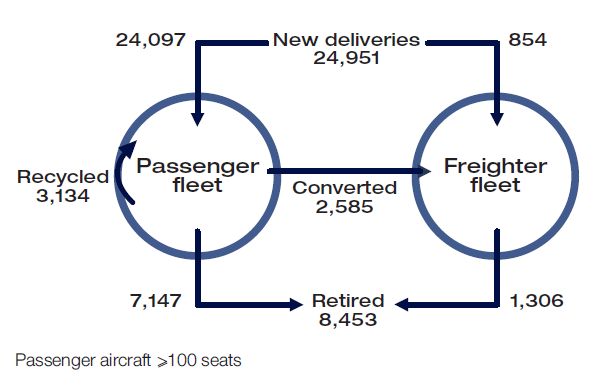
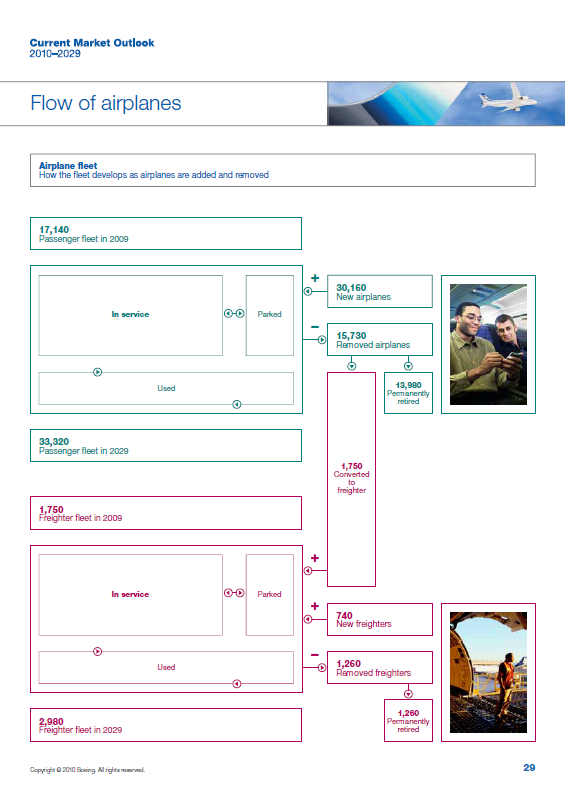
Another very interesting feature that Airbus published in last year’s GMF (it is not yet in this year’s publication) and Boeing used for this year’s CMO is a graphic showing the dynamics of aircraft. In it you may understand how from today’s fleet, adding new deliveries, retiring old aircraft, converting some from passenger to freight transport they arrive to the forecasted fleet in 2029.

I include below both graphics.

Leave a comment

Filed under Aerospace & Defence