Category Archives: Aerospace & Defence

Wide-body mix in 17 years of Boeing CMOs

Two years ago, I wrote a post showing the puzzling change in Boeing’s predicted mix of twin-aisle sales, between small and medium wide-bodies (“Wide-body mix in 15 years of Boeing CMOs”) (1). A few days ago I wrote a post about the publishing by Boeing of its Current Market Outlook for 2015-2034.  As I noted in that post, this year’s CMO is consistent with last year’s figures, i.e., the larger share of the forecasted market corresponds to small wide-bodies (787s from Boeing’s perspective). Recall the numbers:

  • small wide-bodies: 4,500 a/c in CMO2015 (passenger aircraft only),
  • medium wide-bodies: 2,990 a/c in CMO2015 (same figure as in CMO2014).

In the sub-segment of the medium wide-bodies passenger aircraft figures for  have remained constant and there is a slight increase in freighters (60 a/c); whereas for small wide-bodies the main increase is seen in the passenger aircraft (+230 a/c).

Since I keep a collection of CMOs from many years, I will include again a comparison going 17 years back…

Twin-aisle mix distribution (Boeing CMO 1998-2015, includes both passenger and freighter aircraft).

Twin-aisle mix distribution (Boeing CMO 1998-2015, includes both passenger and freighter aircraft).

Seeing at the graphic, made using Boeing’s forecasts’ figures:

  • During the first 5 years (1998-2003) the trends are quite constant, seeing medium wide-bodies a slightly higher demand.
  • From 2003 to 2007, the mix is reverted, possibly to favour the launch of the 787.
  • In 2008 the CMO did not provide the split.
  • From 2009 to 2013, you can see that both trends in the forecasts are erratic… why? Only Boeing knows. (2)
  • From 2013 to 2015, it seems that the trends are stabilized again in a higher demand for 787-size aircraft.

(1) Last year, I made an update of that post with the consolidated view of the last 16 years, find it here.

(2) A speculation: a Boeing-internal need to sell the concept of the 777X?

Leave a comment

Filed under Aerospace & Defence

Review of Boeing Current Market Outlook 2015

Just ahead of Paris air show, Boeing Commercial published its yearly update of the Current Market Outlook (CMO) for the next 20 years of commercial aircraft market (2015-2034).

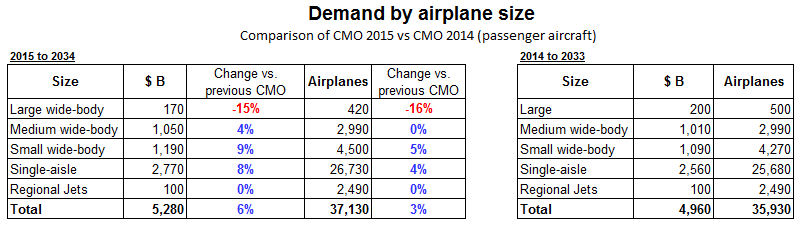
I have just compared the figures for passenger aircraft of the last two years’ CMOs:

CMO 2015 vs 2014 comparison.

CMO 2015 vs 2014 comparison.

Some comments to it:

  • You can see that the total number of new aircraft delivered has slightly increased from 35,930 to 37,130, a 3.3%, which is consistent with the 4.9% traffic increase (1) that Boeing predicts (2).
  • The volume (Bn$) increases by a larger percentage, 6% (320Bn$)… this is due mainly to the increase in:
    • single-aisle aircraft expected sales in volume (8%, +210Bn$) and aircraft (+210), and
    • small wide-body segment with 230 more aircraft (+5%) and an increase in volume of 100Bn$ (+9%).
  • Two years ago, I wrote about a sudden change between CMO 2013 and CMO 2012 of the mix in wide-bodies; in this respect, CMO 2015 is consistent with last year’s one, showing simply a slight increase in demand for both sub-segments.
  • Interesting to note how Boeing continues to downplay the large aircraft segment (-16% in terms of number of aircraft) at the moment when a A380neo is discussed.

This year study’s figures and presentation focus on single-aisle (737 MAX, “fuelling forecast”) and small wide-bodies (787, “re-shaping long-haul marketplace”), the products to be pushed by the sales force.

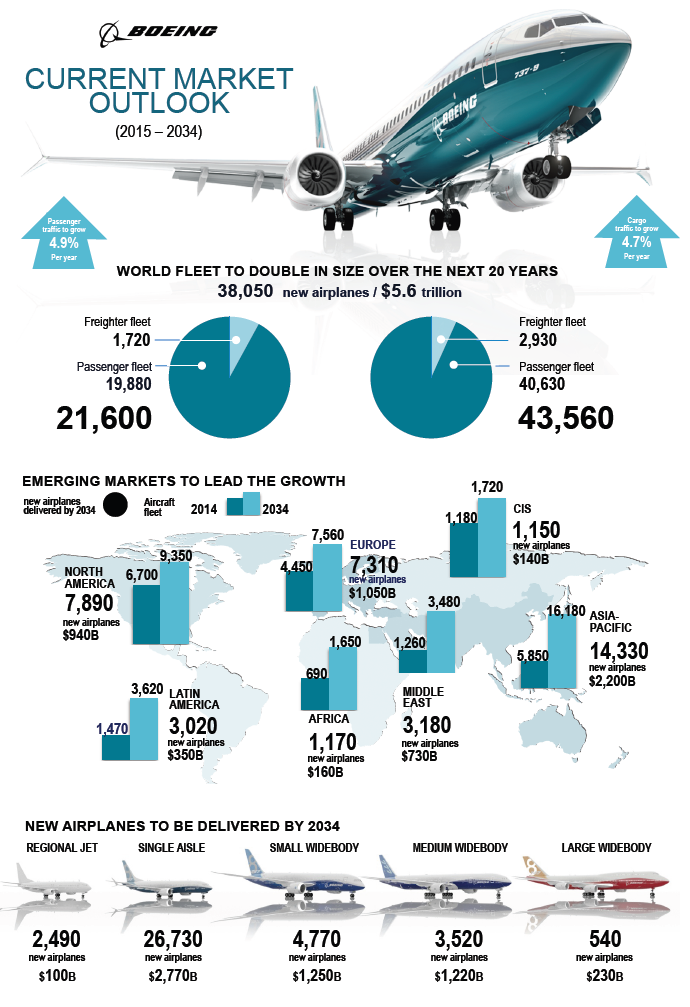
Find below the nice infographic [PDF, 2.1MB] that the guys from Boeing have put up together:

Boeing Commercial Aviation Market Forecast 2015-2034 infographic.

Boeing Commercial Aviation Market Forecast 2015-2034 infographic.

As always, I recommend going through the CMO, as you can learn a lot about the business: from global numbers, to growth, traffic figures, fleet distributions, forecasts, etc… You may find the presentation [PDF, 3.8 MB], a file [XLS, 0.6 MB] with all the data or the full CMO report [PDF, 6.5MB].

For a comparison between this CMO and the respective Airbus’ GMF we will have to wait until after the summer, when Airbus publishes its update. Until then, find here the comparison based on 2014 market studies.

This year together with the CMO, Boeing provides two interesting papers from a couple of years ago: Key Findings on Airplane Economic Life [PDF, 0.3MB, dating from August 2013] and A Discussion of the Capacity Supply -Demand Balance within the Global Commercial Air Transport Industry [PDF, 0.6MB, dating from August 2013].

(1) Traffic increased measured in RPKS (revenue passenger kilometers) in billions.

(2) These two ratios, 3.3% fleet demand and 4.9% traffic growth, point to an implicit increase in the average size of the aircraft in fleet and / or a higher utilization of the aircraft (higher availability).

(3) Find the reviews I wrote comparing 2014 CMO with 2013 CMO and 2013 CMO with 2012 CMO.

2 Comments

Filed under Aerospace & Defence

Hiroshima & Nagasaki, Enola Gay & Bockscar, Little Boy & Fat Man… National Museum of the Air Force

Today, August 6th, in 1945 the Boeing B-29 Superfortress “Enola Gay” dropped over Hiroshima (Japan) the first nuclear bomb, “Little Boy“, used in combat. I guess you have had the chance to read about it in several places along the day. A couple of years ago I wrote a post about that story touching it from different points of view that I had experienced in the previous years: Hiroshima Peace SiteManhattan Project, Einstein’s “The World as I see it“, Genbaku Dome, Sadako Sasaki’s origami,  the  “Enola Gay“, Enola Gay’s Navigator’s Log replica at Pima Air and Space Museum in Tucson…

… last November, we visited the National Museum of the Air Force (1) at Wright-Patterson Air Force Base in Dayton, Ohio. That museum enables the visitor to get more close-up experiences to the story of that August 6th of 1945.

As several other aerospace museums it counts with its own B-29 Superfortress… however, if the Enola Gay is displayed at National Air & Space Museum at Dulles, this one displayed at the National Museum of the Air Force (Dayton) is Bockscar, the aircraft which dropped the Fat Man” atomic bomb on Nagasaki on Aug. 9, 1945, three days after the atomic attack against Hiroshima. You can read about Bockscar in the site of the museum, here.

Bockscar, the B-29 which dropped "Fat Man" atomic bomb over Nagasaki on August 9, 1945.

Bockscar, the B-29 which dropped “Fat Man” atomic bomb over Nagasaki on August 9, 1945.

At Pima Air and Space Museum (Tucson) you could see a replica of Little Boy, however at National Museum of the Air Force (Dayton) they have in display a full size (a 4.4 tonnes, 3m-long bomb) replica of it:

Full size replica of atomica bomb Little Boy, launched over Hiroshima on August 6, 1945.

Full size replica of atomic bomb Little Boy, launched over Hiroshima on August 6, 1945.

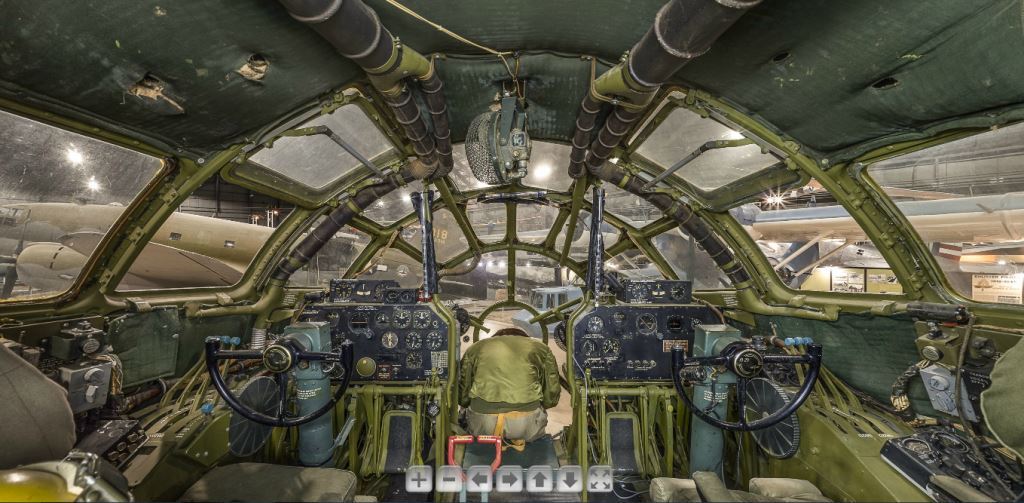
Seeing the bomber B-29 Superfortress from up close is impressive, even more if they are either the Enola Gay or Bockscar, but a completely different experience is going inside the cabin of a B-29. At the National Museum of the Air Force (Dayton) they have at the exhibit dedicated to the Korean War a B-29 walk-through fuselage in display. See here its virtual tour.

B-29 fuselage.

B-29 fuselage.

See below some of the pictures we took of the inside:

Actually, you can get very close to experiencing that by going to the virtual tour at the National Museum of the Air Force (Dayton), where you can go through all sections of the bomber B-29 Superfortress Bockscar. Find the link here.

B-29 Superfortress Bockscar virtual tour.

B-29 Superfortress Bockscar virtual tour.

Finally, see a map displaying US Army Air Forces operations in the Pacific at the time:

Map of US Air Force Pacific operations.

Map of US Air Force Pacific operations.

(1) I haven’t yet written a post about that museum in this blog but my brother Jaime has, find it here; a superb piece of aeronautics information.

Leave a comment

Filed under Aerospace & Defence

Switching jobs to A330neo programme

About four and half-year ago I announced in this blog that I was coming to work to France. I will use this communication channel again to inform those of you who don’t know it, that about a month ago I switched jobs within Airbus Group: I moved from Airbus Defence and Space A400M programme to Airbus Commercial A330neo programme.

Let me share a couple of pictures to depict the move:

Change of lanyards and key chains... a basic integration exercise...

Change of lanyards and key chains… a basic integration exercise…

I will nevertheless keep a close eye in A400M, a programme where I spent the last 5 years working on it…

My first flight on-board the A400M.

My first flight on-board the A400M.

2 Comments

Filed under Aerospace & Defence

Musée Espace Air Passion (Angers)

In the last post I described the Fly Out to Les Châteaux de la Loire that we made the last weekend. In that post I mentioned that we visited the museum Espace Air Passion in Angers airport. This post will be dedicated to that beautiful museum.

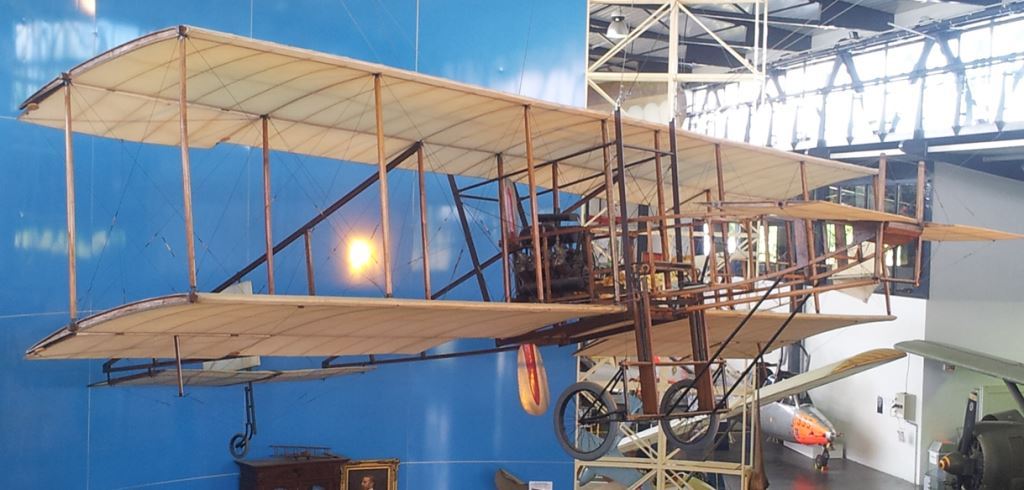
This museum is owned and run by an association, the “Groupement pour la Préservation du Patrimoine Aéronautique” (GPPA), created back in 1981 by a group of friends around the project of restoring an old aircraft (a jewel) from René Gasnier, a local pioneer of French aviation who flew in 1908 along 1km in an airplane built by himself. That airplane is the first one you get to see in the museum:

Rene Gasnier III, built in 1908, restored in 1988.

Rene Gasnier III, built in 1908, restored in 1988.

René Gasnier built his first airplanes between 1907 and 1908. This model, the III was built in 1908. As you can see it was made of wood and cloth. It mounted an Antoinette engine with 8 cylinders in V, with a power of 48hp, wingspan of 10m, less than 500kg at take off. It took the enthusiasts of GPPA over 1000 hours to restore it.

This airplane is surely not the only unique piece of the museum. Take a look at the following two airplanes.

The Gérin “Varivol”, built in 1938 (by the Compagnie Française d’Aviation), was based in the concept of using moving wings which extended themselves increasing the wingspan at the time of take-off when more lift was needed and reducing the wingspan to decrease drag at cruise. A prototype was successfully tested in the wind tunnel of Chalais-Meudon in 1946, however the actual airplane seems to never have flown. Had it flown, it was to have a cruise speed of ~455km/h while only 92km/h for landing speed. The wings were to be extended/retracted 2.75m per side out of a total retracted wingspan of 8.10m.

Alerion Riout 102 T.

Alerion Riout 102 T.

Built in 1937 by René Riout (at the workshop of Louis Breguet) with duralium, the 102 T explored the concept of flying by batting its wings (4, two at each side of the fuselage). During its test in 1938 when the pilot increased the engine regime up to around 4500rpm, after a few seconds, the observers saw torsion vibrations in the tip of one the wings before it broke, closely followed by the other 3 wings. It was then dismounted and forgotten till 2005 when the restoration at GPPA started.

This reminded me of a quote attributed to Igor Sikorsky that goes like:

Our engineers have determined that aerodynamically, the hummingbird shouldn’t be able to fly, but the hummingbird doesn’t know it so it goes on flying anyway.

Another oddity of the museum is one of the only two prototypes (1) ever built of the Moynet Jupiter (designed by André Moynet) which had the rare configuration of two push and pull engines, one in the front and one in the back of the fuselage. It was never sold to any customer, but it flew for the first time on December 17, 1963 (60 years after that glorious day in Kitty Hawk).

Moynet Jupiter.

Moynet Jupiter.

The museum has these other two sailplanes which have been declared patrimoine de l’aviation française due to the records they collected in their high time, the Caudron 800 Épervier and the Avia 40P:

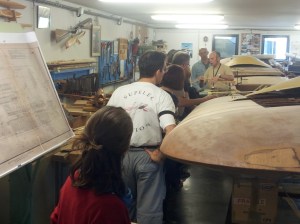
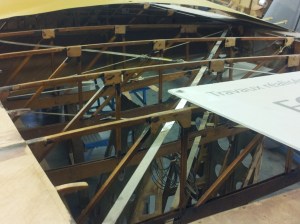
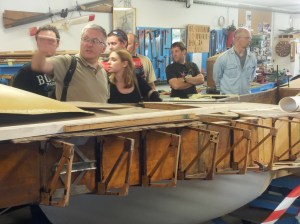
We also enjoyed the visit to the workshops where they restore the fuselages and the wings. Take a look at the pictures and notice the wood and the cloth. Forget about those pictures the next time you get onboard a general aviation airplane.

We were given a guided tour by two members of the association, their explanations, anecdotes, connection with French famous pilots (including former Airbus’ test pilots) were invaluable. On the other hand, the audience couldn’t have been more responsive. Take a look at the pictures above: scores of years of aerospace engineering experience (flight testing, training), thousands of flying hours as pilots, real aviation geeks at its best.

The museum also has playing area for children, a MH-1521 Broussard for children (an adults) to get on and play, and some other beautiful aircraft including a Caudron PC431 Rafale, a Morane Saulnier 505, a Piper L4H Grasshoper, or the car Marcel Leyat Helica… see them below:

This slideshow requires JavaScript.

(1) The other prototype is at  the Musée de l’Air et de l’Espace, at Le Bourget.

1 Comment

Filed under Aerospace & Defence

Fly Out: Les Châteaux de la Loire

Last weekend we took part together with my friend Raphaël and about 20 other members of the Airbus Aviation Society of Toulouse in a Fly Out (1) to Les Châteaux de la Loire. 7 aircraft departed from different airfields around Toulouse to reach Angers, some on Friday evening, some on Saturday morning. From then one we would enjoy some joint activities. In a nutshell:

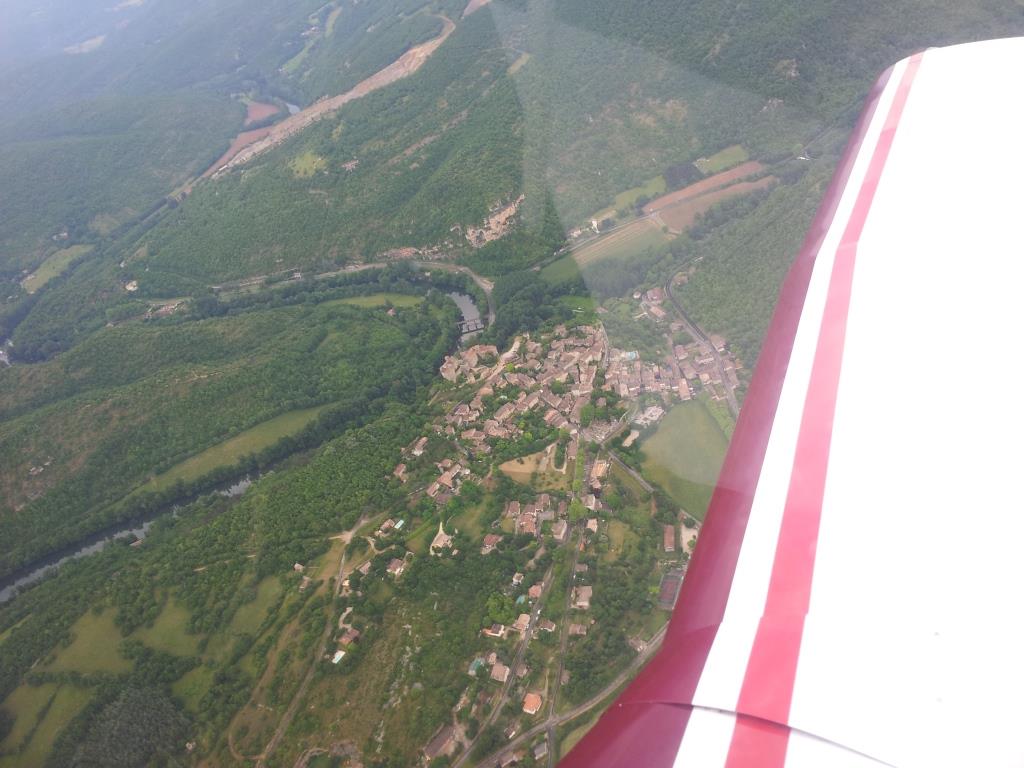
  • On the way to Angers (LFJR, 2h50′ flight), we flew over some very beautiful villages such as Bruniquel, Saint Cirq Lapopie, etc.
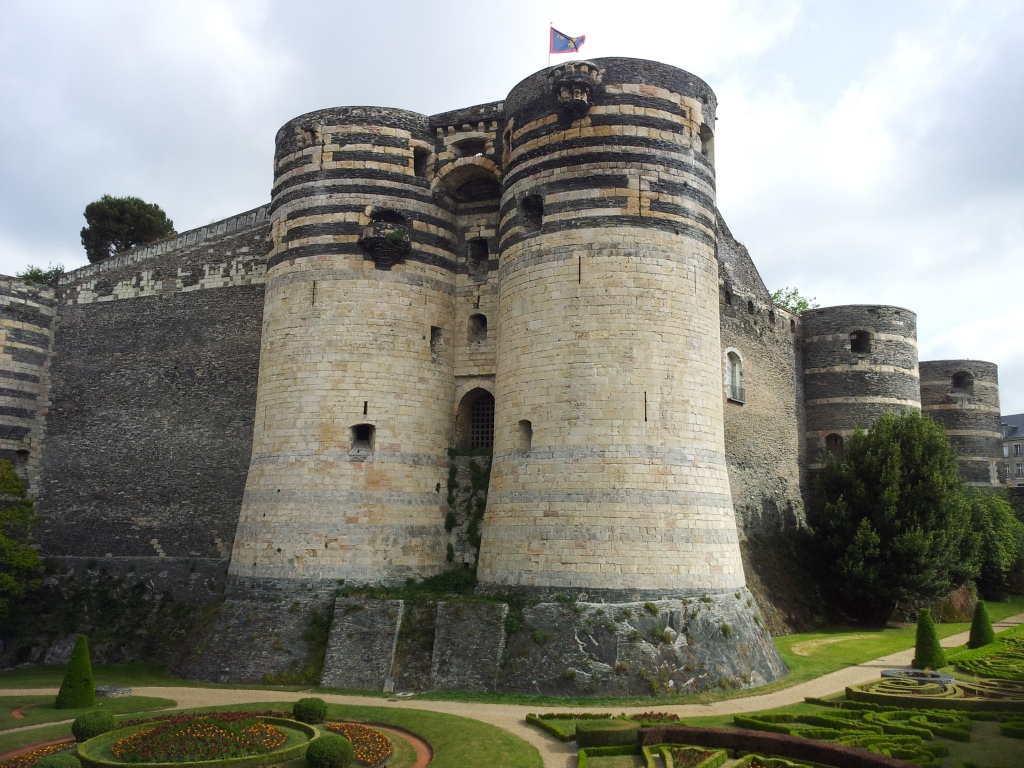
  • On Saturday morning, in Angers we visited the castle and walked around the city. We then visited the museum Espace Air Passion.
  • We then took our aircraft and flew over dozens of castles along the Loire valley, from Angers to Chambord and back to Amboise (LFEF).
  • In Amboise we had an evening event with the local aeroclub.
  • The morning after and due to worsening meteorological conditions we decided to skip the “ground” visit to the Chenonceau castle (next time) and depart early back to Toulouse. In the way we stopped for lunch at Sarlat-Dome (LFDS) where we were very warmly welcome by some members of the local aeroclub.

I believe than rather than wandering with long texts explaining all of these experiences it is better to share some of the pictures we took and let you fly along with us with some captions:

Waiting for the departure time at Toulouse Lasbordes (LFCL)

Waiting for the departure time at Toulouse Lasbordes (LFCL).

Dashboard of the Robin DR-48 we flew (F-GGHT).

Dashboard of the Robin DR-48 we flew (F-GGHT). (2)

Bruniquel.

Bruniquel.

Saint Cirq Lapopie.

Saint Cirq Lapopie. (3)

La Roque Gageac.

La Roque Gageac.

Beynac et Cazenac.

Beynac et Cazenac.

Rapha, concentrated in his piloting.

Rapha, concentrated in his piloting.

Arriving at Angers (LFJR) rather late.

Arriving at Angers (LFJR) rather late.

If you arrive at Angers airport in the evening, you'd better know the theory if you want to get out.

If you arrive at Angers airport in the evening, you’d better know the theory if you want to get out.

Château d'Angers, founded by the Counts of Anjou.

Château d’Angers, founded by the Counts of Anjou.

"Apocalypse Tapestry" at Angers castle.

“Apocalypse Tapestry” at Angers castle.

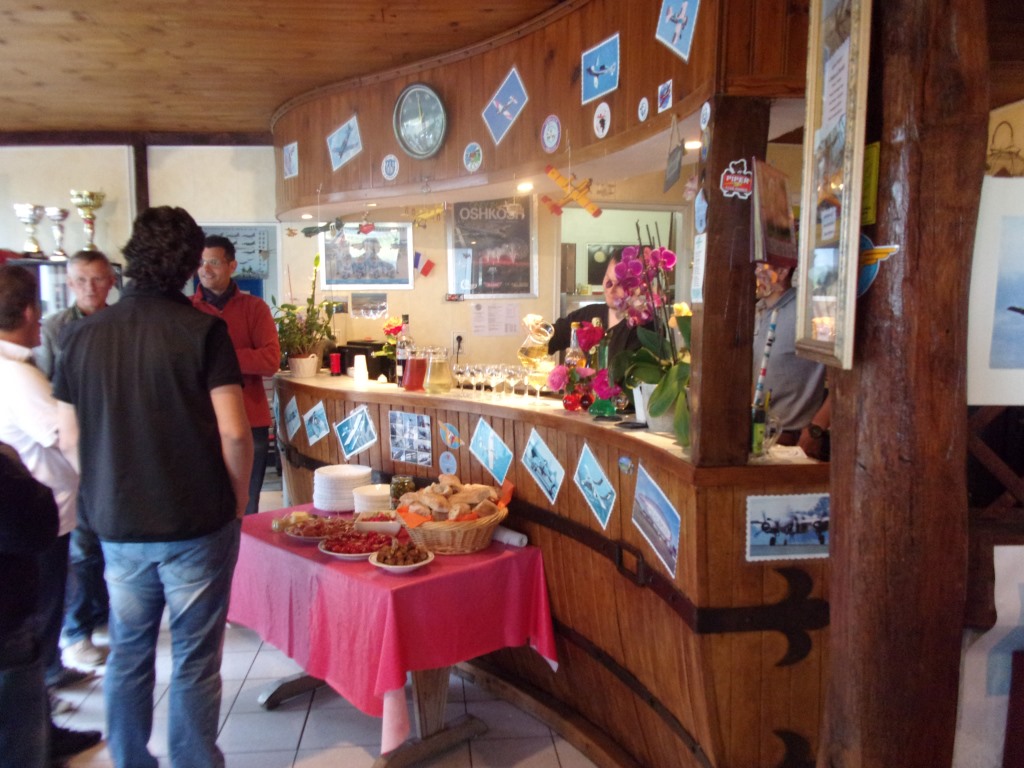
Visiting the museum "Espace Air Passion" at Angers airport.

Visiting the museum “Espace Air Passion” at Angers airport. (4)

"Why is Rapha at the controls again, daddy? When do I get to pilot?!"

“Why is Rapha at the controls again, daddy? When do I get to pilot?!”

Chenonceau.

Chenonceau.

Chambord.

Chambord.

Andrea, a born flyer, and Luca, getting over it.

Andrea, a born flyer, and Luca, getting over it.

Great evening event organized by the "Aéro-club Les Ailes Tourangelles".

Great evening event organized by the “Aéro-club Les Ailes Tourangelles”. (5)

Our commandan de bord, Raphael preparing the next flight.

Our commandant de bord, Raphael preparing the next flight.

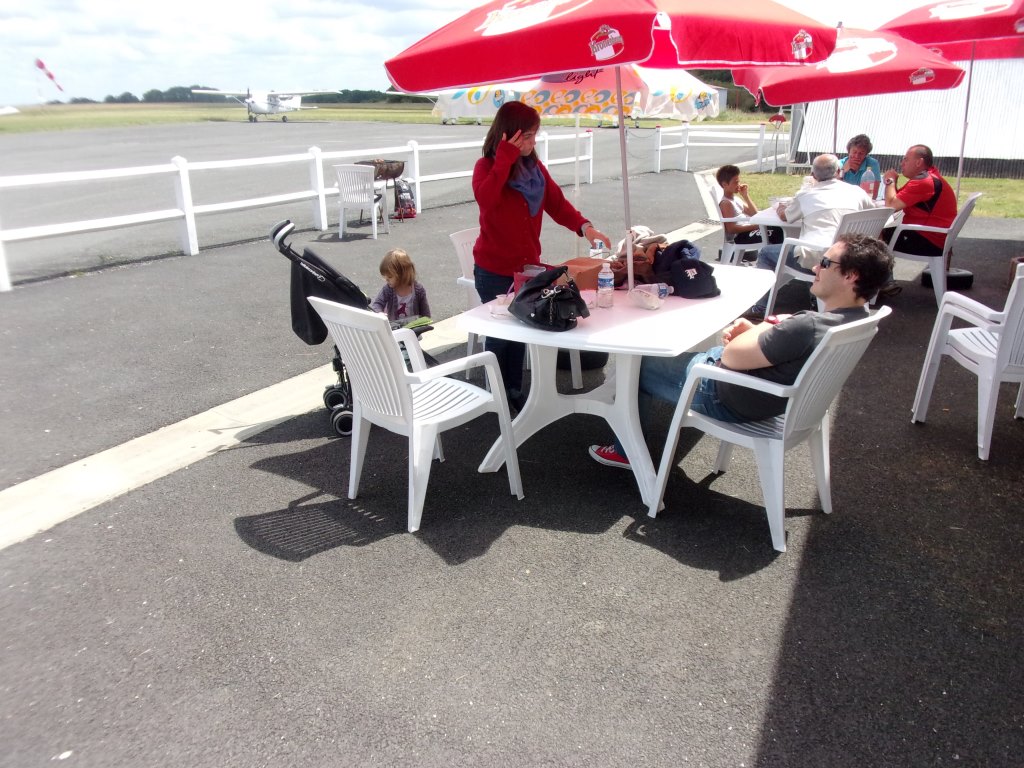
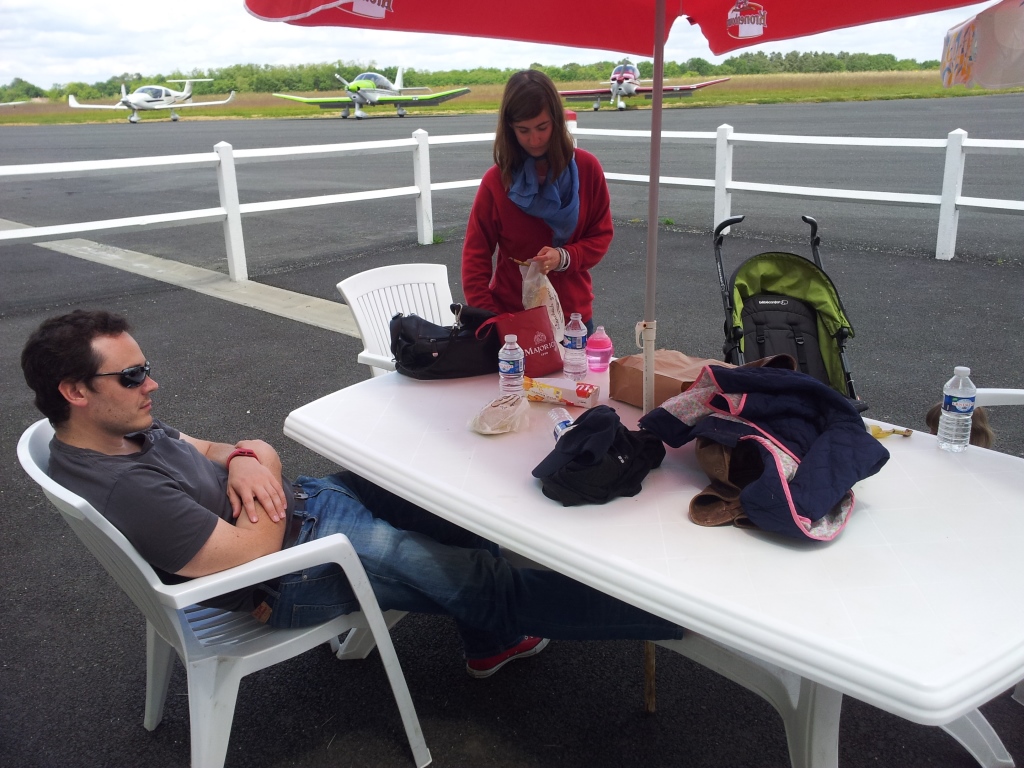
The fellows from the "Aeroclub du Sarladais" got out those table, parasols and chairs for us to have lunch with them.

The fellows from the “Aeroclub du Sarladais” got out those table, parasols and chairs for us to have lunch with them. (5)

Relaxing at Sarlat-Dome aerodrome (LFDS).

Relaxing at Sarlat-Dome aerodrome (LFDS).

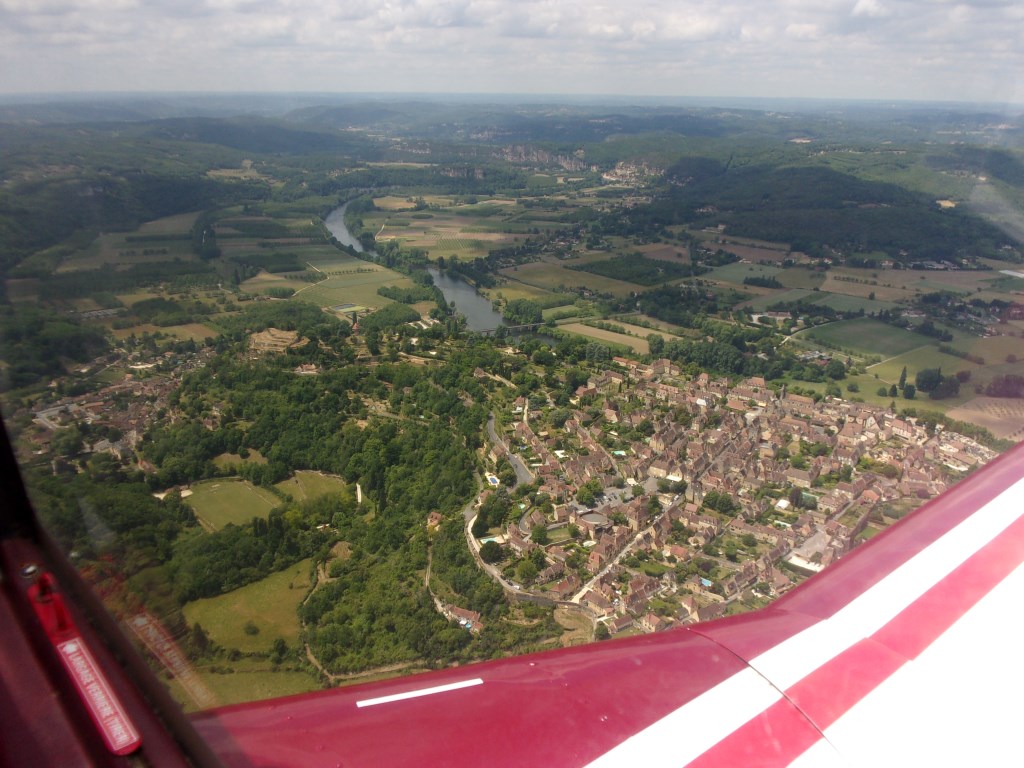
Initial climb at Sarlat-Dome (LFDS), wonderful view of the Dordogne valley and Dome village.

Initial climb at Sarlat-Dome (LFDS), wonderful view of the Dordogne valley and Dome village.

Rocamadour.

Rocamadour.

(1) The term we use for an organized activity in which several aircraft depart together with a common destination.

(2) Check out about the DR-48 here.

(3) Recently selected as the most beautiful village of France.

(4) Be sure that I will dedicate another post about this museum.

(5) If you plan to fly either to Amboise Dierre or Sarlat-Dome, do not hesitate in contacting the local aeroclubs (Les Ailes Tourangelles and Aeroclub du Sarladais, respectively), they will give you a more than warm welcome!

4 Comments

Filed under Aerospace & Defence, France, Travelling

Ailes Anciennes Toulouse, Visites Cockpit (April 2015)

Ailes Anciennes Toulouse is an association that preserves and restores old airplanes and helicopters. It is located in Blagnac, close to the museum Aeroscopia. In its collection has over 50 aircraft, some of which are being worked on, some are displayed in their field and others are ceded to Aeroscopia (e.g. the Super Guppy being one of them).

PosterVisiteCockpitApril11About three or four times a year, Ailes Anciennes organizes what they call Visites Cockpit events. In those days, most of the aircraft on display are opened for visitors to enter in them, sit in their cockpits, experience them, get explanations from enthusiast volunteers of the association, walk through their cabins and cargo hold compartments. Last April 11th was one of those days and we took the opportunity to visit it.

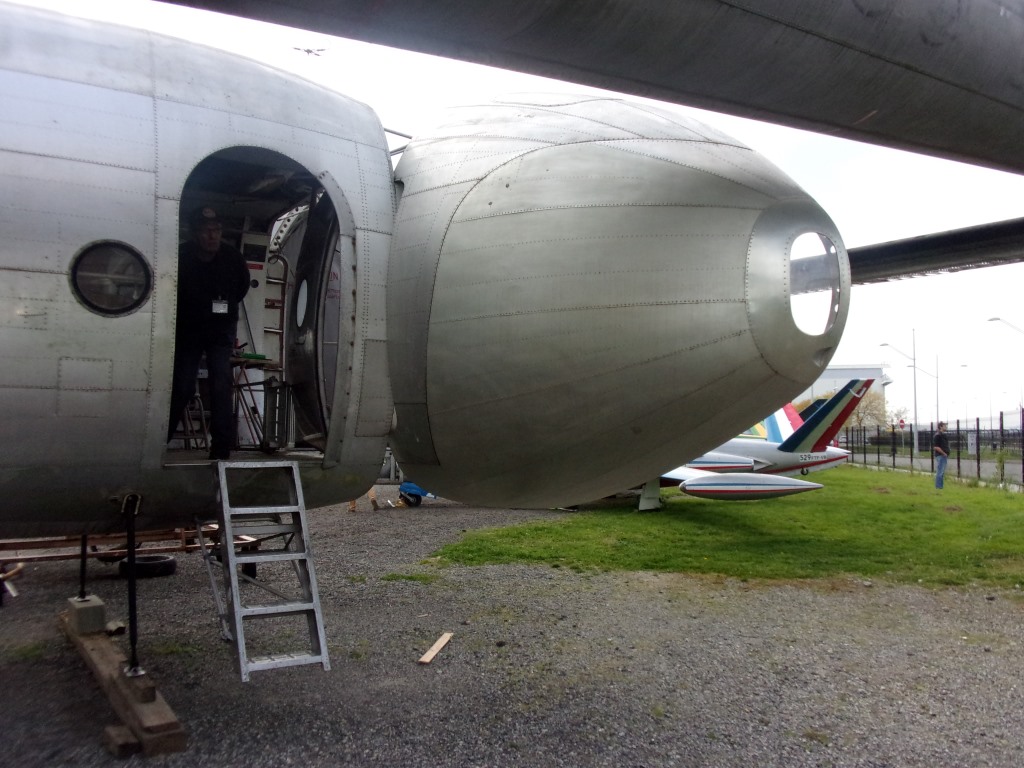
If last year we got the chance to see the only airworthy Noratlas flying in Francazal, this time we got to enter in one:

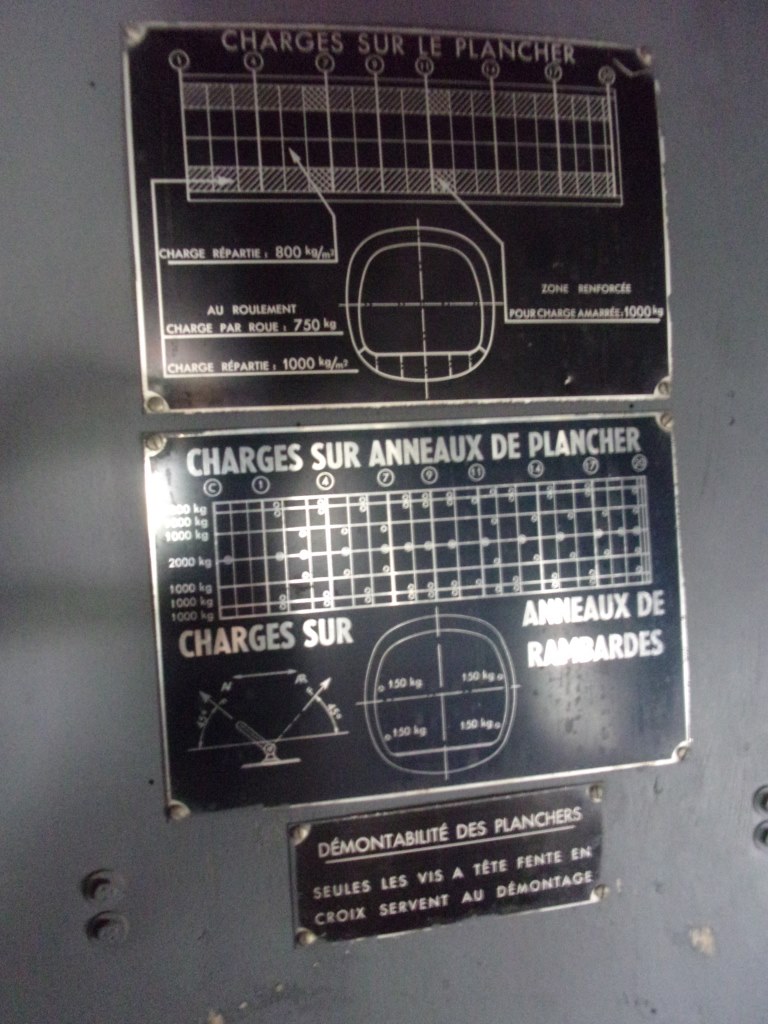
Loading plan of a Nord 2501 Noratlas.

Loading plan of a Nord 2501 Noratlas.

Side view of a Nord 2501 Noratlas.

Side view of a Nord 2501 Noratlas.

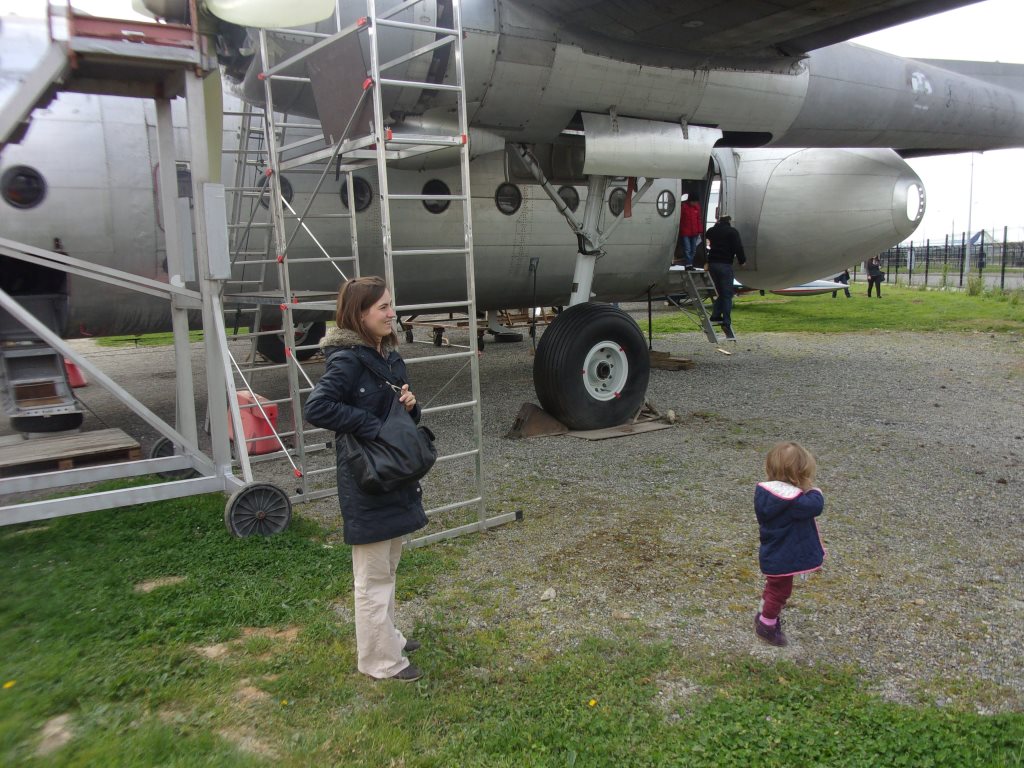
View of a Nord 2501 Noratlas

View of a Nord 2501 Noratlas

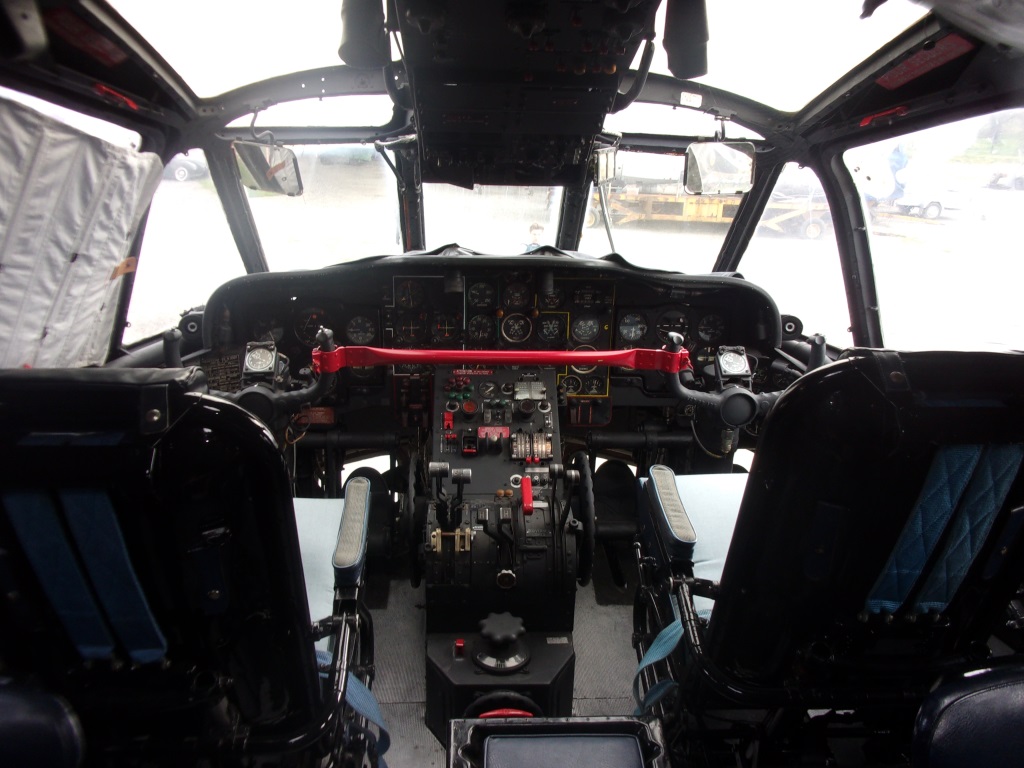
Cockpit of a Nord 2501 Noratlas.

Cockpit of a Nord 2501 Noratlas.

View of an Airbus A350 from the cargo hold of a Nord 2501 Noratlas.

View of an Airbus A350 from the cargo hold of a Nord 2501 Noratlas.

There were some aircraft which I believe I had never seen live before, such as:

Breguet 765 "Sahara".

Breguet 765 “Sahara”.

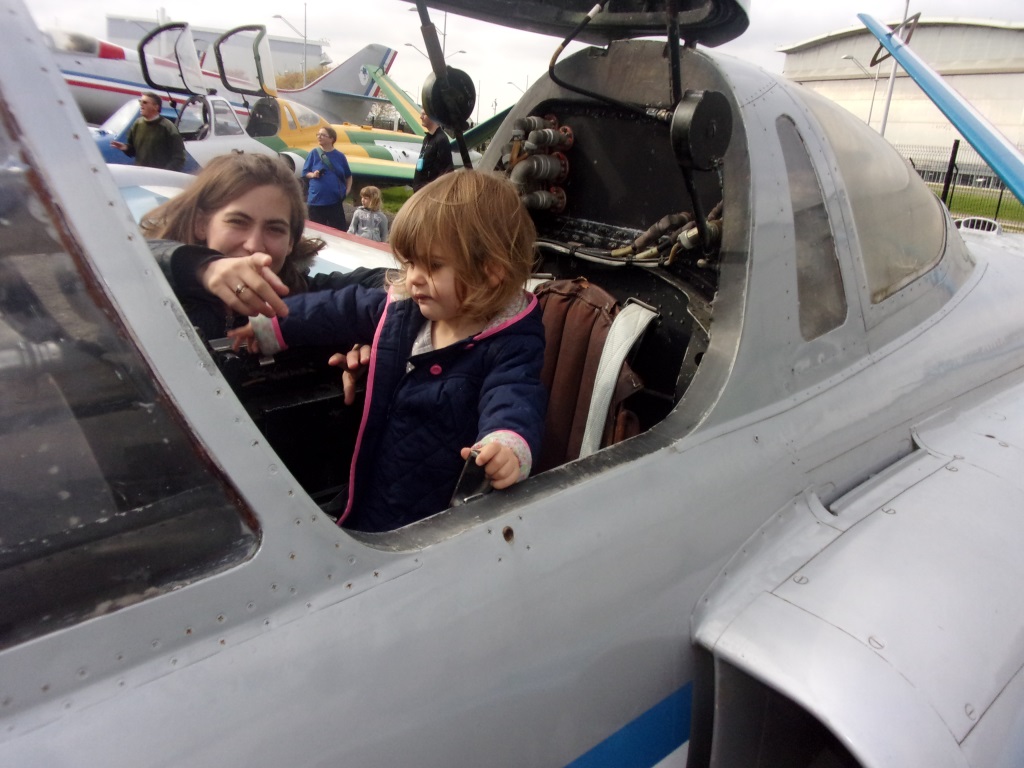
Andrea inside the trainer Fouga Magister.

Andrea inside the trainer Fouga Magister.

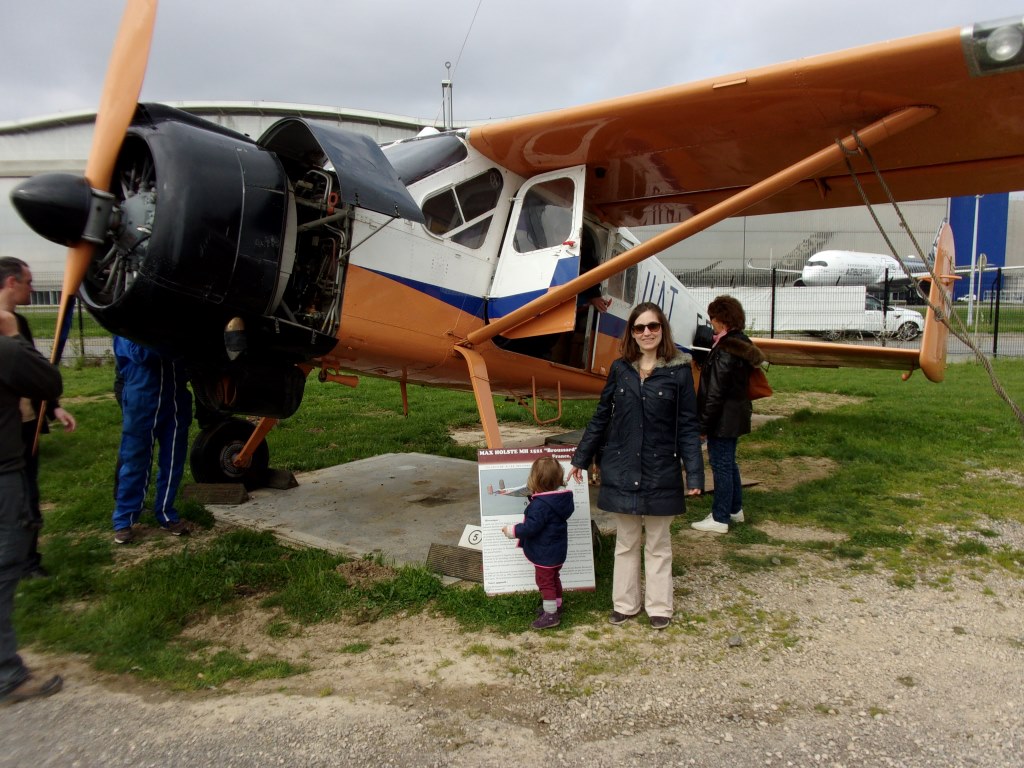
Max Holste MH 1521 "Broussard".

Max Holste MH 1521 “Broussard”.

Panel with limit velocities of a Breguet 941S.

Panel with limit velocities of a Breguet 941S.

Some of the other aircraft we enjoyed include the Sud Aviation Caravelle, the Douglas DC-3 (3), the North American T-6 Texan, the Mikoyan-Gourevitch MiG-21

Mikoyan-Gurevich MiG-21.

Mikoyan-Gurevich MiG-21.

Main dashboard of a MG-21.

Main dashboard of a MG-21.

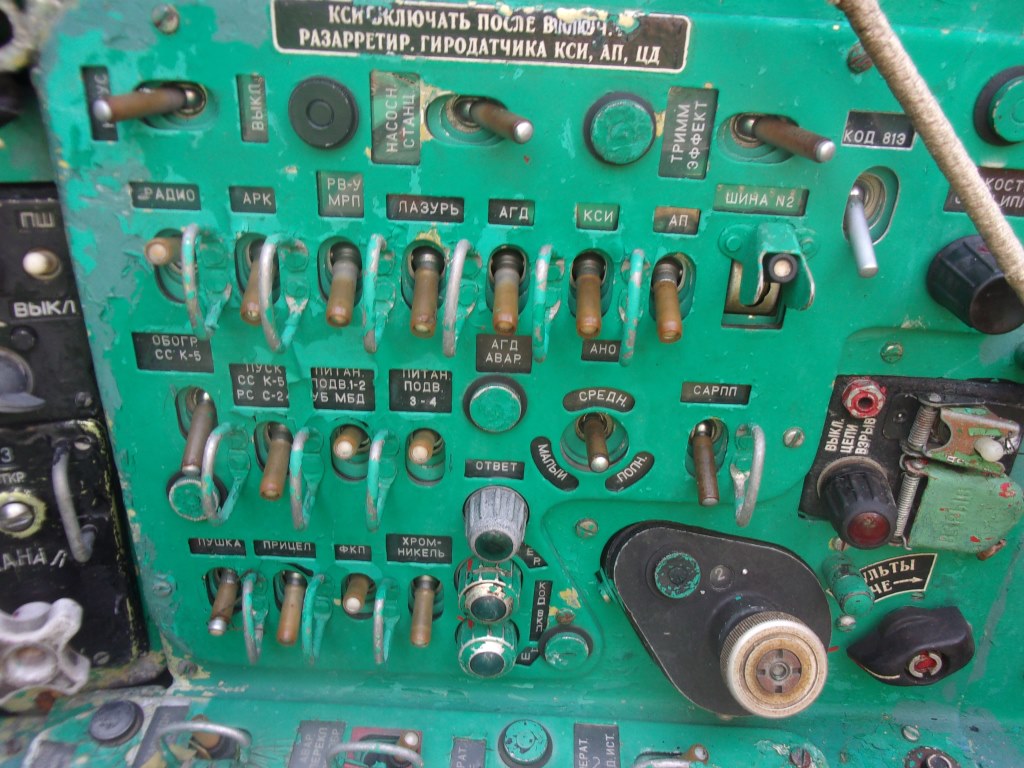
Side panel of a MG-21.

Side panel of a MG-21.

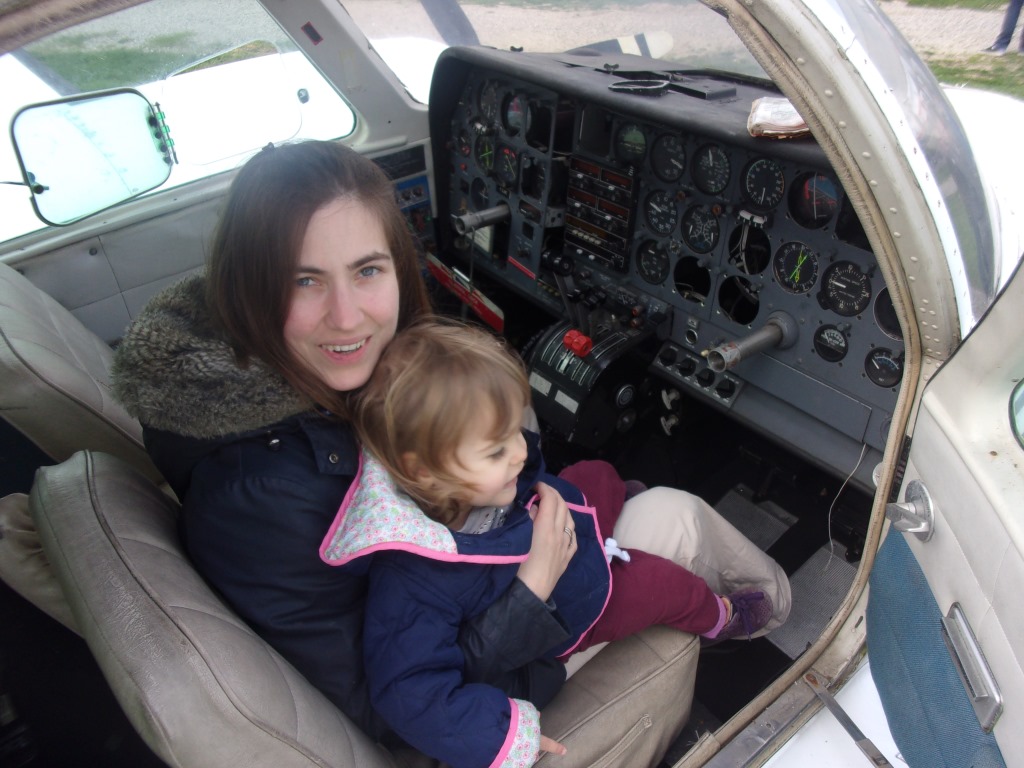
Luca and Andrea inside a Cessna 310.

Luca and Andrea inside a Cessna 310.

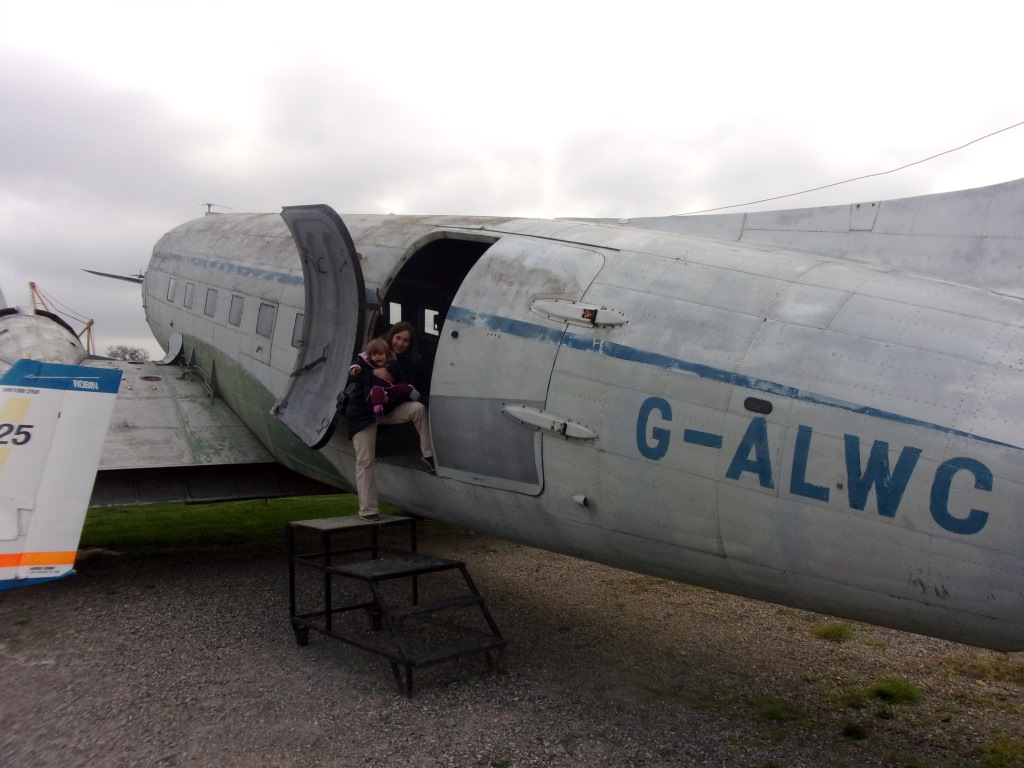
Douglas DC-3.

Douglas DC-3.

Circuit breakers panel of a Sud Aviation Caravelle.

Circuit breakers panel of a Sud Aviation Caravelle.

Posing from the cockpit of a North American T-6G Texan.

Posing from the cockpit of a North American T-6G Texan.

Douglas DC-3 as seen from a North American T-6G Texan.

Douglas DC-3 as seen from a North American T-6G Texan.

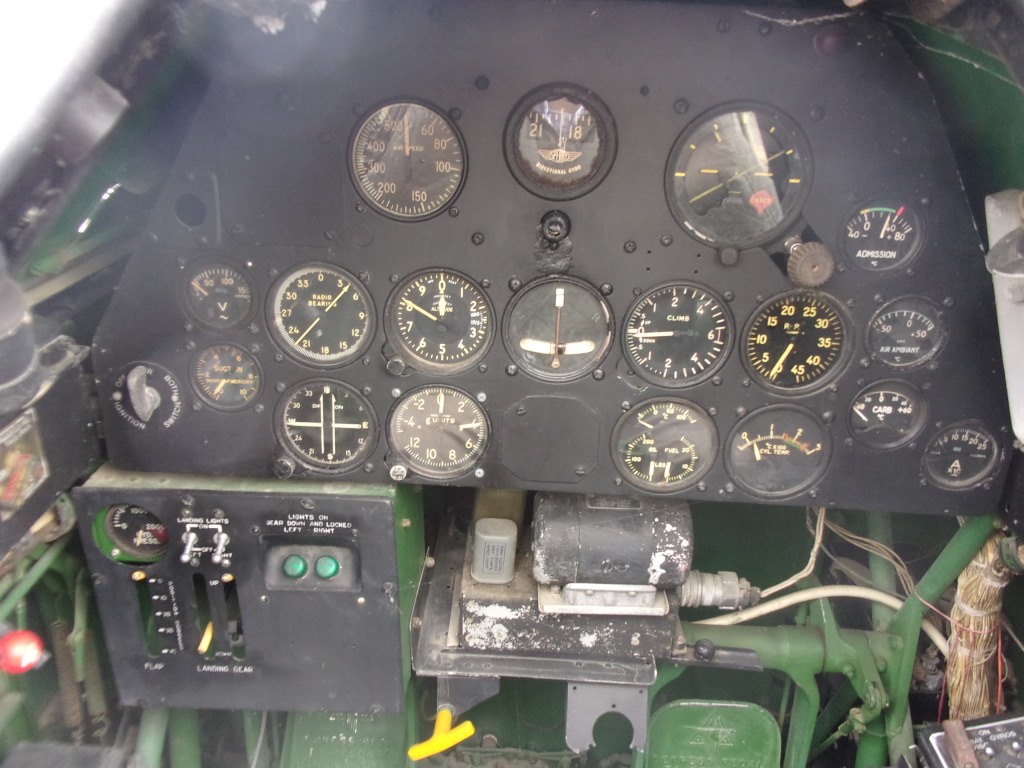
Dashboard of a North American T-6G Texan.

Dashboard of a North American T-6G Texan.

Andrea playing around.

Andrea playing around.

I recommend the visit to Ailes Anciennes in its Cockpit days (10€ for adults). Take a look at their website to see when the next one is scheduled (normally in spring).

(1) See here a video of the Patrouille de France air show in Francazal 2014.

(2) See here a video of a Pratt & Whitney R-985 Wasp Junior radial engine in operation at the National Air & Space Museum of the Smithsonian institution in Washington DC, at Dulles.

(3) Read more about the origins of the Douglas DC-3 here.

1 Comment

Filed under Aerospace & Defence

KC-46 EMD contract (update March 2015)

About two years ago I wrote a post, KC-46 EMD contract 101, in which I reviewed the nature, implications and status of the Fixed Price plus Incentive Firm (FPIF) that the US Air Force had signed with Boeing for the tanker K-46 Engineering Manufacturing and Development (EMD) contract.

I have been wanting to write an update of that post with how the situation has evolved for some months. The recent article in Bloomberg, Boeing KC-46 Tanker Suppliers Behind on Deliveries, GAO Finds, has finally triggered this review.

A recap of the main points from the Bloomberg article:

[…] The boom for the first KC-46 has been “delayed by eight months due to design changes and late parts deliveries,” […]

The delays have resulted in a slip of at least three months in the initial flight of the first fully equipped development aircraft. […]

[…] GAO said “another supplier has experienced significant delays in manufacturing” aerial refueling wing pods […]

[…] the Air Force projected in a revised estimate this year that Boeing will have to absorb $1.5 billion for exceeding a $4.8 billion ceiling to develop the first four planes.

Bloomberg cites GAO as a source. GAO stands for US Government Accountability Office. Every year, in March, the GAO releases its “Assessments of Selected Weapon Programs” where it reviews the Department of Defense (DoD) main programs. Find here [PDF, 10.4MB] the 2015 report released on March 12. It contains just 2 pages about the “KC-46 Tanker Modernization Program (KC-46A)”. What does it say? Main take aways:

[…] After the critical design review, the program had wiring design changes that led to several delays, including at least a three month delay to KC-46 first flight. The program does not plan to demonstrate a full system-level prototype until April 2015, 21 months after its critical design review. […] 

[…] key suppliers have continued to experience difficulties with the design and manufacture of aerial refueling systems, such as refueling booms and wing aerial refueling pods. The boom that was to be installed on the first KC-46 has been delayed by eight months due to design changes and late parts deliveries. Another supplier has experienced significant delays in manufacturing wing aerial refueling pods for qualification testing and development aircraft due, in part, to challenges with parts delays and engineering design changes. As a result of these delays, first flight of an aircraft that integrates military sub-systems has slipped at least three months to April 2015, 21 months after critical design review. […]

[…] Boeing is encountering more than twice the number of software problems than originally estimated that prevent or adversely affect the accomplishment of an essential operational or test capability.

[…] the program office noted that it has mitigated financial risk with the competitive fixed-price incentive development contract with firm-fixed and not-to-exceed pricing for the production of the aircraft. More than 57 percent of the development work has been completed. Boeing has met or exceeded all contractual requirements. […]

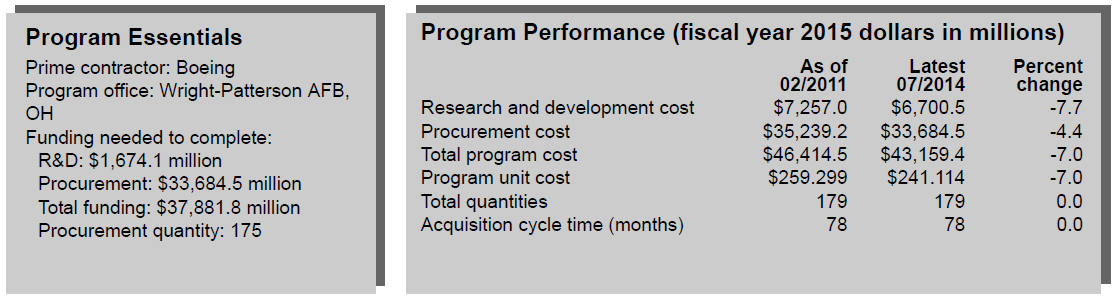
The program performance review that the GAO makes is seen from the Air Force point of view, which, as indicated above, since the contract is a FPIF, the USAF feels protected and thus it does not show any sign of the 1.5bn$ over cost that Bloomberg mentions that Boeing will have to bear:
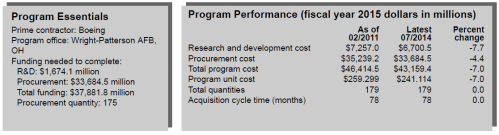
Program Performance (fiscal year 2015 dollars in millions)

Bloomberg quotes a 1.5bn$ estimated over cost based on Air Force data.

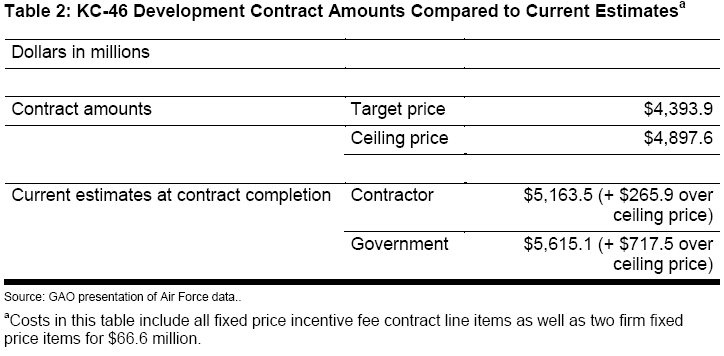
The GAO published in March 2012 [PDF, 1.1MB], February 2013 [PDF, 1.2MB] and April 2014 [PDF, 1MB] three reports reviewing the KC-46 tanker program. Interestingly enough the reports from 2012 and 2013 included such estimates of the over cost using Air Force data, the 2014 report did not. See 2012 and 2013 estimates below:
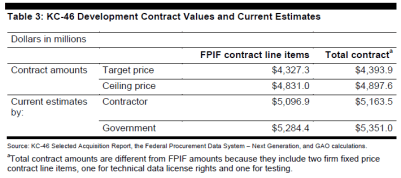
KC-46 EMD Estimates 2012.

KC-46 EMD Contract & Estimates (March 2012).

KC-46 EMD Contract & Estimates.

KC-46 EMD Contract & Estimates (February 2013).

Why did the GAO not include such estimate in 2014 report? Wasn’t the information available? The release of such estimates in 2012 and 2013 did not sit well in some spheres?

Today is March 21st 2015. I guess we shall see soon the annual report from the GAO with the specific view on the KC-46 program. I wonder whether such cost estimate will be included this time (hopefully yes). In any case, I guess the information from the Air Force estimate has been duly leaked.

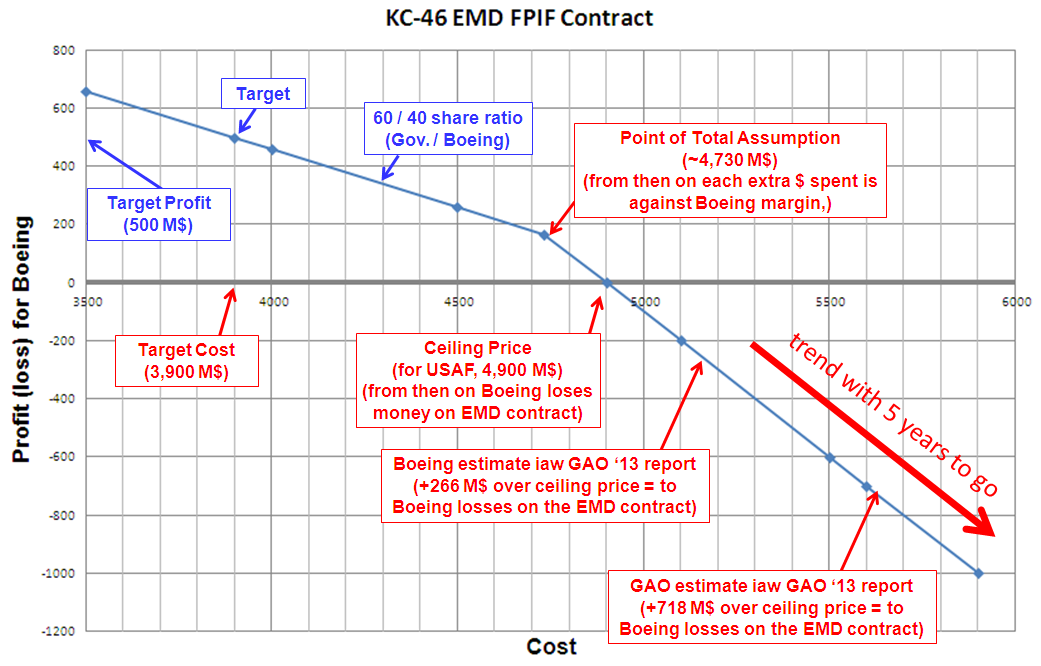
The contract was awarded on February 24th 2011; about a year later USAF was already estimating that Boeing suffered already over 750m$ over costs from target price, 260m$ over ceiling price. For the Air Force the picture was bleaker. One year later the figures had increased again. Luckily for USAF the FPIF contract has a point of total assumption on the side of the contractor (Boeing), as I indicated in the post from 2013:

KC-46 EMD FPIF Contract.

KC-46 EMD FPIF Contract (March 2013).

Let’s see where we would be now in the previous curve taking the information from Bloomberg as good (“[…] the Air Force projected in a revised estimate this year that Boeing will have to absorb $1.5 billion for exceeding a $4.8 billion ceiling to develop the first four planes.”):
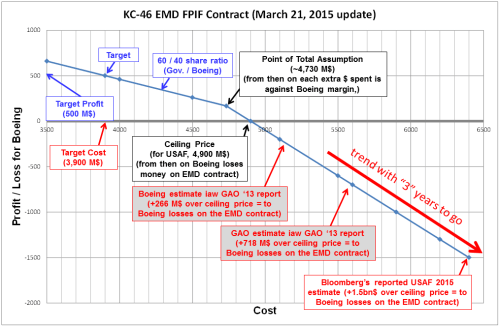
KC-46 EMD FPIF Contract - 2015

KC-46 EMD FPIF Contract (March 2015 update, based on Bloomberg)

As I mentioned in the blog post from 2 years ago: this is the typical FPIF contract curve, which is the only thing which is missing in ALL the news, budgeting materials, GAO reports, etc., that I have read and is the most illustrative graphic to understand what is going to happen if the cost overruns keep piling and who is going to bear which amount of the cost from which point.

Bloomberg and the US Air Force estimate that those 1.5bn$ over the ceiling price are going to be born by Boeing as the FPIF contract stipulates. However, I wanted to call here the attention to the FY2016 budget request from the USAF (DoD) [here, PDF, 8.5MB], see below:
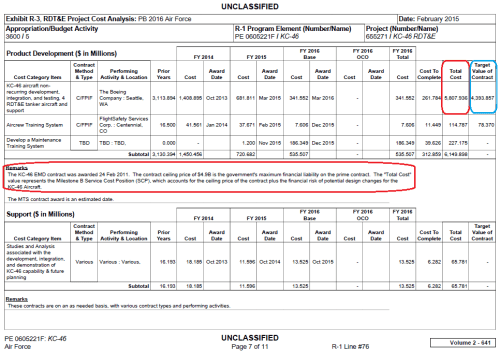
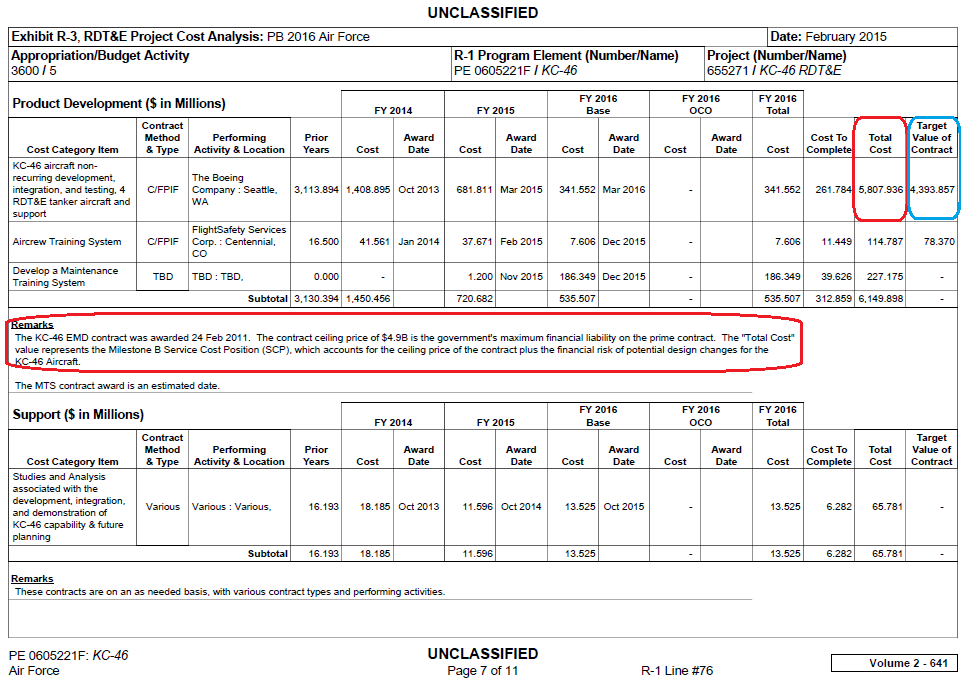
See "Total Cost" and "Remark" (source: Exhibit R-3, RDT&E Project Cost Analysis: PB 2016 Air Force).

See “Total Cost” and “Remark” (source: Exhibit R-3, RDT&E Project Cost Analysis: PB 2016 Air Force).

As you can see the USAF budget request for the KC-46 program includes the remark:

The contract ceiling price of $4.9B is the government’s maximum financial liability on the prime contract. The “Total Cost” value represents the Milestone B Service Cost Position (SCP), which accounts for the ceiling price of the contract plus the financial risk of potential design changes for the KC-46 Aircraft

I would not discard that through the justification of “design changes” the American tax payer will have to bear part of those estimated 1.5bn$ over the ceiling price. We will see.

Finally, I think it interesing to see the planning included in the budget request from USAF (below), as it indicates a Tanker First Flight in the 3rd quarter of 2015 (not April 2015 as quoted by Bloomberg (“initial flight of the first fully equipped development aircraft”)).
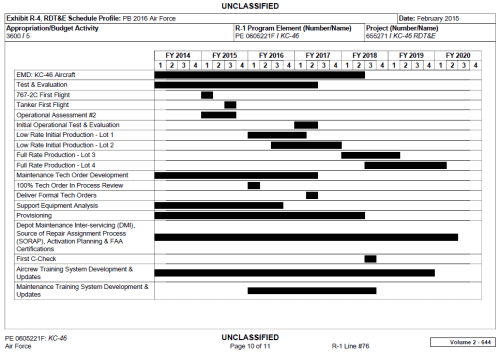
USAF FY2016 budget request - KC-46 Planning.

USAF FY2016 budget request – KC-46 Planning.

You can compare it with the planning presented in February 2012 with FY2013 budget resquest:
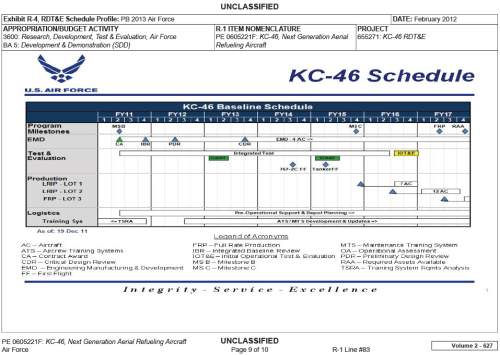
USAF FY2013 budget request - KC-46 Planning.

USAF FY2013 budget request – KC-46 Planning.

The GAO talks about a “first flight of an aircraft that integrates military sub-systems has slipped at least three months to April 2015”, but in my view that doesn’t mean a “first fully equipped development aircraft”. In 2012 the planning had a tanker first flight at the beginning of Q2 2015 which in the 2015 plan it is shown in Q3 2015, thus the 3-month delay mentioned by the GAO.

I am indeed looking forward to the KC-46-specific report from the GAO that may be about to be published (1).

(1) I may then have to write another post with a new update.

2 Comments

Filed under Aerospace & Defence

Boeing vs. Airbus: CEO compensation (2013)

Last Friday, while reading the Seattle Times article “Boeing CEO took home almost $29M last year” (referring to 2014) I was reminded of a recent conversation with some colleagues on the compensation of Boeing vs. Airbus Group CEOs.

As both companies are public companies, this information is public and can be found in the annual report and proxy statement from each one. I will just copy the information below for comparison and future reference. I use 2013 references to compare both at the same exercise, as 2014 annual report from Airbus Group is not yet available.

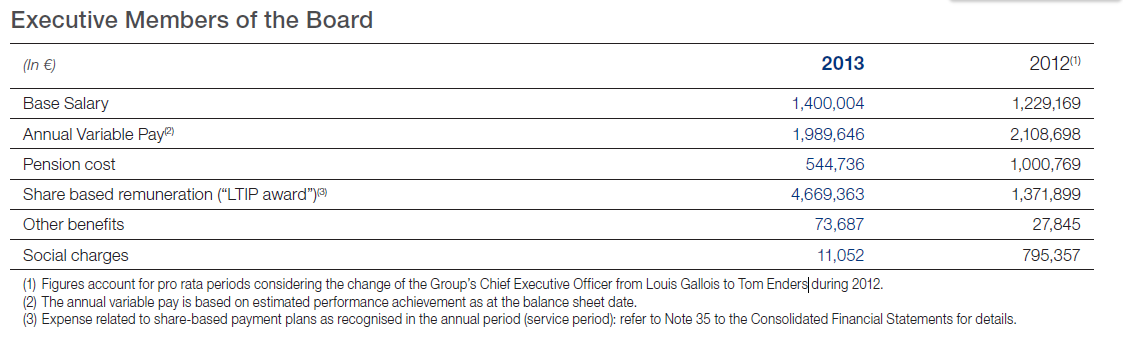
Airbus Group CEO, Tom Enders’ 2013 compensation (annual report here, PDF, 1.4MB)

Airbus Group's Tom Enders 2013 compensation.

Airbus Group’s Tom Enders 2013 compensation.

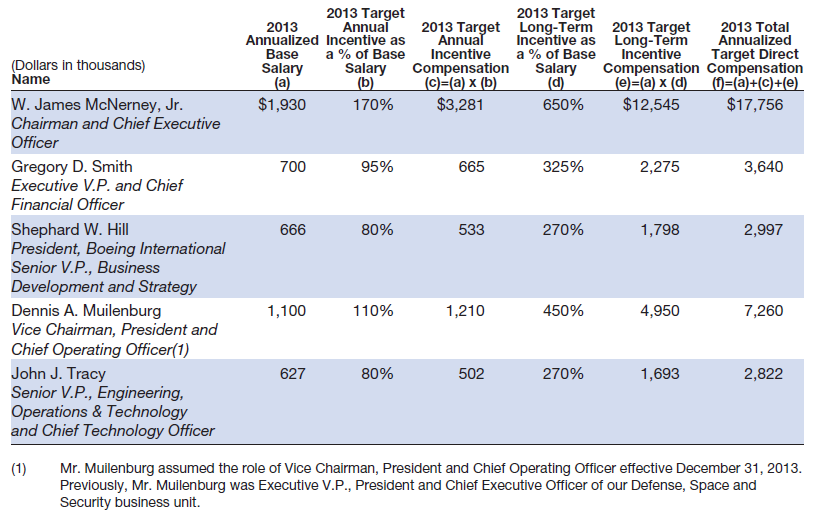
Boeing CEO, Jim McNerney’s 2013 compensation (proxy statement here, PDF, 1.1MB)

Boeing's Jim McNerney 2013 compensation.

Boeing’s Jim McNerney 2013 compensation.

Just as a complement, see in this article from The Washington Post “The pay gap between CEOs and workers is much worse than you realize“, based on a study by Harvard Business School, how the ratios of compensation between CEO and the average worker are in different countries, compared to what respondents to a poll said those ratios should ideally be.


4 Comments

Filed under Aerospace & Defence

Turboprop market vs. oil price (ATR figures 2014 update)

Few weeks ago, the Toulouse-based aircraft manufacturer ATR (Avions de Transport Régional) published a press release reporting some of its numbers for the year 2014 (being a private company, owned by Airbus and Alenia, it does not publish a complete financial annual report). Some of the key figures were:

  • Revenues increased 10% to 1.8bn$.
  • A new record of 83 deliveries (+12%).
  • A new record of sales with 160 firm aircraft orders (plus 120 options). (1)
  • A record backlog at year-end with 280 firm aircraft in the order book.

About 4 years ago, I wrote a post, “Turboprops market different dynamic“, in which I discussed:

[…] how civil turboprop market is unrelated to the larger and more known turbofan civil aircraft market and how its dynamics are completely unrelated to World GDP growth and thus world air traffic growth. […]

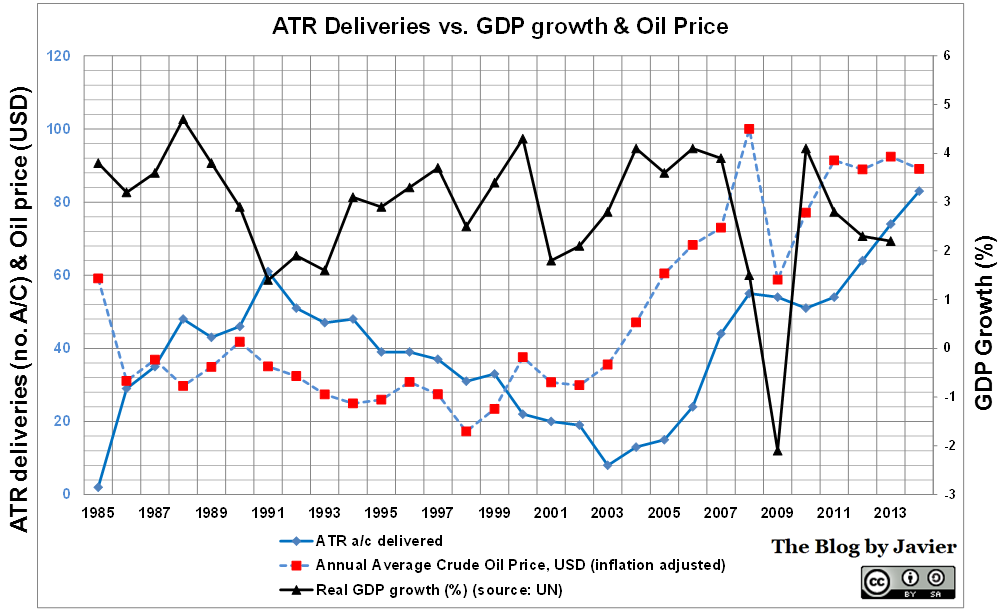
When calculating correlation between the different variables, I discovered that the correlation between GDP and deliveries is rather low, despite of the time lag applied (be it 2, 3, 4 years…). However I found that the oil prices and deliveries did correlate very well with a lag of 5-6 years, yielding coefficients of 0.55-.65, which are rather high.

I wanted to update the calculations I made then and last year, with the information of the 2014 exercise.

ATR deliveries vs. GDP growth and oil price (2014 update).

ATR deliveries vs. GDP growth and oil price (2014 update).

With the last years’ data, correlations are similar:

  • Between oil prices and deliveries: high, above 0.54 from 1 year time lag, increasing through 6 years time lag (when it reaches a maximum of 0.82).
  • Between GDP growth and deliveries: low, not more than 0.34, and negative correlations up from 1 to 5 years time lag.

If there was causality, we could infer that the from the moment that oil prices are computed, till they are taken into regional airlines’ models, the fleet planners identify the need for new turboprops, the case is approved by airlines’ management, discussions start with ATR, negotiations are closed between the airline and the manufacturer, the aircraft are built and delivered to the airline… it takes about 6 years. (2)

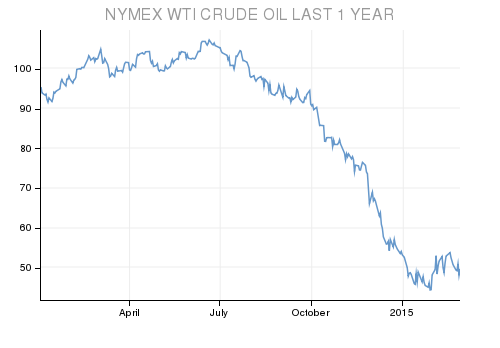
This year the prices of oil have abruptly decreased in the last quarter:

Oil prices drop Q4 2014.

Oil prices drop Q4 2014.

However, this large drop is not yet fully noticed in the comparison made before as the historical database I use (here) only reflects prices up to the end of November and thus the 2014 average is still 89$ vs. 92.4$ in 2013. Even so, taking into account the figures from December (~55$) the year average will drop only to about 86$, not changing much the result.

It would be interesting though to see if oil prices stay low (50-60$) for the full 2015 year. If so, we could check whether the correlation stands and ATR starts to notice it in the form of lower orders (more cancellations?) and this is translated into lower amount of deliveries in about 3 years time (2018?).

(1) Some 18 cancellations that took place in 2014 go untold in the press release, though they are easily deduced from the information of orders, and backlog from 2014 and 2013.

(2) About 3 of those 6 years are consumed from placing the firm order to getting the aircraft delivered, as we can see by the current figures of backlog (280 a/c) and yearly deliveries (83 a/c).

Leave a comment

Filed under Aerospace & Defence