Category Archives: Books

Numbers, numbers, numbers…

As part of my effort to learn French, I was reading some passages of “Le Petit Prince” last weekend. There was one that directly struck me:

Les grandes personnes aiment les chiffres. Quand vous leur parlez d’un nouvel ami, elles ne vous questionnent jamais sur l’essentiel. Elles ne vous disent jamais: “Quel est le son de sa voix? Quels sont les jeux qu’il préfère? Est-ce qu’il collectionne les papillons?” Elles vous demandent: “Quel âge a-t-il? Combien a-t-il de frères? Combien pèse-t-il? Combien gagne son père?” Alors seulement elles croient le connaître. Si vous dites aux grandes personnes: “J’ai vu une belle maison en briques roses, avec des géraniums aux fenêtres et des colombes sur le toit…” elles ne parviennent pas à s’imaginer cette maison. Il faut leur dire: “J’ai vu une maison de cent mille francs.” Alors elles s’écrient: “Comme c’est joli!

Some days before I had seen the following tweet by the management guru Tom Peters:
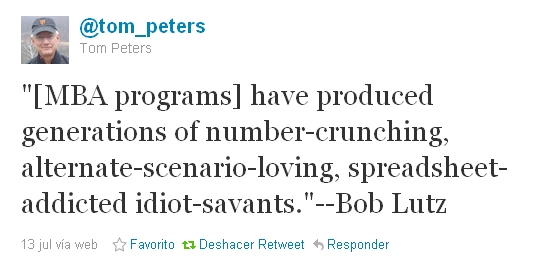
Having said this, I can only confess that I am one of those. One of those old people, grande personne, that loves numbers, crunching numbers, spreadsheets, etc…

If you asked me something about for example my drive to the job every morning, I wouldn’t say “Oh, it’s beautiful, there are lots of trees, you can smell this or that”, no, no…

I would tell you: “it takes door-to-door an average of 31 minutes -which coincidentally is the exact time most repeated-, I depart at 8:35am on average, I have tried 3 different routes and route number 3 seems to be about 4 minutes shorter on average than the other 2 routes, I found out that it is as good to be an early comer to the office than to arrive at about 9:30am, while the worst time to leave home is about 8:15am… Tuesdays are the worst days normally, taking on average about 5 minutes more than Wednesdays, the best day”. Numbers.

And I would have said all these because during the last 7 months I had been taking note of the all the numbers related to those trips, crunching them in a spreadsheet, etc, etc…
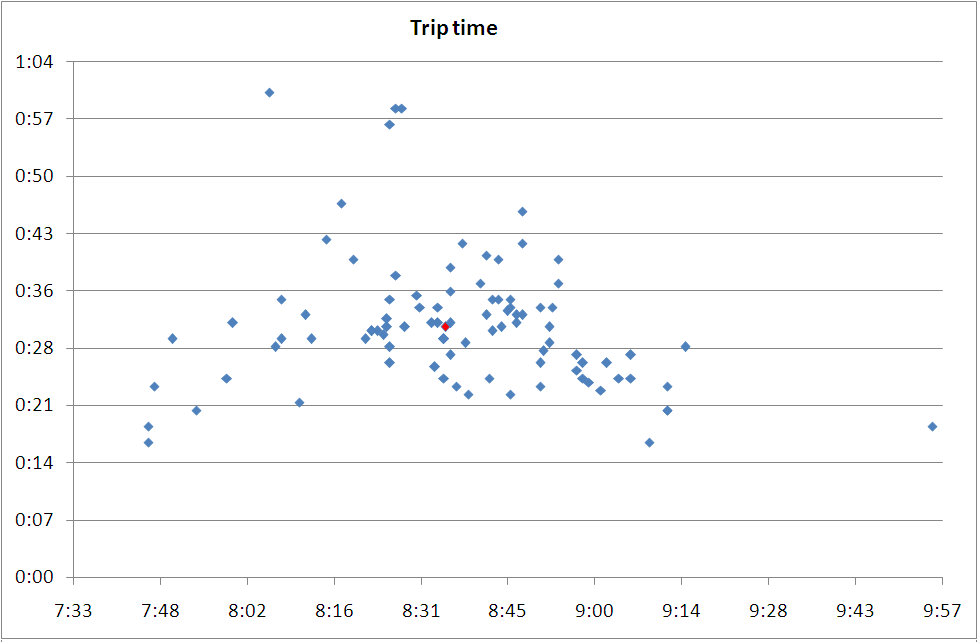
Door to door time to reach the office.

Frequency of different trip times.

Certaines grandes personnes aimons les chiffres.
2 Comments

Filed under Books, France, Twitter & Media

The confession (book review)

I’ve lost count of how many John Grisham novels I have read, but they’re over a dozen. They all look the same: legal thrillers, young lawyers, similar location (South USA states), etc., and yet they’re grabbing your attention from start to finish. I guess that the guy picked the formula some 20 years ago and knows how to exploit it (the formula even calls for books of about 450 pages, with about 12 pages per chapter…).

This last one I read, “The confession“, is no exception to the rule. The plot: an innocent man in death row is about to be executed when the confessed killer pops up out of nowhere and will try to stop the execution and around them: a small firm led by an energetic single lawyer, and some despicable characters including a detective, district attorney, governor, hysterical mother of a victim, etc. The result: a rollercoaster of emotions and engaging novel. I even ended a couple of times with headache due to the anger produced by what I was reading!

I recommend the book.


Leave a comment

Filed under Books

Todo ha cambiado ya

Hace unos meses leí el libro “Todo va a cambiar”, de Enrique Dans (profesor del Instituto de Empresa y blogger), que recomiendo.

De este libro en particular me gusta la diversidad de temas que trata y el enfoque positivo, divulgador que tiene con cada uno de ellos: neutralidad de la red, copyright, impacto de las nuevas formas de comunicación en las empresas y las personas, políticas de comunicación de empresas e instituciones, relaciones con clientes, soluciones a problemas desde las nuevas tecnologías, generación de contenidos, web 2.0…

Para aquellos que lean regularmente su blog, este libro no aporta grandes novedades, se trata más bien una recolección amplia y ordenada de las visiones que el autor tiene sobre varios temas de los que regularmente escribe en el blog.

Especialmente anima a que la gente experimente, use redes sociales, escriba un blog, se haga una cuenta en twitter, etc. Además ofrece varios consejos para padres con hijos pequeños sobre cómo afrontar el acceso de estos a la red de una forma natural, lejos de intentar prohibir el uso de la misma.

Unos meses después de haber leído el libro, los capítulos sobre el impacto en la sociedad de las nuevas tecnologías cobran mayor relevancia tras haber visto los muchos movimientos originados y / o  amplificados tanto en los países árabes como en España antes y después la últimas elecciones municipales y regionales.

Como dice el autor al final del libro: no es que todo vaya a cambiar, sino que todo ya ha cambiado

Por cierto, ante la pregunta ¿debo tener/abrir un blog? La respuesta del autor, que comparto, es: si todavía no lo tienes la respuesta es sí.

Finalmente, quería dejar un enlace a otro post escrito por un amigo en el blog de los Jefotecs donde también dan su visión sobre algunos de los temas que trata el libro (descargas, conocimiento, neutralidad de la red).

Leave a comment

Filed under Books

747

I attended a course at the AirBusiness Acedemy of Airbus some weeks ago. In one of the coffee breaks I hanged around in the building’s library and I found a book that I wanted to read, so I picked it: “747”, by Joe Sutter with Jay Spencer.

Joe Sutter is the engineer who led the engineering development of the Boeing 747, the Jumbo. The book, a biography of Sutter, covers all his life but it is mainly centered in the happenings, decisions, struggles, individuals, etc., involved in the development of the 747 and other aircraft.

I particularly liked the many engineering problems that he mentioned in the book, why & when they encountered them and how they overcame them: e.g. how they debugged the B 377 Stratocruiser, the decision of placing 737 engines under the wing, going for 4 main landing gears in the 747, etc., and the innovations that they introduced in commercial aviation with different aircraft: first pressurized aircraft (B 307 Stratoliner, with the issue they had with the vertical stabilizer), the jet engine mounted in pylons under the wings (with the B 367-80 prototype –now resting at the Air & Space museum at Dulles, DC- which evolved in the 707; configuration mainly used until today), the first wide-body aircraft (B 747), etc.

He also described many details about dealings with customers (e.g. Juan Trippe in Pan Am, Iraqi customers), competitors (including Russian delegations during Cold War), and colleagues at Boeing (with some heated discussions and internal politics, where he doesn’t save any detail).

As a curiosity, I finished the book while flying from Chicago to Frankfurt some days ago aboard a B 747, the first time I flew in one. I was sitting by the wing and took some pictures of the wing (first with a triple-slotted flaps) at different moments of the flight.

This slideshow requires JavaScript.

The book is a very interesting read which I recommend to anyone with passion for aircraft (engineer or not).

6 Comments

Filed under Aerospace & Defence, Books

Historias del Fútbol Mundial

Tengo la costumbre de, siempre que paso por un aeropuerto, visitar la tienda de libros y revistas, a ver si encuentro algún libro. Siempre que vuelo ya llevo algo de lectura conmigo y estas visitas a la tienda de turno las hago por si encuentro algo interesante. A veces lo encuentro.

El año pasado antes de emprender un viaje a Holanda, cuando se estaba jugando la Copa del Mundo en Sudáfrica, encontré en Barajas el libro “366 Historias del Fútbol Mundial”, de Alfredo Relaño. Tras ojearlo un poco, lo compré pensando que estaría bien como complemento al evento futbolístico del momento que tan bien acabó para España. Digamos que para imbuirme un poco más del espíritu futbolístico.

El libro no tiene un hilo argumental, sino que está estructurado a modo de calendario. Ordenadas según los meses del año, el libro tiene una historia por cada uno de los días del mismo. Cada historia una hoja, dos páginas. Perfecto para tener en la mesilla y leer unas pocas historias de vez en cuando.

Muchas de las historias son muy conocidas, algunas casi contemporáneas, y otras tantas no tanto. Por ejemplo, en estas semanas de abril y principios de mayo, cuando se van a vivir tantos partidos entre Real Madrid y Barcelona, en el libro aparece una historia con bronca entre ambos equipos en las semifinales de copa de 1916 tras la cual estarían hasta 10 años sin volver a enfrentarse. ¿Qué diría la prensa durante 10 años sin un partido del siglo cada semana?

Otras historias de estas semanas:

  • El plante del Barcelona en la vuelta de la semifinal de Copa del Rey contra el Atlético de Madrid en el año 2000.
  • La victoria de España en la Copa del Mundo Sub-20 en Nigeria, con Xavi y Casillas. Preludio de lo que ocurriría 10 años después un poco más al sur.
  • El nacimiento de la expresión del “miedo escénico” del Bernabéu en la final a doble partido de la UEFA contra el Colonia en 1986.
  • El accidente que acabó con el Torino en el monte de Superga en 1949.
  • El nacimiento de la Copa en 1902, cuya primera edición duró 3 días y ganó un equipo conjunto formado por jugadores del Athletic y el Vizcaya de Bilbao (que más tarde se fusionarían); o del Scudetto en Italia, cuya primera edición duró 1 día y ganó el Génova.
  • La derrota del Barcelona en la final de la Copa de Europa en Sevilla frente al Steaua de Bucarest.
  • La aparición de las tarjetas amarillas.

Y así hasta 366…

Todavía no he terminado de leer todas las historias del libro, pero las que llevo leídas (algunas releídas) ya me permiten recomendar el libro sin miedo a equivocarme.

3 Comments

Filed under Books, Sports

The 7 Minute Star (book review)

Some weeks ago I read “The Seven Minute Star”, by Florian Mueck. Florian is a fellow Toastmaster from one of the clubs in Barcelona who I met some years ago in a division conference in Madrid.

He is a very energetic speaker and I remember that he came in 2nd in the International Speech contest in that division conference. I have seen him some other times along these years. In one of those occasions, I believe in Porto, he mentioned that he was writing a book. I remember him mentioning something about some stairs, a way to the top, etc. And about a year later here I am, having read the book and writing the review.

The book is a quick guide to become a proficient public speaker by following 15 steps (confidence, transparency, first sentence, eye contact, voice, body language, visual aids, structure, rhetoric, anecdotes, quotations, humor, enthusiasm, passion, and smile). It is a very easy and enjoyable read (~100 pgs.) with lots of stories and examples. If you have no previous experience in public speaking, the book is a very informative guide.

If you are a member of Toastmasters, you may have noticed that the Toastmasters program covers many of those steps in the book, though he adds some more tips: for example, the smile (then you recall having always seen Florian smiling!) or the stress in the use of quotations (though I may disagree in the approach! I would say “read a lot and pick some quotes out of what you’ve read” instead of learning some quotes right away).

Another good point is that in the book he presents some tools he has developed, for example the “speech development template”. I recommend you to pay a visit to his website, where other tools (speech evaluation template) and analysis are available.

If you would like to know more about Toastmasters and you happen to live in or nearby Madrid, take the opportunity to attend the Division Conference of Toastmasters next Saturday May 7th in Madrid.

Leave a comment

Filed under Books, Personal development, Toastmasters

Salesmanship at Airbus

Yesterday I saw John Leahy, Airbus sales chief, in the corridors of the company for the first time since I arrived to Toulouse. At night, I found via Twitter this special report about him by Reuters.

The report is a very interesting piece, and reading in it about Jean Pierson reminded me of a very curious story I heard some years ago and I wanted to recall for you (this is the only reason for this post).

Pierson was the CEO of Airbus from 1985 to 1998. The story I am talking about appears described in the book “Boeing versus Airbus”, by John Newhouse (I haven’t yet read it but is in my wish list). Let me extract the summary that Reuters gave in this other article.

Pierson […] was at US Airways’ headquarters for what he thought would be a short meeting to tie up a 400-plane deal, the anecdote runs.

At the last minute, US Airways’ then-chairman Stephen Wolf started arguing for a 5 percent discount on the selling price.

“Pierson began slowly lowering his trousers and saying ‘I have nothing more to give.’ He then allowed the trousers to fall around his ankles,” says Newhouse in his book.

Wolf replied: “Pull up your pants. I don’t need any more money,” and the deal was signed, according to the book. The author says he got the story from Pierson himself, and it was confirmed by another person present.

Shortly afterward, US Airways announced the purchase of 124 single-aisle Airbus A320 family jets with options for 276 more, a stab into the heart of Boeing’s competing 737 program. It put the European company on track to overtake Boeing in global orders only two years later.

If the situation ever calls for me to drop my trousers I hope there is no one nearby with the intention of reporting it in a book :-).

3 Comments

Filed under Aerospace & Defence, Books

Start blogging

Today it’s been a year since I started this blog. I wrote the first post on February 9th 2010, and went live a few days later. I had been musing the idea of starting it for some months plus some people close to me encouraged me to do so as well.

In the end I decided to give it a try. Initially, I took it as a learning process: It would force me to learn what that of blogging was, some etiquette about them, etc… Few days after the starting the blog I created my Twitter account and gave it a try with some other tools… still, there are many other tools and applications that I still have to learn and use.

During those days I had the simile in my head of our previous generation: some of them are not even using the internet for as little as 10% of the things we use it for (buying things, social media, reading the papers, watching videos, etc.). It all started because some years ago they did not push themselves to try it, when it was all starting. This was what moved me to start. Who knows how the Internet will evolve from now to 10 years time? But what it is sure is that it won’t go backwards, so we better do as much as we can not to stay behind.

I just finished reading the book “Todo va a cambiar”, by Enrique Dans (in Spanish; I may write about the book soon), in the last chapters you may read the following passage:

“¿Debe […] empezar un blog? La respuesta es clara y concisa: si no lo ha hecho hasta ahora, sí”

Starting the blog is relatively easy; you just need to follow the instructions of any of the free blogging services. Continuing with it is a bit more difficult. You need to be creative, think about more or less valuable ideas that you want to transmit: During this first year I have written 120 posts, about 10 per month or one every 3 days… behind some of them there are hours, of thought, of calculations, of editing. But it has always been fun (as my brother said “you started it because you wanted to preach freely”).

It is fun to think about ideas, that later may or may not be translated into a post, while you are travelling, reading the paper, watching a video, etc. It is fun to see the statistics (over 8,000 visits during this first year), make calculations with them (for an average of 22 visits/day), it is fun to read and reply to comments, and even better to see someone recommending one of your posts.

There are many, yes, many other very good reasons for writing a blog.

Since some months ago I follow in Twitter and read the blog of Connor Neill, a professor at IESE business school. I had the chance to attend a workshop/conference by him at the Toastmasters District 59 Fall conference in Barcelona last November where he spoke about leadership. One of the pieces of advice he gave was to write every day for some time, be it 5 minutes, 500 words…

You may find a very good post in his blog that describes very well that part of his presentation about the importance of writing, where he gives up to 20 “starting questions to use for reflection”.

Should you start a blog? The answer is clear and concise: if you haven’t done it yet, yes.

6 Comments

Filed under Books, Personal development, Toastmasters, Twitter & Media

Abraham Lincoln

Last weekend I was playing with my new eReader: the interface with the computer, online shops interfaces, how to get files into it, how to make notes… and I read the eBook “Abraham Lincoln” by James Russell Lowell (which is not really a biography but an editorial about the president).

I underlined some sentences that I especially liked and wanted to share them:

  • “Among the lessons taught by the French Revolution there is none sadder or more striking than this, that you may make everything else out of the passions of men except a political system that will work, and that there is nothing so pitilessly and unconsciously cruel as sincerity formulated into dogma. It is always demoralizing to extend the domain of sentiment over questions where it has no legitimate jurisdiction […]”.
  • “We have seen Mr. Lincoln contemptuously compared to Sancho Panza by persons incapable of appreciating one of the deepest pieces of wisdom in the profoundest romance ever written; namely, that, while Don Quixote was incomparable in theoretic and ideal statesmanship, Sancho, with his stock of proverbs, the ready money of human experience, made the best possible practical governor.”
  • “Never was ruler so absolute as he, nor so little conscious of it; for he was the incarnate common-sense of the people.”

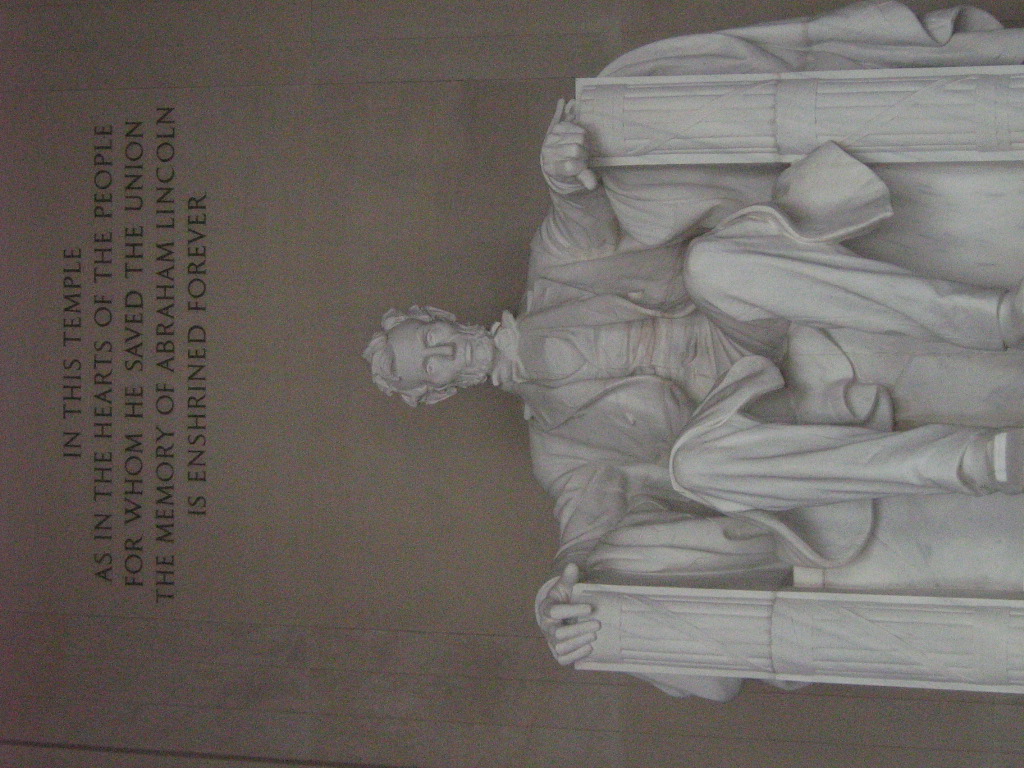
Abraham Lincoln memorial in DC.

Leave a comment

Filed under Books

Master in common sense

What is the main thing you learn from studying an MBA? When I have been asked this question I always answer that the learning process is different: Most of the subjects present you with situations / cases that once solved you said to yourself “well, it was applied common sense, wasn’t it?” Yes, applied common sense to some situations you never encountered or reflected on before. This is one way you learn, the other is hearing from first hand hundreds of real stories experienced by your teachers.

It is not like learning to solve fluid dynamics or differential equations exercises… it is not that before you didn’t how to solve a problem and then you know it, at least this is how I felt at EOI. The learning process during the MBA is more like encouraging you to apply common sense to many issues, making you reflect on new topics from those that entertained you at university.

I tell this because after reading “How to win friends & influence people”, by Dale Carnegie, I felt the same.

I found that Dale Carnegie is a great story-teller and nothing is better to learn or reflect on different issues than seeing the application of solutions, skills or techniques in stories, real stories. Some of the ones in the book came from Abraham Lincoln, Benjamin Franklin, Roosevelt, Rockefeller, several American generals… and many others were stories from lay people like you and me.

I remember that one of my teachers in the MBA used to say “70% of your work within a company is just human relationships; and precisely that is not taught anywhere”.

The skill to deal with other humans effectively is so important that, as Dale Carnegie tells in the book, Charles Schwab was the first person to earn a million dollars a year (when 2.500$ a year was considered a good salary), when he was picked by Andrew Carnegie (no relation) to become the first president of United States Steel company in 1921… Why? As Charles put it: “I consider my ability to arouse enthusiasm among my people the greatest asset I possess, and the way to develop the best that is in a person is by appreciation and encouragement”. (We may argue whether he indeed deserved a salary hundreds of times higher than the average… I already discussed this when I commented other book in this blog).

Now, I leave you the different principles that Carnegie offers to improve your effectiveness when dealing with people (a rare animal indeed!), reflect on them:

Fundamental techniques in handling people:

  1. Don’t criticize, condemn or complain.
  2. Give honest and sincere appreciation.
  3. Arouse in the other person an eager want.

Six ways to make people like you:

  1. Become genuinely interested in other people.
  2. Smile.
  3. Remember that a person’s name is to that person the sweetest and most important sound in any language.
  4. Be a good listener. Encourage others to talk about themselves.
  5. Talk in terms of the other person’s interests.
  6. Make the other person feel important – and do it sincerely.

Win people to your way of thinking:

  1. The only way to get the best of an argument is to avoid it.
  2. Show respect for the other person’s opinions. Never say “You’re wrong”.
  3. If you are wrong, admit it quickly and emphatically.
  4. Begin in a friendly way.
  5. Get the other person saying “yes, yes” immediately.
  6. Let the other person do a great deal of the talking.
  7. Let the other person feel that the idea is his or hers.
  8. Try honestly to see things from the other person’s point of view.
  9. Be sympathetic with the other person’s ideas and desires.
  10. Appeal to the nobler motives.
  11. Dramatize your ideas.
  12. Throw down a challenge.

Be a leader:

  1. Begin with praise and hones appreciation.
  2. Call attention to people’s mistakes indirectly.
  3. Talk about your own mistakes before criticizing the other person.
  4. Ask questions instead of giving direct orders.
  5. Let the other person save face.
  6. Praise the slightest improvement and praise every improvement. Be “hearty in your approbation and lavish in your praise”.
  7. Give the other person a fine reputation to live up to.
  8. Use encouragement. Make the fault seem easy to correct.
  9. Make the other person happy about doing the thing you suggest.

“Obvious…” This is one thought that may come to our mind when reading some of these statements. However, we’re not acting in that way every day, being as obvious as they may be – thus getting the results we get…

I encourage you to read the book (~260 pgs.) and see in those stories many examples applicable to yourself; daily situations in which to apply those principles.

5 Comments

Filed under Books, Education, Personal development