My 2017 reading list

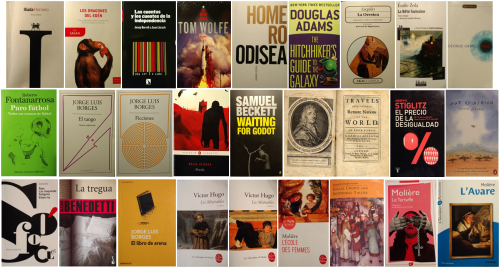
In this post I wanted to share the list of books I read along the year (1) with a small comment for each one and links to some Twitter threads where I shared some passages that caught my attention while reading the book. I have also included a small rating from one to three “+” depending on how much do I recommend its reading:

Portadas_2017.png

  1. Iliad” (by Homer) (+++): arguably the first book of Western civilization, I took on reading after having discussed about it and the Odyssey with a friend during 2016 summer holidays. The Iliad is widely seen as the more epic of the book of the two. I would say it is harsher. It is centered in the battle of Troy, fought around the XII century BC between a coalition of Greek armies led by Agamemnon king of Mycenae and Troy, led by Hector. The war features warriors the size of Achilles, Odysseus, Ajax, Menelaus… the origin of the war is the kidnapping of Helen, wife of Menelaus, by Paris, who takes her to Troy, against which the Greek armies fight in order to bring her back. The description of the fights does not spare any bloody detail, reaches at times the point of recreation in the violence and brutality of the characters. Another interesting point to note are the Homeric epithets; every single time the name of character is referred to a series of epithets will be quoted to describe him, such  as “swift-footed” Achilles.
  2. The dragons of Eden” (by Carl Sagan) (++): I was not yet born when the series Cosmos was released and became so popular in 1980, but I had read often about the character and the importance of Sagan as a outreach scientist. I bought this book, on the evolution of human intelligence, about a decade ago and took on it this year after having read “Exploradores: La historia del yacimiento de Atapuerca” by one of the lead researchers of Atapuerca (José María Bermúdez de Castro) last year. The book is read very easily and draws from different disciplines in order to provide examples, outcomes from scientific studies and his vision on evolution. [I leave here a Twitter thread with some passages that caught my attention while reading the book]
  3. Las cuentas y los cuentos de la independencia” (by J. Borrell and J. Llorach) (+++): this short book by the economists Joan Llorach and Josep Borrell (who among other posts was the Spanish minister of Public Works and Transport in the 1990s) originated from an article they wrote for a news paper refuting some of the populist arguments often used by separatist leaders in Catalonia (note: both writers are Catalan themselves). The main point of the book goes around the different calculations methods for what is called the fiscal balance, pointing to the distortions played by separatists. Before that point is tackled many other mantras are dismantled, such as the purported calculations of fiscal balances in Germany and the limits to them often cited by separatists, for which the authors of the book made a thorough research including cross checking with German economics professors and the German embassy just to find out that the whole story is based on nothing, pure invention, hence the title of the book (“las cuentas y los cuentos“, as in the “the calculations and the stories”). [Twitter thread]
  4. The Right Stuff” (by Tom Wolfe) (+++): released in 1979 and awarded the US National Book Award for Nonfiction, this book portrays the lives, the selection process, the training and mission of the Mercury Seven. The book was later adapted to the cinema in a movie by the same title. The movie and the book are classic of aerospace literature and cinema. The images of the mercury seven in their silver space suits or their orange fighter pilot suits are part of popular culture. The book goes into the struggles and ego disputes among the different astronauts and between them and Air Force test pilots, including Chuck Yeager whose auto biography I had read in 2016, thus letting me see that episode from both sides. A definite must read. [Twitter thread]
  5. Odyssey” (by Homer) (+++): this book is partly the continuation of the Iliad, as in it Homer describes the return trip of Odysseus from Troy to Ithaca, his kingdom, where is wife Penelope and son Telemachus suffer for years the absence of the king. This book is more of an adventure book than the Iliad, and some of the passages are quite known such as those of the cyclops or the sirens. [Twitter thread]
  6. The Hitchhiker’s Guide to the Galaxy” (by Douglas Adams) (+): the novel is part of a comedy science fiction series released in 1979, originated from radio broadcasts and later taken to TV. I read it as had seen it recommended by Elon Musk a couple of times. The book has some hilarious points and fine criticisms, but other than that I thought it was quite overrated. [Twitter thread]
  7. Oresteia (Agamemnon, The Libation Bearers (Choephoroi), The Eumenides)” (by Aeschylus) (+): Aeschylus is seen as the father of tragedy. The Oresteia is a trilogy first represented at a festival in 458 BC. The play plots several tragic events: the murder of Agamemnon by Clytaemnestra, the murder of Clytaemnestra by Orestes, the trial of Orestes, the end of the curse on the House of Atreus and pacification of the Erinyes. [Twitter thread]
  8. La Bete humaine” (by Emile Zola) (++): published in 1890, this novel by Zola caused a great impact in the French society by its brutality: murder, suicides, abuses… the novel is centered around the rail company and the line Paris – Le Havre, and the plot relates the lives of the president, some workers and their relatives.  [Twitter thread]
  9. 1984” (by George Orwell) (++): published in 1949, the influence of this novel cannot be overstated. It coined terms and introduced figures widely used today such as Big Brother, Newspeak, Thought Police, thoughtcrime… even if I found some passages of the book rather tedious, it is a must read, a wake up call, a reminder of always having to be alert in the defence of individual rights. [Twitter thread]
  10. Puro Fútbol” (by Roberto Fontanarrosa) (++): In the 90s I used to read some newspaper articles of former football player and coach Jorge Valdano, in some of them he would refer to stories from the writer Fontanarrosa. Since then, I had heard about those stories some other times. In April we visited Argentina and we went to a bookshop to enjoy going through book stands, when I found his name in bookshelf I picked one of his books to read a few of his stories. The book is a compilation short stories of Argentinean football. They are fictional stories which feature amateur players and aficionados, either playing football, remembering memorable matches or attending events. I especially liked its fresh and down to earth language, which very easy transmit that for some people football is much more than sport. [Twitter thread]
  11. El Tango” (by Jorge Luis Borges) (+++): during a trip to Argentina I bought 3 books of Borges to approach the author. This was the first one I read. Rather than a book written by him, it is the transcription written in 2016 of a series of lectures Borges gave in 1965 around Tango, its origins, meaning, etc. I loved the book, as it gave me some insight into Argentinean life at the beginning of the XX century, the dance itself, its evolution from a dance of locals of dubious reputation to a dance more than socially accepted. Living in Toulouse, I loved to learn that in fact Carlos Gardel might have been a Frenchman by the name Charles Gardés born in the same neighborhood of Saint Cyprien (Toulouse) where I used to live when I came to France. [Twitter thread]
  12. Ficciones” (by Jorge Luis Borges) (+): published in 1944, the book is a compilation of about 20 short stories. With them Borges plays with different concepts, styles and themes. I saw that it has a great reception by critics, I do not share it.
  13. Dracula” (by Bram Stoker) (++): the count of Dracula and vampires are part of our popular culture. There are countless films, books, comics, plays, that include such characters. This book, published in 1897, set a framework for that popular culture: the prominent teeth, the biting and sucking of blood, the coming out at night, the counter measures, etc. The story is made of a series of letters, entries into the diaries of some of the characters and press articles. I liked the originality of such approach, although in my view it lacked some rhythm at some points. [Twitter thread]
  14. Waiting for Godot” (by Samuel Beckett) (+): I got some books from 1969 Literature Nobel prize winner, the Irish Samuel Beckett, as part of my Irish literature immersion following my 2016 trip to the island. Waiting for Godot is theater play that portrays two characters, Vladimir and Estragon, who wait for a third one, Godot, who never arrives. Meanwhile they engage in a series of discussions, absurd at times, comical at others, or even tedious. I have read reviews of the play stating that it is one the most significant play in English language of the XX century. I found it rather absurd and wouldn’t recommend it, other than for the humorous note of reading once and again the gag “We can’t / Why not? / We’re waiting for Godot”. [Twitter thread]
  15. The travels of Gulliver…”  (by Jonathan Swift) (+++): during a trip to Ireland in 2016, I found out that Jonathan Swift had been about everything in Ireland, I thus decided to take on this classic book, out of which some stories we all have heard of at some point or another, such as the trip to Lilliput. Written in 1726, the book covers several trips of Gulliver, to nations previously unknown to him, where he discovers different civilizations (Lilliputians, giants, a civilization on a flying island) with their own ways of thinking. These travels offer the author situations to explain different points of view from menial subjects to more profound ones, such as fraud, the importance of rewarding good behavior, the importance of attitude over skills, astronomy, the influence of lawyers, taxes… up to a rather harsh criticism on human kind in comparison to the honesty of horses. A classic definitely worth reading. [Twitter thread]
  16. The Price of Inequality” (by Joseph E. Stiglitz) (+++): I had bought this book from the 2001 Nobel prize in economics to my father a couple of years ago. Once he finished it, I grabbed this boomerang gift so I could read it too. The book is a review of income inequality in the USA, the policies that have been taken in the last decades and that have contributed to the increasing of that inequality and its consequences. Criticism of austerity, defence of higher taxes, denouncing the double standards, the fine print of trade agreements, the need of labor unions, globalization and rent seeking are some of the topics discussed in the book. [Twitter thread]
  17. Out of Africa” (Karen Blixen) (++): I visited my sister in Denmark in the summer of 2016 and it was in that trip that I got acquainted with Karen Blixen (not having yet seen the movie based on the book). I bought the book and put it on the reading list. Written in 1937, the book is a passionate story of a farm life in Africa, lovely at times, with some descriptions of landscapes, relationships, the sounds of nature, the animals in the safaris, the flights in the Moth of her friend Denys…, that brings you back to a time and a world that most probably, for good and bad, we will never see again. A melancholic read at times, especially at the end, when the author describes when she was already closing her experience in Kenya. [Twitter thread]
  18. Ajax“, “The Trachiniae“, “Antigone“, “Oedipus Rex” (by Sophocles) (++): Sophocles was one of the great tragedians in ancient Greece, following Aeschylus, he lived in the 5th century BC. The book I read is a compilation of the four plays mentioned above. The plays treat the death of Ajax, of Heracles, of Antigone and the self-blinding of Oedipus, this last one considered to be the masterpiece of Greek tragedy. [Twitter thread]
  19. La tregua” (by Mario Benedetti) (++): written in 1959, this novel by the Uruguayan writer, long time based in Buenos Aires, tells the story of the widower Martín Santomé who falls in love with a much younger female work colleague just prior to his retirement. The book is written in the form of entries into the diary of Martin. [Twitter thread]
  20. El libro de arena” (by Jorge Luis Borges) (+): this book, published in 1975, is a compilation of 13 short stories. Together with “Ficciones“, which I had read a few months before (above), it is considered one of the masterpieces of Borges. Other than some pills of sharp criticism on fairmindedness, self described liberal free thinkers, disdain for science, culture and history, I did not like much this book either. [Twitter thread]
  21. Les Misérables” (by Victor Hugo) (+++): it took over 15 years to Victor Hugo to write Les Misérables, a 1,900-page (in the French version) historical novel considered one of the greatest novels of the 19th century if not of all time. Hugo centers the story around Jean Valjean, who was initially convicted for stealing bread but after a series of escape attempts he ends up serving 19 years. Valjean will be transformed into a benefactor who is always chased by his past and who follows an internal struggle between justice and doing good. Valjean will take as personal mission to save Cosette, a young orphan girl. The book includes some other central characters such as Fantine, Eponine, Marius, Gavroche or Javert, and Hugo will use them and the historical events hapenning at the time around which the novel is staged (1820s and 30s) to discuss about several subjects such as monarchy, social justice, criminal justice, romance, family, French politics…  It took me about 10 weeks and around 70 hours to read it, the longest book I have read so far, but definitely worth it, especially the last about 300 pages. [Twitter thread]
  22. L’Écoles des femmes” (by Molière) (+++): this play, published in 1662, portrays a comedy around Arnolphe, Horace and Agnès, where the first has been isolating and “educating” Agnès to marry her and Horace is her lover. Through candid and innocent dialogues between Horace and Arnolphe and Agnès and Arnolphe, the latter will become aware of the affair going on and the failure of his strategy. A great comedy and criticism of the society of his time in its view of women rights. [Twitter thread]
  23. Social Choice and Individual Values” (by Kenneth J. Arrow) (+): one of the 1972 Economics Nobel prize winner, Kenneth Arrow passed away in February 2017. At that point I thought of reading this book, a 100-page essay in which he derives his “General Possibility Theorem”, known as Arrow’s impossibility theorem or voting paradox: “If there are at least three alternatives which the members of the society are free to order in any way, then every social welfare function (…) must be either imposed or dictatorial”. The exposition of his social choice theory, the implications of the theorem and the particular cases when some conditions are quite interesting. However, the book is a plagued with demonstrations with which he arrives to his theorem; a tough read if not on student mode. [Twitter thread]
  24. Le Tartuffe ou L’imposteur” (by Molière) (+++): the first version of this play appeared in 1664, and after some struggles with censorship it reappeared in its final version in 1669. In this comedy, Molière criticizes the hypocrisy and trickery often hidden behind a pious appearance. In the plot, Tartuffe is an impostor that passes by a fervor devotee who uses religion to trick Orgon, to the point of getting his state and at the brink of getting his wife. A great pointed comedy. [Twitter thread]
  25. L’Avare” (by Molière) (+++): written in 1668, in this great comedy the author takes on greed and its influence on love between parents and children, jealousy, marriage arrangements based on dowries…  [Twitter thread]

During this year again, I have been able to read at a higher pace than years ago, before I adopted a more rigorous approach following these two tips:

  • a blog post from Farnam Street blog “Just Twenty-Five Pages a Day“, which was published well after I had adopted such an approach to reading but captures it very well,
  • the Wikipedia article about the Pomodoro Technique, which enables you to efficiently use the last hours of the day.

I wish you all very interesting reads in 2018!

(1) You can find here: my 2012 reading list201320142015 and 2016 ones.

10 Comments

Filed under Books

Our NGOs for 2017 are…

“If you’re in the luckiest one per cent of humanity, you owe it to the rest of humanity to think about the other 99 per cent.” Warren Buffett

Even if this time it has come rather late, if there is a blog post that I am looking forward to write each year is this one. Few things can give you more pleasure than helping others (1). And in doing so I try to be as public and noisy as I can,  hoping that I may serve the causes we contribute to also from the awareness point of view.

Let’s go and see the different causes we decided to support in this 2017 (2):

Why am I “noisy” or public about these donations?

I know that between 100 and 200 of you will read this blog post. I bet with any of you that at least 50% of you will be compelled to take a look at some of these organisations above, 10% of you will consider making a donation. Do you dare thinking that 1% of you won’t actually make such donation?

I learnt about Kiva from Bruno back in 2009. Started contributing to Médecins Sans Frontières in 2010 after a conversation with Juan a couple of years before. I learnt from Slavery International at a temporary exhibit at the Museum of London. I started contributing to the sustaining of the Wikipedia after a tweet from Amalia. Discovered the Fundacion Hombres Nuevos thanks to my father’s 6-month volunteering in Bolivia. Learnt of Gapminder in TED. I started donating myself happiness with Fundacion Khanimambo after Nacho and Alberto. I started supporting to cancer research in part as a way to honour late friends and family members and encourage work colleagues going through therapy. I received the #IceBucketChallenge from Alvaro and Teresa. Avocats sans Frontieres and Movement du Nid were are ideas from Luca, the latest addition to the list being SOS-Racisme. After most of the causes there has been someone who let me discover them.

If not one of those, I am sure that you will be able to find a cause, a NGO which resonates with you. Do yourself a favour and contribute to it. It can be just 25$, the cost of diner at a restaurant. You’ll feel much better.

“No one has ever become poor by giving.” Anne Frank, diary of Anne Frank


(1) See this article from the World Economic Forum “Why being generous is good for your health“.

(2) You may check out similar posts I wrote about our contributions to NGOs in 2016201520142013 and 2012.

Leave a comment

Filed under Helping others

Mi pronóstico de las elecciones autonómicas en Cataluña del 21 diciembre 2017

Con la ocasión de las elecciones autonómicas en Cataluña el próximo jueves 21 de diciembre, quería aprovechar para hacer un pronóstico de las mismas como ejercicio de aprendizaje (1).

Antes de nada, al grano, éste es mi pronóstico:

Pronostico_21D

Pronóstico de las elecciones autonómicas en Cataluña del 21 diciembre 2017.

Una vez visto el resultado, explico cómo he llegado a él. No he utilizado ninguna encuesta, ni promedio u otro algoritmo de encuestas, tampoco he usado datos del CIS; me he basado en repasar los resultados de las últimas elecciones.

Empecé recopilando los resultados de las últimas tres elecciones autonómicas en Cataluña de 2010, 2012 y 2015 por provincias. En ellas intenté ver cómo iban evolucionando unos partidos por provincia en el tiempo y en relación a la participación, comparando “bloques”.

Después, hice el mismo ejercicio con las últimas tres elecciones generales en España (2011, 2015 y 2016) cogiendo los resultados de las provincias de Cataluña. Con ellos hice las mismas comparaciones, tendencias.

Hay muchos detalles que hacen difíciles tales comparaciones: la no participación de CUP en elecciones generales, la coalición JxSí, la aparición de CeC-Podem (desaparición de ICV), el crecimiento de Ciutadans (desaparición de UPyD, aunque ya casi insignificante desde 2010), la separación de CiU (y posterior desaparición de Unió)… Aun así, se puede jugar con los datos.

Por último, aunque de poca fiabilidad también comparé los resultados publicados de los eventos festivos del 9-N de 2014 y el 1-O de 2017. Eso puede servir de alguna manera para ver un posible techo del “bloque” soberanista.

Con todo ello, comencé el ejercicio de predicción, asignando partido a partido y provincia a provincia un número absoluto de votantes. Como punto de partida fijé una participación del 81%. He leído que se espera una participación mayor. Yo soy algo escéptico. En las tres últimas elecciones autonómicas la participación fue de 59.95%, 69.56% y 77.44%, siempre en momentos históricos (ara sí). De todos modos, una vez terminado el ejercicio hice un par de variaciones para ver la sensibilidad esencialmente de Ciutadans ante participaciones que alcancen el 85% o el 90%. A mí me sale que tiene poca sensibilidad (me sale que podría subir un par de escaños).

Con un censo de poco más de 5.3 millones de electores, con ese 81% de participación tenía para repartir algo más de 4.3 millones de votos entre 28 casillas (7 partidos en 4 provincias) en miles de votos aquí y allá. El reparto proporcional de votos por provincias se ha mantenido bastante estable en las últimas tres elecciones autonómicas: ~74.9% de los votos en Barcelona, 9.4% en Gerona, 5.7% en Lérida y 10% en Tarragona.  Una vez asignados los votos a repartir en cada provincia fui asignando los votos a partidos según las reglas, regresiones a la media e intuiciones del ejercicio comparativo inicial.

Una vez repartidos los votos, el siguiente paso es distribuir los escaños del parlamento regional (85 para la provincia de Barcelona, 17 Gerona, 15 Lérida y 18 Tarragona). Ese ejercicio es automático siguiendo el sistema D’Hondt, quedándome el siguiente reparto:

Pronostico_21D_tabla

Pronóstico detallado.

Por último, dejo aquí los votos globales que me han resultado por partido:

  • CUP: 299.000 votos.
  • ERC: 1.055.000 votos.
  • JxCat: 648.000 votos.
  • CeC-Podem: 373.000 votos.
  • PSC: 661.000 votos.
  • Ciutadans: 791.000 votos.
  • PP: 372.000 votos.

Con esos números, el “bloque soberanista” obtendría poco más de 2 millones de votos, cerca de 50 mil más que el 27S, algo menos que el 1-O. El “bloque constitucionalista” poco más de 1.8 millones de votos.

Con los números del pronóstico, el “bloque soberanista” obtendría de nuevo mayoría absoluta si CUP, ERC y JxCat consiguen de nuevo un acuerdo de gobierno. Ante tal escenario, imagino que una de las protagonistas de la noche electoral sería la ley electoral. Los escaños más “baratos” los obtendrían ERC y JxCat (27 y 28 mil votos por escaño), los más “caros”, CeC-Podem (hasta 41 mil votos por escaño). Ciutadans estaría en la media.

La semana que viene veremos…

(1) Ya en 2015 y 2016, antes de las elecciones generales en España hice sendos pronósticos que, aunque con distinto acierto, me sirvieron de gran aprendizaje.

1 Comment

Filed under Miscellanea

Airbus vs. Boeing, comparison of market forecasts (2017)

Two weeks ago, during Le Bourget air show in Paris, both Airbus and Boeing released their market forecasts for the following 20 years: Airbus’ Global Market Forecast (GMF, PDF 3.6 MB) and Boeing’s Current Market Outlook [PDF, 3.8 MB].

In previous years, I have published comparisons (1) of both Airbus’ and Boeing’s forecasts. You can find below the update of such comparison with the latest released figures from both companies.

Forecast2017

Comparison of Airbus GMF and Boeing CMO 2017-2036.

Some comments about the comparison:

  • The main comment for this year CMO is that after years of Boeing dowplaying the demand for the segment of the large aircraft (seen as mainly 747, A380 and some other high capacity aircraft, depending on the manufacturer), it has finally stopped to consider them a category by themselves and has merged that category with the “intermediate twin-aisle” (i.e. 777, A350…).
  • Excluding the large aircraft, both companies’ forecast for the twin aisle segment is nearly identical: ~8,175-8,210 aircraft (we may assume that about 100 of those 8,210 from Boeing’s CMO correspond to large aircraft, thus comparing apple to apples would be ~8,175-8,100). The mix between small and intermediate twins varies, ~400 units up and down.
  • On the other hand, Boeing forecasts about 4,700 single-aisle more than Airbus (the gap has widened in 100 units this year). Boeing doesn’t provide the split between more or less than 175 pax capacity airplanes since its 2015 CMO, nor does Airbus since 2016.
  • Alltogether, Boeing sees demand for 10% more passenger aircraft (excluding regional a/c and freighters) with a 9% more value. The gap is slightly lower than in 2016.
  • In relation to last year’s studies, Airbus has increased demand by ~1,700 aircraft (and ~ 190 Bn$) whereas Boeing has increased it by 1,400 (and ~ 130 Bn$).
  • In relation to traffic, measured in terms of RPKs (“revenue passenger kilometer”), that is, the number of paying passenger by the distance they are transported, they see a similar future: Airbus forecasts for 2036 16.5 RPKs (in trillion, 4.4% annual growth from today) while Boeing forecasts 17.8 RPKs (4.7% annual growth).

Some lines to retain from this type of forecasts:

  • Passenger world traffic (RPK) will continue to grow about 4.5% per year. This is, doubling every ~15 years.
  • Today there are about 18,890 passenger aircraft around the world (according to Airbus; 19,130 in Boeing’s CMO), this number is about 800 a/c more than the year before (5% increase) and will more than double over the next 20 years to 40,120 a/c in 2036 (41,320 as seen by Boeing, excluding regional jets).
  • Most deliveries will go to Asia-Pacific, 42% or ~17,000 passenger aircraft (according to Airbus).
  • Domestic travel in China will be the largest traffic flow in 2036 with over 2,000 bn RPK (according to Boeing, an annual growth of 6.1%), or 11.6% of the World’s traffic.
  • Nearly 13,000 aircraft will be retired to be replaced by more eco-efficient types.
Middle_Class

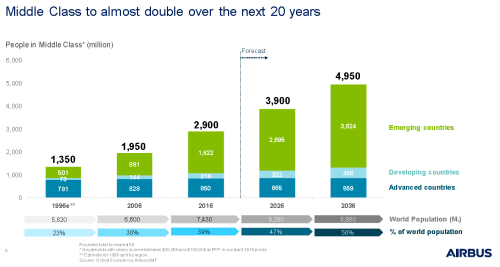
The doubling of the world’s middle class over the next 20 years will fuel air traffic growth and new airplanes demand.

As I do every year, I strongly recommend both documents (GMF and CMO) which provide a wealth of information of market dynamics.


(1) Find here the posts with similar comparisons I made with the forecasts of previous years: 201020112012, 2013, 2014, 20152016.

2 Comments

Filed under Aerospace & Defence

Boeing vs. Airbus: CEO compensation (2016)

For the last 3 years I have been writting a small series of posts comparing the compensation of Airbus and Boeing CEOs (1). This series started out of conversation with colleagues and I keep it to have a record of the evolution and for quick reference in other conversations (2). Thus, this post is just the update with the information for the 2016 fiscal year.

As both Boeing and Airbus are public companies, the information about their CEOs compensation is public and can be found in the annual report and proxy statement from each one. I just share the information and sources below for comparison and future reference.

Airbus CEO, Tom Enders’ 2016 compensation (financial statements here, PDF, 1.0 MB, page 59):

Enders_2016

Airbus CEO Tom Enders 2016 compensation.

Enders saw its base salary increased in 100 k€ after 3 years at 1.4 M€. Variable pay also increased substancially, but share-based remmuneration decreased in a bigger amount. The overall compensation (6.25 M€) decreased, as it has been the case for the last 3 years.

Boeing CEO, Dennis Muilenburg’s 2016 compensation (proxy statement here, PDF, 4.2 MB, page 30):

Muilenburg_2016

Boeing’s CEO Dennis Muilenburg 2016 compensation.

Dennis Muilenburg saw its base salary increased in 50 k$, after a decrease of 330 k$ last year in the transition between McNerney and him. Incentive percentages were kept constant, has been the case in the last 4 years. The total compensation (15.18 M$) increased in relation to 2015 but it is still bellow the 2014 levels (17.8 M$).

Comparison. It is interesting to note that while the base salary is nearly the same, 1.5 m€ vs 1.65 m$ (more so taking into account average exchange rates in 2016 (~ 0.90 EUR/USD)), the incentive schemes at Boeing end up with a total remuneration for the CEO about the double (x2.2) of that in Airbus.


(1) See the previous comparisons for the years 2013, 2014 and 2015.

(2) From what I see in the stats of the visits to this blog, other people are having similar conversations as these posts with the compensation comparison have ranked among the top 10 most read ones the last years.

3 Comments

Filed under Aerospace & Defence

Aircraft market forecasts accuracy (update 2017)

About three years ago I wrote a post in which I analyzed the accuracy of commercial aircraft market forecasts. In particular, Boeing’s series of yearly Current Market Outlook (CMO). In that comparison, between the CMOs from 1999 and 2014, we could compare the predicted and the actual world fleets at 2013 year-end.

In this post, I just wanted to provide an update with the figures from the latest CMO (2017), released a couple of weeks ago, in comparison with 1997’s CMO. In that CMO from 1997, we find the following chart showing Boeing’s forecasted fleet size and distribution for 2001, 2006, 2011 and 2016 year-ends.

Fleet at year end - forecast 1997

1997 Boeing CMO year-end fleet forecasts for 2001, 2006, 2011 & 2016.

In 2017’s CMO, Boeing offered figures of 2016 year-end fleet.

Fleet at year end 2016 - Boeing 2017 CMO

Fleet at year-end 2016 – Boeing 2017 CMO.

Along these years, Boeing has simplified the segmentation with which it provides the fleet and aircraft demand. Single aisle segment is not divided in up to 4 sub-segments. Twin aisle aircraft have gone from two categories (747 and the rest) to three (small and intermediate widebody and large aircraft) and back to two (small widebody and larger), but slightly different. Freighters come with less sub-segments, too.

Despite of the difference in the presentation of the fleet we can try to make a comparison:

Comparison Fleet at year end 2016

Comparison of aircraft fleet at year-end 2016: 1997 forecast vs. actual (sources: Boeing CMO 1997 and 2017).

Some reflections:

  • The overall size of the fleet was quite well predicted, with a difference of 1%.
  • The forecasts for small aircraft was too conservative: both single aisle and regional fleets are today larger than forecasted.
  • The forecasts for larger aircraft was too optimistic: both widebody and freighter fleets are today smaller than forecasted.

This year’s Boeing’s CMO presentation includes a couple of slides on the accuracy of 1997 CMO in relation to what would be the demand for new airplanes vs. what it has turned out to be 20 years later.

CMO_1997_2017

More aircraft have been delivered in relation to what had been forecasted. Retirement of aircraft also increased its pace with increases of oil price in the 2000s. See the chart below from Avolon’s paper “Aircraft retirement and storage trends” [PDF, 2 MB].

Retirement_vs_oil_Avolon.png

Now, having seen all this information, I can update this other graphic which I shared 5 years ago in a blog post titled “World commercial aircraft fleet: forecast vs. actual“:

Fleet evolution - forecast vs actual - 2017 CMO

World commercial aircraft fleet: past forecast vs. actual, and future demand (data source: Boeing CMOs up to 2017). Fleet (blue and red lines) in the left axis; market forecast (grey columns) in the right axis.

As you can see, actual fleets, forecasted fleets and forcasted fleet demand have all been increasing year by year . The compounded annual growth rate (CAGR) for each one has been:

  • Actual fleet growth: 3.65% from 1995 to 2016 (3.04% from 2000 to 2016).
  • Forecasted (15-20 years before) fleet growth: 3.52% from 2000 to 2036 (3.55% from 2000 to 2016).
  • 20-year market forecast: 4.82% from 1992 to 2017 (3.56% from 2001 to 2017).

The 20-year market forecasts have grown at a higher rate (4.82%) than fleets (3.65%), it is mainly because the first sets of data that I could retrieve come from the economic crisis of the beginning of the 1990’s, when Boeing trimmed down its forecasts. From the 2000’s the figures for market forecast have grown at a similar rate (3.56%) than those of fleets (3.04%). And so will be the growth of forecasted fleet from 2016 to 2036: 3.52%.


Notes:

  • 1990 CMO long-term market forecast is made for 15 years, not 20.
  • Forecast of fleet for the periods 2000-2003, 2005-2008 and 2010-2013 does not come from CMOs published 20 years before, but from 5, 10 and 15-year fleet forecasts included in the CMOs of 1996, 1997, 1998 and 1999.
  • Boeing does not publish 5, 10 and 15-year fleet forecasts anymore.
  • It would be interesting to have a per-segment graphic, however there is not consistent data to produce it for the same time span. Boeing has made different changes to the way it reports fleet and market segments.

Leave a comment

Filed under Aerospace & Defence

Review of Boeing Current Market Outlook 2017

Last week, on the first day of Le Bourget air show, Boeing Commercial published its yearly update of the Current Market Outlook (CMO) for the next 20 years of commercial aircraft market (2017-2036).

I have just compared the figures for passenger aircraft of the last two years’ CMOs:

CMO 2017 vs 2016 comparison

CMO 2017 vs. 2016 comparison.

Some comments to it:

  • You can see that the total number of new aircraft delivered has slightly increased from 38,690 to 40,110, a 3.7%, which is consistent with the 4.7% traffic increase (1) that Boeing predicts (2).
  • The volume (Bn$) increases by a lower percentage, 2.3% (130 Bn$) up to 5.79 Trn$… this, as it was the case with CMO 2016, is due mainly to the increase in (3):
    • single-aisle aircraft expected sales in volume (6%, +180 Bn$) and aircraft (+1,390), and
    • small wide-body segment with 70 more aircraft (+7%) and an increase in volume of 70 Bn$ (+6%).
  • Four years ago, I wrote about a sudden change between CMO 2013 and CMO 2012 of the mix in wide-bodies; in this respect, CMO 2016 is consistent with last year’s one.
  • For years, Boeing has been dowplaying in its CMO the demand for the segment of the large aircraft (seen as mainly 747, A380 and some other high capacity aircraft, depending on the manufacturer). This year, Boeing has finally stopped to consider them a category by themselves and has merged that category with the “intermediate twin-aisle” (i.e. 777, A350…).
    • It is interesting to see that, if in CMO 2016 both segments had a combined market forecast of 3,450 aircraft (430 large and 3,020 intermediate twin-aisle), in CMO 2017 the combined figure has diminished to 3,160, a reduction of about 300 aircraft or 8.4%.
    • If the demand for intermadiate twin aircraft was about constant, that would mean that the large segment is seen to almost disappear, in Boeing’s eyes, with not many more than 100 airplanes in 20 years (down from 430 forecasted last year).

This year presentation includes a couple of slides on the accuracy of 1997 CMO in relation to what is the fleet they forecasted for the end of 2016 vs. what has been the reality 20 years later. I will come back to that in a following post, as I wrote some blog posts years ago making similar comparisons and in the last such one, commenting on CMO 2014, I mentioned

For the next such comparison we will need to wait some years, as from the year 2000 Boeing provided CMOs in a different fashion, offering a view of the forecasted fleet only 20 years from the date in question, instead of a view every 5 years. Therefore, we will have to wait until 2017, when we will be able to compare the 20-year forecast from 1997 CMO with the actuals of 2016 to be provided in 2017 CMO.

See below a quick image about that forecast:

CMO_1997_2017

Find below the nice infographic [PDF, 539 KB] that the guys from Boeing have put up together:

BoeingCMOinfographic2017

Boeing Commercial Aviation Market Forecast 2017-2036 infographic.

As always, I recommend going through the CMO, as you can learn a lot about the business: from global numbers, to growth, traffic figures, fleet distributions, forecasts, etc… You may find the presentation [PDF, 3.8 MB], a file [XLS, 0.6 MB] with all the data or the full CMO report [PDF, 53.6 MB].

(1) Traffic increased measured in RPKS (revenue passenger kilometers) in billions.

(2) These two ratios, 3.7% fleet demand and 4.8% traffic growth, point to an implicit increase in the average size of the aircraft in fleet and / or a higher utilization of the aircraft (higher availability).

(3) These two segments (single-aisle and small wide-body) saw as well the largest increases in number of aircraft and volumes in the CMO of 2015 in relation to 2014.

(4) Find the reviews I wrote comparing 2016 CMO with 2015 CMO2015 CMO with 2014 CMO2014 CMO with 2013 CMO and 2013 CMO with 2012 CMO.

Leave a comment

Filed under Aerospace & Defence

Marathon Sevilla 2017

On Sunday February 19th, together with my brother Jaime, I took part again in the marathon of Seville. This was the second time that I was in the departure line of that race, after a failed attempt in 2015 when I fell sick the day before the race (see a related post here). Ever since, I had the idea of coming back to get that one done.

IMG_20170217_140141859

Picking the running bibs on the Friday before the race.

Early November 2016, right after the good finishing experience at the marathon in Dublin, I decided to rest for only 3 days and continue with a good training schedule, trying to get a shape to target a new personal best (PB) time at the marathon in Seville.

Mileage_Sevilla_2017

During the 16 weeks previous to the race (the standard training plan that I follow to prepare marathons since 2013 (1)), I completed:

  • 724 km of running, which is the second highest training volume I had done ever for a marathon (behind the 780 km I did prior to Athens marathon),
  • 21 series / intervals training sessions, out of the 28 included in the plan, a 75% (the second highest completion only behind the 25 sessions I did for Athens marathon). Most of those sessions (18) were completed at the best or second best pace I ever managed in those particular training sessions. Thus, I was going relatively fast.
  • however, I did not complete any long run of 3 hours. I did complete some of 2h30′, once in a split training session going up to 30 km, but that was not up to what is required by the plan. In previous seasons, I had completed more and longer long runs. This was the weakest point of my training this time towards achieving a PB.

Another good thing of the training season is that sharing the progress of it with my brother Jaime, I managed to convince him to join me in running the marathon, which he did, even if the difference in training volume made us decide that we would run on our own during the race itself. See a post with his experience in his blog here.

IMG_20170219_075714052

Before the race at the stadium.

The circuit of the marathon was the same than in 2015. It started from the stadium at La Cartuja, it then went to Triana and Los Remedios, crossed the river and went the bulk of it around the historic centre of the city, passing by Parque Maria Luisa, Plaza de España, the Cathedral, La Alameda, etc., from km. 33 to 38.

Recorrido_2017

The race strategy was rather clear: I would try to run from the beginning at a pace slightly below 5 minutes per kilometre in order to finish below 3h30′. There was a pacer for that time, but I feared that I wouldn’t be able to make contact with him at the departure, as it had been the case in 2015 and was the case this year.

I felt rather well from the beginning, thus, if anything I had to pace myself a bit slower. It was a cloudy and fresh day, conditions which I prefer for long races. However, being a bit cold obliged me to make a technical stop after the 15th km to go to the restroom. There, I lost almost 2 minutes, and passed from being about 40-50 seconds below the target pace to being about 1’20” above. I ran the numbers in my head, stayed cool and decided not to rush but to recover those seconds slowly. I thus continued with the target pace well enough until km. 27.

0006 (2)I then felt that it was becoming difficult to keep below 5 min per km. I opted for relaxing the pace just a few seconds for a couple of kilometres to see how the body was responding. From km 27 to 33 I was then shifting from 5 to about 5’05”-15″. Since I was not recovering the 2 minutes lost at km 15, I then considered shifting from plan A (below 3h30′) to plan B, a new PB (running below 3h34’50”).

A few minutes later, running at Avenida de la Palmera, I felt a bit stiffer, and saw that I would need to soften a bit more the pace, towards 5’30” per km and slower. I then ran the numbers again and forgot about plan B and thought of a plan C, i.e., achieving a new second best time in the distance: anything better than the 3h42’25” clocked in Dublin. I saw that this plan C would be quite doable as I had at that point a buffer of about 7-8 minutes to be consumed in the following 9 kilometres, so I let myself go.

Pace_Sevilla_2017


0002

My running during the last 3-4 kilometres was a disaster. Alternating some stretches of walking with sprinting, for average paces between 5’40” and 6’05”. At every kilometre that my watch was marking I ran the numbers again and saw that I would just make it, that new second best time, so I kept being relaxed. In the end I finished in 3h41’39”, about 40 seconds better than my previous 2nd best.

0007

Last sprint.

In the table below you can see a comparison of partial times of some of the last marathons I ran in the last years.

Marathon_comparison

You can see how in Seville I started rather fast, and was able to keep that pace until km 25. At the 30th I was slower than in Rotterdam, if only due to the stop at the km 15. If in Dublin I managed a comfortable negative split by running a slow first half, this time the pacing was the contrary: I ended with a much worse feeling even if clocking a slightly better time. But I had to try it, to see if a achieved a new PB. I have no regrets with having started fast and not having been able to keep the pace. I will keep trying it whenever I have completed a moderately good training plan and the race is rather flat and fast.

With the 3h41’39”, I finished in the 4,475th place, that is about the upper 44% of the 10,144 finishers. See the diploma from the race below.

diploma-dorsal-6973

I then waited for my brother Jaime to see him finishing and enjoy together the feeling of accomplishment. Two years before I had to quit. This time, both of us were meeting at the finish line.

This was my 16th marathon completed. Possibly not the last one.

IMG_20170219_133349026


(1) I have been using this plan to prepare for 9 marathons already. As all training sessions are recorded and loaded into an online tool of Garmin, this allows the comparison of the volume between different training seasons, or the comparison of specific training sessions in a given day / week from training periods for different marathons.

2 Comments

Filed under Sports

Flight excursion to Malause’s phare aéronautique

Last Sunday, yet again, we took one of the aeroclub’s DR-400 airplanes to make another family flight excursion.

On the occasion of the previous excursion, last week, I introduced the phares aéronautiques, i.e., aeronautic lighthouses that were set up in 1920s to allow night flight navigation for l’Aéropostale courriers. Last week we spotted a couple of them to the South East of Toulouse. This time, we wanted to spot a couple of them to the North West of Toulouse, on the way to Bordeaux, in the villages of Canals and Malause.

Last week, we prepared quite well the spotting, checking in Google maps different views of what we would try to see from the airplane so that we could easily recognise them. This time, we prepared less, just marking a cross in the map with the approximate location of the phares and hoping that we would identify the lighthouses on the ground.

Well, the task proved as difficult as finding a needle in a haystack. We missed the phare of Canals in the first leg. We then continued over flying the Canal Lateral up to the water slop of Montech (1).

montech_1

The navigation of this flight was rather simple, as once over the Canal Lateral we kept flying over it northward up to the Pont-Canal to the East of Moissac (2).

Moissac

We then flew along the river Tarn until it flows into the Garonne and then the Garonne until Malause. We then knew that the phare would be to the North of the river, the canal, the railway and a secondary road. See it below.

Malause_1

If you haven’t been able to spot it, it’s OK. You’re not the only one. We didn’t spot it at first sight. We flew in circle to have a second chance. I reduced the speed from 190 km/h to 150 km/h, to see if at a slower speed we would see it better.

Malause_2

Saw it already? Not yet? Don’t worry, I didn’t either. But you see, I was at the controls, at the left side of the cockpit. But you… you have here a frozen picture, you’ve got no excuse not to see it. In fact, you’ve got the picture because Luca is starting to be a hell of a spotter.

Malause_3

Once at home, I researched a little bit and found this local website about the phare (in French), with a couple of pictures, some data, history of these phares and a nice chart from 1932. It explains that the lighthouses started to be built in 1923 and that by 1932 there were 140 of them across France. This one at Malause was operated by the family Jolly until 1948/1949.

2012_12_30_Cartographie_Phare_St_Exupery_01

On the way back to the aerodrome of Toulouse-Lasbordes we passed by Moissac and Montech again and failed to spot the lighthouse of Canals again. Next time.

Montech_2

Finally, see below the navigation chart with the route followed marked on it. The total engine running time of the excursion: 1h15′.

Mapa

(1) See here a post in which I described the concept of the water slope and a post about another flight excursion in which we took some more pictures of it.

(2) See a post about another flight excursion in which we took some more pictures of it.

Leave a comment

Filed under Aerospace & Defence

Flight excursion to Montferrand’s phare aeronautique and the Pyrenees

Last Sunday, we took one of the aeroclub’s DR-400 airplanes to make another family flight excursion.

This time the purpose of the flight was twofold: (1) we wanted to spot a couple of phares aéronautiques, i.e., aeronautic lighthouses that were set up in 1920s to allow night flight navigation for l’Aéropostale courriers, close to Toulouse, and (2) we wanted to take benefit from a sunny day around Occitanie to make a tour around the snow-covered Pyrenees, something we already did about a year ago when we completed the route of the Cathar castles (see here a post about it).

See below the quick reference paper navigation log prepared for the flight.

Nav_log_new

A few months ago, a friend of Luca, Tijmen, tipped us on the existence of these aeronautic lighthouses. See in this website a map with the precise location all of them had, including those still standing.

Map_phares

We succesfully spotted the 2 phares closest to the East of Toulouse-Lasbordes aerodrome, located in Montferrand (just to the East of the wind turbines by the A61) and Bazièges (just to the North of the silos marking the waypoint SB). See a picture of the first one below (2 houses to the left of the wing blue tip).

Wind turbines

IMG_20170319_112316917

Once we had spotted the phare in Montferrand, we took to the South to start the climb to above 10,000 ft in order to fly over the Pyrenees.

Pyrenees_afar_1Pyrenees_afar_2

Approaching the Pyrenees, we flew over the old castle of Montsegur, which we had already seen before when we flew over the Cathar castles. See below a couple of pictures, in context and in detail.

Montesegur_1

Montesegur_2

Once up there, we just enjoyed some minutes of flying around, spotting skiing stations, seeing possible routes through the mountains towards Andorra and Spain, enjoying the breathtaking views, taking a few pictures…

Detail_navigation

Over_wing

Over_dashboard

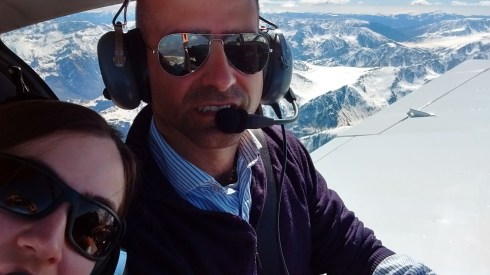
Selfie

Finally, see below the navigation chart with the route followed marked on it and the navigation log as used. The total engine running time of the excursion: 1h28′.

Nav_chart

Navigation_log_used

Leave a comment

Filed under Aerospace & Defence