My forecast of Boeing Commercial Airplanes 2017 revenues

Next January 31st, Boeing will hold an earnings conference where it will announce its Q4 and full 2017 year financial results, including the revenues of each of its units.

Three weeks ago, on January 9th, Boeing already issued a press release where it announced its deliveries and orders for 2017, mainly:

  • 763 commercial aircraft delivered (including 529 of the 737 family, or 136 787).
  • 912 net orders (after cancellations) (including 745 of the 737 family).

The release mentions “912 net orders, valued at $134.8 billion at list prices“, however those list prices are discounted, nothing new, and with an estimate of that discount I’ll try to guess the figure of revenues for the Boeing Commercial Airplanes division, not so much trying to be accurate in itself, but to point in advance to the increasing of the discounts as we will see below.

Where can we find Boeing list prices? Boeing host them in their site, these have just bee raised 10 days ago about 4% (see this comment about it). The previous prices dated from March 2017, when Boeing raised them again, that time by about 2% from its 2015 prices (untouched in 2016). To compute 2017 revenues and estimate of discount I use 2017 prices, not the latest ones.

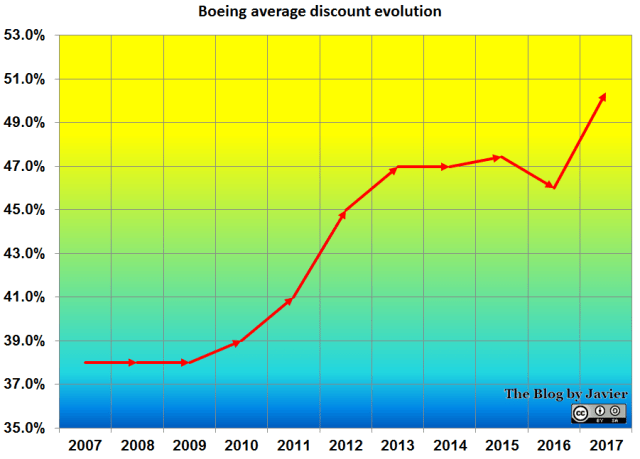
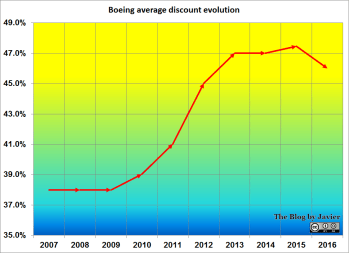
If Boeing didn’t apply those discounts, the value of the 763 aircraft delivered in 2017 would yield revenues of above 118 bn$. To come to a ballpark figure, I will take the latest figure of discounts that I had calculated with 2016 and earlier figures, being the latest ~46%.

Discount evolution_2016

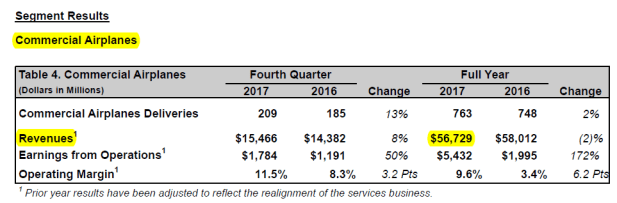
If I plug that discount into the 2017 list prices of the fleet mix of the 763 commercial aircraft that Boeing delivered we would come to a figure of revenues of 62.1 bn$. However, see below what was Boeing’s own guidance in their Q3 earnings release:

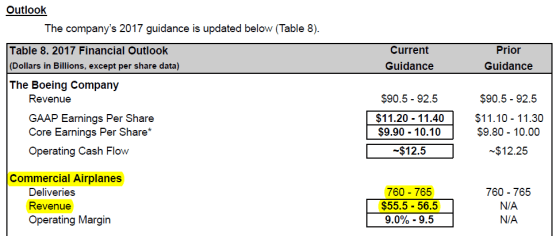
2017 Q3 Financial Outlook

Boeing’s 2017 Financial Outlook at Q3 2017 earnings press release.

At three months to the year end (Q3), they forecast between 760 and 765 deliveries, which turned in 763. At the same time they pointed to revenues between 55.5 – 56.5 bn$… and not above 62 bn$. I believe they will exceed their own estimate, but not by 5 bn$, that is why I see that their discounts have been greatly increased in the last 2017. They must have had a bad time in escalating prices of aircraft sold years ago, delivered in 2017 but with escalation conditions much lower than ongoing list prices.

With all these ingredients… my forecast is: 57.0 bn$.

Some comments to it:

  • My forecast is a bit more optimistic than their upper bracket (56.5) which may be slightly conservative.
  • The implied discount of my revenues forecast would be in the ~ 50% range.

(1) See here a couple of such forecasting revenues exercises that I did for Boeing’s 2014 and 2015 revenues.

(2) See here the latest detailed calculation of discounts that I posted in 2015.


2 Comments

Filed under Aerospace & Defence

El tráfico aéreo en Cataluña desde el 1 de Octubre

En los últimos 3 meses hemos visto muchas noticias al respecto de las empresas que están cambiando de sede de Cataluña a otras regiones como Madrid, Valencia, Baleares… Estas noticias suelen ir acompañadas de calurosos debates sobre lo grande que será el impacto, o si será nulo, si pagan sus impuestos aquí o allá, etc.

También hemos visto varias noticias sobre la desaceleración del crecimiento del empleo. Sobre el desempleo. La publicación de esos datos también conlleva animados debates.

Otros tantos debates surgen con motivo de si las reservas hoteleras en Barcelona bajan, suben o siguen igual que en otros años.

Cada vez que veo estos datos y los debates relacionados me cuesta ver negro sobre blanco el posible impacto de los resultados del 1-O, de la declaración unilateral de independencia del 27-O, etc.

Por otro lado, y sin dudar de la fiabilidad de la EPA (“Encuesta de Población Activa” aquí su metodología), o de los datos sobre capacidades hoteleras, el hecho de que se traten de encuestas me hizo plantearme el buscar un posible indicador basado en datos crudos más que en estimaciones. Datos fiables. Y eso me llevó, obviamente, a buscar datos publicados por ingenieros aeronáuticos. 😉

… Los datos sobre tráfico aéreo que publica AENA (Aeropuertos Españoles y Navegación Aérea) cada mes sobre los aeropuertos que gestiona en España.

El portal de estadísticas de AENA se puede encontrar en el siguiente enlace. En él AENA publica datos mensuales absolutos y relativos sobre el tráfico de cada aeropuerto medido en pasajeros, operaciones (despegues y aterrizajes) y en carga transportada (medido en su peso).

Para ver el posible impacto de los últimos eventos en Cataluña, compilé los datos de tráfico aéreo de los últimos tres años (2015, 2016 y 2017) en el aeropuerto de Barcelona El Prat y Gerona. Su evolución la comparo con aeropuertos con un tráfico similar: Madrid Barajas, Palma de Mallorca, Zaragoza (para el caso de carga) y Murcia (para comparar con Gerona). A continuación dejo aquí cuatro gráficas y una tabla resumen con algunos comentarios.

Tablas comparativas

Tabla comparativa con los crecimientos mensuales de Madrid Barajas y Barcelona El Prat.
Pax MAD - BCN - Palma

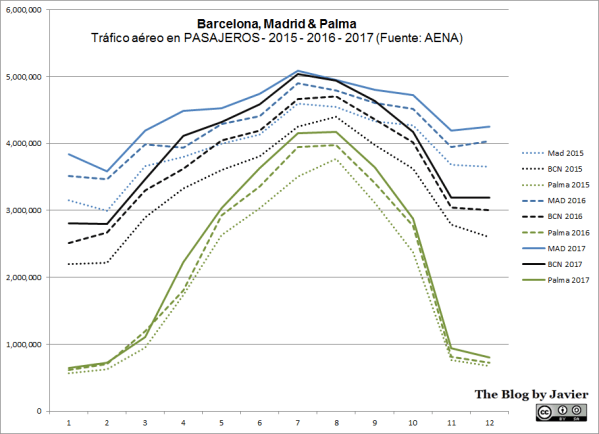
Pasajeros. El volumen de pasajeros en Barcelona disminuyó en los meses de octubre y noviembre con respecto a los meses de verano, como lo hace todos los años. La disminución es más acusada que en Madrid y menos que en Palma. En diciembre, de hecho, en 2017 el tráfico prácticamente ha sido el mismo que en noviembre y no descendido como en otros años. En el global del año El Prat ha crecido un 7.1%, más que Barajas (5.9%). En el último trimestre ha crecido menos. En el último mes, más.

En 2017 El Prat ha crecido menos (7.1%) que en 2016 (11.2%), pero también Barajas ha crecido menos (5.9% vs 7.7%). Se podría decir que la desaceleración es mayor, pero también lo es el crecimiento absoluto, y la mayor desaceleración también se dio en los meses anteriores al 1-O. Se hace difícil sacar una conclusión clara.

Veamos el tráfico medido en operaciones.
Ops MAD - BCN - Palma

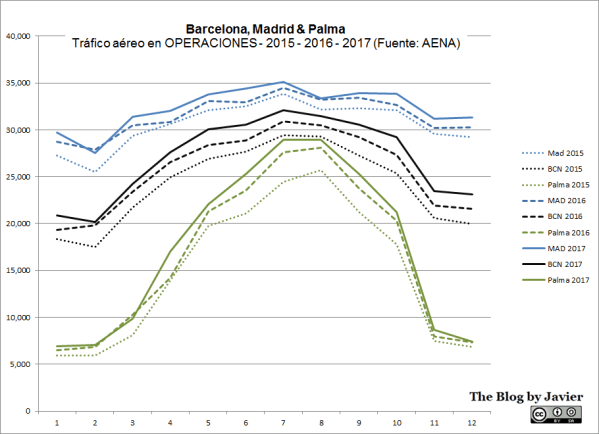
Operaciones. En este caso el los perfiles de las curvas en 2017 vuelven a ser similares a los de los años precedentes. Hay crecimiento en prácticamente todos los meses en los 3 aeropuertos, y desde luego en los tres últimos meses. ¿Se desacelera el crecimiento en El Prat a partir del 1-O? No. En octubre, noviembre y diciembre el crecimiento es del 7.0% cada mes respecto a los mismos meses de 2016. Se podría decir que Barajas crece más en esos meses, pero el crecimiento en el último trimestre en El Prat es superior al crecimiento anual en El Prat (5.1%), por tanto, se acelera.

Sin embargo, el crecimiento en esos meses en 2016 respecto a 2015 fue mayor, y en Madrid el crecimiento en 2017 respecto a 2016 fue mayor que en 2016 respecto a 2015… pero en todos esos meses y en el global del año el crecimiento en El Prat fue mayor que en Barajas. De nuevo se hace difícil sacar una conclusión clara.

Veamos el tráfico medido en carga.
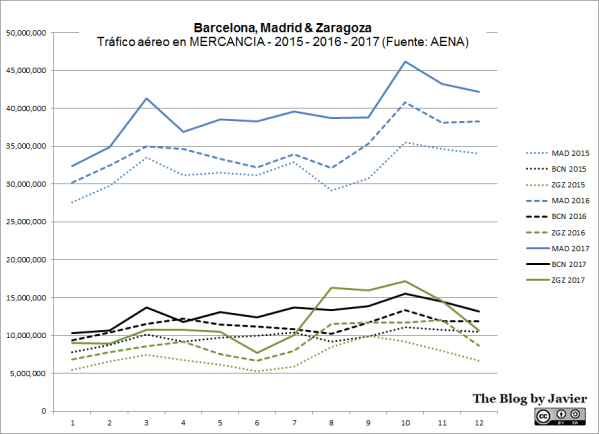
Mer MAD - BCN - ZGZ

Carga / Mercancía. En este caso los perfiles de las curvas son más complicados. Si acaso se distingue que no hay un mayor volumen en verano respecto a los meses de otoño e invierno. El pico en los tres aeropuertos (aquí Zaragoza sustituye a Palma como tercer aeropuerto en cuanto a carga) se produce en octubre y desciende en noviembre y diciembre. En carga, de nuevo El Prat crece más en el global del año (14.9% vs 13.1%) y en los últimos meses que Barajas.

Sin embargo, la desaceleración de ese crecimiento es mayor en El Prat en los tres meses del último cuarto (16.4%) con respecto a los tres anteriores (25.5%), aunque los crecimientos en absoluto sean mayores (16.4% en media en El Prat vs 12.2% en Barajas).

En 2016, sin embargo, el crecimiento se aceleró en el último cuarto del año (14.6% vs 11.4%) y en 2017 se desacelera, pero lo mismo sucede en Barajas. De nuevo se hace difícil sacar una conclusión clara y diferenciada para el aeropuerto de Barcelona El Prat.
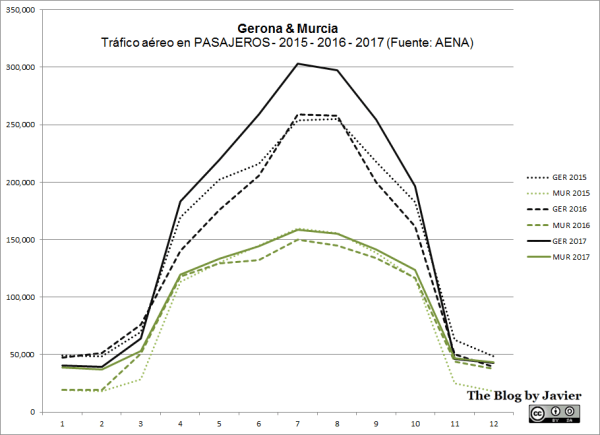
Pax GER - MUR

Si comparamos el tráfico de Gerona con Murcia, vemos el mismo pico en los meses de verano, y en el caso de Gerona vemos que en noviembre y diciembre el tráfico es menor que en los mismos meses de 2015 y 2016. Sin embargo, eso ya ocurrió en los tres primeros meses de 2017, con lo cual se hace difícil ligar ese descenso al 1-O y acontecimientos siguientes.

Como conclusión final a este post, solo puedo decir que sacar una conclusión clara de que hasta diciembre el 1-O o el 27-O hayan tenido un impacto en el tráfico aéreo de los aeropuertos en Cataluña se hace más difícil que leer los posos del café.
 

1 Comment

Filed under Aerospace & Defence, Economy

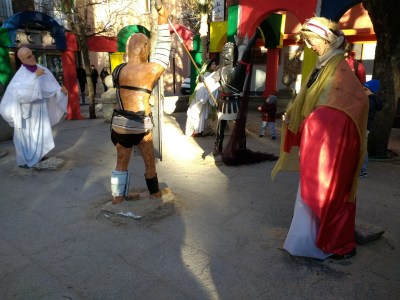
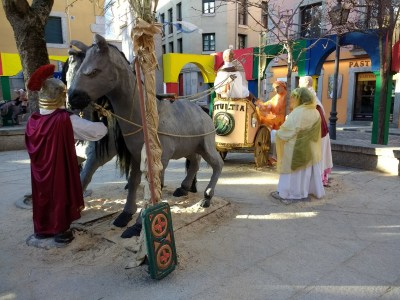
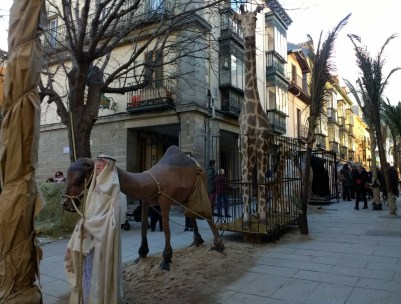
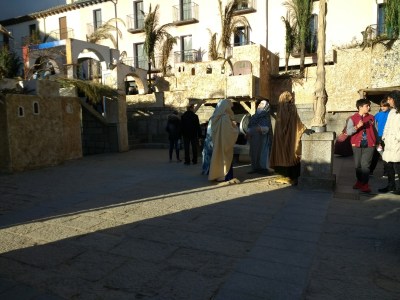
Belén Monumental de San Lorenzo del Escorial

La semana pasada aprovechamos nuestra estancia en Madrid para acercarnos a San Lorenzo del Escorial para pasear con los niños.

En fechas navideñas el Escorial cuenta no sólo con el impresionante monasterio y su lonja como atractivos para dar un paseo, sino con el tradicional Belén Monumental realizado por los voluntarios de Mariano Pardo, “Pardito”, que llevan 21 años realizando dicho Belén, y que forma ya parte del folclore cultural de la Sierra en estas fechas.

En esta entrada quería dejar una serie de fotos de la visita.

IMG_20180103_164505786_HDR

Fachada oeste del monasterio.

IMG_20180103_161814852_HDR

Nacimiento.

IMG_20180103_161951173

IMG_20180103_162343396

¿Herodes?

IMG_20180103_162419224

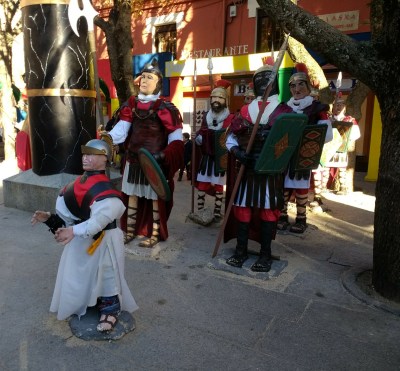
Soldados romanos.

IMG_20180103_162628839

Gladiadores.

IMG_20180103_162635584

Biga.

IMG_20180103_162225146

IMG_20180103_163223072

Río, molino, patos…

IMG_20180103_161555254

Poblado.


Leave a comment

Filed under Travelling

Maratona de Lisboa 2017

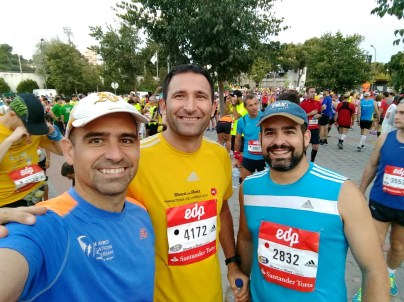
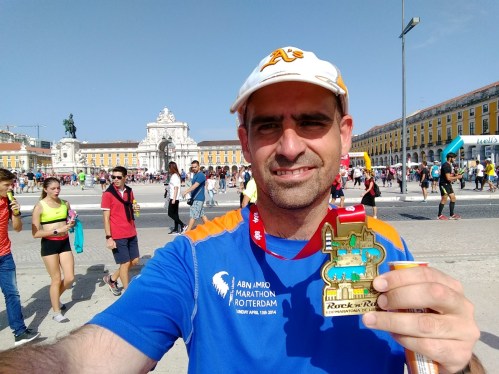
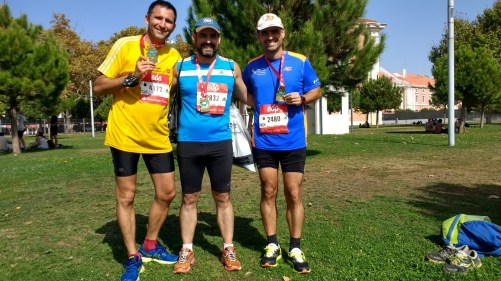
On Sunday October 15th, together with my friend Juan and brother Jaime, I took part in the Maratona de Lisboa.

marathon_expo

Retrieving the bibs at the marathon expo.

Since some years ago, I always follow the same 16-week training plan to prepare for the marathons. That lead to a start of the plan at the end of June 2017. However, I suffered an otitis in July which took over a month to recover from and forced me more or less to stop. I took again the training plan in mid-August, when there were only 10 weeks left. I then had a clear objective: to get a level of fitness to finish comfortably the race, no more.

Lisboa_weekly_mileage

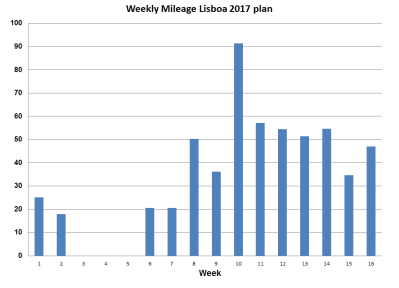
During the 16 weeks of the nominal training plan, I completed:

  • 520 km of running, thanks to a streak of 7 weeks between mid-August and end September in which I averaged 56 km per week.
  • 14 series / intervals training sessions, out of the 28 included in the plan, a mere 50% and not with the fastest paces of the last years.
  • 8 long runs of over 20 km, with 2 of them of 31 and 32 km, and another two days of 28 km split in morning and afternoon double session trainings.

Another good thing of the training season is sharing the progress of it with my brother Jaime and Juan, which helped in overcoming the inertia to stay quiet and to go out to train. See how Jaime explained his own experience in his blog here.

IMG_20171015_074548374

At the departure area before the race.

The circuit of the marathon would take us from Cascais to the West for about 6 km and then back to Lisboa passing again through Cascais and Estoril, along the road that follows the coast line running through the Forte de São Bruno de Caxias or along the Torre de Belém to finish at the Praça do Comércio.

Circuit_profile

The circuit was rather flat except some ups and downs in the first half. The main inconvenient of the race would be the heat. Even if the organization advanced the race departure time in a good last minute decision, at 8 am the temperature was already above 17° C, which at the end must have been around 30° C.

Cascais_2

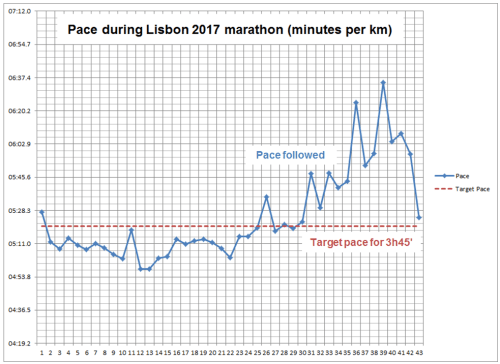
My race strategy was clear: to complete the marathon comfortably at a pace I was used to; for that purpose I would try to run a 3h45′ marathon, a time around which I had already finished 6 marathons. At the beginning I tried to catch the 3h45′ pacers but I found it impossible after having departed a bit behind them. I kept clocking kilometres at a higher pace than I should till km. 15 and still I passed the half marathon mark in 1’30” faster than the pace for 3h45′, however the pacers were running still faster, much faster than required for a 3h45′ though.

Pace_Lisboa

From the km 30 I felt that I was not able to run at the target pace (5’20” per km), and decided to soften the pace to a more comfortable one, around 5’40” which from 37 to 41 became more of a 6’00” with some more time lost in the water stations.

Lisboa_2

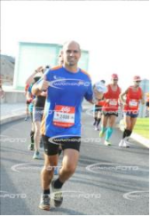
During the last kilometres I wondered whether I would still make a time below 3h50′, which I did not for a matter of seconds. But I still ran at a comfortable pace. This one was a marathon to run for the pleasure of running, now that I can. I had not particular objective. I crossed the finish line at the Praça do Comércio with a great feeling of accomplishment in 3h50’12”, my 17th marathon.

IMG_20171015_120007621_BURST000_COVER

With the 3h50’12”, I finished in the 1,289th place, that is about the upper 28% of the 4,670 finishers. See the diploma from the race below.

Diploma

I then waited for my brother Jaime and Juan to see them finishing and to cheer them for one last effort.

Finisher_duo

Finisher_trio

2 Comments

Filed under Sports

Baarle-Hertog and Baarle-Nassau

A few days ago, we visited the villages of Baarle-Hertog (Belgium) and Baarle-Nassau (The Netherlands). I tweeted a short thread about it that you can see below:

Briefly:

  • The village is divided between Belgian and Dutch exclaves in a very intricate border, including several exclaves which are no more than a few houses or a farm. The Belgian part of the village itself is an exclave in The Netherlands, a few kilometres from the border (such as Llivia from Spain within France, or Treviño of Castile within the Basque country in Spain).
  • The borders were defined in the Maastricht Treaty in 1843. In 1995 a commission clarified the borders.
  • There are marks in the ground that show where the border goes, indicating which side belongs to which country. The panels of the streets or the numbering of the houses also help you to locate where you are.
  • There is a bike route which takes you through the different border lines.

Baarle_1

Baarle_2

Baarle_3

Baarle_4

Baarle_5

Once I tweeted that thread, the beauty of Twitter made it that a friend, Miguel, referred me to a series of posts about that village written by the blogger Diego González who hosts a blog about borders.

On top of that, I had taken the idea to visit that village from yet another retweet from another friend, Pablo.

You can see in that tweet below the different posts (in Spanish).


Leave a comment

Filed under Travelling

San Silvestre 2017

Last December 31st again, we bid our farewell to the year 2017 by running with friends the San Silvestre Vallecana (in Madrid).

Long ago is the day since I first ran it in 1998, this year being my 17th participation in it. This time we were only four in the group: Nacho, Juan, my brother Jaime and me. We missed as well the good quality pictures we had taken in 2016 by Sara or the video prepared by Nacho.

Group.png

Nonetheless, it was a great experience, even if run at a very soft pace we had a few sprints, plenty of jokes and we crossed the finish line together. All in all, 1h07’23” net time according to the chip, the fastest time I have managed in the last four years.

Above all, it is always a pleasure to close the year in such a healthy way running along the colorful streets of Madrid.

Salida.png

Leave a comment

Filed under Sports

2017, the safest year in aviation history

In the last days, I have seen a wave of news and headlines mentioning that 2017 was the safest year in aviation history. The source of the information is the release of 2017 accidents figures made by the Aviation Safety Network a private initiative from the Flight Safety Foundation which curates an extensive database with aviation incidents, hijackings and accidents, from 1946 to nowadays.

The release of the figures can be found here: “ASN data show 2017 was safest year in aviation history“.

The tweet with which they made the announcement is below:

Following that publication, several specialized and generalist media echoed the information. Many of them went to say that there had not been any deaths in commercial aviation in 2017, which is not accurate. A few correctly reported the figures, e.g. Jon Ostrower from CNN. Some headlines reported that there had not been any death in “commercial passenger jet flights”, which is accurate, but misses the accidents and deaths of commercial aviation based on other aircraft than jets. Most of the headlines in the media that I have see in Spanish quickly copied the message but failed to note the word “jet”, and simply stated that there had not been any death in commercial aviation (the opposite would be private or military) or commercial passenger flights (this category would exclude cargo flights but not flights on turbo propellers for instance).

ASN_infographic_2017

If we take a look at the source of the information, we can have a quick look at the accidents:

  • there were 10 accidents in commercial aviation: 5 on passenger flights and 5 on cargo flights.
  • 44 occupants died as a consequence of those accidents. Moreover, 35 people died on ground as a consequence of those accidents.
  • there was 1 accident that involved what would be referred to as a “jet” aircraft, a Boeing 747, but this was on a cargo service. Involving four deaths.
  • there were several accidents involving commercial passenger aircraft, in this case turbo propellers, e.g. 4 Cessna 208 Caravan and Grand Caravan, or an ATR-42.

It is true that most of us rarely fly on those Cessnas, but about 2,500 have been built and they are operated by dozens of operators, including passenger commercial aviation (or FedEx, which flies over 200 of them), especially in regional aviation and inter-island flights.

ATR aircraft are also very successful in regional aviation, with over 400 ATR-42 built, and operated for example by the Air France subsidiary HOP! In this case, the ATR-42 that crashed, was operated by West Wind Aviation in Canada. After the crash investigation, Transport Canada removed the licence to the operator.

To conclude, yes, 2017 was the safest year in aviation history, but unfortunately there were 44 plus 35 fatal victims of commercial aviation.

Leave a comment

Filed under Aerospace & Defence

Reading language and format (2017 update)

Two years ago, I wrote a couple of blog posts where I reflected on the mix of languages I used when reading books between English, French and Spanish and about the format of the books I read, whether electronic or paper books. Last year I made an update of those stats and this post, written after having shared last week my 2017 reading list, is just a follow up update of those two tables:

Reading language

Booksperlanguage_2017

From 2010 to 2015 I read mostly in English. From mid 2015 I have started to read more in Spanish than in the past (mainly classics) and in French. In terms of books the mix for 2017 would be English 32%, French 20% and Spanish 48%. However, this year I thought that the mix would be better measured in terms of pages read, as the books can vary quite a bit in their length. Thus, in terms of pages: English 25%, French 33% and Spanish 42%.

Reading format

Booksperformat_2017

In 2017 I mostly read books in paper format, with a single book in electronic format. As I estimated here the amortization of the e-reader in about 20 e-books read with it, I am still just above half way through achieving that. Seeing, the stock of paper books that I have in the shelves, I doubt that I will read many e-books in the near term.


Leave a comment

Filed under Books

Corrida de Noël 2017

Since 1998 I have taken part for the most part of the years in the San Silvestre Vallecana in Madrid, in the evening of December 31st. That is a great tradition.

However, I have not yet shared in the blog another such tradition that I have been taking part in since 2015: running the  Corrida de Noël in Toulouse, organized the weekend before Christmas on a Sunday morning.

That is another great event, in which around a thousand runners take part in different distances races all dressed up in Santa Claus or Père Noël costumes.

Warm up

This time the circuit of the race took us from the Saint Sernin Basilica on two loops around Capitole, Alsace-Lorraine, Metz, Pont-Neuf, Saint Cyprien, Pont St Pierre and back to Saint Sernin, for a 7.2 km-long race which took me 34’54” to complete.

Circuit

running

Leave a comment

Filed under Sports

Summary of (my) 2017

Time to look back and reflect how the year which is about to end developed. Brief recap of my 2017. (1)

The main event of the year: On July 17th, we signed the contract for the purchase of our house, as Andrea quickly and aptly named it: la maison bleu!

IMG_20170723_173740491

That was by far our main objective for the year, and was achieved rather quickly thanks to the thorough research of the market by Luca, who quickly spotted the opportunity.

Having said that: the other personal objectives for 2017 have been moderately accomplished to different extents. Now, let’s review the year in more detail.

Reading. We purchased at the turn of the year a good pack books in order to build up our library and reading waiting list. This year I kept up with the reading pace, having read 25 books, over 8100 pages or just above 22 pages per day. This permitted me to tackle some classics which I had wanted to read for some time such as the “Iliad”, the “Odyssey”, “Dracula” or “Les Misérables“. For the complete list of books, see a post I wrote about my 2017 reading list with a brief description of each book plus links to more thorough summaries which I wrote in the blog for some of them.

Avgeek. Reflecting for this post, I realize that this year I have unintentionally reduced the amount of aviation-related activities: we visited again the Cite de l’Espace in Toulouse (for Airbus September event) and I only read one aerospace book (“The Right Stuff”).  I clearly need to make up for this in the coming 2018.

Flying. After obtaining the licence at the end of 2015, in this 2017 I had to ensure that I met the minimum requirements to renew it before it expired, which I did in October, thus we have two more years to enjoy the pleasure of flying. I did not reach the objective of flying of 30 hours, but still managed to flew above 20 flight hours (20.7), including 25 take-offs and landings, and we made a few flight excursions: notably a second flight to San Sebastian, in which we hope it’s going to become a tradition, “the July flight to Biscay”(we technically flew down to Biscay, though landed in Fuenterrabia), another excursion over the snow-covered Pyrenees, one to La Escala Rosas, Creus cape, or a couple of them chasing and spotting aeronautical light houses from the old days of l’Aeropostale (see the flight excursions section of the blog here). Ah, I almost forgot to mention it: this year, after an 18-month self-imposed ban to improve navigation skills, we started navigating using GPS. It makes a difference, though I’ll continue to fly old-style.

San Juan de Gaztelugatxe_3

FH_2017

If I recall it well, this year  only Luismi had his baptism regarding flying with me at the controls. I flew as well with Luca, Andrea and David a few times, and with Asier, my brother Jaime and my mother. Believe me, there are very few more enjoyable things than flying with friends. I am sure that in 2018 that will be the case with some more.

Collage_flying_2017

Within this flying  paragraph I could not fail to mention that the A330neo, the Airbus project in which I have been working since mid 2015 flew for the first time in October 19th. Since them a second flight test aircraft also joined the flight test campaign, and together have flown well over 30 flights (search them in flight radar by their call signs: F-WTTN and F-WTTE).

A330neo_FF

Blogging. Family life, intensive reading and the buying of the house were the main culprits for having drastically dropped the production for this blog… not the lack of ideas, books or events to write about. I only managed to write 13 blog posts in 2017 Definitely, I will be a bit more productive on this front in 2018.

The blog received just above 40,000 visits in 2017 (less than in 2016) and above 328,000 since I started it in 2010.

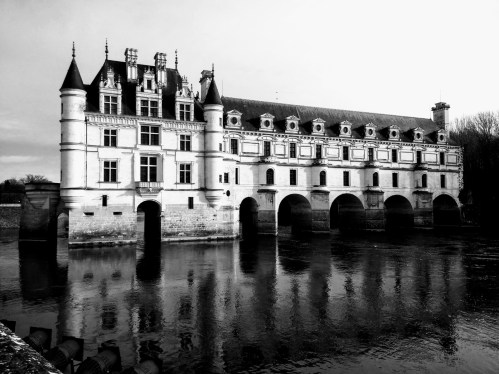
Travelling. This year we, the family together, or I alone, visited Sevilla, Argentina (Perito Moreno, route 40, los 7 lagos, Buenos Aires), Bilbao, Saint Bertrand de Comminges, Saint Cirq Lapopie, Rocamadour, Lisboa, the Netherlands, Gargilesse-Dampierre, Orleans, Waterloo, Chenonceau, La Rochelle, San Sebastian. Many of these places have meant repeat visits, but they are lovely and we’ll continue to go there. On the other hand, this year I almost didn’t have to travel due to the job: just a single trip to Madrid.

Collage_familia_Argentina_2017

Sports – Running. For yet another year, practicing sports has meant mainly running. However, in 2017 I have run just above 1,260 kilometres, well below the 2,000 km target that I set to myself at the beginning of the year. Many issues contributed to that, mainly illnesses and trips (skiing stage and Argentina). Nevertheless, I competed in some 12 races (versus 10 in 2016) including: 2 marathons (Sevilla (where I managed a second best time in the distance) and Lisboa), a half marathon, three trails (Ronde des Foies Gras (25 km), Trail du Cassoulet (32 km) and Trail du Pastel (22 km)) and a few 10k races.

2017_weekly_mileage

Following a mantra I keep to letter, “the running shoes, always in the suitcase”, the year 2017 caught me running in: Sevilla, El Calafate, Getxo,  Lisboa and Wijchen, plus the tens of times I trained in Toulouse, Colomiers, Blagnac and now Fonsorbes.

Collage_running_2017

Apart from running, I played football one single day and for the first time went on a all-family skiing week in the Alps (Vars). That was a lovely experience, with courses for Luca and me, and Andrea ! That was cute, seeing Andrea sliding at 3 years old. No need to say, that in this 2018 again, we will repeat the experience.

Collage_familia_Vars_2017

Other reasons for joy in 2017 have been:

  • My family: my sister completed an internship at NATO in Norfolk (USA) and now is back in Denmark.  My brother continues to enjoy his time in Seville with A400M deliveries. My father is enjoying is retirement busy with university, conferences, trips and other events. My mother continues with her massages business, stayed with us for weeks in the summer and enjoys travelling, reading, etc.
  • Some more friends got married: Juan and Lara.
  • And we welcome some newborns from family and friends: Boris, Carlos, Mateo…

Now it’s time to rest, celebrate and soon to plan how we want the 2018 to turn out. It will include the certification and first delivery of the A330neo (which will mean I’ll be closer to change to another job), another all-family skiing week in the Alps, a marathon in Vienna, lots of flying and running, some books to read, museums to see, trips and excursions to enjoy… For now, I will close 2017 celebrating my sister’s birthday (in the distance), running the San Silvestre Vallecana in Madrid with several friends and enjoying a last dinner with the family.

I wish you the best for 2018, enjoy it!

Pyrenees

(1) You can see here my 20102011, 2012 , 2013 , 2014, 2015 and 2016 recaps.

8 Comments

Filed under Personal development