La semaine dernière j’ai passé le contrôle de compétences linguistiques langue anglaise (FCL.055) VFR (1). Je m’avais mis cet objectif au début de l’année et au moment de démarrer avec la préparation j’avais un peu de difficulté à voir comment préparer l’examen. C’est la raison d’écrire ce petit article, pour partager les quatre ressources que j’ai utilisé.
Le site du « Ministère de l’environnement, de l’énergie et de la mer » (2) offre quelques bonnes exemples de comme le contrôle se déroulera (un exemple de vol fictif et deux exemples de écoute de bande). Je conseille de les reviser, surtout celui du vol fictif pour voir comme le scénario va être présenté au candidat.
Autres exemples d’écoute de bande. Le magazine de la Fédération Française d’Aviation, Info Pilote, a depuis des années une page dédiée à l’utilisation de l’anglais dans les communications aéronautiques.
La compilation des enregistrements de ces bandes se trouvent sur le site « Anglais pour voler ».
Des versions PDF de chaque page dédiées aux communications en anglais des différents numéros d’ Info Pilote pendant des années peuvent se trouver ici. (c’est utile si tu n’étais pas abonné au magazine il y a 10 années ou si tu ne gardes pas les vieux magazines).
Avec ces deux dernières ressources tu peux bien préparer l’exercice d’écoute de bande et voir des différents niveaux de difficulté.
Finalement, pour voir des exemples des situations inhabituelles avec des traductions proposées de français à anglais, cette autre site, Cockpitseeker, a un bonne répertoire (+300 situations).
Effort. Je m’étais mis des horaires pour étudier rigoureusement. Finalement, je n’ai pas suivi ces horaires que dans la moitié de la moitié des jours avant l’épreuve, mais j’ai bien étudié entre 12-15 heures de lecture et écoute de bande, avec un bon résultat à l’examen.
—
(1) Ancienne FCL1.028.
(2) Le nom du ministère peut changer assez suivent, je suggère de cliquer sur les liens ou faire un petit recherche sur l’internet.
(3) Pour l’inscription à l’examen, toute est bien expliqué sur le site du ministère, et la mise en œuvre d’un site internet dédié, OCEAN.
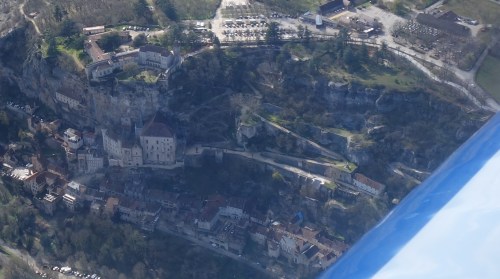
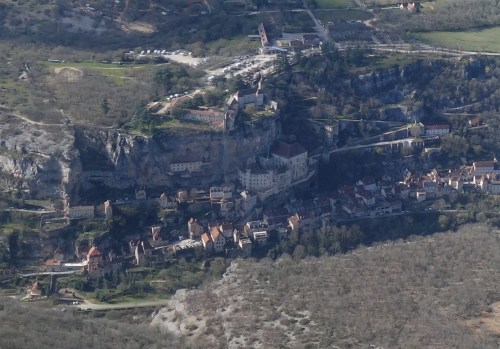
Rocamadour is a small village built in the gorges of a tributary to the Dordogne river. Several of its houses, churches and shops are partially built within the rocks. With about 500 inhabitants it receives 1.5 million of visitors per year, making it one of the most visited places in France and a major attraction for pilgrims, who among other things come to see a black Madonna in a chapel in the rock carved by Saint Amadour, hence the name of the village.
On the way to Rocamdour, flying from Toulouse there is Saint Cirq Lapopie, a small village built on a cliff over the river Lot. Both Rocamadour and Saint Cirq Lapopie are two of the most beautiful villages in the Midi-Pyrénées region and an obvious destination for an excursion, on the ground (which we did years ago) and flying.
Last Saturday, my father in-law and I booked a plane (a DR-400-120) at about 14:10 to fly over those places. In the way we would fly over Montech, to see the “Pente d’eau” from the sky (1), and Moissac, to see the Pont-Canal du Cacor, a bridge over the river Tarn made to allow the canal Lateral (an extension to the canal du Midi) to continue its course towards Bordeaux.
Pente d’eau, in Montech.
Pente d’eau, in Montech.
Pont-canal du Cacor, in Moissac.
Pont-canal du Cacor, in Moissac.
The flight would be over 175 nautical miles (over 320 km) and would last almost 2 hours with the integration to the aerodrome circuit, though in the end we spent 2 hours and 10 minutes with the rounds we made around the different spots. The navigation went rather well with no other help than the chart, compass, heading indicator and VOR (no GPS nor tablets). We had some doubts at a couple of points but we quickly found ourselves, once with the help of the controller.
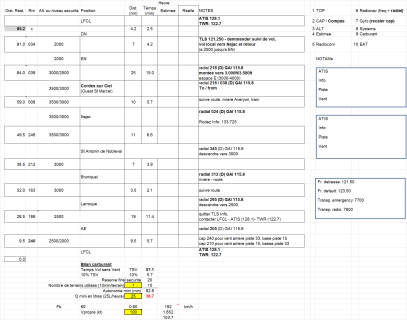
Navigation log.
This was the first flight in which we used the GoPRO video camera that I got last Christmas together with the suction pad to stick it to the windshield. With it we were able to have over 90 minutes of videos recorded that I have tried to shorten into the following 7 minutes:
At some points in the video the ground below seems to move slowly: we were flying at between 180 and 200 kilometres per hour, but at some 1,500 to 2,000 feet (500-700 m) above ground that is the way it feels. Be assured that the closer you get to the ground the faster it feels :-).
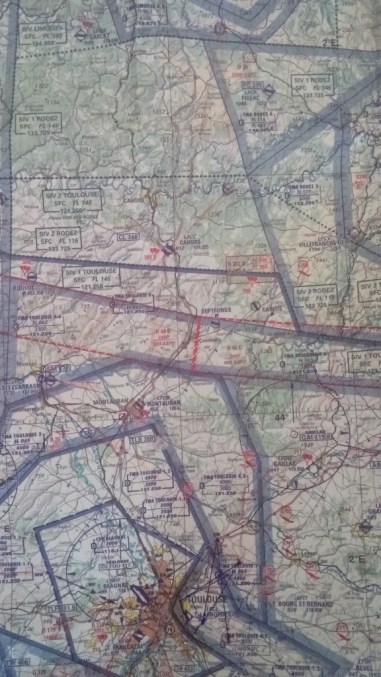
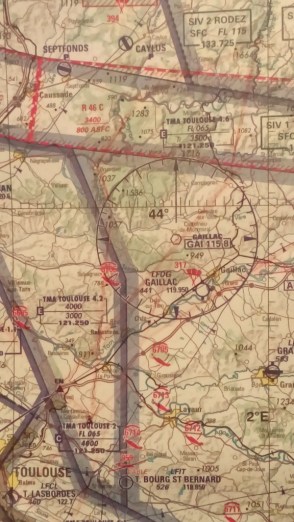
In the chart below you can see the route we followed: departure from Toulouse-Lasbordes (East of Toulouse), waypoint EN, Labastide-St. Pierre, Montech (South West of Montauban), Moissac (West of Castelsarrasin aerodrome), St.Cirq Lapopie (via Cahors) and Rocamadour (North West of Figeac).
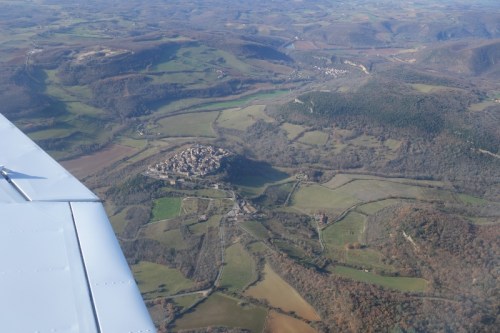
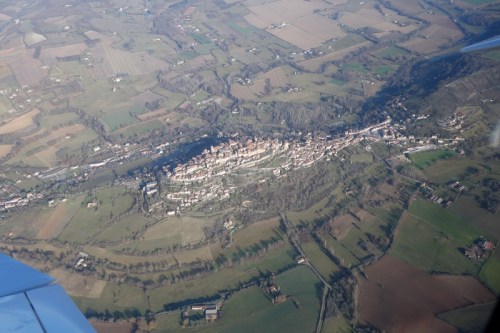
Lastly, some pictures with the images of both villages and the flight log as used after the flight.
(2) Actual engine running time: LFCL-LFCL: 2.17 FH (2h10′, with the aircraft registered as F-GORM, with an engine powered with 120 HP) (taking off and landing from runway 15).
Santos is a port city about an hour drive from Sao Paulo, crucial for the development of the coffee industry in Brazil and the inflow of slaves from Africa in the XIX century. But Santos is mainly known today because of the Santos football club. The Santos football club is known because it was there where Peléplayed for the most of his career. And Pelé…
“My name is Ronald Reagan, I’m the President of the United States of America. But you don’t need to introduce yourself, because everyone knows who Pelé is.” Ronald Reagan (at a visit of Pelé to the White House)
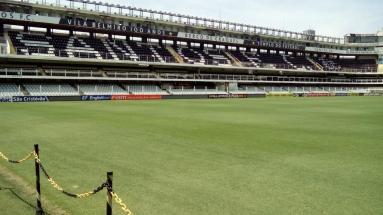
In my third trip to Brazil, I wouldn’t let it pass away the opportunity to rent a car, drive from Sao Paulo to Santos and visit Vila Belmiro, the stadium of Santos FC and the museum “Memorial of the conquests” (Memorial das Conquistas).
Named the “Athlete of the Century” by the International Olympic Committee, Pelé joined Santos when he was 15 years old (in the museum you can see his first contract as professional) and in his first complete season he finished as top scorer of the league with just 16 years. At age 17 he scored 58 goals in the league; a record that still stands today… With Pelé, Santos went to win:
10 Campeonato Paulista (in 16 years from 1958 to 1973; in total the club has won to date 21 titles) (1),
6 Brasileirao (including 5 in a row from 1961-65 and 1968) (2),
2 International Cup (1962 and 1963), being the first team to win it twice.
Today, Santos it is neither the team with more Paulistas championships (Corinthians (27), Palmeiras (22) and Sao Paulo (21) are ahead in that ranking), it shares the lead in Brasileiraos with Palmeiras (both with 8), it is not the club with more Libertadores cups (8 teams are ahead in that ranking, led by the Argentinean Independiente (8), Boca Juniors (6), Peñarol (5)… including Brazil’s Sao Paulo with 3) nor is the American club with the most International Cup (Peñarol, Boca Juniors and Nacional de Montevideo won 3). And despite of all that, the club Santos was declared by FIFA as the best club of the XX century in the Americas(4). Because it was in Santos where Pelé played, and with him the team reached the summit in the 1960s when it lived a dream decade, the years of Os Santásticos who achieved 25 titles between 1959 and 1974. Santos, according to FIFA was the first team to reach the 10,000 goals scored and has plenty of other goal records (5). It was in that Santos that Pelé was the first attacker reaching the mark of 1,000 goals scored (6).
Those days are long gone. Nowadays the club, Santos, wanders around the 100th position of the World Best clubs (7), struggles in the Brasileirao (ending between 7th-9th in last 3 seasons) and most great players are continuously sold (8). However, Vila Belmiro still captures very well the essence of the good old times.
Vila Belmiro, or rather the Urbano Caldeira stadium, was built in 1916, close to the port of Santos. It is a small stadium with capacity for barely 17.000 spectators. Thus, for some important matches Santos plays in the bigger stadiums of Sao Paulo (mainly at Pacaembu (9)). Nevertheless, it’s a cozy stadium, where you have a good view of any spot of the field from anywhere. I liked especially the boxes at ground level named after the great players of the history of the club (10).
The tour of the stadium included a visit to the locker rooms (each locker in the local team room named after the club’s legends, with a special spot for Pelé), the tunnel to the field (well separated from the visitor’s tunnel, each at a different corner of the stadium), the field, the benches.
This slideshow requires JavaScript.
An anecdote for Spanish football fans: in the corridors at field’s level a poster with the following sentence from the Spanish football commentator, Julio Maldonado, can be seen:
“Silencio… juega el Santos”, Julio Maldonado, “Maldini” (Silence… Santos’ is playing)
I definitely recommend the visit to the museum and the stadium. You will be submerged into the history of football for a couple of hours (if you chose to read everything) for just 13 R$ (about 3 euros).
—
(1) Arguably the most important of Brazilian states’ tournaments.
(2) Competition founded in 1959.
(3) Created in 1960, is the South American equivalent to the then Europe Cup and nowadays’ European Champion’s League.
(4) The award was based on a vote by the subscribers of the bi-monthly FIFA World Magazine (see here). For the record, with over a 42% of the vote, Real Madrid was elected as best club of the century.
(5) The goal 10,000th was scored in 1998 (the club was founded in 1912). In the museum there is a digital counter updated with each goal scored. At the time of my visit it was above the 12,200 mark. For comparison, Real Madrid had scored about 8,800 goals in official competitions only up to January 2015.
(6) Pelé holds the Guinness World Record for being the player with most goals scored, 1,279.
(8) Unlike Pelé, who in 1961 was declared as a national treasure in order to prevent him from being transferred to richer European clubs.
(9) At the municipal stadium of Pacaembu there is another museum, the Museo do Futebol, which I also visited and about which I may write at a later point.
(10) I only referred to Pelé in this post but in Santos played at some point in time as well: Gilmar, Coutinho, Clodoaldo, Carlos Alberto (the latter two were part of Brazil’s 1970 World Cup final roster), and most recently Robinho, Ganso and Neymar.
“If you’re in the luckiest one per cent of humanity, you owe it to the rest of humanity to think about the other 99 per cent.” Warren Buffett
If there is a blog post that I am looking forward to write each year is this one. Few things can give you more pleasure than helping others (1). And in doing so I try to be as public and noisy as I can, hoping that I may serve the causes we contribute to also from the awareness point of view.
Let’s go and see the different causes we decided to support in this 2016 (2):
I know that between 100 and 200 of you will read this blog post. I bet with any of you that at least 50% of you will be compelled to take a look at some of these organisations above, 10% of you will consider making a donation. Do you dare thinking that 1% of you won’t actually make such donation?
I learnt about Kiva from Bruno back in 2009. Started contributing to Médecins Sans Frontières in 2010 after a conversation with Juan a couple of years before. I learnt from Slavery International at a temporary exhibit at the Museum of London. I started contributing to the sustaining of the Wikipedia after a tweet from Amalia. Discovered the Fundacion Hombres Nuevos thanks to my father’s 6-month volunteering in Bolivia. Learnt of Gapminder in TED. I started donating myself happiness with Fundacion Khanimambo after Nacho and Alberto. I started using the support to cancer research as a way to honour and encourage work colleagues going through therapy. I received the #IceBucketChallenge from Alvaro and Teresa. The latest additions, Avocats sans Frontieres and Movement du Nid, are ideas from Luca… and so on. After each cause there is someone who let me discover them.
If not one of those, I am sure that you will be able to find a cause, a NGO which resonates with you. Do yourself a favour and contribute to it. It can be just 25$, the cost of diner at a restaurant. You’ll feel much better.
“No one has ever become poor by giving.” Anne Frank, diary of Anne Frank
I discovered Najacliterally by flying over on the way to Villefranche des Rouergues (LFCV) during a flight lesson with my instructor back on July 17th, 2014. That day, when I came back home, I immediately told Luca: “we have to go on an excursion to Najac“.
We did.
Back in April 2015 we made a weekend excursion doing a night stop over in Najac and visiting other nice villages (mainly) around the Tarn river. Luca wrote two nice posts about them with plenty of bright pictures: Najac and Route verte (including Castelnau-de-Montmiral, Puycelci, Bruniquel and Saint Antonin Noble Val).
Time passed, and I got my private pilot licence last November (1) and for the first flight with passengers (Luca and Andrea) we decided to go again to Najac.
On the way to Najac we would fly by Cordes-sur-Ciel and on the way back we would partially follow that route verte by St. Antonin de Nobleval, Bruniquel, Puycelci… basically the same trip but up above in the air.
The flight would be short, as estimated when preparing the navigation. It would take about 57 minutes of flight time plus around 10% to take into account the wind, some more minutes for the integration back in Lasbordes… about 1 hour and 10 minutes (2).
Navigation log prepared for the trip Toulouse Lasbordes – Najac.
Find below a view of the chart to have an idea of the circuit:
Chart view of Toulouse Lasbordes – Najac.
Let me share some pictures of the villages and a video taken by Luca:
(2) In the end it took 1.37 engine hours (or 1h22′), a bit more than estimated… due to departing Southbound and not having found Cordes-sur-Ciel straight away plust some time spent in circling villages.
In the past days, the first episodes of the documentary “The Age of Aerospace” were released. The documentary consists of a series of 5 episodes each one lasting about 45 minutes and divided in a few chapters. The series, produced by The Documentary Group, covers much of the history of aerospace with a special focus on The Boeing Company, which celebrates 100 years in this 2016.
The series is progressively released in Science Channel, Discovery Channel and American Heroes Channel. It can also be watched via streaming at the website created for the documentary, here.
So far, I have watched the first four episodes, find some notes and comments below:
1 – What Can’t We Do?
The episode covers the initial years of flight: the creation of Boeing, the hiring of Wong Tsu (its first aeronautical engineer, fresh from MIT), the air mail expansion, the creation of United Aircraft and Transport Corporation (including Boeing, Hamilton, Pratt & Whitney, Sikorsky, United Air Lines… among others), its split after the Air Mail scandal and the investigation led by senator Black, the early retirement of William Boeing, the Boeing 247, the Clipper, the B-17 Flying Fortress.
2 – Miracle Planes.
This episode covers how WWII gave new life to Boeing. From having been wiped out in the commercial aviation by Douglas and having lost to Douglas the contest for a new bomber with the B-17, due to a crash of the prototype, to a new emergence due to Roosevelt’s call for mass production of defense assets: including the success of the Flying Fortress with over 12,000 units produced in 10 years (“some days you would see 8 to 12 coming out”). Black Thursday with the lost of dozens of B-17s and the finding of the need for fighter coverage; the North American P-51 Mustang (Göring: “When I saw Mustangs over Berlin, I knew the war was lost.”). The Big Week in early 1944 and D-Day. The need for a longer range bomber for the pacific, the B-29 Superfortress.
3 – Shrinking the Earth.
This episode covers the jet age, from the operation LUSTY (LUftwaffe Secret TechnologY), the revamp of the swept wing technology originated by Adolf Busemann, the Boeing B-47, the taking over as president of Boeing by Bill Allen, to its inclusion in commercial aviation: the Comet, the prototype Dash-80 (including Tex Johnson‘s unexpected promotional double barrel roll flight), the Boeing 707 (Pan Am’s Juan Trippe: “Tomorrow you will see in the press that I have invented the jet age“), and 747 (Boeing’s Joe Sutter to Trippe: “You are sitting on a 747 in this conference room“).
4 – In the Vastness of Space.
This episode covers the Space race. From the first warnings of Soviet Union breaking of frontiers to the launch of the Apollo program, the accident of the Apollo 1, its investigation and the need for more supply chain oversight and systems integration, the successes of the Apollo 8 (orbit around the moon), the Apollo 11 (landing in the moon), the Space Shuttle, International Space Station…
5 – The Dreamliner.
(Yet to be released in streaming) [Updated on March 29, 2016]
This episode covers the launch and development of the Boeing 787, the Dreamliner, a “game changer”. The launch of new programmes put manufacturers future at a stake, and after Airbus’ launched the A380 in 2000, Boeing had to define its next move. It first intended to launch the Sonic cruiser, but the 9/11 attacks changed the landscape and Boeing’s bet changed from speed to the economics of flight. Boeing challenged the hub-and-spoke strategy and launched a middle-sized aircraft that could connect middle cities far away from each other more economically. The documentary covers as well other innovations introduced in this programme: extensive use of composite materials, design of large components outsourced to risk sharing partners (check out the images of the giant Mitshubishi’s autoclave), the development of the 747 Dreamlifter to transport sections between partners… It covers as well the development issues (sections not fitting, quality, rivets…), the 3-year delay, the first flight at the end of 2009, the first delviery to ANA and the issue with the Lithium-ion batteries which caused the fleet of 787 in-service to be grounded by the FAA in 2013 for four months (a first in Boeing’s history). This last chapter conveys quite well the size of the undertake that is the launching of a brand new airplane.
—
I will conclude this review post recommending the documentary and leaving its 3-minute trailer:
A couple of weeks ago I asked my flight instructor about destinations for a short flight excursion (from our base aerodrome in Toulouse – Lasbordes), a nearby aerodrome with a nice bar or restaurant with some spots worth to see on the way. At first thought he recommended: Auch, Cahors and Gaillac.
I had booked an airplane in the aeroclub for last Saturday some weeks ago and we were lucky again in having good weather for the day, mostly clear and sunny in the beginning. So, at 11:30am we drove to the aerodrome. Destination: Auch.
A friend, Rapha, had also recommended Auch and he was going to join us for the trip, but other activities prevented him for being early at the aerodrome. After receiving the keys of the plane a bit late, at 12:53 I was starting the engine.
“Fox-Golf-Sierra-Bravo-Juliet, DR-400 au parkingACAT, 3 personnesabord,avecl’infoBravo, pour un vol destinationAuch,sortien début de ventarrièrepiste15, pourroulerau point dearrête.“
The flight would be rather quick. That was good as we were late in departing and the guy at the restaurant had told us to arrive before 13:30… when preparing the navigation I had estimated the return flight in about 62 minutes, plus some plus 10% due to the wind, plus some 10 minutes per integration and taxing in each aeroport… that woud make it about 88 minutes or 44 minutes per leg. We knew we would not make it (12:53 + 00:44 ~ 13:37) but we decided to give it a try and see if we still were able to get some food. If not, at least we would have trained the crossing of Blagnac’s CTR plus landing in Auch, an aerodrome I had never landed in before.
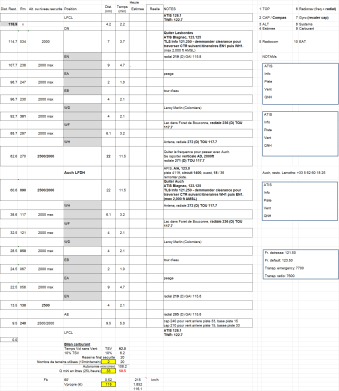
Navigation log prepared for the trip Toulouse Lasbordes – Auch.
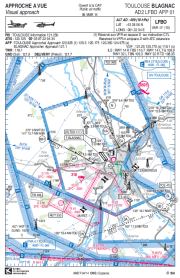
Transits through Toulouse Blagnac’s CTR.
The flight to Auch went very smooth even if it took longer than estimated (55′ of engine running in total) (1). Radio communications with Toulouse information and Blagnac’s tower went well and we quickly got clearances to cross the CTR and the axis of Blagnac’s airport runways. That feels good. Seeing those Airbus’ and Boeings down there and even making some commercial flight wait a minute in the runway while you cross the axis. 🙂
Once you fly over the airport the next highlight of the flight comes: over flying Airbus’ Toulouse facilities, seeing from above the delivery centre, flight line, A330 FAL, A350 FAL, flight test aircraft, Beluga’s, etc., you name it. See a short video filmed by Luca below.
You quickly arrive to the Leroy Merlin in Colomiers (point WD) and then turn Westerly towards the Bouconne forest (WF) and further ahead you leave the CTR (at WH). Then you only need to keep exactly a West heading (270⁰) easily aided by Toulouse VOR for about 22 nm (12 minutes at our speed, ~ 115 kt) until you find yourself above Auch aerodrome.
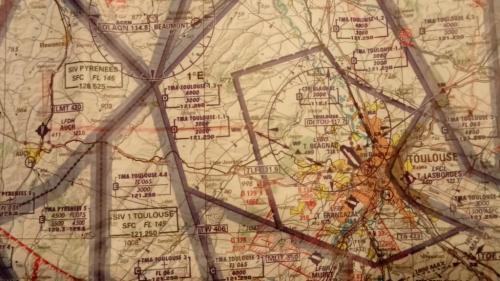
Chart view of Toulouse Lasbordes – Auch.
We flew the vertical of the airport, integrated the circuit in the cross wind leg, right after another plane which had just taken off. Reduced speed, put the carburetor heating on, activated the electrical pump, deployed flaps in take off position, gave a message with the radio, reduced speed to 150 km / h, trimmed the aircraft and gently proceeded towards base leg, lost some altitude and found ourselves in a final leg with a runway of 1,900 metres to land, four times of what we needed.
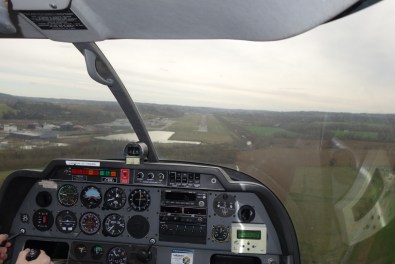
Final approach to Auch (LFDH).
We taxied to the parking, locked the planed and called the restaurant: “I had called you from Toulouse, we’ve just landed, we know we are late, are you still serving food?”
Jean Philippe, a Belgian chef who resonates very much with the charm of the Gers, was cooking at the grill, welcoming guests at the restaurant, picking the phone, giving casual conversations to all customers in all four corners at any time from any place within the restaurant… running the show.
The menu… we had not ordered anything and saw the aperitif (kir), water (wine, if we had not refused it), bread, soup… coming to the table. The soup, “carbure” (as I later learned) is a traditional soup cooked with meat and vegetables from the previous meal; definitely the best dish of the restaurant. I then asked how did it work with the menu, the ordering… Jean Francois pointed at a corner: “it’s a buffet, you take the starters there, I take charge of the meat”. The starters included all kinds of salads, vegetables and sea food.
Once we had eaten half of the salad, an unannounced pâté came in. “Please, taste it”. Then came in the meat. A pork chop here, a steak there… then another one. A beef steak… With a tray already full of meat in front of us, I hinted “that is more than enough, we won’t be able to eat that much!”. “Don’t worry…”
We then took some desert (from another buffet in another corner) and to our regret we had to leave quickly back to Lasbordes to try to give back the plane on time for the next pilot.
The all-included menu cost 19 euros per person. Check out the restaurant (“Aerodrome d’Auch Lamothe”) and book your table here (phone call).
I booked a plane at the aeroclub for 3h30′, but in order to enjoy the trip in a more relaxed way, I recommend to arrive there before 13h and to book a plane for no less than 4 hours (if departing from Lasbordes), to ensure you have time to enjoy the lunch with time enough and so that the departures do not feel like a rush.
—
(1) The actual engine running times of both flights were:
LFCL – LFDH: 0.93 FH, 55′ (taking off from runway 15, southbound then towards EN)
LFDH – LFCL: 0.84 FH, 50′ (taking off from runway 18, then holding at WH some minutes waiting for the clearance)
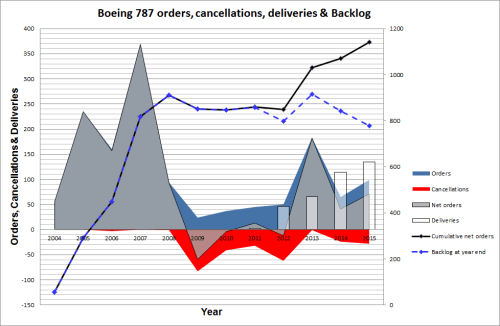
Quick post with the updated figures and graphic of orders, cancellations, deliveries and backlog of the 787 programme at the end of 2015.
There were no major operational hick-ups in 2015, but commercially it saw 28 cancellations for 99 gross orders, thus, 71 net orders. This, together with the increased ramp up which enabled 135 deliveries, make that the book to bill of the programme stood at 0.53, far from a desired >1. Therefore, the backlog at year-end continued to decrease down to 779 aircraft (1).
An image is worth a thousands words:
787 orders, cancellations, deliveries and backlog through 2015.
—
(1) That level is lower than 2007 year-end backlog. The highest at previous year-ends was 916 in 2013.
Today’s Iowa caucuses made me remember some anecdotes of a trip we made five years ago which took us through Iowa. I already wrote a post about the visit we made to the Iowa Aviation Museum, but I had not yet written about El Bait Shop, arguably the best bar in America.
After driving all the way from Chicago, we stopped for the night of Thursday 28th April 2011 in Des Moines, Iowa. While changing clothes in our room at the Rodeway Inn motel, by the interstate 80, I went through some flyers and recommendations for tourists. One caught my attention: “the best bar in America” (1).
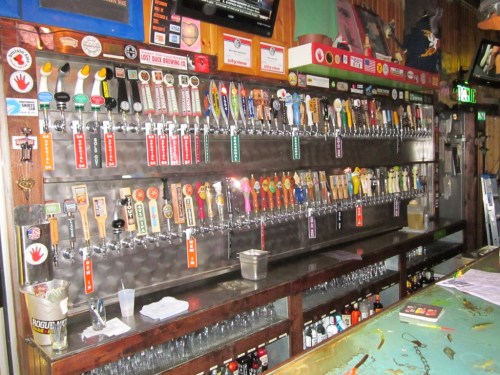
Some minutes later we left for Des Moines downtown and after some driving and walking around we looked for the bar, which wasn’t easy to find. Once inside the first thing that catches your attention is the amount of beer taps, 180!
Some of El Bait Shop’s 180 beer taps.
The bar itself is comfortable, with a very good service, quite cheap and with nice music. After receiving some tips from one of the waiters we decided to pick a couple of “beer flights” to taste some 12 different beers (accompanied with some food) (2). See below the flights.
Beer “flights”.
El Bait Shop offers many more beer options than the 180 that are in the taps. They change the beers on the menu on a monthly basis, continuously incorporating new brands. You can check the menu today, and you can see below the menu in April 2011.
Menu in April 2011 (1/4).
Menu in April 2011 (2/4).
Menu in April 2011 (3/4).
Menu in April 2011 (4/4).
I want to call the attention on the fact that most of the beers on offer, almost all, are brewed in America, by small breweries producing all kinds of varieties. When you read in the menu “German Hefeweizen” you do not see Paulaner… you see brands from Oregon, Texas or California. When you see “Belgian Ales & Belgian Style Ales” only 3 out of 22 on offer come from Belgium.
The experience was great. A nice surprise in the middle of a road trip. That’s serendipity.
Outside of El Bait Shop.
El Bait Shop interior.
—
(1) When reading the tip I also thought that the claim might be overrated. Not so after visiting the bar. I invite you to Google “best beer bar in America” or something similar, I bet you’ll find El Bait Shop among any top bar list.
(2) No need to mention that the beer flight I took was “Flyin’ High”.
“Looking backwards it’s clear that 2015 was a peak in wide-bodies deliveries. Looking forward it may have been a short-term peak, but looking further ahead it is not so clear.”
Commercial wide-body airplanes’ deliveries per year, 1969-2015.
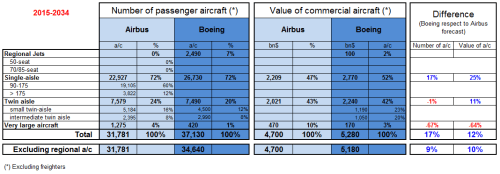
Comparison of Airbus GMF and Boeing CMO 2015-2034.
If we focus on the twin-aisle segment, we see that both companies are very closely forecasting between 7,500 and 7,600 passenger aircraft deliveries (with less than 90 aircraft of difference, a 1.2% deviation). The forecast for the freighters is not shown in the table but it is also very similar for the segment, between 718 (Airbus’ view) and 800 (Boeing’s) freighter aircraft. In combination, each company foresees between 8,290 (Boeing view) and 8,297 (Airbus’) airplanes’ deliveries in the segment. Remarkably similar and definitely converged from years ago.
In the very large aircraft segment both forecasts do not converge. But since the figures of deliveries are an order of magnitude lower, I will focus on what they define as “twin-aisle” segment.
Let’s put forward again the question: was 2015 a peak year in terms of twin-aisle deliveries?
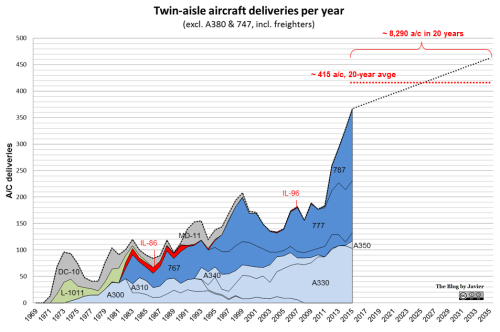
Quick math: if we take those ~8,300 aircraft to be delivered in the next 20 years, we arrive at an average of 415 aircraft per year. That figure excludes the very large aircraft. In 2015, there were 367 deliveries of twin-aisles (excluding A380 and 747):
A330: 103
A350XWB: 14
767: 16
777: 98
787: 135
IL-96: 1
Thus, in 2015 we would have been far from the peak. If we simply linearized those 8,300 deliveries from 2015 levels up to 2034, we would get the following profile:
Twin-aisle deliveries historic and 20-year forecast.
The reader may correctly think that market forecast figures are not engraved in stone and are rather optimistic. Fair enough.
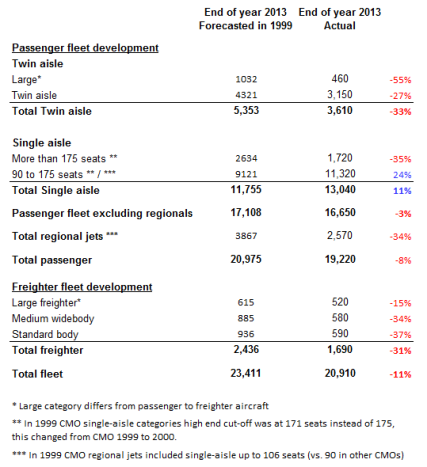
Both forecast have been rather accurate in the past forecasting traffic growth. Not necessarily in forecasting the number of aircraft in each specific segment. See the post, “Aircraft market forecasts accuracy (update 2014)“, in which I analyzed Boeing CMO forecast of 1999 with the actual fleet at the end of 2013. See the result below:
Comparison of aircraft fleet at year-end 2013: 1999 forecast vs. actual (sources: Boeing CMO 1999 and 2014).
Thus, in 2013 there were 27% less twin-aisle aircraft than what had been predicted in 1999.
If 2015 market forecasts were off the mark in the same proportion (27%), that would mean that instead of 8,300 airplane deliveries in the next 20 years we would see about 6,050… meaning ~300 airplanes per year in the 20-year span.
In that case, we might have seen the peak.
Let’s take a look at current backlogs at the end of 2015:
Airbus: 1,112 a/c
A330 family: 350 a/c
A350: 762 a/c
Boeing: 1,383 a/c
767: 80 a/c
777 family: 524 a/c
787: 779 a/c
Thus, at the end of 2015 the combined backlog (firm) stood at ~2,500 airplanes. That is a 30% of the 8,300 forecast, and a 41% of the 6,050 aircraft (i.e. forecast reduced in 27%).
The sceptic reader could still have doubts of the quality of the backlog (i.e., some customers may go through troubled waters and cancel orders).
787 orders, cancellations, deliveries and backlog through 2014.
The 787 programme experienced serious delays and industrial issues from 2009 to 2013 in the midst of the worst financial and economic crisis since the Great Depression of the 1930s. Through 2014, the programme had suffered 247 cancellations out of 1,318 gross orders, that is almost 19% of cancellations.
I believe that 19% can be considered an upper ceiling of how much of the current 2015 twin-aisle backlog (~2,500 a/c) could be considered as dubious. Thus, at least about 2,000 firm orders could be seen as rather secured.
Let’s see at the question (was 2015 a peak year?) from a different perspective: in the immediate coming years, what are the announcedproduction rates?
Thus, according to the announced production rates and targets, in 2016 we should see about 380 twin-aisle combined deliveries, higher than the 367 we saw in 2015.
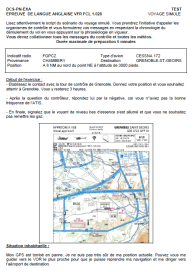 Le site du « Ministère de l’environnement, de l’énergie et de la mer » (2) offre quelques bonnes exemples de comme le contrôle se déroulera (un exemple de vol fictif et deux exemples de écoute de bande). Je conseille de les reviser, surtout celui du vol fictif pour voir comme le scénario va être présenté au candidat.













 The Blog by Javier