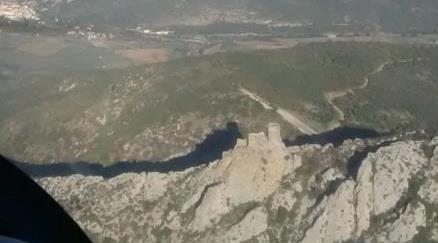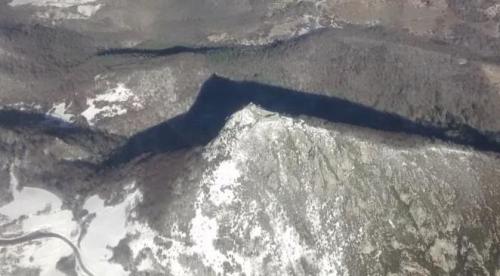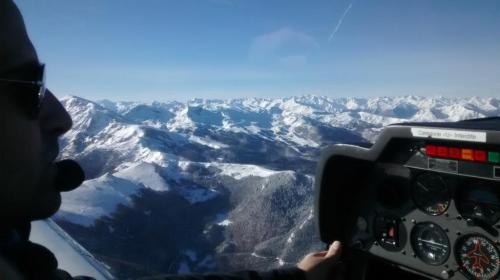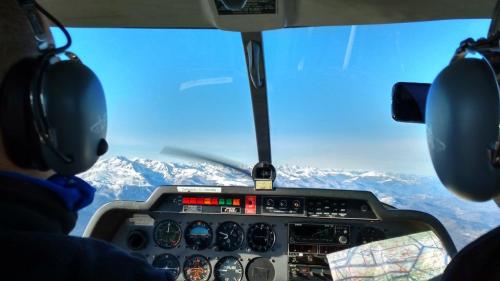
Flying over the Cathar castles

An extract from the Wikipedia to introduce the Catharism to start with:

Catharism was a Christian dualist movement that thrived in […] southern France, between the 12th and 14th centuries. Cathar beliefs varied between communities, because Catharism was initially taught by ascetic priests, who had set few guidelines. The Catholic Church denounced its practices and dismissed it as “the Church of Satan”.

[…] Though the term “Cathar” has been used for centuries to identify the movement, whether the movement identified itself with this name is debatable. In Cathar texts, the terms “Good Men” (Bons Hommes) or “Good Christians” are the common terms of self-identification. The idea of two Gods or principles, one being good and the other evil, was central to Cathar beliefs. The good God was the God of the New Testament and the creator of the spiritual realm, contrasted with the evil Old Testament God—the creator of the physical world whom many Cathars, and particularly their persecutors, identified as Satan. All visible matter, including the human body, was created by this evil god; it was therefore tainted with sin. This was the antithesis to the monotheistic Catholic Church, whose fundamental principle was that there was only one God, who created all things visible and invisible. Cathars thought human spirits were the genderless spirits of angels trapped within the physical creation of the evil god, cursed to be reincarnated until the Cathar faithful achieved salvation through a ritual called the consolamentum.

A tourism highlight of the region, the French Sud-Ouest, is the visit to one or several of the many Cathar castles spread in it.

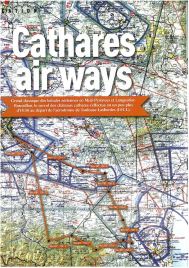
"Cathares air ways", Info Pilote magazine.

“Cathares air ways”, Info Pilote magazine.

Years ago, a colleague (Asier) shared with me an extract of the French Aviation Federation (FFA)  magazine, Info-Pilote, with a proposed route to fly over some of the Cathar castles in the region. Ever since, this has been an excursion in the to-do list.

A few days ago we did it.

I booked some weeks ago a plane of the aeroclub for 3 hours for the morning of Sunday 17th. We were lucky enough to have an incredibly sunny, calm and clear morning in the mid of cloudy and rainy weeks. Thus, we went to the aeroclub and at 9am we started preparing the plane, checking last-minute weather reports, NOTAMs, restricted zones, printing a missing aerodrome chart, refueling the plane… the series of procedures that make general aviation take always longer time spans than you think.

At 9:50am I started the engine.

“DR400 avec 4 personnes abord au parking ACAT, avec l’information Alfa, pour un vol de navigation autour des chateaux cathares, pour rouler au point d’arret de la piste 33…”

What followed were 2 hours of a wonderful flight.

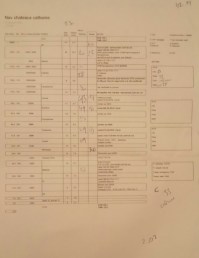
Navigation log.

Navigation log.

The route, as calculated while I planned the navigation the night before, extended for over 160 nautical miles (about 300 km). We flew over the following Cathar castles: Saissac, Lastours, Carcassone, Termes, Queribus, Peyrepertuse, Puylaurens, Puivert and Montsegur.

Each of those castles definitely deserves a walk-in visit. But, yep, among the many cool things aviation can offer on the spot walk-in visits are not among them. I had visited before the castles of Carcassonne and Montsegur, I now have on the to-be-visited list some others, though most of them are not easy at all to access.

I will be brief in text and generous in pictures (1).

Saissac.

Saissac.

Lastours.

Lastours.

Carcassonne.

Carcassonne.

Termes.

Termes.

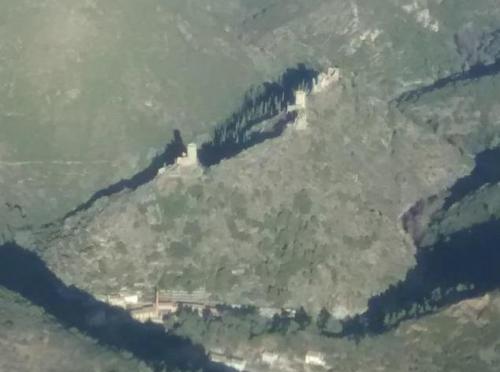
Queribus.

Queribus.

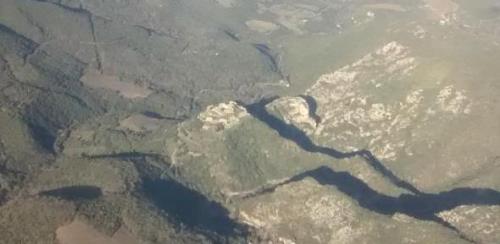
Peyrepertuse.

Peyrepertuse.

Puylaurens.

Puylaurens.

Puivert.

Puivert.

Montsegur.

Montsegur.

Pyrenees.

Pyrenees.

Cockpit.

Cockpit.

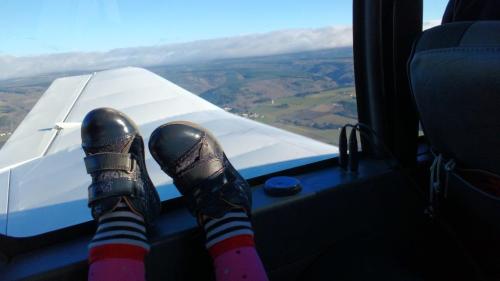
Andrea's feet.

Andrea’s feet.


(1) In fact, the generosity and credit go to both Luca and Asier who were the ones taking the pictures.

2 Comments

Filed under Aerospace & Defence

Reading format

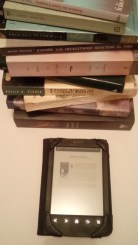
BooksIn a previous post, Reading language, I reflected on the mix of languages about the books that I read. This post, some days later, triggered the idea of taking a look at which format do I use when reading books; paper books or electronic books.

I have had a couple of electronic readers since some time ago. The first one being a gift received in 2010 (1) and the second one, a similar model I bought in 2013 to replace the previous model which got damaged. I have always thought that the business case for the electronic book was clear and positive: after just reading about 20 books in it the purchase was probably justified, especially if those books were classic ones, of which free copies are available in the net.

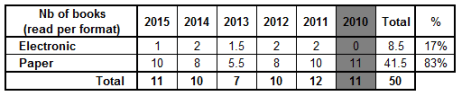
Find below the figures.

ReadingFormat

However, taking a look at the table above, the business case for me it has clearly not yet proven positive… In the past 5 years I have read less than 10 electronic books. So far, the cost of the 2 e-readers that I have had, plus the cost of the ebooks divided by the number of books I read in electronic format (a figure between 20 and 30 euros) surely exceeds the average cost of the books in paper format that I buy (which I haven’t calculated but must be between 10 and 20 euros).

What is actually the electronic book adoption trend nowadays? I found several articles. It seems that the high growth of the e-book market up to 2010 has more or less stopped. In this article from The New York Times, it is mentioned that about 30% of readers read a majority of books in electronic format, whereas this other one mentions that in terms of sales ebooks represent as well around 27-30%.

Finally, on the other hand, there is people like my wife, Luca; if she made the numbers for her reading habits, they would show that she reads books per dozens per year and that she reads a large majority of electronic books. She has a Kindle reader from Amazon, rather than a Sony e-reader as I do. This subtle difference may have a point in the shaping of habits: in the Kindle the shop is in the device itself. In a couple of clicks she has the book with her. In my case, I have to buy or download the books using a computer and then transfer the files from the computer to the reader. I guess that this subtle difference, which eases the availability of books for Kindle readers, may have a big impact.

Note: In 2013 I completed reading “Thinking Fast and Slow” which I started in electronic format, but after my e-reader got damaged I continued and completed in paper format (in the meantime, Luca had bought it in parallel in paper), hence the use of decimals.

(1) I received this gift at the end of 2010 from former work colleagues when I left my job in Madrid for Toulouse. I therefore include in the table for the mix of format, only the books from 2011 onwards (it is obvious that before 2011 all the books I read were in paper format).

3 Comments

Filed under Books

My forecast of Boeing Commercial Airplanes 2015 revenues

Last year, I put the model I use to estimate the discounts applied by Boeing on the sales of its commercial aircraft to the test of trying to forecast in advance what would be Boeing Commercial Airplanes division revenues for the year. In this post I want to repeat that exercise (1).

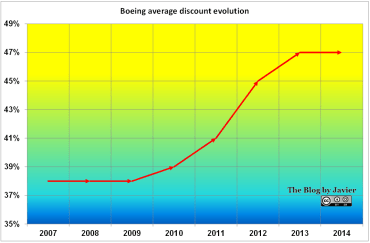
The latest estimate of the discounts that I made, in 2015 yielded a 47% (same as the previous year). See here the post in which that estimate was explained (using Boeing’s reported figures of deliveries, orders, list prices and revenues) and below its evolution.


Boeing Average Discount Evolution, through 2014.

Boeing Average Discount Evolution, through 2014.

As of today, January 11th, Boeing revenues for the full year 2015 have not been announced yet. Boeing’s investors relations website informs that the 2015 earnings conference call will take place on January 27th.

The process and sources with which I will reach to my forecast are described below:

  1. See here Boeing (net) orders for the year 2015: 768 aircraft among all models.
  2. See here Boeing deliveries in the year 2015: 762 aircraft among all models.
  3. See here Boeing 2015 list prices.
  4. See in the above curve the average discount I will use: 47% (this is the figure calculated with 2014 data, and that is a hypothesis that will be put to test with how accurate the forecast turns out).
  5. See here [PDF, 839KB] Q3 2015 earnings press release. I use it to see how were faring in 2015 Boeing Commercial Airplanes services, deducing it from the reported figures of Sales of Services, Boeing Capital and Global Services & Support, reported in different pages of the release. Up to end September 2015, the services figures were increasing in comparison to 2014 figures. I will assume the global figure to follow the same proportional increase; arriving at ~1,636 m$ for Boeing Commercial Airplanes services (remember, this figure will not be actually explicitly reported).

With all these ingredients… my forecast is: 66.98 bn$ (2).

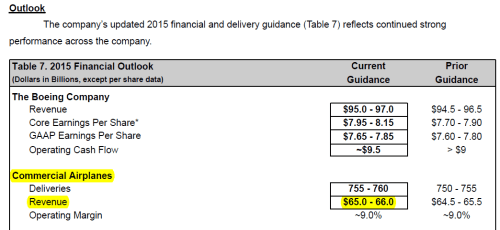
In the 2015 Q3 report you can see Boeing’s own guidance for year-end figures:

Boeing’s 2015 Financial Outlook at Q3 2015 earnings press release.

Boeing’s 2015 Financial Outlook at Q3 2015 earnings press release.

Some comments:

First, you can see that my forecast (66.98 bn$) is about a billion dollars more optimistic than Boeing’s own outlook 3 months ago, 65.0-66.0 bn$  (3), which was even lifted from 64.5 – 65.5 in the 2015 Q3 earnings release.

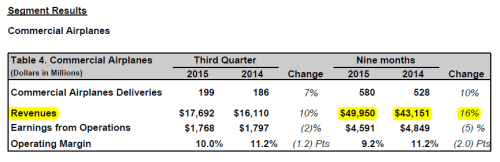
Second, in the 2015 Q3 release, you can see the revenues up to end September (below). In them, you can see that up to then, revenues of Boeing Commercial Airplanes had increased 16% in relation to 2014. My forecast is a bit less optimistic here for the year-end as it estimates the increase in revenues will be +12% (that is due to lower deliveries in the Q4 of 2015).

Boeing Commercial Airplanes revenues Q3 2015.

Boeing Commercial Airplanes revenues Q3 2015.

Final comment: if Boeing managed in 2015 to command better prices on delivered aircraft, the figure will be even higher. If the figure is lower than the 66.0 bn$, and in line with Boeing’s Outlook, it’ll mean that the market is forcing Boeing to apply ever higher discounts to their published list prices.

I am now looking forward to January 27th and Boeing’s earnings call!

Note: After Boeing’s earnings call, in order to compare the results with the forecast and evaluate its accuracy I will either write an update of this post or a new entry.

(1) See here the post from last year, in which I missed the revenues by just a 0.3%, closer than analysts and Boeing’s own financial guidance provided in their 2014 Q3 earnings release.

(2) To be more precise the forecast from the model is 66,978 m$.

(3) As I mentioned in last year’s post, if my forecast turns out correct some may be tempted to say that this is the usual trick played by CFOs: to present better figures (in the results) than expected (in the outlook).

3 Comments

Filed under Aerospace & Defence

Reading language

In a previous post, Musings on objectives setting, I mentioned about reading:

I found that I am not that fast reader (in English and French and neither in Spanish!) nor all the books that I pick are that easy or short, so I linger every year around the 10 books.

BookShelfIn the second half of 2015 I was able to catch up with the objective by reading 2 books a month as intended. This demanded a rigorous approach, dedicating some time each night to reading (not that I didn’t enjoy it!).

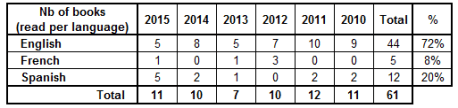
I then reflected on the fact that of the last 8 books I read: 4 were in Spanish (plus 3 in English and 1 in French, a light novel by Saint-Exupéry). Did it help in that last reading rush that I read more books in Spanish than in 2014? In 2014 the mix of the books I read was 8 in English and 2 in Spanish. This reflection triggered the curiosity to find out the language mix of the books I read in the previous years, which I checked with the help of this blog (1). See below:

Booksperlanguage

I do not speak many languages, thus I cannot read all the books I read in their original languages (e.g. “The diary of a young girl” or “Crime and Punishment” lately). However, I try to read books in their original language when the authors write in English, Spanish or French, with few exceptions (normally due to availability of a book). When I cannot read one in the original language, I assume that the different translations to the languages I understand are as good (2) and I normally chose the Spanish version to ease the reading.

Seeing the mix above, in the last 6 years I have read more than three times as many books in English than in Spanish. This was intentional, since over a decade ago, in order to keep learning, improving, and to exercise the mind (3). I considered that each book I read in English (or now in French) met two objectives in one: using a different language and reading. It is only now that I reflect that by pushing myself to this exercise I might be reading a bit less than I could if I read always in Spanish, but I am happy with the mix and I think I will keep up with that policy.

I wonder whether you have similar reading language mixes or policies, feel free to comment below if you like.

(1) Either in a specific post about each year’s personal reading list or in the personal summary of each year provided some info of the books I read. However, in 2011 and 2010 I relied on a then available feature of LinkedIn which enabled you to track and comment books read, not active anymore. I retrieved some info of what books I read in those years via the book reviews I made in the blog but I was not able to retrieve all books from 2010 (over a dozen vs 11 I am able to track now).

(2) This may be a bold assumption, but I never go that far as to knowing or researching about how good translators are (may be I should!).

(3) Similar reasons are behind the fact of writing most of the posts in the blog in English: exercising, learning and improving, plus reaching a much wider audience (including foreign in-laws and friends).

4 Comments

Filed under Books

Musings on objectives setting

A few days ago, I had a short Twitter exchange with a couple of friends on  objectives. Sara mentioned that she was not setting objectives for the New Year. Nacho made a point of my objective tracking approach, which I detailed in a post in the blog back in 2011 (Personal mid-year review). Unfortunately (or fortunately) I do not follow such a thorough approach anymore (1), though I do set myself some personal yearly objectives, have them noted down, track them, etc.

In that post from 2011, I made reference to a previous post in which I commented on a HBR study and a post post by Sid Savara. The main takeaways from those readings were: have the goals in written, have plans towards achieving them and share the objectives with someone (at least with someone you have confidence with, not necessarily with everyone!).

In this post I quickly wanted to share some examples of the objectives I set to myself (2):

  • Reading: as I mentioned in a previous post in which I shared a summary of (my) 2015, I set myself a minimum objective of reading 10 books a year. I do not read any book for the sake of meeting the objective. It is rather that I have dozens of very much dear books in the shelves waiting to be read and I keep buying (and grabbing from my parents’ home) books that I think would teach me something or add some value. Ideally, I would like to read about 2 books a month. That would make over 20 books in a year, however, during some periods along a year I read less often, I found that I am not that fast reader (in English and French and neither in Spanish!) nor all the books that I pick are that easy or short, so I linger every year around the 10 books. Do I share the objective? Up to now, not explicitly, though I force myself to write at least a yearly post commenting the books I have read… thus, I do have to read them! Follow up: it is not very structured, though I know at any moment the books I have read along the year (I keep a record) and every now and then make some numbers of pages to be read per day, per week, in order to complete this or that book at a given point in time.
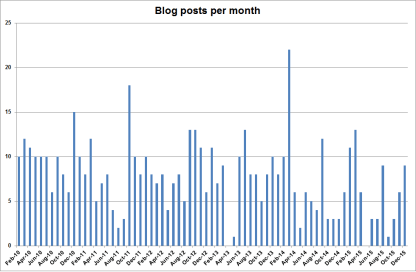
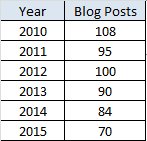
  • Writing: here I always remember a tip from Conor Neill, a professor at IESE, who says that we should strive to write something everyday, at least 500 words (see the blog post where he explains the benefits of doing so, Writing to reflect. Mindful leadership). In my case, apart from job emails, files, presentations…, I do not write (and reflect on) for this blog (or any other format) on personal interests everyday. Ever since I started the blog, back in February 2010, I intended to write regularly. What does that mean? Initially I aimed at publishing 8 posts per month, I lowered this target lately to about 6 posts per month. That would make about 70 a year. In 2015 I just met that target. Previously I had always been above 80 posts. See below the monthly production.

Blog post per month

Blog post per year

  • Speaking: on this front I was very consistent when I joined Toastmasters in December 2007, trying to give a public speech every two months. I kept being quite engaged until more or less mid 2012. I then dropped Toastmasters until I re-engaged myself in mid 2014 at the corporate club of Airbus in Toulouse. I am now trying to figure out the pace at which the club attendance allows and I am able to prepare myself to speak often (by speaking I refer to giving prepared speeches, as every two weeks in the club almost everyone gets to speak either with a role of evaluator, in table topics, etc). Thus, a vague objective (speaking regularly), not quantified, not yet in written, though shared.
  • Flying: for this objective scheduling is key. As I mentioned in the post where I shared my path to the private pilot license (PPL), it took me 4 years to obtain it mainly due to the difficulty in finding slots. From March 2015 (once I had passed the theoretical exam) I was more rigorous, always trying to have at least two slots scheduled with the instructor and airplanes booked at any point in time. This enabled that, even if many slots had to be cancelled due to weather conditions (or any other issue), I was more regular with the flying, I managed to obtain the license and fly over 19 hours. For the 2016, the goal is clear: to fulfil the requirements to maintain the license, that is 12 flight hours with 6 take offs and landings in the last 6 months prior to the license expiry date. On top of that, in order to carry passengers it is required to have completed 3 take offs and landings in the previous 90 days. Thus, the requirements by law help you in aiming at flying often. On the other hand, I was trained to fly on Robin DR 400 airplanes and another objective I have is to learn to fly another model, Diamond DA20 in order to have more flexibility with the scheduling of airplanes and be able to fly oftenhow often is often? At least a flight per month (ideally 2), about 2 flight hours a month… this objective, then, is well followed up with the aeroclub scheduling tools, navigation logs, etc.
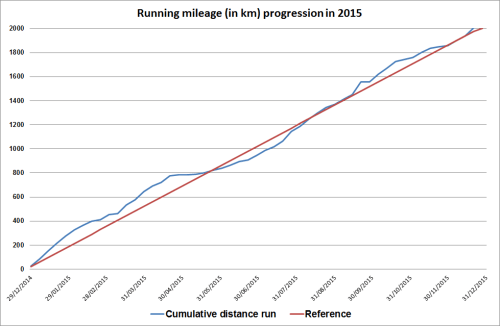
  • Running: with the running I have many and varied objectives. From running (e.g.) 2,000 km in a year, to completing at least 2 marathons a year, to beating personal best times (PBs) in different distances (10k, half marathon and marathon), to other miscellanea objectives (e.g. running x days in a given week, y kilometres in a given week or month, running some special race, running a number of days while on holidays…). For the completion of marathons and aiming at PBs I do schedule training plans at the online tool provided by Garmin (the provider of the GPS watch I use). Thus, the objectives are clearly defined, shared (with Luca, colleagues, in social media) and well followed up.

And it is here that I wanted to stress on the definition of the goal, its writing and its sharing. I will take the objective “running 2,000 km”. In 2014 I started to publish online in Twitter regularly both the goal and how I was progressing.

With the online tool I have the objective clearly written down and tracked, I know whether I am ahead or behind, the weekly or monthly mileage needed to attain the goal, etc. The sharing of the goal in my inner circles helps with the finding slots to run. The sharing of the goal more widely encourages and pushes oneself. See below how I reached the objective in 2015. You can see that while the training towards Seville (February) and Madrid (April) marathons lasted I was well ahead the reference. After those marathons took place I fell behind, even if I only fully stopped for a week after Madrid marathon. I kept running below the reference weekly mileage until the end of June, when I was 70km behind… I then subscribed for Millau (September) and started building up mileage for it, then extended the training up to Toulouse marathon (October), stopped only 3 days after it and, since then, I always was around or over the reference to attain the goal (even if I had to stop for over a week at the end of November due to a cold that got me down with severe throat ache).

Running mileage 2015 progression

***

It is clear that each one has a different approach and there is not a single one that fits us all. Many will not want to be constrained by fixed goals, nor be reminded of them by having them written, even less sharing some goal they are unsure to meet, not to talk about publishing it on social media! This is just how I go about trying to meet some personal objectives.

(1) At least not for every objective and plotting a global indicator.

(2) These goals are easy to share others are kept in the inner circles.

1 Comment

Filed under Personal development

San Silvestre 2015

Fifteenth participation (1) in the popular San Silvestre Vallecana on New Year’s Eve.

The team this time was composed by some 8 friends (Nacho, me, Pablo, Maicol, Carlos, Sara, Jaime and Alicia):

https://twitter.com/soler_bravo/status/682661492689342464

This year, we finished the race with a sprint over the last 200 meters, after having been joking about it all along the race. Even with that last rush, we added some more seconds to our record: this year it took us 1h12’17” to complete the 10km.

The time in this race is the less important aspect of it. As always, it is a pleasure to share a run through the centre of our home town with friends to give a healthy, funny and colorful farewell to the year. Be sure that next year we’ll be there to laugh, jog and beat our time!

(1) I took part in it for the first time in 1998, when less than 5,000 raced in it, and have always participated (not always inscribed though) except for 3 years (twice I spent New Year’s Eve in the Netherlands and other time I was injured).

Leave a comment

Filed under Sports

Summary of (my) 2015

Brief recap of my 2015. (1)

In the last year recap I mentioned about the coming 2015 that it would be “a year full of personal and professional changes, with plenty of learning opportunities, kilometres to run, marathons to enjoy, airplanes to fly and flights to catch, museums to see, books to read, trips to make and parties to enjoy“. Let’s see:

Family..

Family.

The main events of the year:

  • We are expecting a second child! (a boy)
  • I switched jobs (always within Airbus).
  • I passed both theoretical and practical exams and am now a private pilot!

Having said that: the personal objectives for 2015 are fully accomplished. Now, let’s review the year in more detail.

Avgeek. Believe it or not, this year I visited as many zoos than aerospace museums. But this is only because Andrea is as keen on seeing animals as on seeing airplanes. We visited the museum Espace air passion in Angers, the exhibition Pasion por Volar at ABC museum in Madrid, we visited Ailes Anciennes in Toulouse. Together with my engineering school colleague Serna and thanks to the kindness of several work colleagues we visited several of Airbus facilities in Toulouse (including simulators, telemetry room, iron birds, A380 FAL, etc).


DA20Flying
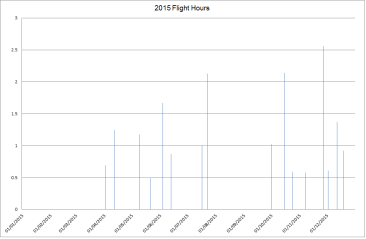
. As mentioned above, this 2015 has been the year in which I passed both theoretical and practical exams and finally became a private pilot! I managed to complete some 16 flights totalling over 19 flight hours33 take-offs and landings and including 5 solo flights (see here an account with my path to the PPL) and 2 flights already as captain (alone and with the family).

If I recall it well, this year only my former colleague Ruth had her baptism regarding flying with me at the controls. I am sure that in 2016 that will be the case with many more friends.

On top of that we made an unforgettable excursion with my friend Rapha and other colleagues from the Aviation Society to visit the Castles of the Loire Valley. We were about to make another one to Menorca island, but the weather forced us to cancel that one at the very last minute.

2015 Flight Hours.

2015 Flight Hours.

Reading. This year again I didn’t set any objectives in terms of number of books, but I only prepared a shelf with a selection of about 20 books that I wanted to prioritize. I started well the first month and finished the year at a decent pace  of 2 books per month, but reading “The spirit of Saint Louis” by Charles Lindbergh took me ages. In the end, together with that, I read 11 books: “Profiles in Courage” (by J.K. Kennedy), “El arte de ser padres” (by F. Dodson), “El general en su laberinto” (by G. Garcia-Marquez), “Diary” (by Anne Frank), “Pensar con Arte” (by M. Conthe), “España 3.0: Necesitamos resetear el pais” (in Spanish), “Lee” (by D. Southall Freeman), “Common stocks and uncommon profits and Other Writings” (by P. A. Fisher), “The gospel of wealth and other timely essays“ (by Andrew Carnegie), “Vol de nuit“ (by Antoine de Saint-Exupéry). See a post I wrote about my 2015 reading list.

Learning. This year, I have not taken any online open MOOCs but plenty (10+) of Airbus internal online trainings and some class ones (People make the difference (↑), Finance for non financiers (↓, too basic)).

Since switching jobs in July I started using French continuously at work (which wasn’t the case before even if working in France!). In 2016, what I will take on (again) is Dutch, this time joining a small group of students to get formal training!

Family 2.0. Despite of the family life and different changes, I managed to write just about 70 posts, though a bit less regularly. The blog received just over 45,000 visits in 2015 (less than in 2014 though) and is very close to reaching the 250,000 since I started it in 2010.

On top of that, Luca created a new professional website to offer her services as a lawyer in France (take a look here). Andrea hasn’t yet started her own blog.

DSC_0124Travelling. This year we visited Sevilla and Madrid (to take part in both marathons), the Loire Valley, stayed with friends for a week in Mallorca, made an escapade to San Sebastian and Biarritz to meet our friends from Brazil, made a 2-week tour around Spain (covering Madrid, Ubeda, Baeza, Sevilla, Huelva, Merida, Madrid, Valencia, Gandia, Murcia, Barcelona… driving some 4,500 kilometres in those two weeks). We visited the Netherlands (three times, about a week each time). Made some more escapades to Andorra, Montauban, Montpellier, Nimes, Arles, La Camargue, Millau…

Again, those were the leisure trips; on top of that, the job made me go to Madrid another 10-12 times (?), that made it tiresome and difficult to combine with other things but gave my plenty of opportunities to see my family, friends and to run in the Retiro park… however, that changed since I switched jobs in July 🙂

Sports Running. Again, this year, apart from a day in which I went skiing and some more of swimming, what I did was basically plenty of running.

DSC_0177In 2015 I have run over 2,000 kilometres, which was a goal I set to myself at the beginning of the year (setting a new yearly record surpassing the 2019km achieved in 2013). I competed in some 11 races (versus 9 in 2014) including: 3 marathons (Madrid (my 3rd participation in it), Toulouse (my second) and Sevilla (where I had the bitter experience of quitting for the first time)), another 100km-long ultramarathon (Millau again, this time with Jaime), a half marathon (Blagnac, where I set my new personal best time in the distance!), a trail (Ronde des Foies Gras, with a new personal best time) and some three 10k and the Course the Noel in Toulouse over 8.5 km.

Following a mantra I keep to letter “the running shoes, always in the suitcase”, the year 2015 caught me running in: Wijchen (10 times), Sevilla (4), Mallorca (6), Madrid (5), Gandia (3), Torrelodones (6), Andorra (1), Millau, Mauvezin plus the tens of times I trained in Toulouse and Blagnac.

2015 running monthly "mileage".

2015 running monthly “mileage”.

Other reasons for joy in 2015 have been:

  • My family: My sister completed her internship at  the NATO Energy Security Centre of Excellence (in Vilnius, Lithuania), then moved back to Madrid and she completed her thesis for the master she did in Odense (Denmark). We had the pleasure to have my mother again for a couple of weeks during summertime, when she found the time among the many clients of her massaging operation (here). My brother switched jobs and is back in Seville enjoying the high pace job at the last stages of A400M deliveries (we both visited him and had him visiting us in September). My father, enjoying is condition as retired, is ever more engaged with luncheons, conferences, reading, re-learning about electrical motors and construction activities at home.
  • Some more friends got married: Loreto and Jose.
  • And we welcome some newborns from family and friends: Martin (in fact, his was a last-minute arrival in 2014), Tim, Felice, Vera, Amelie, Victoria, Elena…

Now it’s time to rest, celebrate and soon to plan how we want the 2016 to turn out. It will include the welcoming of the baby (“two is more than the double of one” they say), an early trip to Brazil, lots of flying and running, Dutch lessons, some books to read, museums to see, trips to enjoy… For now, I will close 2015 celebrating my sister’s birthday, running the San Silvestre Vallecana in Madrid with several friends and enjoying a last dinner with the family.

I wish you the best for 2016, enjoy it!

Flight 2015.11

(1) You can see my 20102011, 2012 , 2013 and 2014 recaps.

11 Comments

Filed under Personal development

My 2015 reading list

In this post I wanted to share the list of books I read along the year (1) with a small comment for each one (2), links to Wikipedia articles about the book (if available) and to the authors (in case you want to read about them). I have also included a small rating from one to three “+” depending on how much do I recommend its reading:

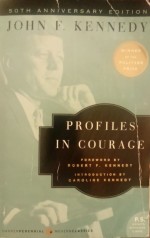
  1. DSC_0342Profiles in Courage (by John F. Kennedy) (++): written by then senator Kennedy when he was convalescent from a back surgery in the 1950s, this book analyzes the context, figures and controvert decisions made by 8 different US senators mainly from the XIX century (from John Quincy Adams, Daniel Webster… to Robert A. Taft), decisions that were not popular at the time in their constituencies but the politicians understood were needed to be taken and demanded courage to do so. For this book Kennedy obtained a Pulitzer prize in 1957. From the analysis, Kennedy extracts some lessons in the last chapter that are well encapsulated in the following dilemma: “[…] the loyalties of every Senator are distributed among his party, his state and section, his country and his conscience. On party issues his party loyalties are normally controlling. In regional disputes, his regional responsibilities will likely guide his course. It is on national issues, on matters of conscience which challenge party and regional loyalties, that the test of courage is presented.” 
  2. “El arte de ser padres” (by Fitzhugh Dodson) (++): a loan from my parents to help us in the quest of upbringing our daughter, the book, written in the late 1970s, did help in removing weight from some situations when the child was at the turn of being 2 years old. Among other things, it teaches you to get more relaxed, laid-back, not to enter into conflict trying to impose things, etc. It was also interesting to see how society and some social conventions have changed from the 1970s to today (e.g. drinking and smoking during pregnancy).
  3. TheSpiritOfStLouisThe Spirit of Saint Louis (by Charles A. Lindbergh) (++): this autobiographic book describes one of the great adventures of the XX century, the first non-stop flight across the Atlantic ocean in May 1927. For this book Lindbergh received a Pulitzer prize in 1954. The beginning of the book covers the days of Lindbergh working for the postal service of Robertson Aircraft Corporation and how he gets engaged into the race of who would be the first pilot(s) to cross the ocean. He later describes the conception, development and testing of the Ryan aircraft he flew for the feat. He finally gives a detailed account of the 33h30′ flight; hour by hour, alone, squeezed in his seat, with scarce food and water supplies, cold, flying day (within the clouds at times) and night, thrilling and semi-unconscious (asleep) at times, until he lands in Le Bourget. I wrote a post review the book, find it here.
  4. El General en su Laberinto (by Gabriel García Márquez) (+): this book is a novel trying to figure out how the last days of the Venezuelan revolutionary Simon Bolivar were. The characters, trips, locations, etc., are real. The dialogues, thoughts, feelings, are the work of Garcia Marquez. As always with Garcia Marquez, there are very vivid dialogues and reflections in the book by way of its characters, however this wasn’t the book I liked the most from him. On the hand, to get a better feeling and description of the last days of a person I very much preferred for the uneasiness it puts you as a reader The Death of Ivan Ilyich by Tolstoy.
  5. Pensar con Arte (by Manuel Conthe) (++): this book shows how our minds work in their way of thinking with their biases and the situations that may arise. The concepts covered are similar to other books that I have read in the past (Thinking Fast and Slow, Seeking Wisdom: From Darwin to Munger or Poor Charlie’s Almanack), the originality here comes from the parallels and connections that the author brings and offers with the arts (literature, paint, cinema, music…), showing examples from different art craft.
  6. España 3.0: Necesitamos resetear el pais (by Javier Santiso) (+++): this book is call for action, for change, for resetting Spain into a country which bases its economy and growth on innovation, education and technology. It starts by offering a rather harsh and in my opinion good diagnostic of many of the ailments of the country. Then shows how several things do work in the country and how in previous occasions the country has raised up to similar challenges and it can and has to do so again. The sooner the better.
  7. The Diary of a young Girl (by Anne Frank) (++): the diary of a 13-year-old girl when she starts writing it and 15-year-old when it finishes, Anne Frank describes how she, her family and some others live day by day in hiding from the Nazis. Throughout the book there are many comments, appreciations, worries, misunderstandings, etc., very typical of that age. Despite of that, at some points of the book Anne provides a great example of resilience, attitude and hope: e.g. at times she reflects that all in all she cannot complain, she doesn’t lose time and imposes onto herself a rigorous studying and reading time schedules, etc. In that extent, her attitude and the diary reminded me of another book I have often seen recommended that I must read, “Man’s Search for Meaning” by Viktor Frankl, a jew imprisoned at a concentration camp.
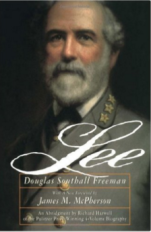
  8. LeeLee (by Douglas Southall Freeman abridged version by Richard Harwell) (++): this is the biography of Rober E. Lee the general of the Army of Northern Virginia on the Confederate side during the US civil war. The book covers from the origins of the family, the birth and early education of Lee, his days at West Point where he specialized as an US army engineer, and how as the different states start seceding and viewing that his allegiance shall remain to Virginia he resigns from the US army. The book then describes the different battles, the style of Lee during the war and the surrender at Appomattox. Then it covers his final years as president of the Washington college in Lexington. For the extended version of this biography, Douglas Southall Freeman received a Pulitzer prize in 1935.
  9. commonstocksCommon stocks and uncommon profits and Other Writings (by Philip A. Fisher) (++): a classic book about investing strongly recommended by many, among others Warren Buffett. The first edition was written in 1950s, the edition I read dates from the 1970s and includes some reflections of what he wrote in the first one. The main contribution of the book is what the author calls the scuttlebutt (rumor, gossip) technique, that is the thorough research ground work an
    investor must make before investing in any stock by way of talking to sales men of competitor companies, customers, experts on the field, academics, management of the company, etc., and which he summarizes in 15 points. A quick takeaway from the book is that, if you lack the time to thoroughly proceed with the scuttlebutt, it might be better to leave for others, who have, the task of picking your stocks. The Other Writings included in the book relate to what is and how it was developed his investment philosophy and on whether the markets are efficient.
  10. The gospel of wealth and other timely essays (by Andrew Carnegie) (++): In the main essay of the book (The Gospel of Wealth), Carnegie, discusses the moral obligation of the wealthy to redistribute their wealth in life back to the society. He positions himself against charity and offers several options that would have a great impact in lifting those among the poor willing to work in their own progress: funding of educational institutions, hospitals, libraries, parks, monuments, etc. Other essays relate to whether the United States (the Republic) should or not follow the path of Britain in having colonies and dependencies (in relation to the Philippines), a speech explaining the arrangements of the American constitution, critiques on proposals for free trade agreements between Britain and its colonies, etc. A good review of business and politics at the end of the XIX century.
  11. Vol de nuit (“Night Flight”, by Antoine de Saint-Exupéry) (++):  in Saint-Exupéry’s second novel he describes the operations of an air mail business based in Buenos Aires and with aircraft incoming from different locations in South America. The book describes the difficulties of night flight at the time and of developing this new type of service. One particular flight under cyclonic conditions will put into question the whole operation and the different characters, the pilot, her wife, the line operations’ chief, radio operators, etc.

(1) You can find here: my 2012 reading list, 2013 (embedded in my summary of 2013) and 2014 ones.

(2) In this 2015 I have not written many dedicated posts about the books I have read (just one about the The Spirit of St. Louis), but I do not discard making a review of some of them in the future.

14 Comments

Filed under Books

Análisis comparado sobre el acierto de mi pronóstico de las elecciones generales 2015

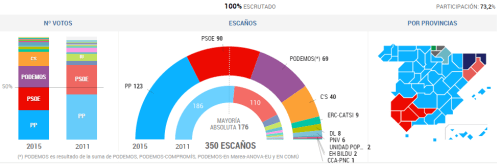
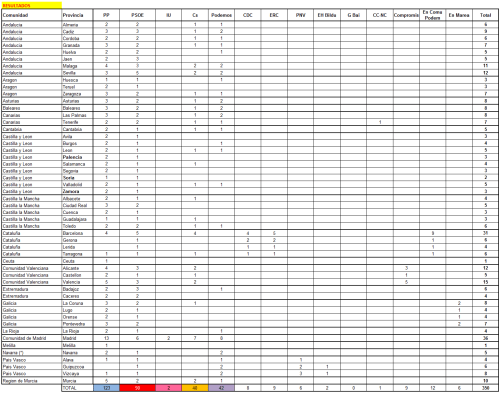
Ayer se celebraron las elecciones generales al congreso de España. Los resultados, conocidos por todos, ya con el escrutinio acabado han sido los siguientes:

Resultados elecciones generales 2015.

Resultados elecciones generales 2015.

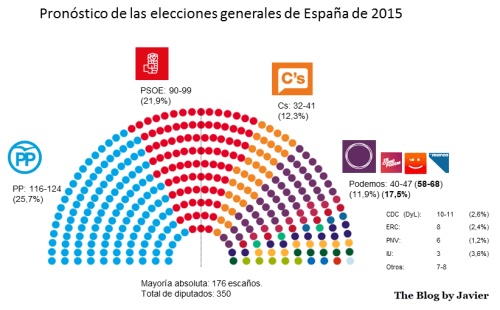
La madrugada del viernes al sábado publiqué un post con el pronóstico que yo hacía para estas elecciones. Muestro aquí de nuevo el resumen con la distribución de escaños en el arco parlamentario.


Como quedaría el arco parlamentario.

Como quedaría el arco parlamentario.

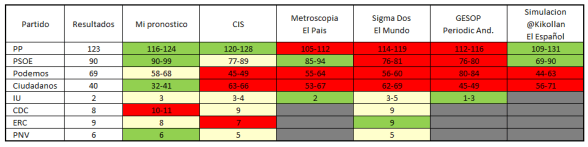
En este post quería simplemente examinar la bondad de dicho pronóstico. Para ello, en primer lugar quería compararlo con otros pronósticos que se han hecho en estas fechas. En la tabla de debajo, muestro una compilación de pronósticos con el resultado final a la izquierda. El código de color lo añado para ver donde aciertan y fallan cada uno de los pronósticos. Si el resultado cae dentro del margen que se indica lo doy por bueno (verde, independientemente de cómo de grande es el margen), si el resultado se desvía del margen por un solo escaño lo marco en amarillo, si se desvía por dos o más escaños lo dejo en rojo (como muy “desviado”) (1).

Comparativa de encuestas electorales vs resultados.

Comparativa de encuestas electorales vs resultados.

En la tabla se puede ver que de los 4 grandes partidos en 3 de ellos el resultado se encuentra del pronóstico que hice y con Podemos me desvié en 1 escaño. Todos los otros pronósticos tienen al menos a dos partidos (si no los cuatro) completamente fuera de los márgenes. Con quien más se han columpiado todos es con Ciudadanos, a quienes prácticamente todos daban resultados muy por encima de los obtenidos. Igualmente a Podemos prácticamente le daban todos menos de 64 escaños (excepto GESOP, que se pasó por encima en más de 10). A PP varios le daban bastante por debajo de 120 escaños. Es el PSOE el que mejor predijeron en general, aunque dos encuestas le daban un hundimiento bastante más pronunciado.

Por otro, sobre esta comparación quería indicar que la famosa cocina del CIS tampoco es tan tendenciosa como a veces se quiere hacer ver (2). Al partido del gobierno le ha dado justo en el centro. Al PSOE lo tiene prácticamente en el margen. Y es a Ciudadanos y Podemos donde los tiene cruzados, como las otras encuestas excepto GESOP.

Por último, tengo la impresión de que en las cocinas al voto indeciso lo tienden a ver como más de cambio de lo que realmente es (3).

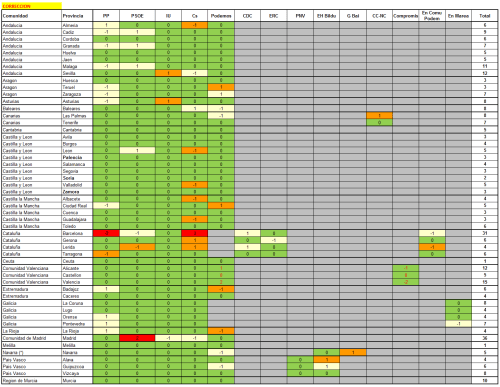
Una vez comparadas las encuestas y visto que mi pronóstico efectivamente fue mucho más certero, quería ver cómo de certero fue en términos absolutos. Para ello he recopilado los resultados provincia por provincia para poder comparar la desviación o no que tiene el pronóstico para cada partido. Ello se ve en las siguientes 3 tablas: pronóstico, resultados y corrección.

Pronóstico detallado.

Pronóstico detallado.

Resultados detallados por provincia.

Resultados detallados por provincia.

Correccion_por_provincia

Corrección del prónostico con resultados por provincia y partido.


En la corrección he usado el mismo código de colores: verde cuando el resultado estaba dentro de lo pronosticado, amarillo si me equivoqué en 1 escaño para ese partido (introduciendo un naranja cuando ese error supone pasar de estar representado a no estarlo o viceversa) y rojo cuando me equivoco en 2 o más escaños.

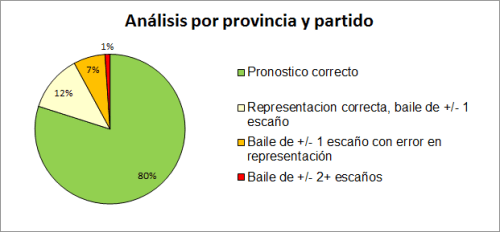
En total, en la tabla hay unas 280 predicciones a hacer: 223 correctas (si bien prácticamente 50 son darle un cero a IU en las provincias donde se presenta, todas), 53 errores de un escaño (19 de los cuales suponen cambio en la representación), 3 errores de 2 o más escaños.

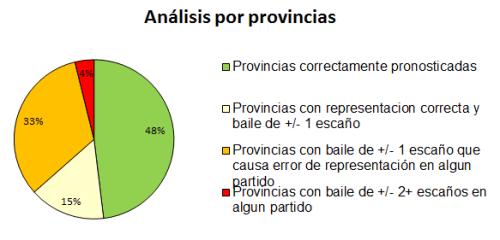
Debajo incluyo un par de gráficas donde se puede ver de un vistazo lo descrito arriba. Por partido y provincia acierto en un 80%. Por provincia, prácticamente el 50% están predichas correctamente para todos los partidos.

Analisis por partido y provincia.

Análisis por partido y provincia.

Análisis por provincia.

Análisis por provincia.

Finalmente, en el post donde incluí el pronóstico indicaba que las dos castillas parecían fáciles de predecir, no así Cataluña, Galicia y País Vasco. Efectivamente, de largo es en Cataluña donde más errores he tenido. Castilla y León ha salido bastante bien. Y en Castilla La Mancha tuve algún error más de los esperado (escaños a Ciudadanos). (4)

(1) El hecho de usar una desviación de 1 o 2 para distinguir entre poco y muy desviado es totalmente arbitrario. De hecho, podría haber cogido como “poco desviado” hasta 5 escaños, y mi pronóstico seguiría siendo igual de mejor que los otros, pero he querido coger 1 porque así es el mismo código de colores que uso en este mismo artículo un poco después para ver el acierto provincia a provincia y partido a partido. Y ahí, sí, no se puede suponer que desviarse por más de 1 escaño es “poca” desviación.

(2) No en vano, la última encuesta del CIS se realiza sobre 17.000 muestras, esto es un orden de magnitud de las ~800, ~1200, 2800, etc., que usan las otras.

(3) En mi opinión mejor harían en pensar en ese voto como una regresión a la media de lo ya visto en elecciones anteriores.

(4) En la tabla se puede ver que en la Comunidad Valenciana he coloreado todas las casillas en verde a pesar de haber números en Podemos y Compromís. Esto es debido a que en el momento de hacer el pronóstico no era consciente de que de hecho iban juntos. Y le di a cada uno la representación que creía que iban a tener. La suma de ambas representaciones pronosticadas es igual al resultado del conjunto. Esto ha sido posible en parte gracias a que Valencia es una circunscripción grande y el error en no agruparlas no ha hecho que mi pronóstico perdiese escaños de Podemos.

1 Comment

Filed under Miscellanea

To my old GPS watch

photo (5)A few days ago I picked my new running watch which incorporates a GPS (1). The previous one, a Garmin 405 Forerunner was a present from Jaime and Luca back in the Christmas period of 2010 to 2011.

At that time, I had then just moved to Toulouse and they thought that it would be a good gift to incentivize the expressed wish to take on running again. And how it worked! With the new watch I started to measure some running tracks, track my heart beats, beat my personal records, record every run, run plenty of races, race and train with friends…

In just half a year I lost about 20 kilos and completed about 900km. Never before I had run so often so constantly. It helped me to run firstly slower focusing on the heart and then faster focusing on the pace. It helped to introduce tempo and series sessions in the training.

weight

In these 5 years, wearing the watch almost at every run (2), pacing myself with it, making numbers in my head about rhythms, times, kilometres, etc., I have completed over 9,000 km, more than 50 races, including 10 marathons and 2 ultras.

stats

Since the last summer it started to work faulty. Sometimes it switched itself off, it re-started by itself, it didn’t recharge the battery well… The last time it recorded well a complete activity was on October 29th, when we ran together 7km, just 4 days after having completed the Toulouse marathon. Maybe it needed more time to rest.

Rest in pace.

(1) A Garmin Forerunner 220.

(2) Except for having for some times in which I forgot it or its battery went out.

Leave a comment

Filed under Sports