My grand navigation solo

When talking about flying lessons and my progress (or the lack of it :-)) I am often posed the following question or comment: “but if you are taking lessons… then you always fly with an instructor, right?”

The answer is no. Unlike car driving lessons, part of the requirements to become a private pilot is to have completed a given amount of flying hours having flown solo (i.e. without instructor), part of them “navigation” flying hours (1).
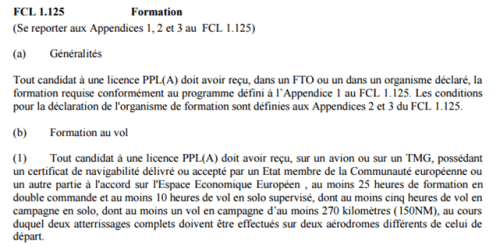
Flight Crew Licence formation requirements.

Flight Crew Licence formation requirements.

The first flight solo is typically a marking moment in the flying life of a pilot. See here a post with my experience then. The first flights solo are typically around your home aerodrome, where you are used to all geographical accidents, the aerodrome circuit, radio frequencies and you may feel less stressed. A friendly scenario where to push the bird to fly.

There are many other marking moments in the flying life of a student pilot: the first take off or landing that you do at the controls, or the first navigation solo. The word navigation is used to describe flights going from one aerodrome to another, hence some navigation skills are required and employed to reach the destination.

Then, another big marking moment is what in France is called the “Grande Nav solo”. As its name points out, it is a solo flight implying navigation, but then a big one, a rather long flight. Specifically, as required by the FCL 1.125 (b) (1) “done au moins un vol en campagne d’au moins 270 kilometres (150NM), au course duquel deux aterrisages complets doivent etre effectues sur deux aerodromes differents de celui de depart” (see requirements above).

I completed such grande nav solo flight back on July 23rd. I had been after it for months, trying to find a slot with good meteorological conditions and having accumulated some flight hours in the prior weeks to feel at ease. It was big moment that I wanted to share here.

For that navigation we selected the route Toulouse Lasbordes – Rodez (2) – Cahors and back to Lasbordes. The route had over 160 nautical miles (over 300 kilometres) and would take me over 2 hours, including the two complete landings. You can see below the route in a screenshot from the 1/500.000 aeronautical chart available at the website carte aero fr.(3)
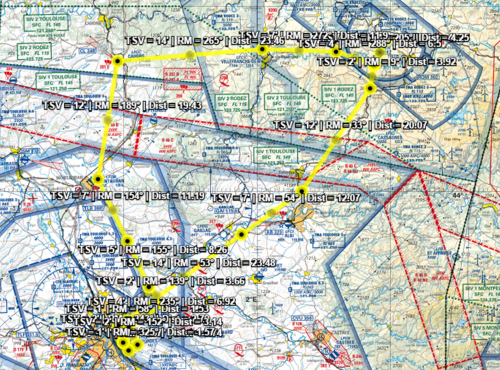
Route planned for my grand navigation solo.

Route planned for my grand navigation solo.

The experience during the flight.

The flight went remarkably well, even if I started a bit pressured because of the time.

I arrived at the aerodrome at about 18:00. With the flight preparation, finding out last information about weather, points of contact for special zones, pre-flight check list, etc., I only managed to start the engine at 18:36 local time. At that point I started to have some doubts of whether if anything went wrong I might not be able to return back after the complete flight… would I have to shorten it? I decided to take a look at the timing at Rodez parking.

After the take off, and en-route to Rodez, right after quitting Lasbordes’ radio, I passed with Toulouse Info and demanded a flight tracking, which is reassuring at the beginning. I couldn’t start climbing up to 4,000ft right after flying over Gaillac as there was some Airbus traffic coming from Blagnac. Reaching Camaux, close to Albi, I had to turn left (033) and then I could start the climb.

The week before I had got lost while navigating towards Rodez (I was then with my instructor, and we found ourselves with the help of a GPS). Not this time. I paid much detail to the navigation, finding the villages that marked the different way points of the approach to Rodez, and cross-checking with the tower that I was indeed at those points.

Curiously enough, when I was at the parking in Rodez there was a helicopter coming in, which followed the same descent path, runway, taxi way, etc., as if it was an airplane.

At the parking, I quickly made the numbers and thought I would have enough margin to complete the whole flight so I decided to go.

On the way to Cahors I continued being followed by Rodez Info (same controller than Rodez tower). When I mentioned that I was quitting to pass with Toulouse Info frequency he noted that I could continue with him all the way to Cahors, so I did. Having the sun setting in front of me and not wearing sun glasses that afternoon it was difficult to locate the terrain. I was seeing some cleared land about 10nm ahead, thus, I again asked the controller. He confirmed that it was Cahors aerodrome and that the distance was 8nm. Good. Second leg almost done.

I passed to Cahors frequency. As there was no controller it operated only for communication between airplanes… and parachute jumpers, as there were many jumping at that moment. The pilot of the plane from which they jumped proved quite helpful there. Even if I had studied the aerodrome chart, he provided all kind of explanations via the radio at my arrival:

“as there is parachuting activity, don’t fly over the vertical, integrate yourself directly into the circuit. There are no more airplanes at the moment, report in base leg (the circuit is a right hand for runway 31, the one in service). There are two exits to the runway, take the second one as in the first one there is a plane waiting for departure: me…”.

While parked at the tarmac, I drank some water and listened to some message for me. They offered to sign something for me. I wasn’t not understanding it fully. What did I need to get signed? Nothing. So I asked them about that. Apparently they offered to sign some paper as a souvenir of having flown to that aerodrome and visited the aeroclub. I thanked them and told that I wanted to go quickly back to Toulouse. “So, you’re doing your Grande Nav Solo, aren’t you?”. “Yes, I am” (all radio exchanges in French, though). “Good luck then!”. After a couple of minutes, I proceeded with the check lists to depart.

On the way back to Toulouse I passed again with Toulouse Info. I passed by the East of Montauban, Villemur-sur-Tarn… and then I was already in an area I knew well, thus I was rather calm.

Arriving to the way points EN and AE there was some traffic (informed by TLS Info), and as soon as I got a visual of them and they flew away I passed to Lasbordes frequency (no controller anymore due to the time of arrival). I proceeded with the integration, landing and parking at my aeroclub’s tarmac. Done!

Finally, find below a copy of the navigation log I used during the flight, with remarks for changes of heading, comments for the route, annotations during the flight, ATIS information, and the sum made at Rodez to estimate the remaining duration of the flight to decided whether to continue or not.
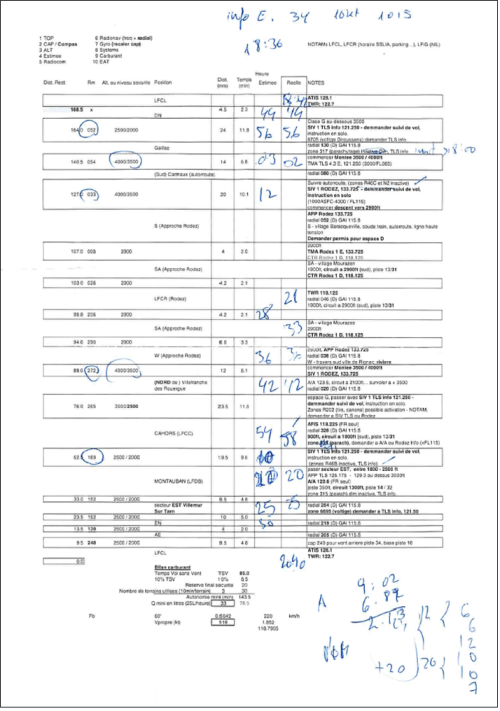
Navigation Log for the Grande NAV solo (2015.07.23).

Navigation Log for the Grande NAV solo (2015.07.23).


(1) The extract is taken from the French ministry for sustainable development [PDF] which oversees Flight Crew Licence requirements.
(2) Coincidentally, just a few days before that flight I had flown with my instructor and a colleague to Rodez and got lost at the destination.
(3) A tip from my colleague Rapha and a good resource to quickly start preparing a navigation flight.
 

1 Comment

Filed under Aerospace & Defence

100km of Millau (2015)

I had doubts I would ever put myself to the test of an ultra marathon or a 100km race again after having completed the “100km de Millau” in 2011.

Jose, whom I ran with that time, suggested at times to do another one. Manuel, with whom  I have trained often and now regularly runs ultra marathons, had often suggested to join him in one. My brother Jaime had also indicated that he would like to try once. I never go tempted by those calls…

… a couple of months ago, Manuel mentioned that he would run Millau and asked whether I was interested. I passed on the baton to Jaime, who almost immediately said yes. And thus, we subscribed ourselves to the race.

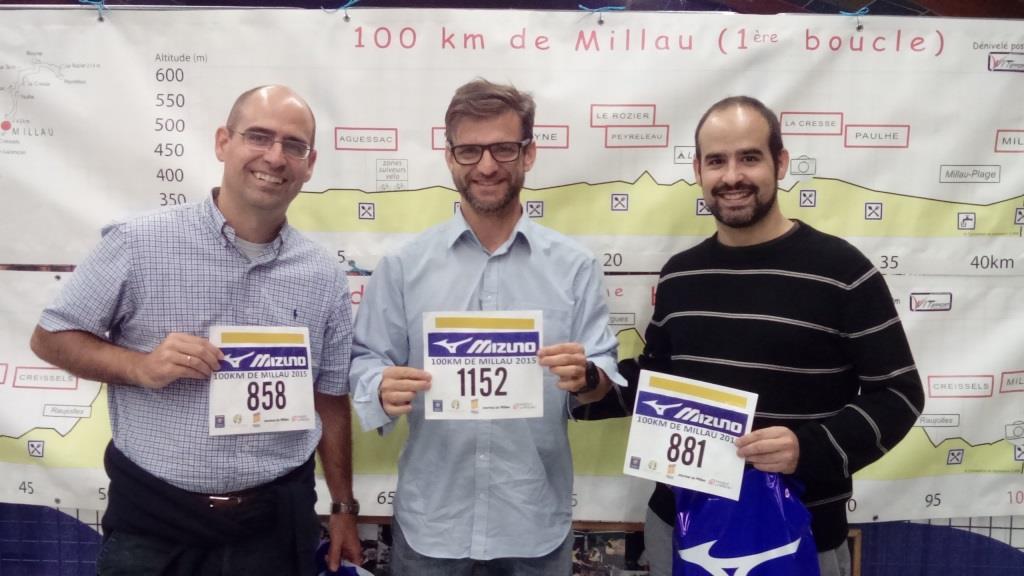
Running bibs the night before the race.

Running bibs the night before the race.

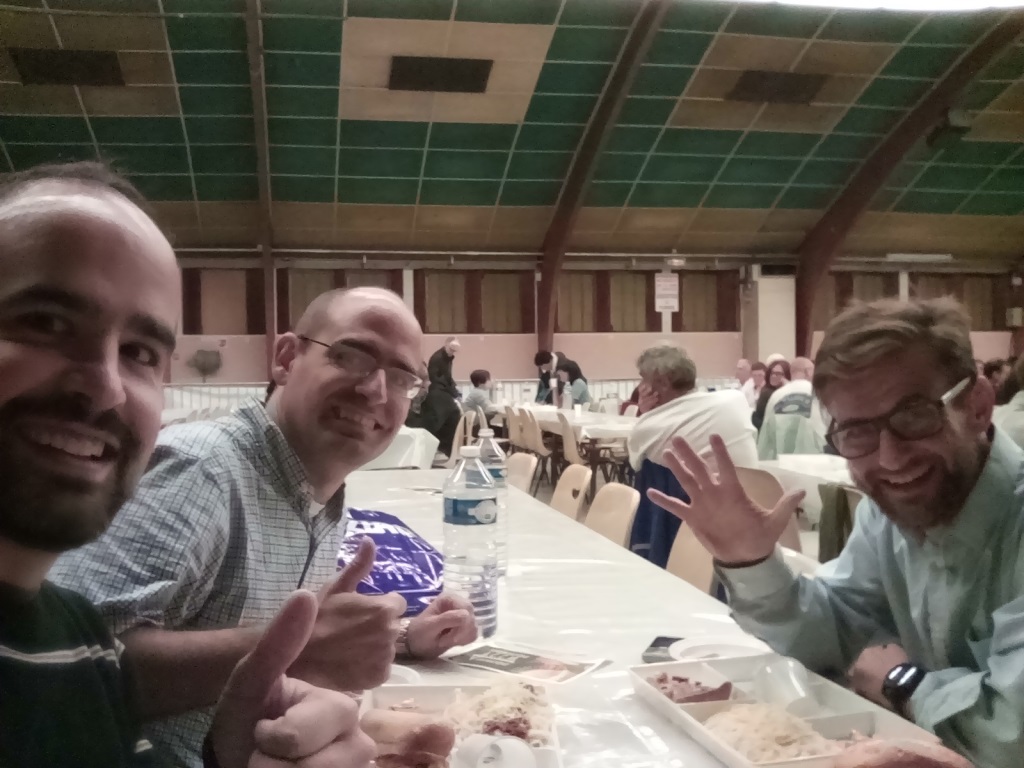
Pasta dinner the night before the race.

Pasta dinner the night before the race.

We didn’t specifically train for this race. Jaime didn’t almost find the time to train, except for the weekends. I took a look at some training plans and the amount of dedication required put me off. Thus, I decided to simply keep running a moderate mileage of between 40-60km per week on average and knowing that this would suffice to complete the marathon satisfactorily, go with that as training and rely on the mental side and experience for the rest.

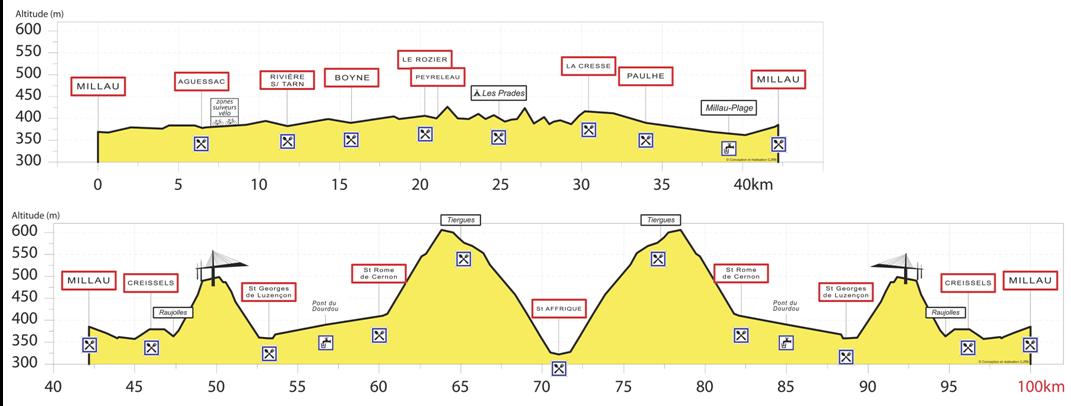
The circuit of the race and the profile remained unchanged from 2011. This helped a lot, as I remembered several parts of the race, profiles, etc. (1)

Perfil de la carrera.

Profile of the course.

Our race strategy was rather simple this time: run a marathon in a ~6:20 pace, aiming at about 4h30′, stopping briefly in the supply posts, reduce at least in half the time spent changing clothes and shoes in Millau (km 42) and Sainte Affrique (km 71)… and so we did. We basically followed it to the point.

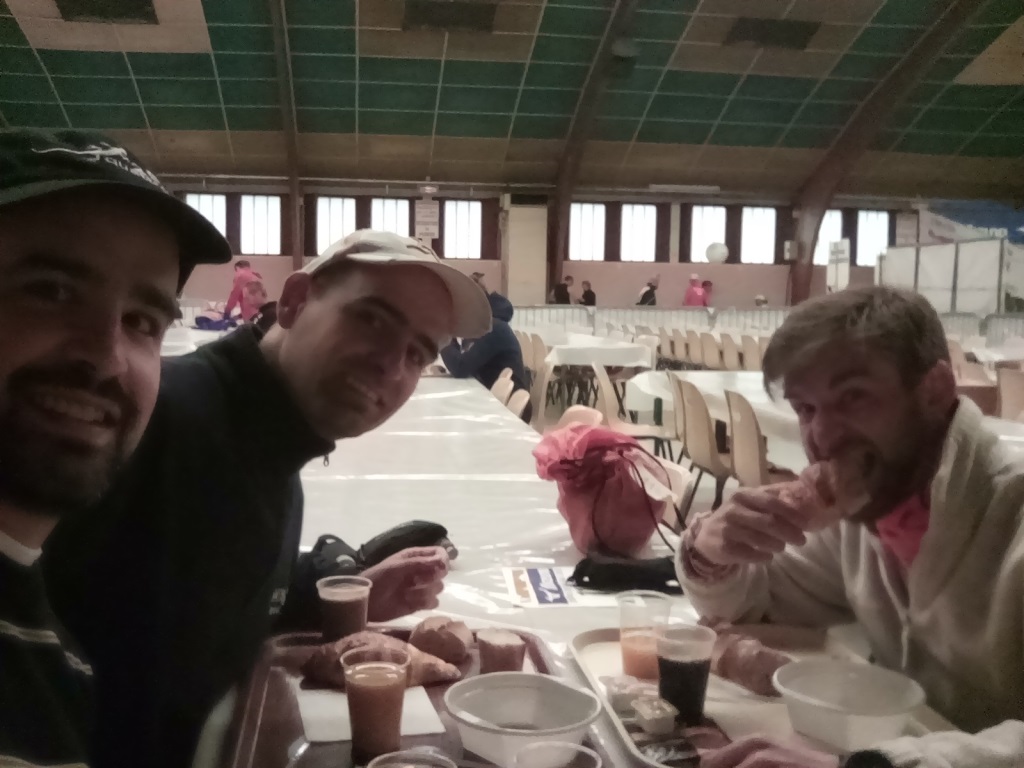
Breakfast the day of te race.

Breakfast the day of te race.

Leaving the hall towards the starting point.

Leaving the hall towards the starting point.

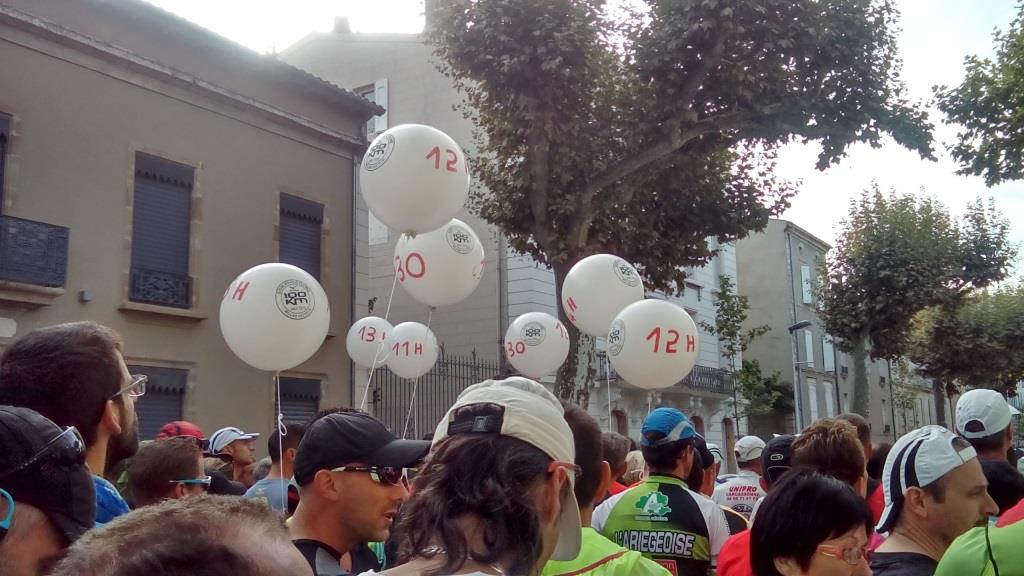
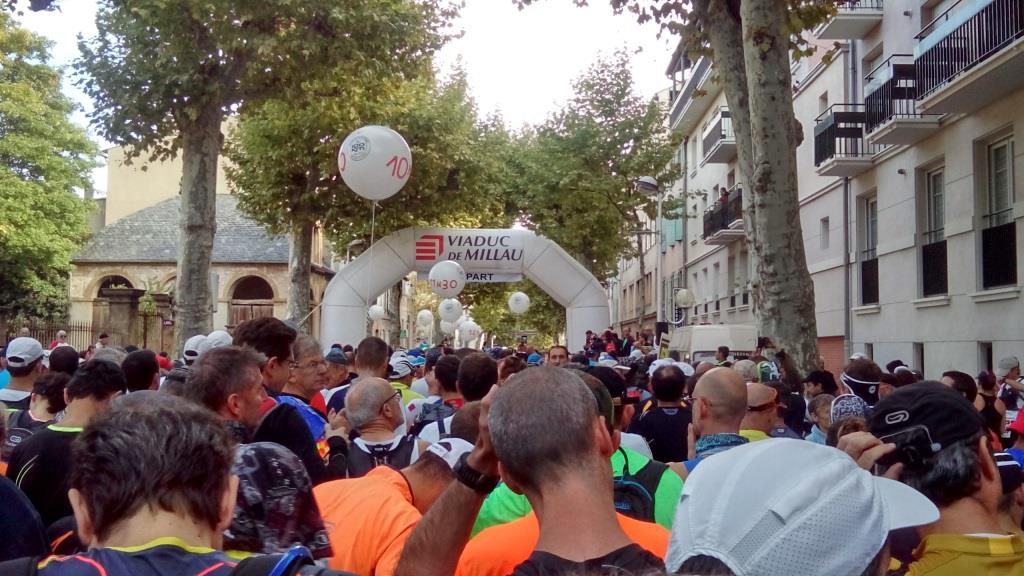
Which pacer do we follow?

Which pacer do we follow?

Departure line.

Departure line.

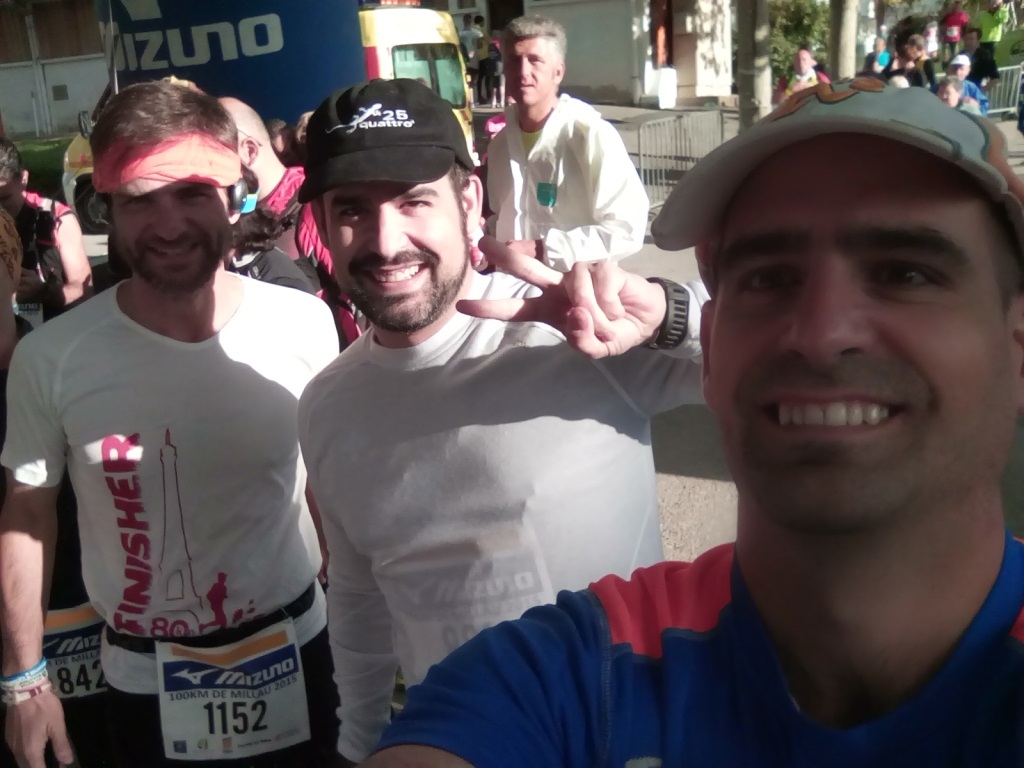
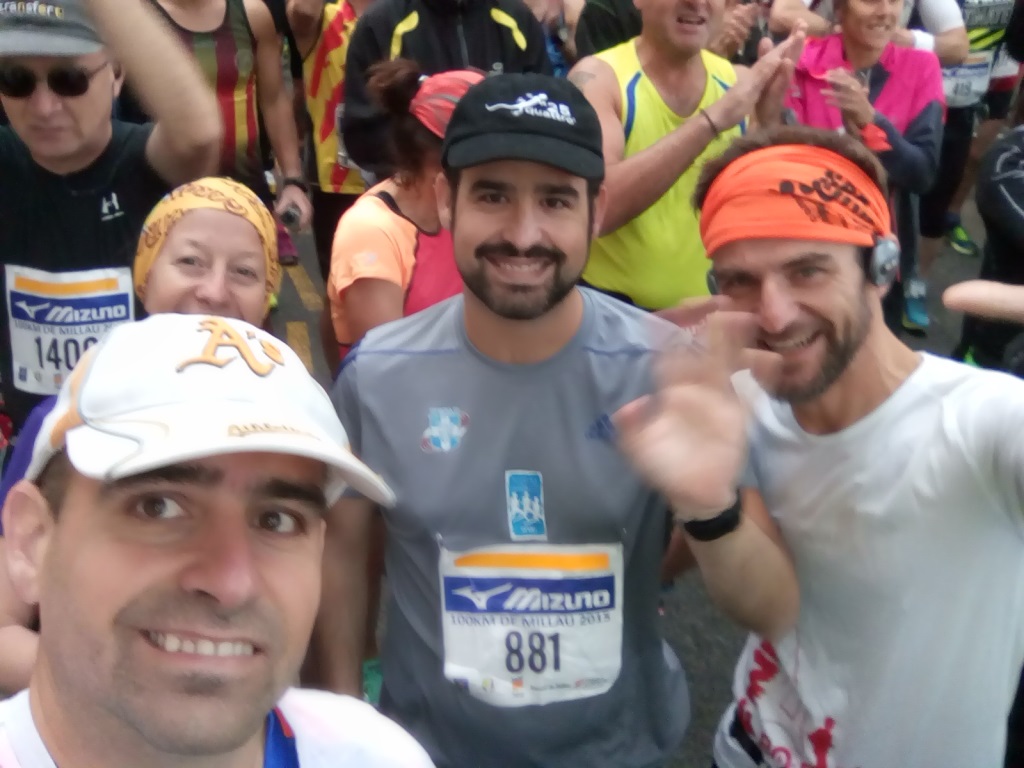
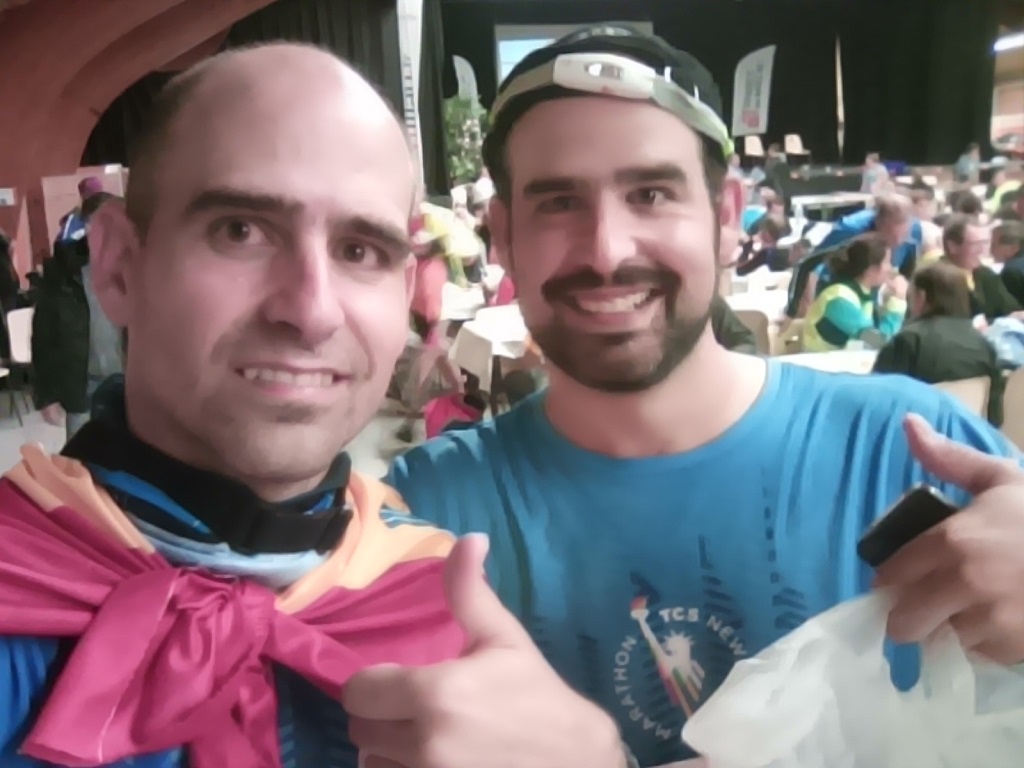
One last picture before we start running.

One last picture before we start running.

We started running at the intended pace. We first catched the 13h pacer, the 12h pacer, the 11h30 pacer… we knew we wouldn’t arrive with them but wondered why we were overtaking them. We asked their estimated arrival time at the marathon and it was slower than ours (though they wouldn’t stop then and would keep a faster pace in the second 58km than what we intended). So, after about 10km we went forward with our 6’20″/km rhythm.

When you see the profile of the complete race you may get the impression that the marathon runs along a flat profile. It certainly does  not. There are some spots, especially right after the half marathon, which are very demanding. We took them easily even if kept running in them. At about the km 28, we softened the pace to avoid meeting the Wall. And so we did. Again, running this marathon at a leisure pace was a great experience. In the end we spent some 14 minutes longer than planned (~4h42′), but the timing was good enough.

At Millau (km 42.195) we changed clothes, but kept the pause shorter than we did in 2011 (just less than 20′). Departing from Millau was difficult again: getting the muscles to work again after a little resting time. We needed to keep running for just about 5km until the first hard climb to pass under the viaduct. We did so. Even if I had some pain in the Achilles tendon when running uphill.

Km. 47, it is tough...

Km. 47, it is tough…

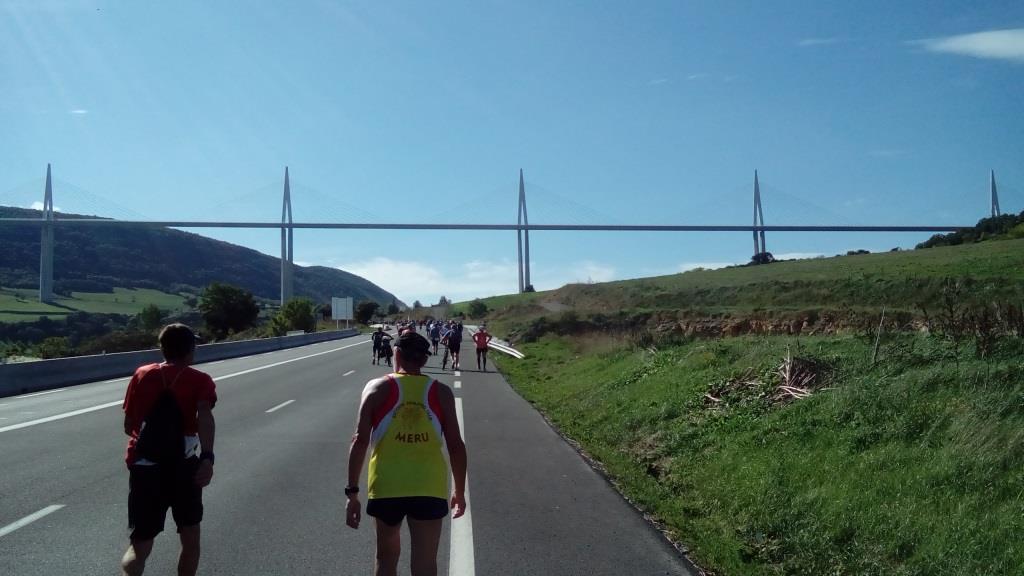
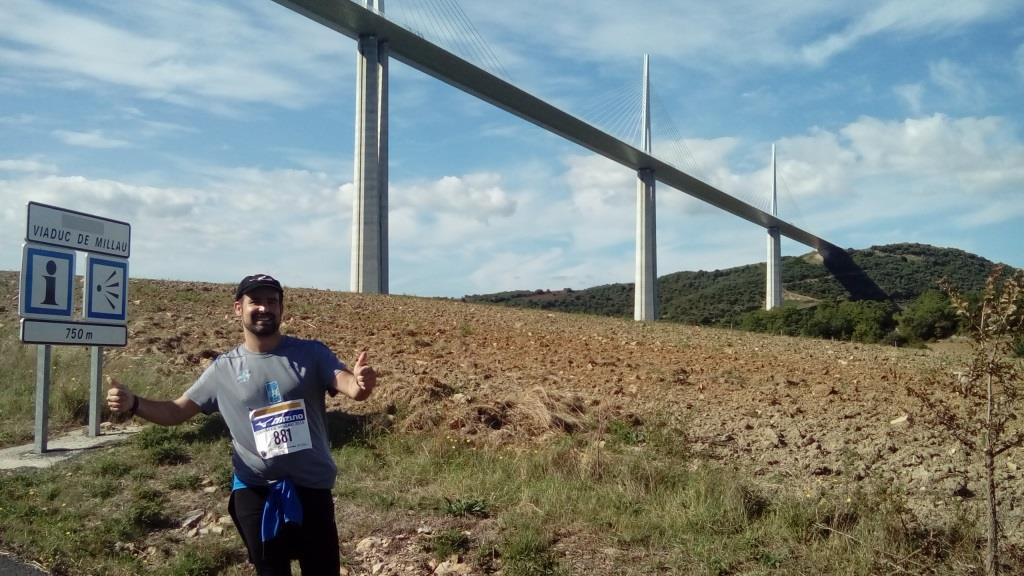
At the viaduct we took again some pictures, plus another at the 50km mark, even if changed to a smaller one (in comparison to 4 years ago). Descending towards St. Georges Luzencon we took a conservative pace as we did at the beginning of the false flat course towards St. Rome de Cernon. However, after some minutes of soft climb I felt again pain in the Achilles tendon and I had to walk at some stretches combining it with running.

Highest viaduct in the World, definitely worth a picture.

Highest viaduct in the World, definitely worth a picture.

At St. Rome, we took a quick preventive massage. Followed by a good supplies ingestion. Funny enough, just leaving the village, I was still eating some bread with foie gras and drinking (both hands occupied) when some spectators cross checked my bib number with the local newspaper, found my name and started cheering me! I found it funny: being cheered for eating and drinking :-).

After St. Rome, it came the climb to Tiergues, which we walked up. In the descent from the top of the hill towards Tiergues itself (at km 65) we met Manuel who had some muscular troubles himself (but he nevertheless would finished in a very respectable time of 11h22′). After the supply post at Tiergues we continued running down to St. Affrique.

We arrived there with some 40-50′ in advance in relation to the timing we did in 2011. And again, we kept the stop in St. Affrique to the minimum time needed for changing clothes, eating and drinking. Another 20′ and we went. Started running just to the outskirts of the village before starting the long(est) climb back to Tiergues, about 7km. At the top we were about 1h10′ ahead of the time we did in 2011.

I remember one of the volunteers at Tiergues (ex km. 65, now km. 77) who was continuously making jokes to runners, very loudly, all other volunteers laughing with him. I told my brother that I wouldn’t have minded to stay there partying with them. However, after a few minutes of eating (some hot soup) and drinking (some beer) we re-started running to complete the uphill climb and the downhill descent back to St. Rome.

Once you start the descent to St. Rome you know you have made it. You’re about a half marathon from it. 22km. In the (almost) worst of the cases you can slowly walk them to the end and it would take you a mere 5 extra hours… so what? But then you run and it takes half of it.

At St. Rome I needed some attention from the podiatrist to heal a blister. It did more bad than good, as instead of just removing the liquid and drying it out, she introduced some other disinfectant liquid which kept the pressure and left me in pain for a couple of days.

From St. Rome we had another gentle descent down to St. Georges. At mid-way point (Pont du Dourdou) there was the supply post in which the play rather loud and very animated music, a kind of discotheque. I would not have minded to stay there either for the remainder of the night. But we still had 15km to go. At the time I was already making numbers knowing that we wouldn’t finish under 14h but confident that we would under 15h.

We kept running down to St. Georges where we stopped to take some more soup, coke… one more kilometer and up again to the viaduct, walking again. Once you run under the viaduct on the way back you’re less than 8km to go. It – is – done. At the descent down to Raujolles we noticed the sign post with the 8% descent (meaning that from km. 47 you had a nice 2km-long 8% climb!).

By then we had been over taking runners and walkers for some time. Some of whom were not stopping at supply posts and would overtake us during those pauses. At Creissels we took the last bit of soup, chocolate and water. And there we went down to Millau. Again, to Millau. Millau.

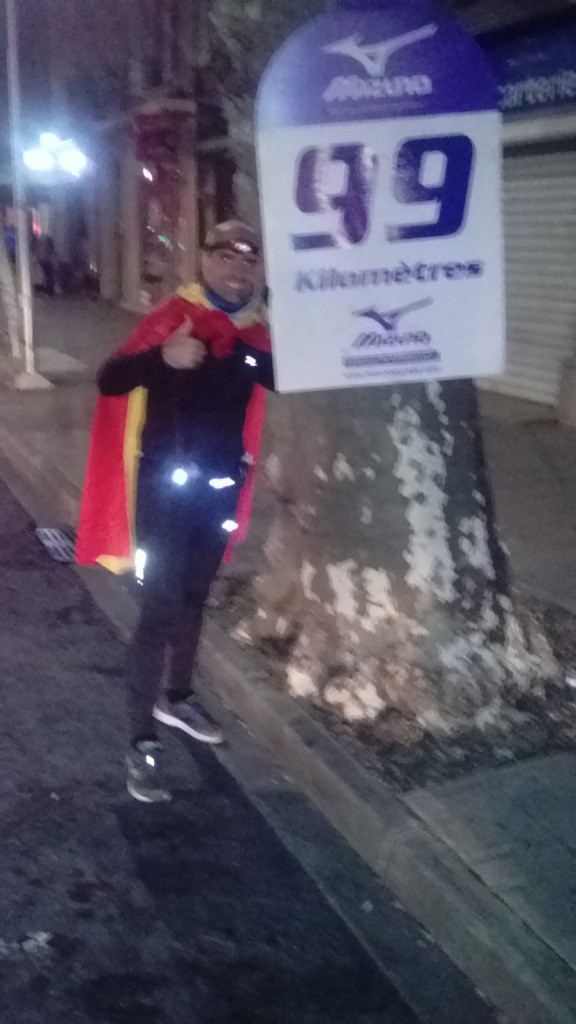
The bridge crossing the river Tarn in the entrance of the city is at about the 98th kilometer. This time again, I put then on the Spanish flag to complete the last two kilometers with it. We again took some pictures at the emblematic sign post at the km. 99 in the streets of Millau.

DSC_0177

Posing by the km. 99 sign post.

We kept running in the Avenue de la Republique afterwards called Charles de Gaulle, we then entered the Parc de la Victoire and again we sprinted to climb the metallic structure allowing us to enter into the Salle de fetes de Millau, crossing the finish line in 14h39’21”.

Four years later, again, objective accomplished. The 100km of Millau completed. Another ultra marathon finished.

Mission accomplished!

Mission accomplished!

This time we employed some 35′ less than the previous time. We basically reduced the time spent in long pauses, we ran a faster marathon and needed less medical assistance. However, we ran slower the last 22km (we consumed there some 35′ more, or half of the time-cushion we had at Tiergues).

This time, for me it was very much less mentally demanding. I remember that in 2011 I had many doubts at some points. If Jose had not been there, I may had dropped it between km 60 and 71. This time I didn’t have any doubt. I was cheering my brother and myself from km. 25 every now and then. Knowing that we would make it. Again, no matter the time.

The following days, again, I had a terrible pain in the legs, similar to those you may have after the first marathon you run (especially if not well trained, as it was my case back in 2000). However, after a week I could start running and training again. A much better recovery than 4 years ago, when I suffered from a serious tendonitis.

I don’t know if I will run another time in Millau, or even another ultra, but this time, yes, I felt comfortable with knowing that it was manageable and that if needed, it can be done yet another time.

(1) It also helped that I had written a detailed post about it in this blog, to which I came back for references.

7 Comments

Filed under France, Sports

Corrida Camarguaise (bullfighting / toros)

Hace unos meses viajamos a La Camargue, y en particular al pueblo Saintes Maries de la Mer. En esa visita tuvimos la oportunidad de asistir a una corrida de toros, pero a una “corrida Camarguaise“, que es diferente a una corrida de toros “andaluza” (como dicen en Francia).

Durante la corrida hice una serie de fotos y videos que se pueden ver más abajo para entender mejor el breve resumen de las cosas que percibimos, aunque estoy seguro de que no llegué a entender todas sus particularidades.

En una corrida camarguesa, no hay un matador, ni banderillas ni picador. El toro no muere. De hecho se parece más a lo que en España llamamos concurso de recortes; aunque tampoco es igual, es mucho menos vistoso y espectacular (al menos la que tuvimos la oportunidad de presenciar).

En la corrida camarguesa que presenciamos, un pequeño grupo se enfrenta al toro por turnos. En este caso eran como tres recortadores (raseteurs), vestidos de ropa deportiva (no un traje de luces), que por turnos partían en carrera para pasar por delante del toro, y si tenían la oportunidad hacerse con uno de los trofeos que lleva el toro en la sien, entre los cuernos. Estos trofeos son pequeñas cintas de papel, que el raseteur debe coger en carrera con la ayuda de un garfio.

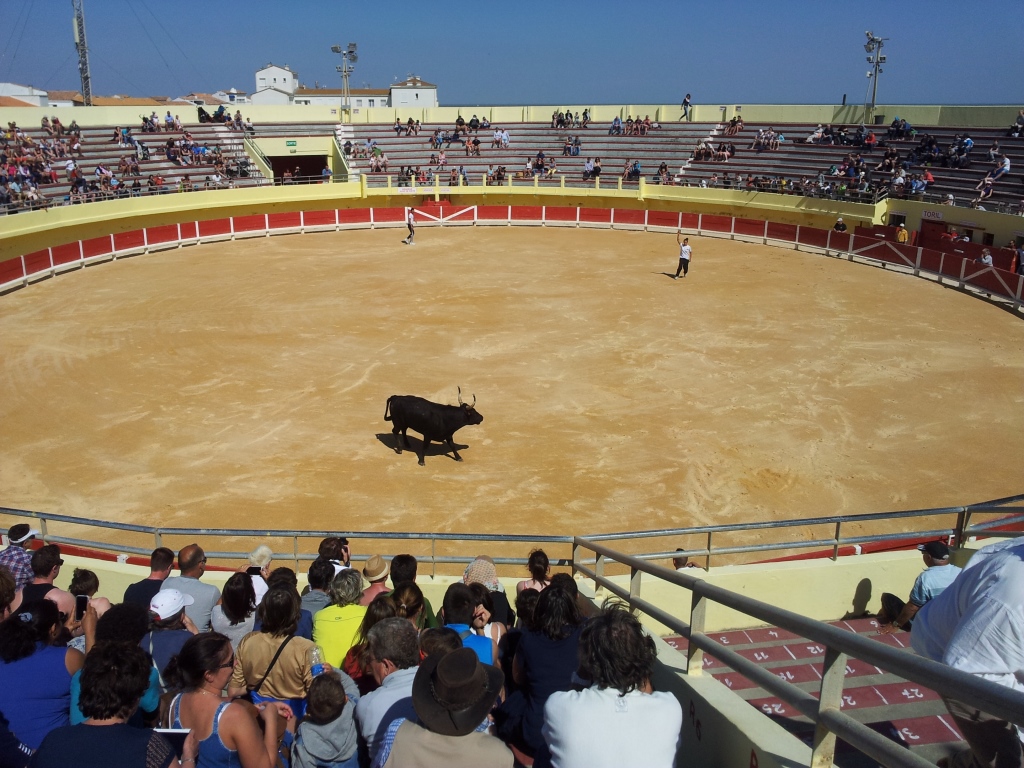
Corrida camarguesa en Saintes Maries de la Mer.

Corrida camarguesa en Saintes Maries de la Mer.

Por cada trofeo que cojan, el raseteur obtiene una puntuación y un premio en metálico. Ese premio depende de las aportaciones de los negocios locales y asistentes a la corrida, que financian la fiesta. De hecho, durante la corrida, hay un locutor que va anunciando los nombres de distintas empresas y la cantidad dineraria que aportan. Al cabo de unos segundos el locutor indica en cuanto está la suma en ese instante. Conforme la suma aumenta mayor es el incentivo de ser el primero en coger los trofeos.

Además de los 3 raseteurs (pueden ser más), estos estaban acompañados de un equipo de ayudantes (peones) que tenían como misión el llamar al toro, orientarlo y posicionarlo en el ruedo. También el ganadero tenía su labor. Puede ser porque la barrera en esa plaza fuese de menor altura de la que tienen las plazas en España; el hecho es que el toro saltó varias veces la barrera y corrió por el pasillo entre la barrera y la grada. Entonces, era el ganadero, el que, con la ayuda de una vara, reconducía al toro a una de las puertas de acceso a la plaza.

En resumen, un espectáculo curioso, con un cierto parecido a un concurso de recortes.

1 Comment

Filed under Miscellanea, Travelling

Pasión por volar

Durante mis últimas vacaciones en España, vi un tuit de la cuenta de Iberia promocionando la exhibición “Pasión por volar” en el Museo ABC (1). Dado que pocos días después, el viaje me llevaría a Madrid, me anoté la visita.

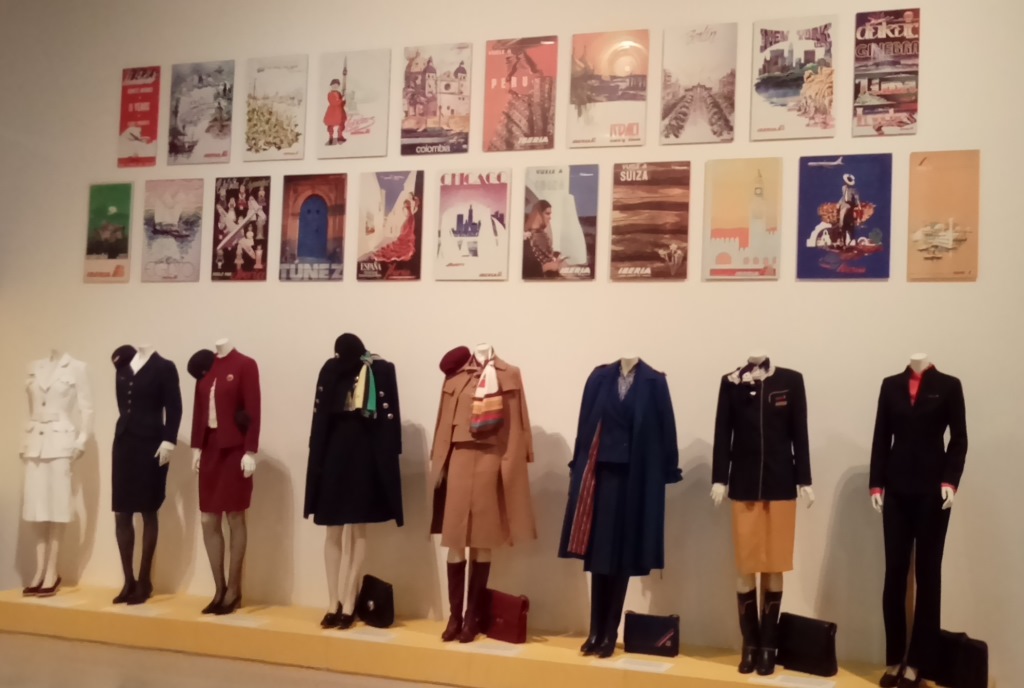
La exhibición ofrecía un breve repaso del desarrollo de la aviación desde principios del siglo XX hasta nuestros días con énfasis en España. El recorrido se basaba sobretodo en archivos (fotos, dibujos y textos) del periódico, trajes de azafatas de Iberia, fotos y maquetas de aviones de Iberia, y maquetas e imágenes de aeropuertos aportados por AENA, pequeños apuntes biográficos de algunos de los pioneros de la aviación…

Eché de menos la participación de Airbus como sponsor y como heredera de CASA, Hispano Aviación, etc., y como fabricante de aviones en España. De todos modos en la propia exhibición se indicaba que esta exposición tampoco pretendía ser exhaustiva y refería al Museo del Aire a tal efecto.

Carteles de Iberia. Siempre que va uno a un museo relacionado con la aviación se encuentra con carteles que son auténticas obras de arte. Carteles que le daban al hecho de volar un toque de ensueño. Si esa tradición no se ha perdido, al menos no conserva su misma aura. Los primeros carteles de la exposición venían firmados, precisaban el año, la introducción de la línea que se abría o promocionaba… Los últimos posters apenas si son una fotografía y un logo de la compañía.

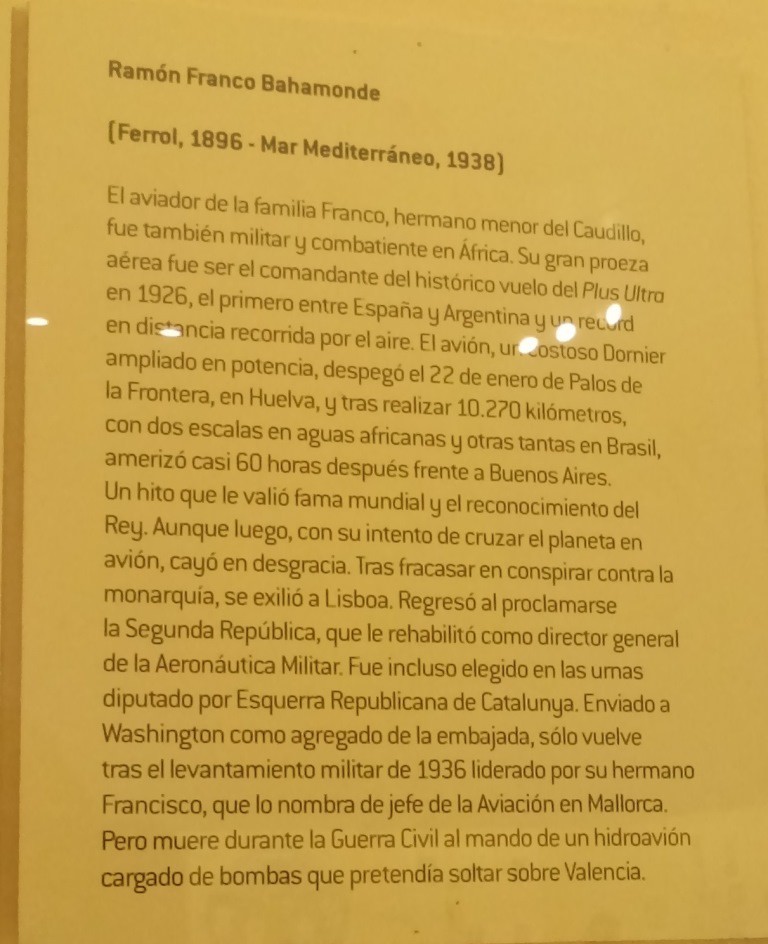
DSC_0084Las biografías de los pioneros. Además de hablar de los hermanos Wright o de Charles Lindbergh, el recorrido sobre los pioneros se centraba en figuras españolas (algunas de las cuales desconocía): Antonio Fernandez Santillana (primer español en fabricar y pilotar un aeroplano), Juan Olivert Serra (primer español en volar un avión fabricado por un español en España), Emilio Herrera, Jose Ortiz Echagüe, Juan de la Cierva, Ramón Franco Bahamonde


El catálogo de la exposición. Antes de salir del edificio pasé a recoger a Luca en la tienda del museo, y allí vi el libro catálogo sobre la exposición. A pesar de que había tomado varias fotos, me decidí a comprarlo (18€) (2). Una gran decisión. En el libro hay bastantes más fotos, artículos, ensayos y curiosidades de las que había en la propia exhibición. De la misma forma me habría gustado comprar (al menos tener la posibilidad de hacerlo) alguna réplica de los posters de Iberia; pero no era posible. Pienso en la cantidad de posters del pintor Toulouse-Lautrec que uno ve adornando pisos, tiendas, bares… Si hubieran hecho una edición de posters de los carteles expuesto, creo que habría sido un éxito.

Maquetas y fichas técnicas de los aviones. Aquí los organizadores de la exhibición lo podrían haber hecho mejor. Maquetas y fichas estaban separadas. Recuerdo una pareja preguntándose por un avión “grande” (porque la maqueta era la más grande de las expuestas  – sobretodo cuestión de escala) y evocando el avión que les había traído de algún origen en América del Sur, preguntándose si sería el mismo (la maqueta era un A330). No todo el mundo reconoce un avión con solo verlo.

DSC_0087

(1) La exhibición terminó el 27 de septiembre.

(2) El libro todavía se puede adquirir.

2 Comments

Filed under Aerospace & Defence

Pregnant again!

Dear readers, we are expecting a second child!

As I did a bit over two years ago (here), I take the opportunity of using this communication channel to inform (especially to those of you I couldn’t see in the past month) the good news.

Family..

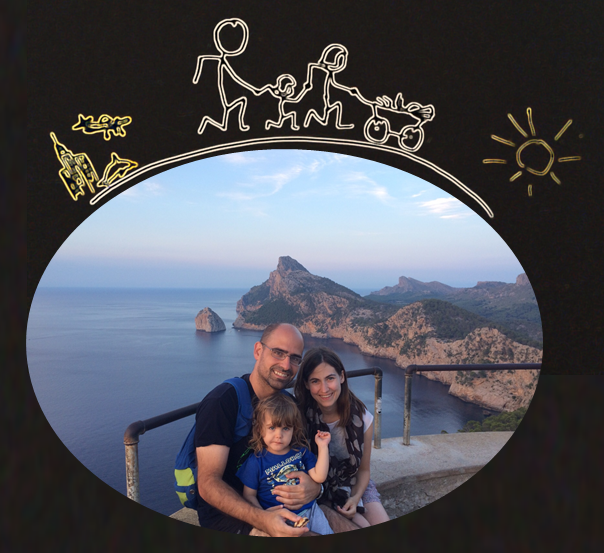
“The family venturing around the world now looking forward to meet the baby” (small collage made from a design by Jaime, the uncle).

If everything goes well and dates are as expected, the delivery would take place at the beginning of April 2016.

6 Comments

Filed under Miscellanea

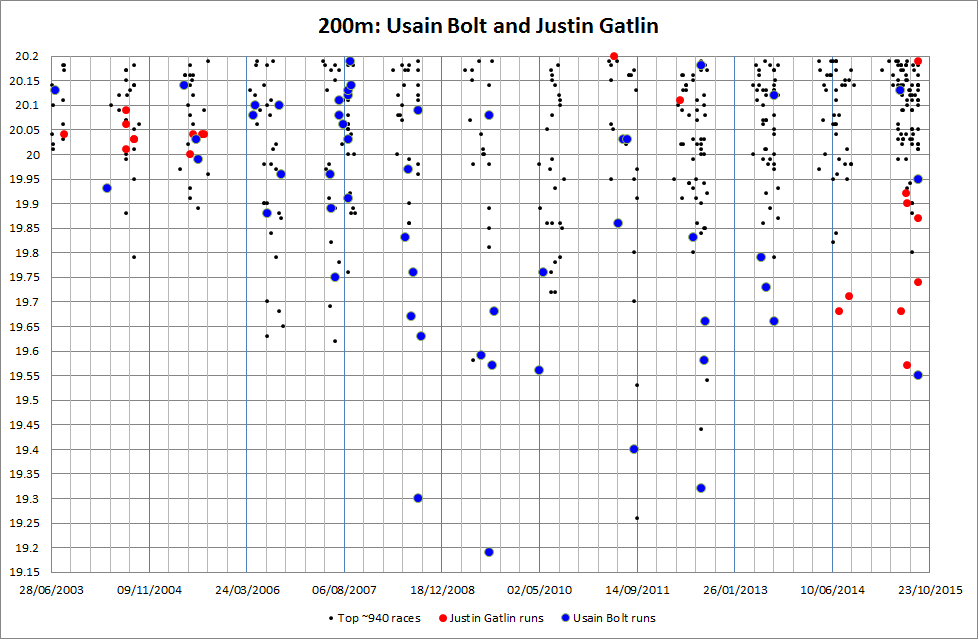
Usain Bolt and Justin Gatlin; 100m and 200m

In the previous two posts I compared Usain Bolt and Carl Lewis as 100m and 200m sprinters. For that comparison I used as a source a website with all time best performances in track and field (maintained by Peter Larsson). I will use the same source to make a more relevant comparison nowadays: Usain Bolt and Justlin Gatlin, both in 100m and 200m.

Best ever ~800 100m times, focus on Usain Bolt and Justin Gatlin.

Best ever ~800 100m times, focus on Usain Bolt and Justin Gatlin.

Best ever ~950 200m times, focus on Usain Bolt and Justin Gatlin.

Best ever ~950 200m times, focus on Usain Bolt and Justin Gatlin.

You can see in both graphics why there was so much attention in the races of this summer Beijing World Championship and expectation with the possibility of Bolt being defeated by Gatlin. 2014 wasn’t a good year for Bolt due to injuries. Gatlin ran more often and faster that year. The year of 2015 had started in the same way, with Gatlin running more often and faster, to the point of beating his personal bests in both 100m and 200m (twice).

  • The best 5 times in 100m of the year belong to Gatlin, yet the 6th best time made Bolt the World Champion.
  • Of the best 4 times in 200m of the year, 3 belong to Gatlin, yet the Bolt managed the best time (better than Gatlin’s personal best) on the final and that made Bolt the World Champion.

Note: the times included here exclude wind-aided races and times excluded due to doping.

Leave a comment

Filed under Sports

200m: Usain Bolt and Carl Lewis

Usain Bolt has recently won the gold medal in the 200m of Beijing Athletics World Championships, with a time of 19.55″, that is the 10th best ever time.

In the previous two posts, I wanted to highlight the size of the figure of Carl Lewis as a long jump athlete (here) and to compare both Usain Bolt and Carl Lewis as 100m sprinters (here). I want to recap here the following two graphics:

Best ever ~180 long jumps, focus on Carl Lewis.

Best ever ~180 long jumps, focus on Carl Lewis.

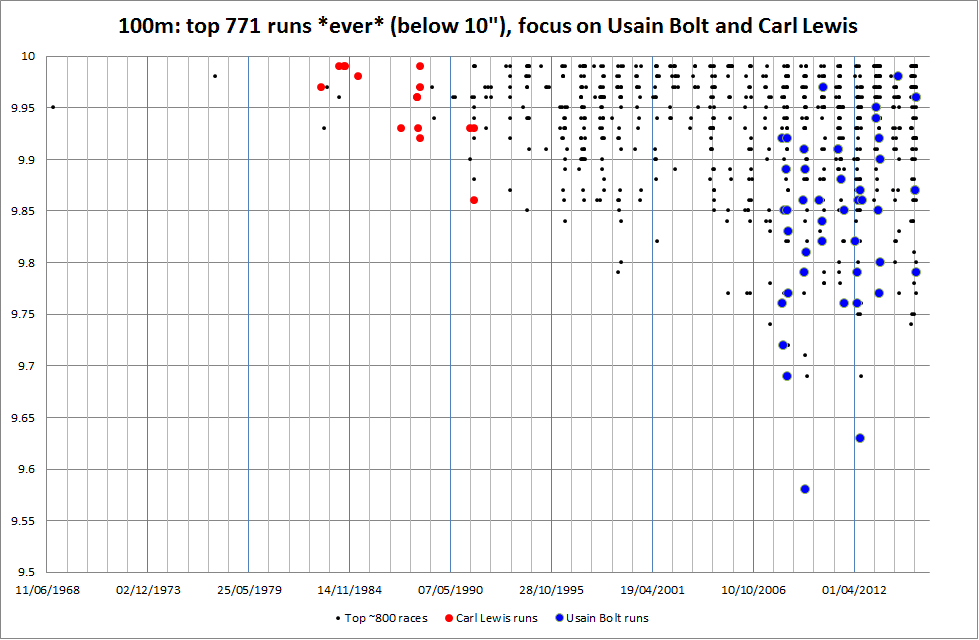
Best ever ~800 100m times, focus on Carl Lewis and Usain Bolt.

Best ever ~800 100m times, focus on Carl Lewis and Usain Bolt.

Recall the following lines from those two posts, on the long jump:

Now, in 2015, 18 years later, of the best 184 long jumps ever (all those at or above 8.50m), 55 of those jumps (a 30%) correspond to Carl Lewis. I let you to qualify the feat.

The runs (100m and 200m) Carl Lewis did in the 80s would probably not win him any gold medal today; his jumps would still win him almost everygold medal today.

On the dash 100m:

[…] on all the times a runner has *ever* finished the 100m below 9″90, 187 times. Of those,

  • 32 times correspond to Usain Bolt (17%), and
  • just 1 to Carl Lewis.

In this post, I want to compare Usain Bolt and Carl Lewis as 200m sprinters. I will use as a source again the website with all time best performances in track and field (maintained by Peter Larsson).

Best ever ~950 200m times, focus on Carl Lewis and Usain Bolt.

Best ever ~950 200m times, focus on Carl Lewis and Usain Bolt.

In the previous graph you can notice that times in the 200m have significantly improved since the 80s and 90s. Usain Bolt is today way faster than Carl Lewis was in the 80s.

If we want to focus not on the best ~950 times, but in a similar amount of marks as in the long jump and the 100m above, we can just focus on all the times a runner has *ever* finished the 200m below 19.95, 190 times. Of those,

  • 26 times correspond to Usain Bolt (14%), and
  • just 7 to Carl Lewis (4%).

Compare that 14% of best times of Usain Bolt in the 200m with the 17% in the 100m. Despite his telling that the 200m is his preferred distance, his dominance of the 100m has been even greater. Anyway, compare that to the 30% of long jumps today (while he retired 18 years ago) of best long jumps of Carl Lewis.

In relation to Lewis, he retains 7 of the best 190 200m times (4%) while only 1 of the best 184 100m times… who would have suspected that? We tend to remember Lewis as more of a 100m sprinter and Bolt more of a 200m…

… and it seems that Lewis was first a jumper, then a 200m sprinter (despite of never holding the world record of any of those) and then a 100m sprinter. Whereas it seems that Bolt is a more distinguished 100m sprinter despite of what he likes best.

2 Comments

Filed under Sports

100m: Usain Bolt and Carl Lewis

Usain Bolt has recently won the gold medal in the 100m of Beijing Athletics World Championships, with a time of 9″79, that is the 34th best ever time.

In the previous post, I wanted to highlight the size of the figure of Carl Lewis as an athlete, but a long jump athlete. I want to recap here the following graphic:

Best ever ~180 long jumps, focus on Carl Lewis.

Best ever ~180 long jumps, focus on Carl Lewis.

Recall the following lines from that post:

Now, in 2015, 18 years later, of the best 184 long jumps ever (all those at or above 8.50m), 55 of those jumps (a 30%) correspond to Carl Lewis. I let you to qualify the feat.

The runs (100m and 200m) Carl Lewis did in the 80s would probably not win him any gold medal today; his jumps would still win him almost every gold medal today.

In this post, I want to compare Usain Bolt and Carl Lewis as 100m sprinters. I will use as a source again the website with all time best performances in track and field (maintained by Peter Larsson).

Best ever ~800 100m times, focus on Carl Lewis and Usain Bolt.

Best ever ~800 100m times, focus on Carl Lewis and Usain Bolt.

In the previous graph you can notice that times in the 100m have significantly improved since the 80s. Usain Bolt is today way faster than Carl Lewis was in the 80s.

If we want to focus not on the best ~800 times, but in a similar amount of marks as in the long jump above, we can just focus on all the times a runner has *ever* finished the 100m below 9″90, 187 times. Of those,

  • 32 times correspond to Usain Bolt (17%), and
  • just 1 to Carl Lewis.

Compare that 17% of best times of Usain Bolt today (while he is running) with the 30% today (while he retired 18 years ago) of best long jumps of Carl Lewis. That speaks about the size of the figure of Bolt as a sprinter but, again, speaks a great deal about the figure of Lewis as a jumper and also about the different evolution of both events.

3 Comments

Filed under Sports

Carl Lewis, the jumper

I read earlier today an article claiming that Usain Bolt might be the best athlete ever (here, in Spanish). I do not want to dispute that with this post; by the number of olympic and world championship medals he has won and the records he has set, he might be so. However, in that article the author compared Usain Bolt (the runner) with Carl Lewis the runner. However, it happens that Carl Lewis was much more than a runner, he was a long jumper. In this blog post I just want to put into perspective the size of Carl Lewis as a jumper.

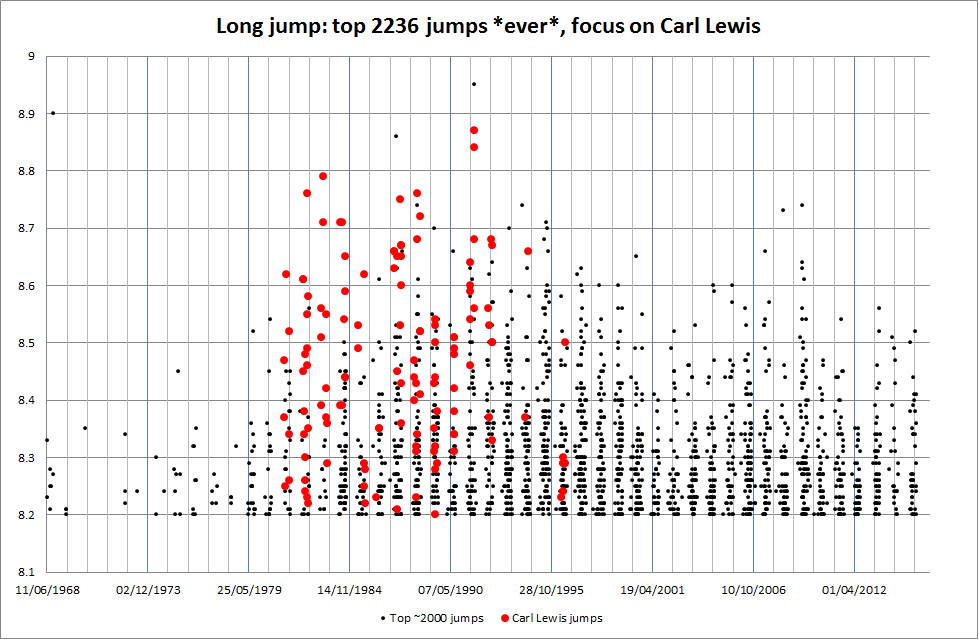
I will again base the analysis on the following terrific website with all time best performances in track and field (maintained by Peter Larsson (1)). In the following two graphics you can see the best ~2200 and the best ~180 long jumps *ever*. The red dots correspond to Carl Lewis’ jumps.

Best ever ~2200 long jumps, focus on Carl Lewis.

Best ever ~2200 long jumps, focus on Carl Lewis.

Best ever ~180 long jumps, focus on Carl Lewis.

Best ever ~180 long jumps, focus on Carl Lewis.

Carl Lewis retired in 1997. His last great competition was the Olympic Games of Atlanta in 1996 (where, by the way, he collected a gold medal with a 8.50m jump at age 35).

Now, in 2015, 18 years later, of the best 184 long jumps ever (all those at or above 8.50m), 55 of those jumps (a 30%) correspond to Carl Lewis. I let you to qualify the feat.

The runs (100m and 200m) Carl Lewis did in the 80s would probably not win him any gold medal today; his jumps would still win him almost every gold medal today.

That was Carl Lewis the jumper.

Finally, after having highlighted the talent of Carl Lewis as a jumper, I wanted to recall that several times along the past years we have read news indicating that Usain Bolt was going to venture into either long jump (here) or 400m (here), he hasn’t done so far (not in big events, at least). This is not a criticism. Without a doubt, he is the best sprinter ever. However, athletics is much more than sprinting… (2)

(1) I already used this magnificent source when I analyzed Rotterdam marathon times, here.

(2) Personally, I would always pick a marathoner ;-).

Edit [28/08/2015]

(3) I believe it would be interesting to share the World Championship long jump competition of 1991, when Mike Powell managed to set a new long jump world record (8.95m), 22 years after Bob Beamon had set the previous one in Mexico DF (8.90). Find the explanation from the Wikipedia here. Despite of losing it, Carl Lewis managed the following four jumps in that competition: 8.91 (wind aided, therefore it doesn’t count for world record and best ever jumps), 8.87, 8.84, 8.68 and 8.56. The first 3 jumps would have won *any* competition in history except 3, including the two world records referred. Unluckily for Lewis, these jumps got him only a silver medal.

(4) Better still, see it here:

3 Comments

Filed under Sports

Wide-body mix in 17 years of Boeing CMOs

Two years ago, I wrote a post showing the puzzling change in Boeing’s predicted mix of twin-aisle sales, between small and medium wide-bodies (“Wide-body mix in 15 years of Boeing CMOs”) (1). A few days ago I wrote a post about the publishing by Boeing of its Current Market Outlook for 2015-2034.  As I noted in that post, this year’s CMO is consistent with last year’s figures, i.e., the larger share of the forecasted market corresponds to small wide-bodies (787s from Boeing’s perspective). Recall the numbers:

  • small wide-bodies: 4,500 a/c in CMO2015 (passenger aircraft only),
  • medium wide-bodies: 2,990 a/c in CMO2015 (same figure as in CMO2014).

In the sub-segment of the medium wide-bodies passenger aircraft figures for  have remained constant and there is a slight increase in freighters (60 a/c); whereas for small wide-bodies the main increase is seen in the passenger aircraft (+230 a/c).

Since I keep a collection of CMOs from many years, I will include again a comparison going 17 years back…

Twin-aisle mix distribution (Boeing CMO 1998-2015, includes both passenger and freighter aircraft).

Twin-aisle mix distribution (Boeing CMO 1998-2015, includes both passenger and freighter aircraft).

Seeing at the graphic, made using Boeing’s forecasts’ figures:

  • During the first 5 years (1998-2003) the trends are quite constant, seeing medium wide-bodies a slightly higher demand.
  • From 2003 to 2007, the mix is reverted, possibly to favour the launch of the 787.
  • In 2008 the CMO did not provide the split.
  • From 2009 to 2013, you can see that both trends in the forecasts are erratic… why? Only Boeing knows. (2)
  • From 2013 to 2015, it seems that the trends are stabilized again in a higher demand for 787-size aircraft.

(1) Last year, I made an update of that post with the consolidated view of the last 16 years, find it here.

(2) A speculation: a Boeing-internal need to sell the concept of the 777X?

Leave a comment

Filed under Aerospace & Defence