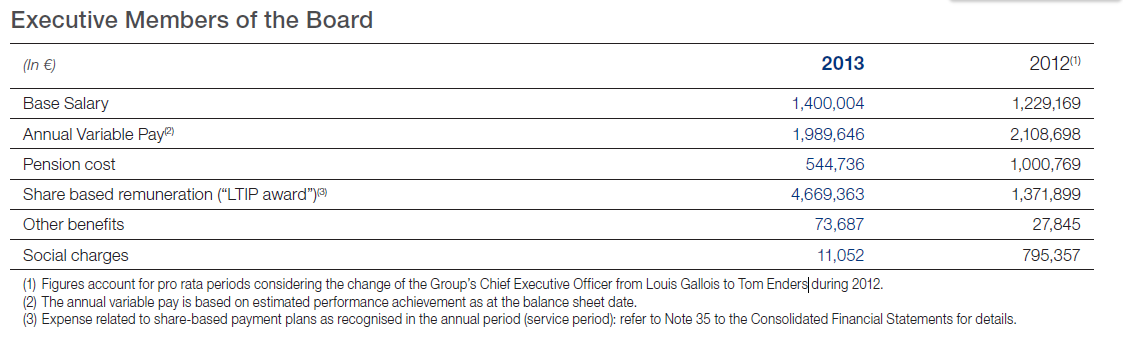
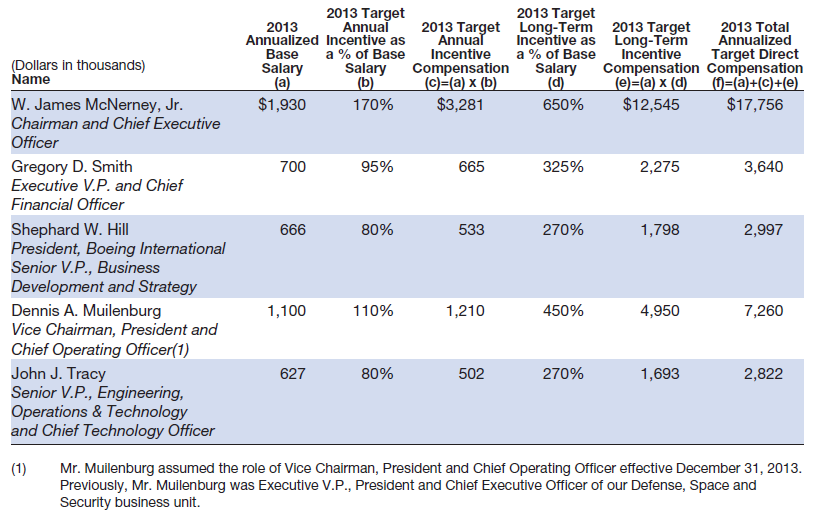
Boeing vs. Airbus: CEO compensation (2013)

Last Friday, while reading the Seattle Times article “Boeing CEO took home almost $29M last year” (referring to 2014) I was reminded of a recent conversation with some colleagues on the compensation of Boeing vs. Airbus Group CEOs.

As both companies are public companies, this information is public and can be found in the annual report and proxy statement from each one. I will just copy the information below for comparison and future reference. I use 2013 references to compare both at the same exercise, as 2014 annual report from Airbus Group is not yet available.

Airbus Group CEO, Tom Enders’ 2013 compensation (annual report here, PDF, 1.4MB)

Airbus Group's Tom Enders 2013 compensation.

Airbus Group’s Tom Enders 2013 compensation.

Boeing CEO, Jim McNerney’s 2013 compensation (proxy statement here, PDF, 1.1MB)

Boeing's Jim McNerney 2013 compensation.

Boeing’s Jim McNerney 2013 compensation.

Just as a complement, see in this article from The Washington Post “The pay gap between CEOs and workers is much worse than you realize“, based on a study by Harvard Business School, how the ratios of compensation between CEO and the average worker are in different countries, compared to what respondents to a poll said those ratios should ideally be.


4 Comments

Filed under Aerospace & Defence

Blagnac half marathon 2015

Just two weeks after an illness forced me to quit in the Seville marathon, I had the chance to test myself in competition again at the half marathon of Blagnac. This was the 3rd time I ran the race, after I took part in the 2012 and 2014 editions. In neither of those I made an especially good time, always slower the in the Toulouse half marathon, even if I think Blagnac’s one is a bit flatter. In those previous two occasions the morning of the race had been very sunny and I felt too hot during the race (in 2014 it was a bit too windy as well). Therefore, this time, being another sunny morning, I decided to run with a cap in order to cover my head from the heat of the sun. As part of the training for Seville marathon I had run by myself alone a half marathon in 1h39’17”, my second best time in the distance, without any support in the form of supplies or other runners around. This made me confident that I could beat my personal best time in the distance, 1h37’29”, achieved in Toulouse in September 2013 (then in the preparation towards Athens marathon). I would have liked to run behind a pacer for 1h35′, but  there wasn’t. There were only pacers for 1h30′, 1h45′ and 2h. I decided to pace myself from the start aiming at 1h35′, that is a pace of 4’30” per km. I managed to keep that pace until about the kilometres 13-14. From then on I was more on 4’40-45″. But I still was making numbers in my head knowing that I would be able to beat my best time. I just needed to be below 5′ per km on average. Therefore, only the margin by how much would I beat it was in question.

Final sprint at Blagnac half marathon.

Final sprint at Blagnac half marathon.

In the end I managed a time of 1h35’48” (net time), that is effectively a new PB or PR (personal best or record), a reduction of 1’41” in comparison to my previous PR. You can see below in the comparison of both performances that this time I was reducing some seconds kilometre per kilometre. In the end a global pace of 4’32” vs the previous record of 4’38”:

Comparison of Blagnac 2015 and Toulouse 2013 half marathon performances.

Comparison of Blagnac 2015 and Toulouse 2013 half marathon performances.

In fact, I passed the 10 kilometre mark in about 44’20”, practically my second best time in the distance. If I had been running a 10k race, I am sure would have been below 44′, beating my personal best in that distance. See below the evolution of the pace, compared with my initial target (4’30”) and the final average pace (4’32”):

ccc

Evolution of pace compared to initial target and average pace.

Another good thing of this race is that I get a good feeling after the bitter experience from Seville. 🙂

2 Comments

Filed under Sports

Marathon Sevilla 2015

“A marathon always offers you the opportunity to do something epic”, Jaime Irastorza (my brother)

After several dozens of races completed in the last years, including 11 marathons and an ultra, on February 22, a race hunted me down. In the last Seville marathon I DNF. I did not finish.

I wrote a post which was published on the morning of the race. In it I explained that I arrived to that marathon in my best shape so far. However, for me the race took place not on the Sunday 22nd February but on Saturday 21st.

I had put much illusion into the event: running in Seville, the attempt at beating my personal best time, being accompanied by family and friends…

On Friday afternoon we went to the marathon expo at the FIBES. There we retrieved our running bibs, got the confirmation that we could start the race together, took our official expo picture and by chance I met elite runner Pablo Villalobos (1), with whom I had exchanged some tweets in the morning.

That evening we had dinner out with friends in the downtown; plenty of different delicious tapas to share. We had some fun… though at the end of the dinner I started feeling weak, and I went back to the hotel instead of staying with the friends to take some drinks.

On Saturday morning I woke up with stomach problems and some diarrhea. I went to the pharmacy to get some pills and rested a few hours. I feared for the race the day after. The hours passed and I felt a little bit better so we went to have lunch with some 14 friends at Puerto Delicia.

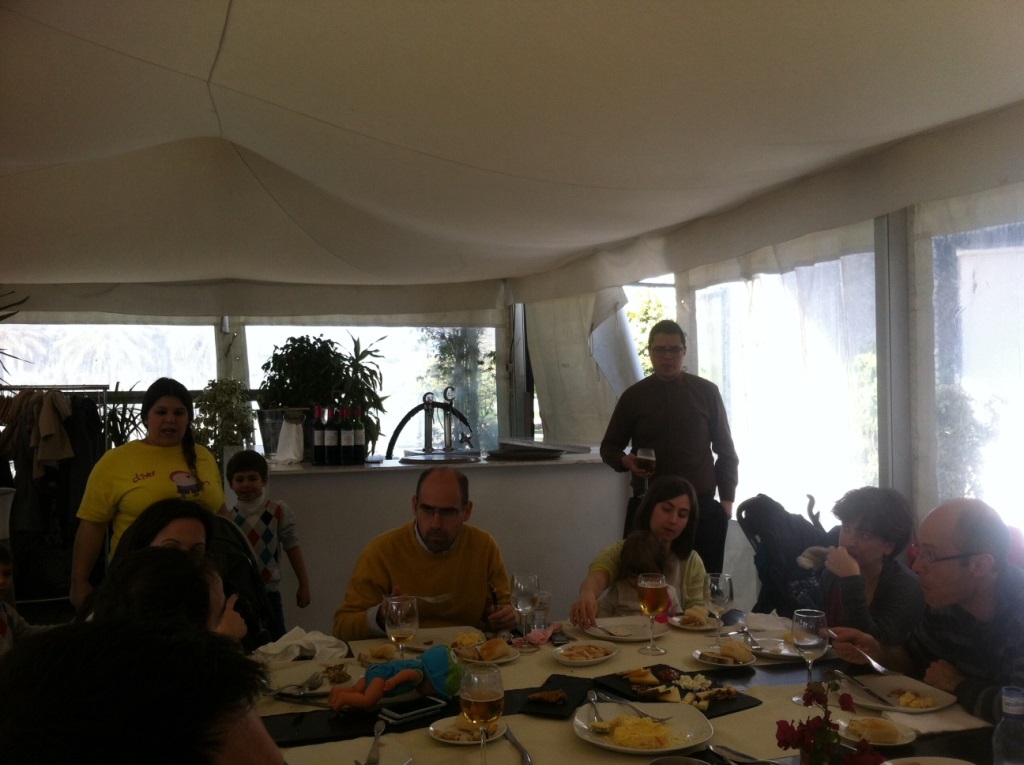
Saturday's lunch with friends.

Saturday’s lunch with friends.

After lunch we went for a walk and I started to feel weak again. We went back to the hotel room. By about 18h, in the bed, I started shivering. During the following hour the fever went up and up. At 19h I reached out for the WC to vomit (such a pity of the previous meals!). I called my brother to ask if he could bring me some drinks and food to the room. By 20h he came with some Aquarius and bananas. 10 hours to recover before waking up time, 13 hours to the marathon start time. That was the start of my race during the night in order to take part of the event.

In the following hours I drank, ate and slept bit by bit, until 24h, when I finally put myself to get a long sleep (6 hours).

On Sunday morning at 6am I woke up on the clock alarm. I stood up and it seemed that I felt OK. With that check I went downstairs to have breakfast. I met there Jaime and Juan, who were happy and very surprised to see me there. After the breakfast we took a taxi and departed for the Stadium at La Cartuja, where we met Jose.

The day was sunny though a bit cold. Changing clothes, drinking a bit, seeing the thousands of runners going through the rituals before the race… that cheered me up.

Before the race.

Before the race.

At few minutes before 9am we went to our corral, 3h45’-4h. We chatted with other runners and with that we went off for a good run!

You can see here a good report of the marathon by my brother Jaime.

We went together for the first 13 kilometres. Our target was to run at a pace of 5 minutes per km. We alternated some at a somewhat higher pace with other at a slower pace. At km 7 we saw Luca and Andrea who greeted us from the hotel room.

Passing by the hotel at km 7.

Passing by the hotel at km 7.

By the 10km mark we were just losing some 40″ in relation to our 3h30’ target time.

Running at some point.

Running at some point.

After having drunk at a few supply posts I started feeling some pain in the stomach, like cramps. Something wasn’t working well. I told my brother and Jose to go ahead with their pace and forget about me. I wasn’t sure of the fate of my race. Ten minutes later, at km 15 I stopped at one of the WC cabins. I had to vomit everything I had taken. Not a good signal. I was emptying my reserves and not replenishing sugar nor minerals.

I re-started at a slower pace (~5:15) for some minutes and then decreased it later (~5’20”-5’30”). I passed the half marathon point in 1h52’01”, not a bad time. In theory that would point at a marathon time of around 3h50′. However, the feelings weren’t good.

At the km 22 I was feeling weaker and most important, I started to worry. After the last 24 hours, having vomited everything and not being able to ingest food and liquid, at some point I would run out of glucose. I feared that if I continued to run I would be risking fainting in any moment above around 2 hours. I pondered during some minutes whether to give it a try. “It doesn’t matter if you are well above 4 hours!” I had been there (in those times) before. I had completed other marathons in pain, injured. However, I thought this risk was more serious.

At about km 23 I had decided to quit. I would have other marathons to beat my best time. Other marathons to complete. Other marathon to run with Jaime end to end. But it would not be this one. I continued running softly, seeking out for a taxi. I found it at km 26.6… and then I stepped aside.

With that decision I put an end to my epic fight against the distance of that marathon that day. See the records of my Garmin watch below:

My Garmin data from Seville marathon.

My Garmin data from Seville marathon.

I regretted having quit not even a minute afterwards while seeing the runners along. I even saw Juan from the taxi… but thinking it over a few days later I think it was a good decision. In less than 2 months from that date and just 6 weeks from the date this post is published I will be running the Madrid marathon and there will hopefully be many other marathons to run.

The experience in Seville will teach me to appreciate even more the marathons completed, to value the good health enjoyed on race days so far, and to realize how difficult is to achieve and beat a personal best time… something you do not conquer the day after you have been sick. Nevertheless, I love the distance, the race, the marathon, and I had to give it a try. I tried some thing epic but it could not be.

This slideshow requires JavaScript.

(1) He had placed 2nd and 4th in previous editions of the race. You can check out his blog here. By the way, for Pablo it wasn’t also the best day: he quit in km 26 too, his first marathon not completed, too.

7 Comments

Filed under Sports

The most (and least) read of the first 500 posts

A classic post of the blog: a recap at each hundredth post dedicated to show which were the most and least read of the first 500 posts. (1)

Since I started the blog in February 2010, the blog has received over 207,000 visits and hundreds of comments.

Find below the list of the top 10 and bottom 10 posts:

1. Impuestos en Francia vs. España
2. Will Boeing 787 ever break-even?
3. Mi adiós a Ibercaja
4. 787 Break Even for Dummies
5. Monaco GP Walking Tour
6. Impuestos en Francia vs. España (actualización 2012)
7. Airbus vs. Boeing, comparison of market forecasts (2012)
8. Beluga vs. Dreamlifter
9. Patek Philippe Caliber 89
10. Airbus vs. Boeing, comparison of market forecasts (2011)

490. Resist the bias to act
491. Bill Clinton endorsing Kiva (video)
492. Risk
493. Europe Day
494. Nothing like a good red wine…
495. What charities do you support?
496. Bye, Vistalegre
497. Boulevards de Colomiers 2014
498. Special assistance vs. free ride
499. Wells Fargo History Museum at San Francisco

Let’s see what I’ll write in the next 100 posts…

(1) I wrote four such posts when I reached the first 100200300 and 400 posts in the blog.

NOTE: the box in the right showing “Current Top Posts” shows the most read ones in the last two days, not the all-time most read ones (the ones above).

1 Comment

Filed under Miscellanea

International Women’s Day, Global Gender Gap and backing women dreams

Today, March 8th it’s International Women’s Day. In the last few days I have seen a significant buzz in social media about the day. In particular I read a couple of pieces that made contribute to the buzz with this post.

World Economic Forum:

Equal pay benefits men, too. Here are four reasons why, backed up by our Global Gender Gap Report. [PDF, 6.1MB]

I liked the approach: “What’s in it for me?” (from the perspective of men, of course) (1).

Take a look at the report (395 pages). I skimmed through it and picked some essentials, especially from a couple of graphics. The Global Gender Gap Index measures gaps in 4 sub-indices: Economic Participation and Opportunity, Educational Attainment, Health and Survival and Political Empowerment. The sources for the data are the International Labour Organisation, World Economic Forum, UNESCO Institute for Statistics, Central Intelligence Agency, World Health Organisation and the Inter-Parliamentary Union. The authors (Ricardo Hausmann (Harvard University), Laura Tyson (Berkeley), Yasmina Bekhouche (World Economic Forum) and Saadia Zahidi (World Economic Forum)) explain their methodology as follows:

There are three basic concepts underlying the Global Gender Gap Index, forming the basis of the choice of indicators, how the data is treated and the scale used. First, it focuses on measuring gaps rather than levels. Second, it captures gaps in outcome variables rather than gaps in input variables. Third, it ranks countries according to gender equality rather than women’s empowerment.

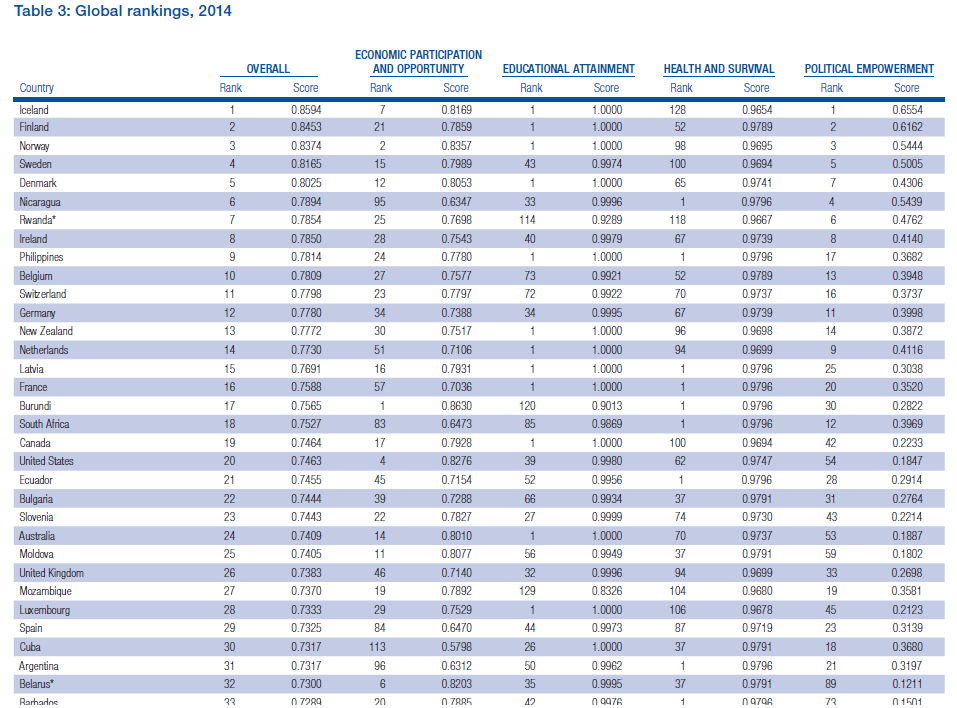
I attach below a screenshot showing the top 30 countries in the list.

Global Gender Gap Index, 2014 ranking, top 30 countries.

Global Gender Gap Index, 2014 ranking, top 30 countries.

Some comments to it:

  • Scandinavian countries are in the top of the list (no surprise here).
  • Some readers will wonder about the top places occupied by Nicaragua, Rwanda… read again the methodology above: “it focuses on measuring gaps rather than levels”.
  • When I see this kind of indices, for personal reasons I focus on the positions occupied by: Denmark #5, Germany #12, Netherlands #14, France #16, Spain #29, Lithuania #44.
  • A curiosity: Spain #29 vs. Cuba #30.
  • No surprises either at the bottom of the list: Bahrain, Turkey, Algeria, Ethiopia, Oman, Egypt, Saudi Arabia, Mauritania, Guinea, Morocco, Jordan, Lebanon, Ivory Coast, Iran, Mali, Syria, Chad, Pakistan, Yemen… which they all have in common that are located in arid subtropical zone and that most of them have at least one letter a in the name.

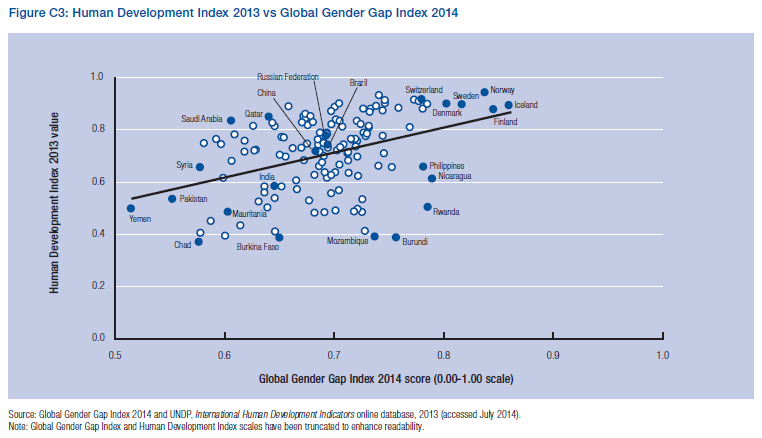
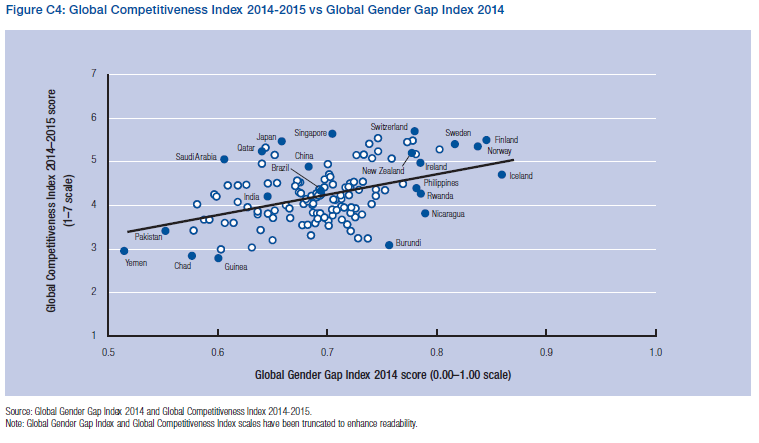
Coming back to the question: “What’s in it for me?” The report shows how countries in which the gender gap is lower also have good scores in several other metrics which improve the conditions of life for men as well. There is the catch. See below the comparison for the Human Development Index and the Global Competitiveness Index:

Human Development Index vs. Global Gender Gap Index.

Human Development Index vs. Global Gender Gap Index.

Global Competitive Index vs. Global Gender Gap Index.

Global Competitiveness Index vs. Global Gender Gap Index.

What can you do to help to close the gender gap? In your community you can do much. See this other open letter also in World Economic Forum from Belinda Parmar, “To men, for International Women’s Day“:

We need you.

We need you to listen. When we tell you about a problem, we don’t want you to jump to a solution for us. We just want to say it out loud to solve it ourselves knowing that you will support us.

We need you to talk. To raise the issue of gender. Don’t worry about saying the wrong thing. Saying the wrong thing is better than saying nothing at all. It’s the only way to start the conversation.

We need you to value our differences. Realise that we bring a different perspective and encourage us to bring our personalities to work, to not feel like we have to put on a ‘male suit.’

One step further: what can you do to help to close the gender gap in the countries at the bottom of the list? (those with the letter a in the names)

A few days ago I received an email from Jason Riggs of Kivathe world’s first and largest crowdfunding platform dedicated to alleviating poverty and expanding financial inclusion (about which I have written before in this blog (2)). Kiva has launched Kiva.org/Dreams to empower even more women to reach for their dreams and they asked me to help them in making this campaign more widespread. Thus, here is my contribution:

By visiting Kiva.org/Dreams, you can back a dream by choosing a woman whom Kiva should lend $25 to. There is no cost to you. By choosing her, you help her to follow her dream of starting or growing her business, sending her children to school, and ultimately, gaining financial independence.

When women have the resources to make their dreams a reality, the world changes. More children go to school, more food is grown, and nations are more peaceful and prosperous. A case in point: if women farmers had equal access to farming assets and finance, they could increase their crop yields up to 30% and 150 million people who go hungry every day would be able to eat.

By contributing to the success of an entrepreneurial woman who has overcome obstacles, we discover so much more about our own resiliency, possibility, and potential. Each of us has a part to play.

 Together we can make dreams a reality for thousands of women around the world. So in honor of International Women’s Day and the power of women, back a dream at Kiva.org/Dreams.

My suggestion: visit the site of Kiva, filter by Yemen, the country at the very bottom of the list and help dreams come true, gender gaps close and turning around the situation.

Happy International Women’s Day!

(1) I like the approach for its different persuasion approach, not like the closing the gap out of equal treatment, fairness, justice… wasn’t engouh.

(2) See other posts about Kiva: My 100th loan with Kiva“, “A Kiva success story

Leave a comment

Filed under Economy, Helping others

Turboprop market vs. oil price (ATR figures 2014 update)

Few weeks ago, the Toulouse-based aircraft manufacturer ATR (Avions de Transport Régional) published a press release reporting some of its numbers for the year 2014 (being a private company, owned by Airbus and Alenia, it does not publish a complete financial annual report). Some of the key figures were:

  • Revenues increased 10% to 1.8bn$.
  • A new record of 83 deliveries (+12%).
  • A new record of sales with 160 firm aircraft orders (plus 120 options). (1)
  • A record backlog at year-end with 280 firm aircraft in the order book.

About 4 years ago, I wrote a post, “Turboprops market different dynamic“, in which I discussed:

[…] how civil turboprop market is unrelated to the larger and more known turbofan civil aircraft market and how its dynamics are completely unrelated to World GDP growth and thus world air traffic growth. […]

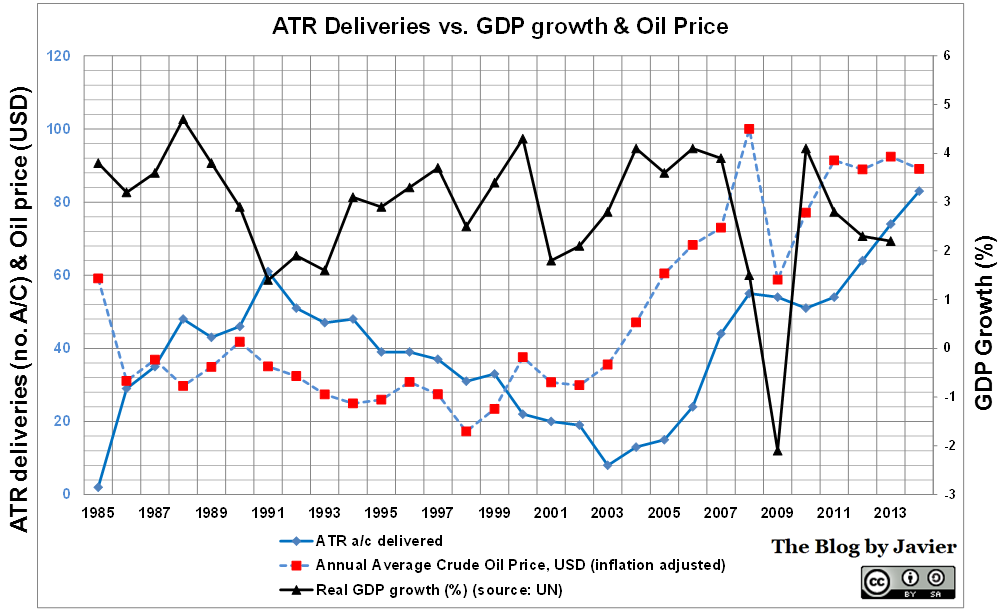
When calculating correlation between the different variables, I discovered that the correlation between GDP and deliveries is rather low, despite of the time lag applied (be it 2, 3, 4 years…). However I found that the oil prices and deliveries did correlate very well with a lag of 5-6 years, yielding coefficients of 0.55-.65, which are rather high.

I wanted to update the calculations I made then and last year, with the information of the 2014 exercise.

ATR deliveries vs. GDP growth and oil price (2014 update).

ATR deliveries vs. GDP growth and oil price (2014 update).

With the last years’ data, correlations are similar:

  • Between oil prices and deliveries: high, above 0.54 from 1 year time lag, increasing through 6 years time lag (when it reaches a maximum of 0.82).
  • Between GDP growth and deliveries: low, not more than 0.34, and negative correlations up from 1 to 5 years time lag.

If there was causality, we could infer that the from the moment that oil prices are computed, till they are taken into regional airlines’ models, the fleet planners identify the need for new turboprops, the case is approved by airlines’ management, discussions start with ATR, negotiations are closed between the airline and the manufacturer, the aircraft are built and delivered to the airline… it takes about 6 years. (2)

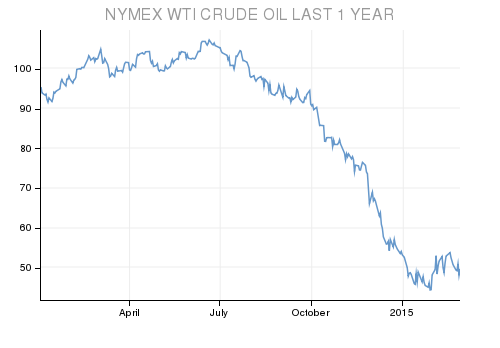
This year the prices of oil have abruptly decreased in the last quarter:

Oil prices drop Q4 2014.

Oil prices drop Q4 2014.

However, this large drop is not yet fully noticed in the comparison made before as the historical database I use (here) only reflects prices up to the end of November and thus the 2014 average is still 89$ vs. 92.4$ in 2013. Even so, taking into account the figures from December (~55$) the year average will drop only to about 86$, not changing much the result.

It would be interesting though to see if oil prices stay low (50-60$) for the full 2015 year. If so, we could check whether the correlation stands and ATR starts to notice it in the form of lower orders (more cancellations?) and this is translated into lower amount of deliveries in about 3 years time (2018?).

(1) Some 18 cancellations that took place in 2014 go untold in the press release, though they are easily deduced from the information of orders, and backlog from 2014 and 2013.

(2) About 3 of those 6 years are consumed from placing the firm order to getting the aircraft delivered, as we can see by the current figures of backlog (280 a/c) and yearly deliveries (83 a/c).

Leave a comment

Filed under Aerospace & Defence

The Theory of Interstellar Trade

This blog post is not about the movie Interstellar, which I haven’t watched yet, but about a rather wonkish paper (as its author would put it) that I stumbled upon very recently.

The American economist and Nobel laureate Paul Krugman wrote in 1978 the paper “The Theory of Interstellar Trade” [PDF, 516KB]. The paper is simply hilarious. One of the best pieces I have ever read. It has just 15 pages and in them the author sets out to search how interest charges should be computed in interstellar trade when goods travel at close to the speed of light. It mixes economy with very light special relativity and great doses of humour. The author himself remarked in the introduction:

It should be noted that, while the subject of this paper is silly, the analysis actually does make sense. This paper, then, is a serious analysis of a ridiculous subject, which is of course the opposite of what is usual in economics.

Well, given today’s ventures, it might not be so silly 😉

Let’s review some of the highlights and conclusions derived from the paper:

To start with, he sets some fundamental considerations:

There are two major features distinguishing interstellar trade from the interplanetary trade we are accustomed to. The first is that the time spent in transit will be very great, since travel must occur at less than the light speed; round trips of several hundred years appear likely. The second is that, if interstellar trade is to be at all practical, the spaceships which conduct it must move at speeds which are reasonable fractions of the speed of light.

Because interstellar trade will take so long, any decision to launch a cargo will necessarily be a very long-term investment project […]

The second feature of interstellar transactions cannot be so easily dealt with (physicists are not as tolerant as economists of the practice of assuming difficulties away). If trading space vessels move at high velocities, we can no longer have an unambiguous measure of the time taken in the transit. The time taken by the spacecraft to make a round trip will appear less to an observer on the craft than to one remaining on Earth. […]

To solve the problem he refers to the Minkowski space-time, and includes the following diagram with the note below:

"Readers who find the Figure II puzzling should recall that a diagram of an imaginary axis must, of course, itself be imaginary".

“Readers who find the Figure II puzzling should recall that a diagram of an imaginary axis must, of course, itself be imaginary”.

By comparing the returns from actual trade between planets with the return of bonds he arrives at the First Fundamental Theorem of Interstellar Trade:

When trade takes place between two planets in a common inertial frame, the interest costs on goods in transit should be calculated using time measured by clocks in the common frame, and not by clocks in the frames of trading spacecraft.

After proving the theorem take a look at this other passage:

theorem


The author then takes on investigating possible arbitrage in interstellar transactions, and arrives to the Second Fundamental Theorem of Interstellar Trade:

If sentient beings may hold assets on two planets in the same inertial frame, competition will equalize the interest rates on the two planets.

It goes without saying that I recommend the reading of this paper.

Leave a comment

Filed under Economy, Investing

Airbus backlog at end 2014 into perspective

Last Friday, Airbus Group announced its 2014 full year financial results at a press conference in Munich (Germany). You can find here [PDF, 785KB] the presentation used at the conference. In general, the results have been very positive in most metrics. There is one that in my opinion especially deserves attention, see it bellow:

AIRBUS 2014 results - backlog.

AIRBUS 2014 results – backlog.

Airbus has a record backlog of 6,386 civil aircraft.

In 2014, Airbus delivered 629 commercial aircraft. That is why, in the presentation it is stated “> 10 years of deliveries”. In essence, one may see it as if Airbus airplanes were sold out for the next 10 years! Of course, that is not the case for all product lines (think A330, A380) and will not be the case as a production ramp-up is announced in the A320ceo line.

Nevertheless, to put it into perspective, I wanted to compare this backlog to the historical aircraft deliveries of Airbus (which can be found here). Since its first delivery, an A300B2 back in May 1974, through the end of January 2015, Airbus had delivered 8,921 aircraft. With the information of yearly deliveries I compiled the graphic below, yearly per model and cumulative deliveries for all models combined.

AIRBUS deliveries through January 2015.

AIRBUS deliveries through January 2015.

Take a look at the cumulative deliveries.

On the occasion of the 8,000th delivery, on August 2013 (an A320 for AirAsia) Airbus published an article making a review of all the main delivery landmarks.

  • the 1st delivery, in May 1974, an A300B2.
  • the 1,000th delivery, in March 1993, an A340-300,
  • the 2,000th handover, in May 1999, an A340-300,
  • the 3,000th delivery, in July 2002, an A320,
  • the 4,000th delivery, in September 2005, an A330-300,
  • the 5,000th delivery, in December 2007, an A330-200,
  • the 6,000th delivery, in January 2010, an A380,
  • the 7,000th handover, in December 2011, an A321,
  • the 8,000th delivery, in August 2013, an A320 featuring Sharklets,
  • the 9,000th delivery… somewhere in the Spring 2015.

You can see that since the first delivery in 1974, it took Airbus almost 19 years to deliver the first 1,000 aircraft.

It took over 35 years to deliver the first 6,000 aircraft. That is what today it has as backlog…

Leave a comment

Filed under Aerospace & Defence

Warren Buffett’s 2014 letter to the shareholders of Berkshire Hathaway

Every last Saturday of February, a must read for the weekend comes out: Warren Buffett’s letter to the Shareholders of Berkshire Hathaway [PDF, 499KB]. This year, it is the 50th anniversary since Buffett took over the company, and thus together with the letter both him and Charlie Munger, his partner and vice chairman, have included as well two letters describing the last 50 years, what made them so successful and what can be expected in the following years. The 3 letters together make up 42 pages, a strongly recommended read.

From this year’s letter, I wanted to bring attention to the following quotes or passages on simplicity of some transactions, on the sale of TESCO, the distinction between volatility and risk, not using borrowed money to invest, consequences of using shares instead of cash for acquisitions, the synergies announced in M&A, the importance of cash, trust and bureaucracy:

***

On simplicity of some transactions and trust. Last year he introduced the acquisition of Nebraska Furniture Mart, this year is the turn of National Indemnity:

[…] since 1967, when we acquired National Indemnity and its sister company, National Fire & Marine, for $8.6 million. Though that purchase had monumental consequences for Berkshire, its execution was simplicity itself.

Jack Ringwalt, a friend of mine who was the controlling shareholder of the two companies, came to my office saying he would like to sell. Fifteen minutes later, we had a deal. Neither of Jack’s companies had ever had an audit by a public accounting firm, and I didn’t ask for one. My reasoning: (1) Jack was honest and (2) He was also a bit quirky and likely to walk away if the deal became at all complicated.

On pages 128-129, we reproduce the 1 1 ⁄2-page purchase agreement we used to finalize the transaction. That contract was homemade: Neither side used a lawyer. Per page, this has to be Berkshire’s best deal: National Indemnity today has GAAP (generally accepted accounting principles) net worth of $111 billion, which exceeds that of any other insurer in the world.

Offer Letter for National Indemnity (retrieved from BRK 2014 annual report [PDF, 2.2MB])

Offer Letter for National Indemnity (retrieved from BRK 2014 annual report [PDF, 2.2MB])

On the advantages of using an animated character as advertising tool in low cost operations:

[…] No one likes to buy auto insurance. Almost everyone, though, likes to drive. The insurance consequently needed is a major expenditure for most families. Savings matter to them – and only a low-cost operation can deliver these. […]

[…] Our gecko never tires of telling Americans how GEICO can save them important money. The gecko, I should add, has one particularly endearing quality – he works without pay. Unlike a human spokesperson, he never gets a swelled head from his fame nor does he have an agent to constantly remind us how valuable he is. I love the little guy.

On his lack of decisiveness in selling TESCO:

[…] An attentive investor, I’m embarrassed to report, would have sold Tesco shares earlier. I made a big mistake with this investment by dawdling.

At the end of 2012 we owned 415 million shares of Tesco, then and now the leading food retailer in the U.K. and an important grocer in other countries as well. Our cost for this investment was $2.3 billion, and the market value was a similar amount.

In 2013, I soured somewhat on the company’s then-management and sold 114 million shares, realizing a profit of $43 million. My leisurely pace in making sales would prove expensive. Charlie calls this sort of behavior “thumb-sucking.” (Considering what my delay cost us, he is being kind.)

During 2014, Tesco’s problems worsened by the month. The company’s market share fell, its margins contracted and accounting problems surfaced. In the world of business, bad news often surfaces serially: You see a cockroach in your kitchen; as the days go by, you meet his relatives.

We sold Tesco shares throughout the year and are now out of the position. (The company, we should mention, has hired new management, and we wish them well.) Our after-tax loss from this investment was $444 million, about 1/5 of 1% of Berkshire’s net worth.

On volatility versus risk:

Stock prices will always be far more volatile than cash-equivalent holdings. Over the long term, however, currency-denominated instruments are riskier investments – far riskier investments – than widely-diversified stock portfolios that are bought over time and that are owned in a manner invoking only token fees and commissions. That lesson has not customarily been taught in business schools, where volatility is almost universally used as a proxy for risk. Though this pedagogic assumption makes for easy teaching, it is dead wrong: Volatility is far from synonymous with risk. Popular formulas that equate the two terms lead students, investors and CEOs astray.

On not using borrowed money to invest:

[…] borrowed money has no place in the investor’s tool kit: Anything can happen anytime in markets. And no advisor, economist, or TV commentator – and definitely not Charlie nor I – can tell you when chaos will occur. Market forecasters will fill your ear but will never fill your wallet.

A confession after having introduce the major mistake of acquiring Berkshire (a sinking textile company) out of stubborness:

Can you believe that in 1975 I bought Waumbec Mills, another New England textile company? Of course, the purchase price was a “bargain” based on the assets we received and the projected synergies with Berkshire’s existing textile business. Nevertheless – surprise, surprise – Waumbec was a disaster, with the mill having to be closed down not many years later.

On his initial strategy of buying low priced small companies and why he changed it:

[…] Most of my gains in those early years, though, came from investments in mediocre companies that traded at bargain prices. Ben Graham had taught me that technique, and it worked.

But a major weakness in this approach gradually became apparent: Cigar-butt investing was scalable only to a point. With large sums, it would never work well.

In addition, though marginal businesses purchased at cheap prices may be attractive as short-term investments, they are the wrong foundation on which to build a large and enduring enterprise. […]

On using shares instead of cash for acquisitions:

Consequently, Berkshire paid $433 million for Dexter and, rather promptly, its value went to zero. GAAP accounting, however, doesn’t come close to recording the magnitude of my error. The fact is that I gave Berkshire stock to the sellers of Dexter rather than cash, and the shares I used for the purchase are now worth about $5.7 billion. As a financial disaster, this one deserves a spot in the Guinness Book of World Records.

Several of my subsequent errors also involved the use of Berkshire shares to purchase businesses whose earnings were destined to simply limp along. Mistakes of that kind are deadly. Trading shares of a wonderful business – which Berkshire most certainly is – for ownership of a so-so business irreparably destroys value.

On the trumpeted synergies announced in M&A:

(As a director of 19 companies over the years, I’ve never heard “dis-synergies” mentioned, though I’ve witnessed plenty of these once deals have closed.) Post mortems of acquisitions, in which reality is honestly compared to the original projections, are rare in American boardrooms. They should instead be standard practice.

On cash:

At a healthy business, cash is sometimes thought of as something to be minimized – as an unproductive asset that acts as a drag on such markers as return on equity. Cash, though, is to a business as oxygen is to an individual: never thought about when it is present, the only thing in mind when it is absent.

American business provided a case study of that in 2008. In September of that year, many long-prosperous companies suddenly wondered whether their checks would bounce in the days ahead. Overnight, their financial oxygen disappeared.

At Berkshire, our “breathing” went uninterrupted. Indeed, in a three-week period spanning late September and early October, we supplied $15.6 billion of fresh money to American businesses.

On trust and bureaucracy:

With only occasional exceptions, furthermore, our trust produces better results than would be achieved by streams of directives, endless reviews and layers of bureaucracy. Charlie and I try to interact with our managers in a manner consistent with what we would wish for, if the positions were reversed.

The books that are recommended this year in the letter are:

  • “Where Are the Customers’ Yachts?”, by Fred Schwed,
  • “The Little Book of Common Sense Investing”, by Jack Bogle,
  • “Berkshire Hathaway Letters to Shareholders”, compilation by Max Olson,
  • a new book in preparation commemorating the 50th anniversary of Berkshire Hathaway under present management.

Another article about Jim Ling in D magazine (from 1982) is recommended to understand the mentality of some CEOs running holdings at the time and why some negative perception towards holdings continue to exist today.

Finally, in the two last letters from Buffett and Munger, in which they review the future prospects of Berkshire there is some language that will no doubt stir again the rumours of whether Buffett may step down as CEO and / or chairman anytime soon. We will see.

For nostalgic investors, in this year’s annual report it is embedded Berkshire’s 1964 annual report (pages 130-142).

See the review I made of 2009, 2012 and 2013 letters.

2 Comments

Filed under Books, Investing

Boeing 787 recurring costs vs. recurring income

Few days ago I was discussing with some commenters on the blog of aviation analyst Scott Hamilton (Leeham News and Comment) about the recurring costs Boeing may be experiencing in the 787 program at the moment.

I used in the discussion the analysis I had made of the learning curve Boeing has experienced in the last 2 years according to cost reductions reported by its CFO, Greg Smith. See a post I wrote about it here. The result I reached is that lately they achieved a 87%. With information disclosed last year, the figure I arrived for 2013 was ~84%, see the post here. However, in the calculation to obtain the learning curve experience the actual costs are not needed, it is sufficient to know cost reductions achieved (reported) between given units.

However, when in 2011 I wrote a series of posts (1) about Boeing 787 break even, I did try to estimate what the cost of the first production units were using published information at the time. At that time it was disclosed that Boeing had about 18bn$ of work in process (WIP) and a number of aircraft in different stages of production. Reported average costs ranged from 250m$ to 400m$. I made some simple assumptions and arrived at an average cost of 310m$ for the first ~60 units.

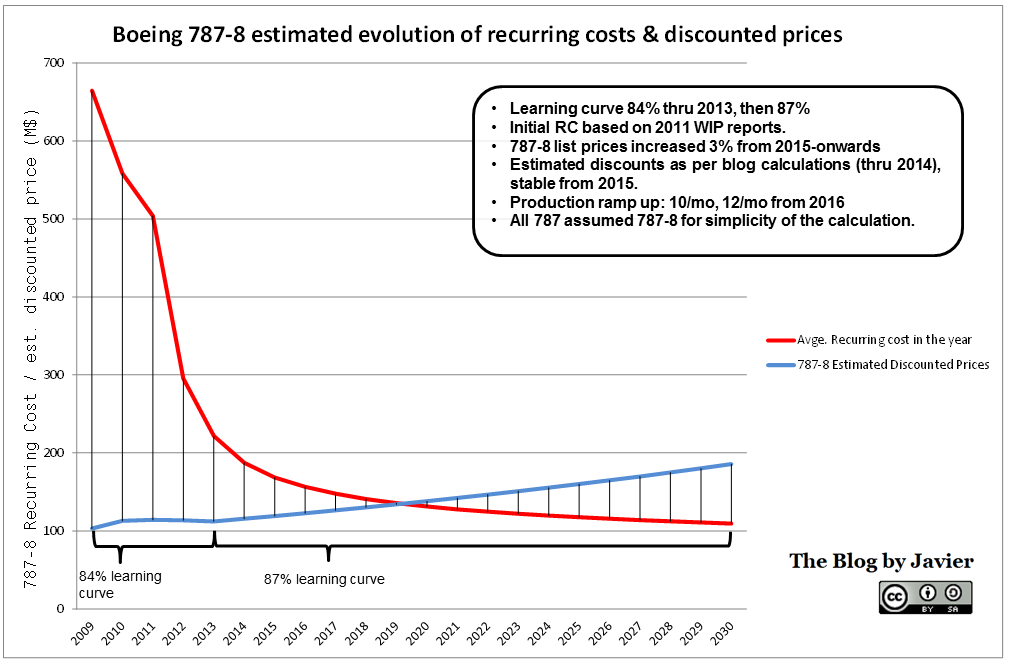
The next step is to accommodate those average costs into a learning curve profile. The steeper the curve (75%) the more expensive the first unit would have been. Since in 2013 the calculated curve was a 84%, I obtain that the first must have been around 650m$ (2). From then on, I apply the mentioned 84% through end 2013. Then I switch to a 87% curve (slower learning) following the reported figures from Greg Smith.

This discussion so far gives an idea of how to estimate the recurring costs. At the end of 2014 this figure is estimated around 180m$.

In order to know by when Boeing will turn the production of 787s into something profitable, we first need to know by when the recurring costs will be lower than the recurring income. The latter is estimated from the information about prices (published by Boeing here) and discounts applied (estimated in other blog posts, see the last update for 2014).

Boeing list price for the 787-8 in 2014 was 218.3M$.

These list prices are, however, increased almost on a yearly basis by Boeing. Sometimes very steeply (+11.4% in 2010, from 2008) and other times more moderately (+2.4% in 2013 vs. 2012). Going into the future I assumed this increase to be constant and about equal to 2014′ increase, 3%.

On the other hand, Boeing applies some discounts to its customers. These are never disclosed. Some are reported by some sources. What I do is to try to estimate an average discount from reported information. See a detailed calculation here. The latest figure that I arrived at was about 47%. Going into the future I assumed this discount to remain constant. You can see here the recent evolution of discounted 787-8 prices.

With all these ingredients, the only thing left is to plot together the recurring costs and recurring income:

787 recurring cost vs. recurring income evolution.

787 recurring cost vs. recurring income evolution.

As you can see recurring costs may be lower than recurring income at the end of 2019.

This will truly depend on the learning curve achieved, the number of units produced (3) and the pricing power Boeing manages to have. If the learning is steeper, the date will be sooner. If the ramp up is higher, the date will be sooner. If the discounts are lower or the list prices increased more, the date will be sooner. In any other case, either 2019 or beyond.

(1) See the complete series here: “Will Boeing 787 ever break-even?“, “More on Boeing 787 break even” and “787 Break Even for Dummies“.

(2) We will never know that figure. I wonder whether this is even known or registered (if not deleted and forgotten) within Boeing.

(3) For the numbers of units built I based the model in reported information that the ramp up to 12 aircraft per month is expected for 2016. I assumed that in 2015 they are at somewhere between 10 and 12 aircraft per month.

Leave a comment

Filed under Aerospace & Defence