Tag Archives: aviation

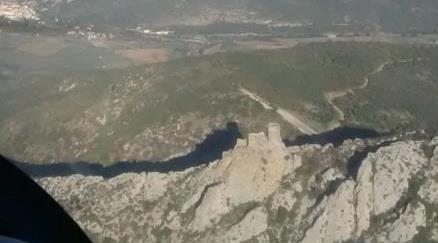
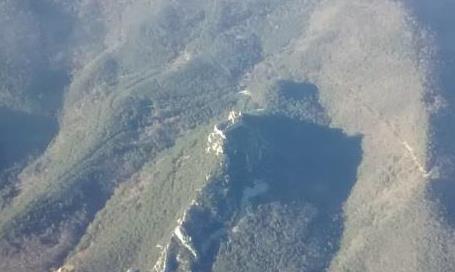
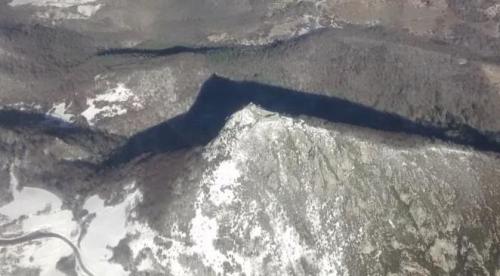
Flying over the Cathar castles

An extract from the Wikipedia to introduce the Catharism to start with:

Catharism was a Christian dualist movement that thrived in […] southern France, between the 12th and 14th centuries. Cathar beliefs varied between communities, because Catharism was initially taught by ascetic priests, who had set few guidelines. The Catholic Church denounced its practices and dismissed it as “the Church of Satan”.

[…] Though the term “Cathar” has been used for centuries to identify the movement, whether the movement identified itself with this name is debatable. In Cathar texts, the terms “Good Men” (Bons Hommes) or “Good Christians” are the common terms of self-identification. The idea of two Gods or principles, one being good and the other evil, was central to Cathar beliefs. The good God was the God of the New Testament and the creator of the spiritual realm, contrasted with the evil Old Testament God—the creator of the physical world whom many Cathars, and particularly their persecutors, identified as Satan. All visible matter, including the human body, was created by this evil god; it was therefore tainted with sin. This was the antithesis to the monotheistic Catholic Church, whose fundamental principle was that there was only one God, who created all things visible and invisible. Cathars thought human spirits were the genderless spirits of angels trapped within the physical creation of the evil god, cursed to be reincarnated until the Cathar faithful achieved salvation through a ritual called the consolamentum.

A tourism highlight of the region, the French Sud-Ouest, is the visit to one or several of the many Cathar castles spread in it.

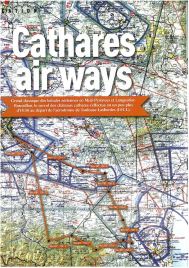
"Cathares air ways", Info Pilote magazine.

“Cathares air ways”, Info Pilote magazine.

Years ago, a colleague (Asier) shared with me an extract of the French Aviation Federation (FFA)  magazine, Info-Pilote, with a proposed route to fly over some of the Cathar castles in the region. Ever since, this has been an excursion in the to-do list.

A few days ago we did it.

I booked some weeks ago a plane of the aeroclub for 3 hours for the morning of Sunday 17th. We were lucky enough to have an incredibly sunny, calm and clear morning in the mid of cloudy and rainy weeks. Thus, we went to the aeroclub and at 9am we started preparing the plane, checking last-minute weather reports, NOTAMs, restricted zones, printing a missing aerodrome chart, refueling the plane… the series of procedures that make general aviation take always longer time spans than you think.

At 9:50am I started the engine.

“DR400 avec 4 personnes abord au parking ACAT, avec l’information Alfa, pour un vol de navigation autour des chateaux cathares, pour rouler au point d’arret de la piste 33…”

What followed were 2 hours of a wonderful flight.

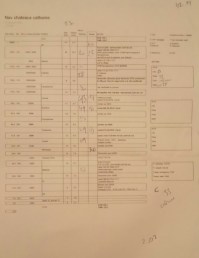
Navigation log.

Navigation log.

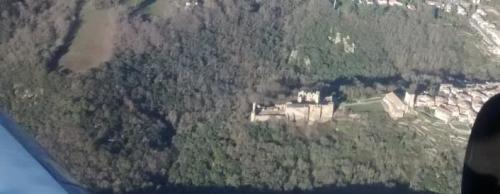
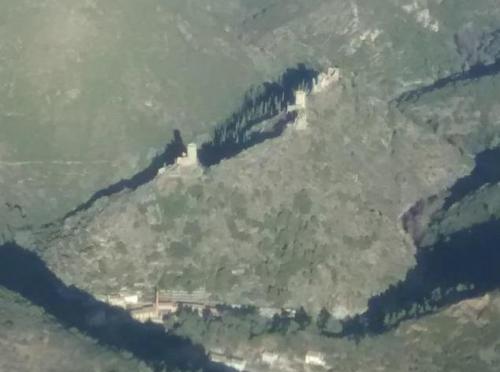
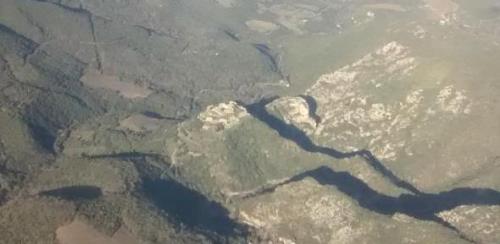
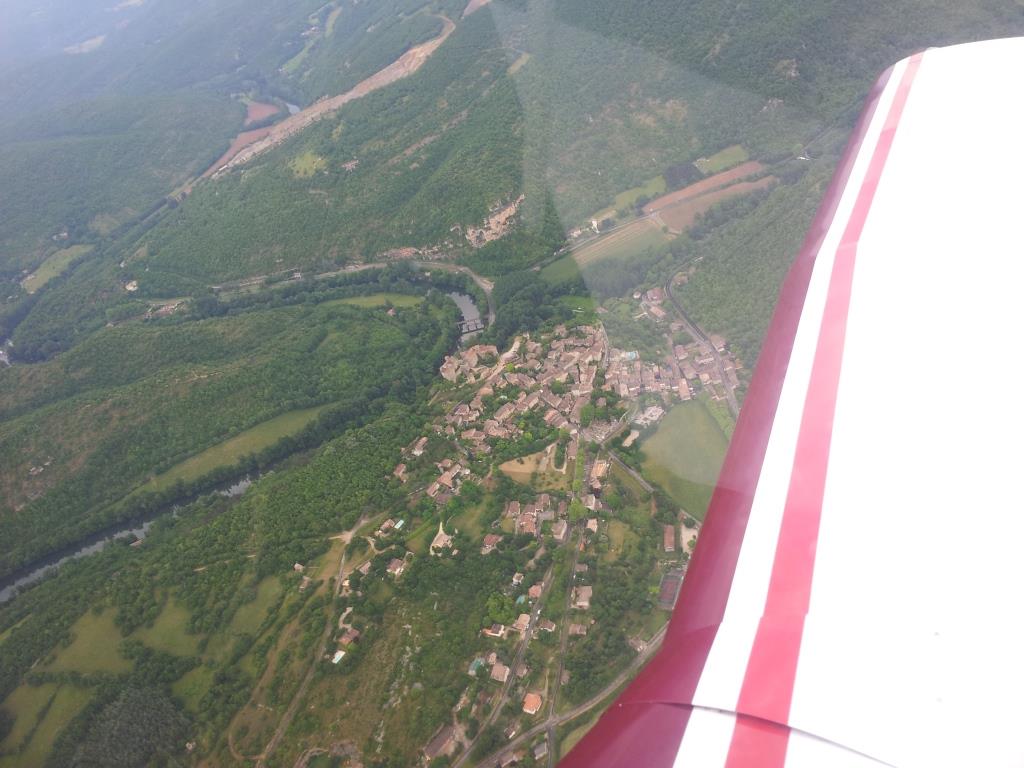
The route, as calculated while I planned the navigation the night before, extended for over 160 nautical miles (about 300 km). We flew over the following Cathar castles: Saissac, Lastours, Carcassone, Termes, Queribus, Peyrepertuse, Puylaurens, Puivert and Montsegur.

Each of those castles definitely deserves a walk-in visit. But, yep, among the many cool things aviation can offer on the spot walk-in visits are not among them. I had visited before the castles of Carcassonne and Montsegur, I now have on the to-be-visited list some others, though most of them are not easy at all to access.

I will be brief in text and generous in pictures (1).

Saissac.

Saissac.

Lastours.

Lastours.

Carcassonne.

Carcassonne.

Termes.

Termes.

Queribus.

Queribus.

Peyrepertuse.

Peyrepertuse.

Puylaurens.

Puylaurens.

Puivert.

Puivert.

Montsegur.

Montsegur.

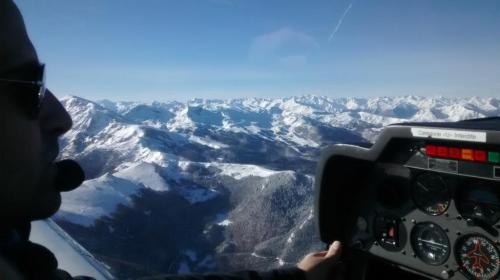
Pyrenees.

Pyrenees.

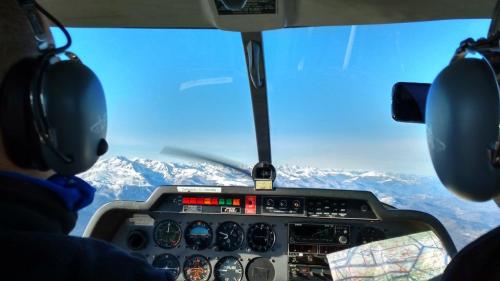
Cockpit.

Cockpit.

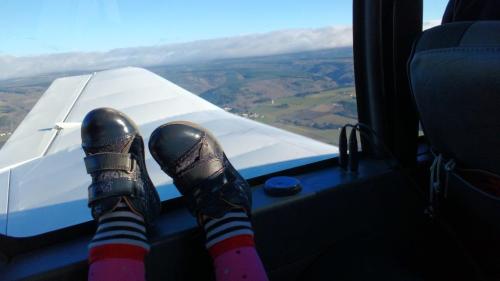
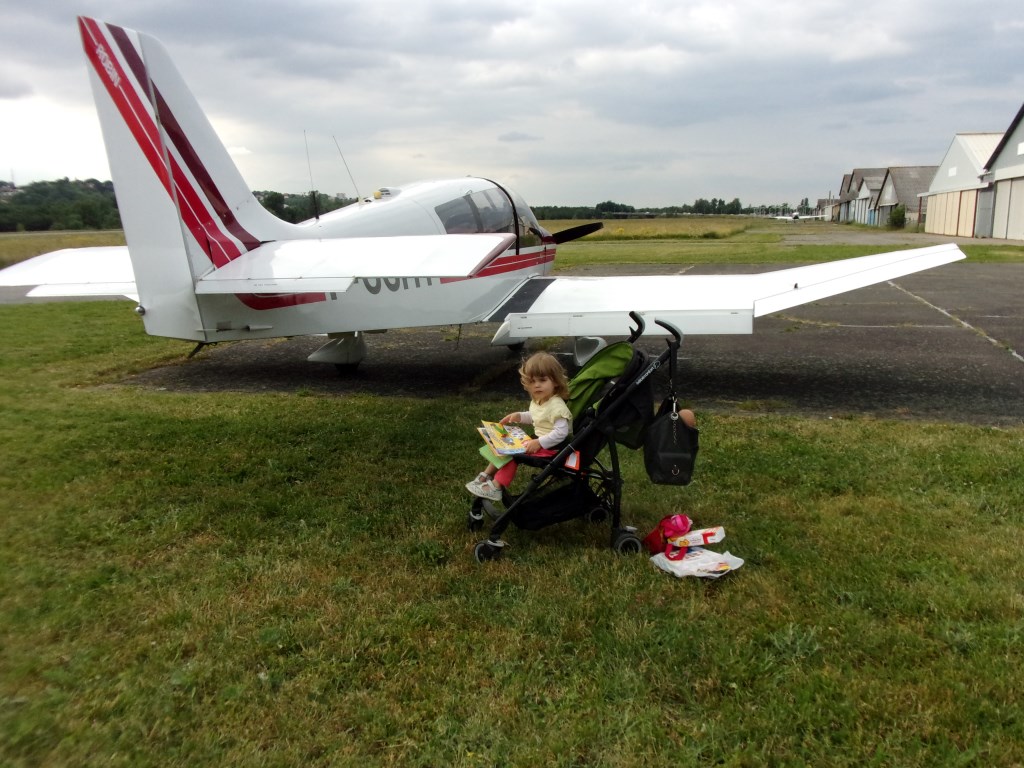
Andrea's feet.

Andrea’s feet.


(1) In fact, the generosity and credit go to both Luca and Asier who were the ones taking the pictures.

2 Comments

Filed under Aerospace & Defence

The Spirit of St. Louis (book review)

TheSpiritOfStLouisCharles A. Lindbergh is without a doubt one of the aviation (1) figures and legends of the XX century, being the first pilot to fly non-stop across the Atlantic ocean in May 1927, managing to win the Orteig Prize. Lindbergh wrote “The Spirit of St. Louis” in 1953, as an autobiography because he was not comfortable with the previous books written about the flight, especially “WE”, as it did not cover with enough exactitude the experience. For this book Lindbergh was awarded the Pulitzer prize on 1954 in the category biography.

I bought this book at the US Air Force museum in Dayton a place that without a doubt stimulates the passion for aviation and I read it in the months while I was completing the last stages of my training as a private pilot, which also contributed to the setting of the stage for the reading.

The beginning of the book covers the days of Lindbergh working for the postal service of the Robertson Aircraft Corporation, the flights along the USA from Saint Louis to Chicago, the incidents due to the weather or the fall of the night, the landings on fields at night with the help of cars’ lights, etc.

As an aviation enthusiast, Lindbergh gets interested in and then engaged into the race of who would be the first pilot(s) to cross the ocean. A crowded race at the time in which many of the great aviation aces were involved, including names like René Fonck or Charles Nungesser (two of the three top French WWI aces (2)).

He later describes the conception, development and testing of the aircraft by the Ryan Aircraft Company in San Diego, the purpose-built airplane he flew for the feat and how they managed to get a Whirlwind engine from the Wright company.

The author finally describes the days in New York before the departure, where up to 3 teams were getting ready to depart and how in the morning of the 20th May, having received positive weather reports from boats in the Atlantic, he takes off. The flight lasted 33h30′ which he describes hour by hour: how he is feeling at each moment, alone, squeezed in his seat, with scarce food and water supplies, cold, flying day (within the clouds at times) and night, thrilling at times and semi-unconscious (sleep), and how his mind is drifting. Until he sees land in Ireland, finds the route to Paris and lands in Le Bourget.

What I liked the most of the book were the description of the flying experiences as a postal service pilot and the development phase of the aircraft. Those are very interesting pages, full of concepts and anecdotes.

It took me months to complete the reading of the book. Why? I was stuck and I advanced very slowly in different parts of the narrative of the 33-hour-long flight. I would say that Lindbergh did that in purpose: writing hour by hour, a few pages per hour, describing what was going on, how his mind got distracted, how he began to remember memories from years back, how he suddenly found once and again that he had lost the bearing and needed to correct it, how he cursed himself for the lack of attention or being on the verge of falling sleep… I felt caught many nights in the same sleepy, somnolent mood. Unable to read more than one or two pages before falling asleep. If that was really the purpose of Lindbergh I cannot know, but, if it was, he was very skillful in conveying the length of those hours and the risk he went through. However, it goes against the readability of the book itself!

Some quick personal reflections I took from the book:

  • Observation. While crossing the ocean, he didn’t have any support information as to the direction or speed of the wind, therefore he descended to see close enough the waves and try to estimate them himself.
  • Bearing. My flying instructor used to say “in the air, the bearing is the life“. When he is flying over the ocean he finds himself sometimes having to correct up to 10 degrees. On top, due to lack of intermediate points of reference and that he is not sure about the speed and direction of the wind, hours before seeing the land in Ireland he finds himself estimating that he may either see the land in Norway or the gulf of Biscay in Spain.
  • Changing position within seat. In order to prevent falling asleep, at some times he goes systematically changing position within the seat: stretching a leg, then the other, grabbing the commands with a hand, then the other. This is something that we can do also while piloting or driving a car (though preferably mixing it with frequent stops!)

As I always do, I marked several pages and underlined different passages that trigger different thoughts. See some of them below:

“I have divided my reserves for the flight in two categories: reserves for success and reserves for failure.”

“[…] I don’t wish my competitors hard luck. Crashed planes and flyers in hospitals impair all of aviation, and destroy the joy of flight.

Landing on one wheel and a wing tip with a highly loaded plane isn’t very dangerous when a pilot is well acquainted with his craft. […] it has been done many times. The newspapers always make it seem a good deal worse than it really is.”

“On our mail route, the pilots expect forced landings. We don’t average a hundred hours between them.”

“Science, freedom, beauty, adventure: what more could you ask of life? Aviation combined all the elements I loved.”

“A pilot has the right to choose his battlefield – that is the strategy of the flight. But once the battlefield is attained, conflict should be welcomed, not avoided. If a pilot fears to test his skills with the elements, he has chosen the wrong profession.”

I wish I could take an aeronautical engineering course. […] I could work hard to understand the magic in the contours of a wing.”

Now pretty soon you fellows are going to think you’re pretty good. It happens to every pilot. Usually starts when he’s had about 25 or 30 hours solo. I just want you to remember this: in aviation, it may be all right to fool the other fellow about how good you are – if you can. But don’t try to fool yourself.” (advice from his instructor in the Army, Master Sergeant Winston)

“No matter how much training you’ve had, your first solo is far different from all other flights. You are completely independent, hopelessly beyond help, entirely responsible, and terribly alone in space.”

“One old Negro woman came up to me with serious face and asked, ‘Boss, how much you all charge fo’ to take me up to Heaven an’ leave me dah?‘ “

The book includes several very interesting appendices about the flights of the aircraft, technical data and maps, prizes collected…

After completing the flight, Lindbergh made some tours around the world until the airplane was finally retired after 174 flights and 489 hours of flying. Today it can be visited at the National Air and Space Museum in DC.

If you like aviation, I do recommend you the reading of the book.

(1) I would say that the size of his fame, legend and iconic figure is not restricted to the aviation world.

(2) The third of the trio, Guynemer, died in the war.

4 Comments

Filed under Aerospace & Defence, Books

My path to the private pilot licence (PPL)

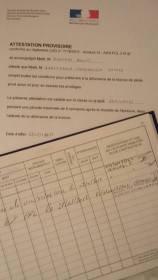
Provisional attestation and log book.

Provisional attestation and log book.

A week ago, on Friday 27th of November, I finally took and passed the practical exam towards obtaining the private pilot licence (PPL).

I have written several posts along these years of different experiences during the learning process: the start of the flight lessons, the first take off at the controls, about weight and balance calculations, the preparation of a flight to Corsica, the flying experience to Corsica, the first solo flight, about refuelling or not, the flying experience to the Loire Valley, and the grand navigation solo

In this post, I just wanted to share some figures of my educational path that may help readers form an idea if they are interested in pursuing the licence:

  • I arrived to the exam with 62.4 flight hours (FH) (1),
    • thereof 51.92 FH accompanied by an instructor.
    • thereof 10.48 FH flying solo (2), a 17% of the total amount,
      • thereof 6.31 FH flying solo in navigation flights (3).
  • To complete those flying hours I performed 71 flights,
    • thereof 14 flights flying solo, a 20% of the total amount.
  • In those flights I performed 123 landings (4)
    • thereof the first ~17 were performed by the instructor (4).
    • thereof 29 landings flying solo, a 24% of the total amount.

I didn’t fly often, therefore even if it has not taken many hours above the minimum requirement to obtain the licence it has taken a long time. Exactly 1503 days since the first flight, or 4 years, a month and 11 days.

Chronologically some dates to remember and as reference:

  • First flight: October 16, 2011.
  • First take off at the controls: December 17, 2011 (on the 5th flight).
  • First landing at the controls: not sure, about June / July 2012 (16-17th flight and about 14-15 FH).
  • First solo flight: August 30, 2013 (the 33th flight and after having completed almost 30FH).
  • First solo navigation flight (from A to B): May 16, 2014 (the 50th flight and after having completed almost 42 FH, of which almost 3 solo in the aerodrome circuit).
  • First solo navigation  flight (from A to B to A): August 19, 2014 (the 55th flight and after having completed 47 FH, of which 3.5 solo).
  • Grand navigation solo: July 23rd, 2015 (65th flight and after having completed 56 FH, of which almost 8 solo (3.6 in navigation)).
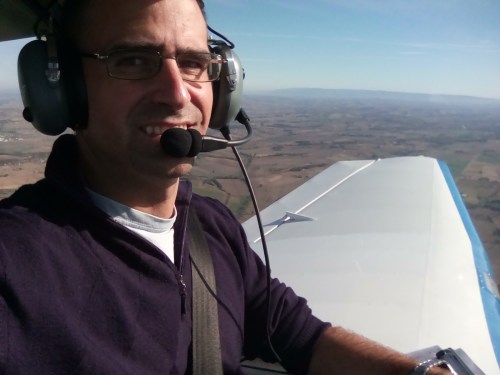
Flying in November 2015.

Flying in November 2015.

(1) Minimum requirement: 45 FH.

(2) Minimum requirement: 10 FH.

(3) Minimum requirement: 5 FH.

(4) Thus, about 106 landings, as I started doing the landings when I had cumulated about 14 FH.

5 Comments

Filed under Aerospace & Defence

“A good landing” (speech)

Over a year ago, I wrote a post about a speech I gave at the then prospective Toastmasters club that some colleagues were pushing to set up within Airbus in Toulouse. Yesterday, we had the 48th session of the club. And yesterday, the club president (Sarah) announced that the club, Airbus Speakers Toulouse, is now a chartered club (1). For this achievement, I wanted to congratulate our colleague Eduardo, who a few months ago left Toulouse for Seville:

Coincidentally, yesterday I was giving a speech at the club. It was the second project of the advanced manual “Speeches by Management” (2), that is “The Technical Speech”. I had to convert a technical paper into a speech, use a technique called “inverted-pyramid” and effectively read out the speech. This was a challenge in the sense that, since long time ago, I don’t use notes for the speeches I prepare. I don’t like it. And this time, I didn’t need them either. But as part of the exercise I forced myself to use them, in order to practice for a situation in which I might need them. That is Toastmasters: practice, practice, practice. (3)

In order to read out the speech, the manual gave tips on how to write the speech in paper: large fonts, short sentences, bottom of each page blank, etc., very useful tips. See below how for a 10-minute speech, about 1,000 words (4), it took 7 pages, instead of about 2 that it would have normally taken (find here the speech) [PDF, 623 KB].

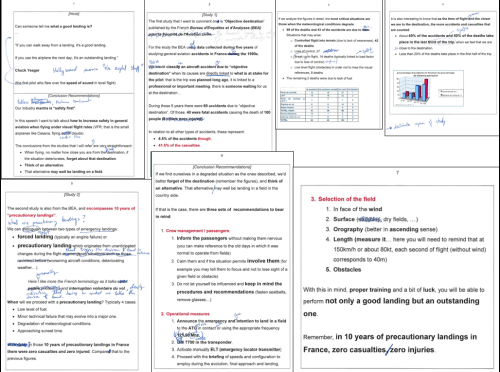
A good landing

Above you can see how I made some grammar corrections, how I deleted some sentences which did not sound well, how I annotated some instructions (e.g. to distribute copies of the paper), how I emphasized some words and… how I introduced some last-minute adaptations. In Toastmasters’ meetings we normally have a word of the day which speakers should strive to introduce in their speech. Yesterday’s one was split. You can see how upon discovering it at the beginning of the meeting, I scanned my speech and located the 3 places in which I would insert it (which I did in the delivery). 🙂

In our club, we not only have a word of the day but we have a theme of the day, picked by the Toastmaster of the day (5). Yesterday’s theme was Hollywood. You can see how, as soon as I learned about the theme, I decided to make reference of a movie which featured Chuck Yeager (6) as I was quoting a couple of sentences from him. Funny enough, I had learned about that movie thanks to my brother Jaime just a couple of days before.

The speech talks about safety in general aviation, putting the emphasis on precautionary landings when the situation deteriorates. The idea of the speech comes from a safety note published by my flying instructor, Thierry, some time ago in the internal bulletin of the aeroclub. He referred then, and I do so in my speech, to a couple of studies from the French Bureau d’Enquêtes et d’Analyses (BEA), principally one called “Objective: Destination” [PDF, 318 KB].

Finally, see below the video of the speech.

The recording starts about 30″ after the speech started and the quality is not very good. A good part of the image is taken by the table in which the camera rests and the light is not optimal. The sound is not great either, as neither is my vocalisation. In fact, that was one of the criticisms that I got, as part of a generally good feedback (7): I should vocalise more clearly. Nevertheless, I must say that I enjoyed delivering it.

(1) That is in Toastmasters language that we are an official club within the organization.

(2) From the version of 2009, as I have later learned that manual contents and organization have changed since then.

(3) By the way, for this speech: I had it written 4 days ahead of the meeting. I rehearsed it 8 times. Seven of them having Luca as an attentive mentor.

(4) At my speaking pace.

(5) The master of ceremonies in Toastmasters language.

(6) A NASA flight test pilot.

(7) Feel free to comment and provide feedback below :-).

Leave a comment

Filed under Aerospace & Defence, Movies, Toastmasters

My grand navigation solo

When talking about flying lessons and my progress (or the lack of it :-)) I am often posed the following question or comment: “but if you are taking lessons… then you always fly with an instructor, right?”

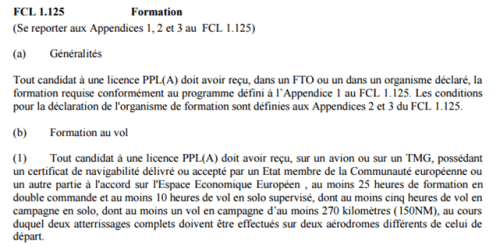
The answer is no. Unlike car driving lessons, part of the requirements to become a private pilot is to have completed a given amount of flying hours having flown solo (i.e. without instructor), part of them “navigation” flying hours (1).

Flight Crew Licence formation requirements.

Flight Crew Licence formation requirements.

The first flight solo is typically a marking moment in the flying life of a pilot. See here a post with my experience then. The first flights solo are typically around your home aerodrome, where you are used to all geographical accidents, the aerodrome circuit, radio frequencies and you may feel less stressed. A friendly scenario where to push the bird to fly.

There are many other marking moments in the flying life of a student pilot: the first take off or landing that you do at the controls, or the first navigation solo. The word navigation is used to describe flights going from one aerodrome to another, hence some navigation skills are required and employed to reach the destination.

Then, another big marking moment is what in France is called the “Grande Nav solo”. As its name points out, it is a solo flight implying navigation, but then a big one, a rather long flight. Specifically, as required by the FCL 1.125 (b) (1) “done au moins un vol en campagne d’au moins 270 kilometres (150NM), au course duquel deux aterrisages complets doivent etre effectues sur deux aerodromes differents de celui de depart” (see requirements above).

I completed such grande nav solo flight back on July 23rd. I had been after it for months, trying to find a slot with good meteorological conditions and having accumulated some flight hours in the prior weeks to feel at ease. It was big moment that I wanted to share here.

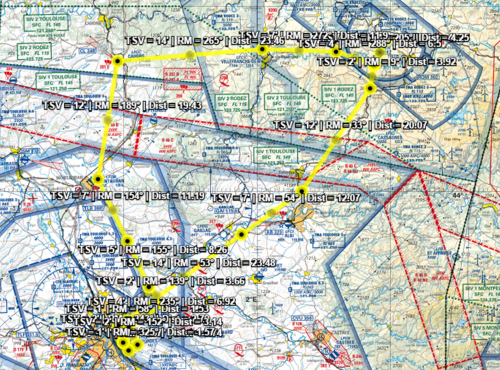
For that navigation we selected the route Toulouse Lasbordes – Rodez (2) – Cahors and back to Lasbordes. The route had over 160 nautical miles (over 300 kilometres) and would take me over 2 hours, including the two complete landings. You can see below the route in a screenshot from the 1/500.000 aeronautical chart available at the website carte aero fr.(3)

Route planned for my grand navigation solo.

Route planned for my grand navigation solo.

The experience during the flight.

The flight went remarkably well, even if I started a bit pressured because of the time.

I arrived at the aerodrome at about 18:00. With the flight preparation, finding out last information about weather, points of contact for special zones, pre-flight check list, etc., I only managed to start the engine at 18:36 local time. At that point I started to have some doubts of whether if anything went wrong I might not be able to return back after the complete flight… would I have to shorten it? I decided to take a look at the timing at Rodez parking.

After the take off, and en-route to Rodez, right after quitting Lasbordes’ radio, I passed with Toulouse Info and demanded a flight tracking, which is reassuring at the beginning. I couldn’t start climbing up to 4,000ft right after flying over Gaillac as there was some Airbus traffic coming from Blagnac. Reaching Camaux, close to Albi, I had to turn left (033) and then I could start the climb.

The week before I had got lost while navigating towards Rodez (I was then with my instructor, and we found ourselves with the help of a GPS). Not this time. I paid much detail to the navigation, finding the villages that marked the different way points of the approach to Rodez, and cross-checking with the tower that I was indeed at those points.

Curiously enough, when I was at the parking in Rodez there was a helicopter coming in, which followed the same descent path, runway, taxi way, etc., as if it was an airplane.

At the parking, I quickly made the numbers and thought I would have enough margin to complete the whole flight so I decided to go.

On the way to Cahors I continued being followed by Rodez Info (same controller than Rodez tower). When I mentioned that I was quitting to pass with Toulouse Info frequency he noted that I could continue with him all the way to Cahors, so I did. Having the sun setting in front of me and not wearing sun glasses that afternoon it was difficult to locate the terrain. I was seeing some cleared land about 10nm ahead, thus, I again asked the controller. He confirmed that it was Cahors aerodrome and that the distance was 8nm. Good. Second leg almost done.

I passed to Cahors frequency. As there was no controller it operated only for communication between airplanes… and parachute jumpers, as there were many jumping at that moment. The pilot of the plane from which they jumped proved quite helpful there. Even if I had studied the aerodrome chart, he provided all kind of explanations via the radio at my arrival:

“as there is parachuting activity, don’t fly over the vertical, integrate yourself directly into the circuit. There are no more airplanes at the moment, report in base leg (the circuit is a right hand for runway 31, the one in service). There are two exits to the runway, take the second one as in the first one there is a plane waiting for departure: me…”.

While parked at the tarmac, I drank some water and listened to some message for me. They offered to sign something for me. I wasn’t not understanding it fully. What did I need to get signed? Nothing. So I asked them about that. Apparently they offered to sign some paper as a souvenir of having flown to that aerodrome and visited the aeroclub. I thanked them and told that I wanted to go quickly back to Toulouse. “So, you’re doing your Grande Nav Solo, aren’t you?”. “Yes, I am” (all radio exchanges in French, though). “Good luck then!”. After a couple of minutes, I proceeded with the check lists to depart.

On the way back to Toulouse I passed again with Toulouse Info. I passed by the East of Montauban, Villemur-sur-Tarn… and then I was already in an area I knew well, thus I was rather calm.

Arriving to the way points EN and AE there was some traffic (informed by TLS Info), and as soon as I got a visual of them and they flew away I passed to Lasbordes frequency (no controller anymore due to the time of arrival). I proceeded with the integration, landing and parking at my aeroclub’s tarmac. Done!

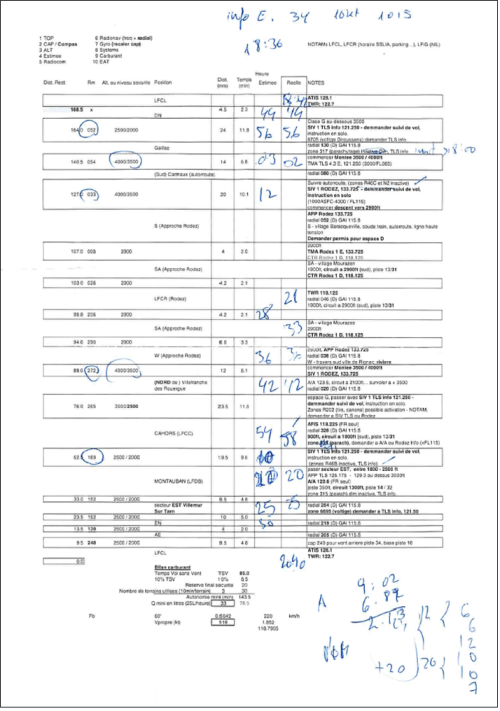
Finally, find below a copy of the navigation log I used during the flight, with remarks for changes of heading, comments for the route, annotations during the flight, ATIS information, and the sum made at Rodez to estimate the remaining duration of the flight to decided whether to continue or not.

Navigation Log for the Grande NAV solo (2015.07.23).

Navigation Log for the Grande NAV solo (2015.07.23).


(1) The extract is taken from the French ministry for sustainable development [PDF] which oversees Flight Crew Licence requirements.
(2) Coincidentally, just a few days before that flight I had flown with my instructor and a colleague to Rodez and got lost at the destination.
(3) A tip from my colleague Rapha and a good resource to quickly start preparing a navigation flight.


1 Comment

Filed under Aerospace & Defence

Musée Espace Air Passion (Angers)

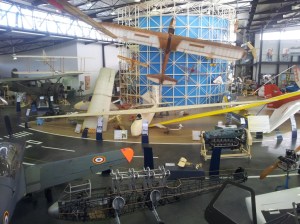
In the last post I described the Fly Out to Les Châteaux de la Loire that we made the last weekend. In that post I mentioned that we visited the museum Espace Air Passion in Angers airport. This post will be dedicated to that beautiful museum.

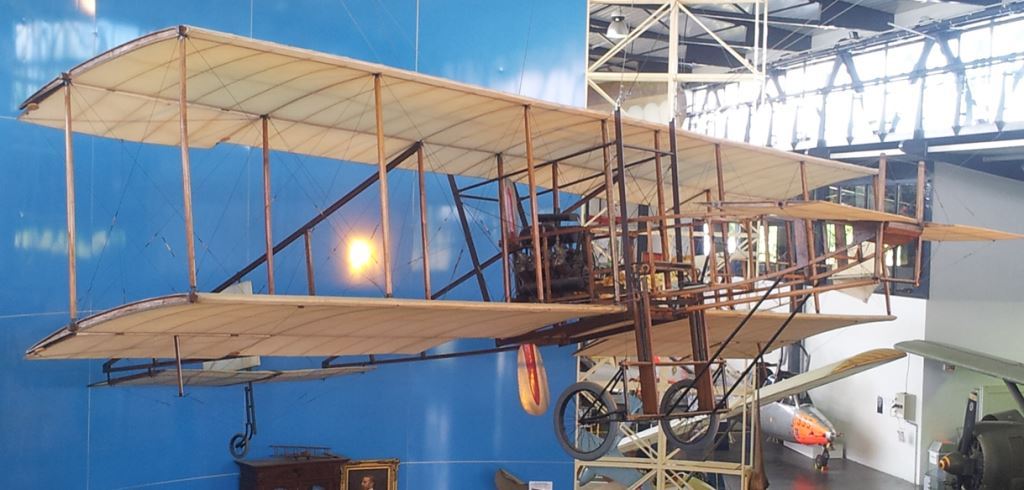
This museum is owned and run by an association, the “Groupement pour la Préservation du Patrimoine Aéronautique” (GPPA), created back in 1981 by a group of friends around the project of restoring an old aircraft (a jewel) from René Gasnier, a local pioneer of French aviation who flew in 1908 along 1km in an airplane built by himself. That airplane is the first one you get to see in the museum:

Rene Gasnier III, built in 1908, restored in 1988.

Rene Gasnier III, built in 1908, restored in 1988.

René Gasnier built his first airplanes between 1907 and 1908. This model, the III was built in 1908. As you can see it was made of wood and cloth. It mounted an Antoinette engine with 8 cylinders in V, with a power of 48hp, wingspan of 10m, less than 500kg at take off. It took the enthusiasts of GPPA over 1000 hours to restore it.

This airplane is surely not the only unique piece of the museum. Take a look at the following two airplanes.

The Gérin “Varivol”, built in 1938 (by the Compagnie Française d’Aviation), was based in the concept of using moving wings which extended themselves increasing the wingspan at the time of take-off when more lift was needed and reducing the wingspan to decrease drag at cruise. A prototype was successfully tested in the wind tunnel of Chalais-Meudon in 1946, however the actual airplane seems to never have flown. Had it flown, it was to have a cruise speed of ~455km/h while only 92km/h for landing speed. The wings were to be extended/retracted 2.75m per side out of a total retracted wingspan of 8.10m.

Alerion Riout 102 T.

Alerion Riout 102 T.

Built in 1937 by René Riout (at the workshop of Louis Breguet) with duralium, the 102 T explored the concept of flying by batting its wings (4, two at each side of the fuselage). During its test in 1938 when the pilot increased the engine regime up to around 4500rpm, after a few seconds, the observers saw torsion vibrations in the tip of one the wings before it broke, closely followed by the other 3 wings. It was then dismounted and forgotten till 2005 when the restoration at GPPA started.

This reminded me of a quote attributed to Igor Sikorsky that goes like:

Our engineers have determined that aerodynamically, the hummingbird shouldn’t be able to fly, but the hummingbird doesn’t know it so it goes on flying anyway.

Another oddity of the museum is one of the only two prototypes (1) ever built of the Moynet Jupiter (designed by André Moynet) which had the rare configuration of two push and pull engines, one in the front and one in the back of the fuselage. It was never sold to any customer, but it flew for the first time on December 17, 1963 (60 years after that glorious day in Kitty Hawk).

Moynet Jupiter.

Moynet Jupiter.

The museum has these other two sailplanes which have been declared patrimoine de l’aviation française due to the records they collected in their high time, the Caudron 800 Épervier and the Avia 40P:

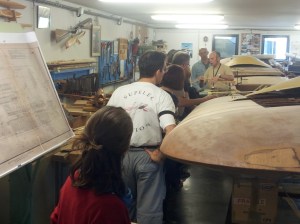
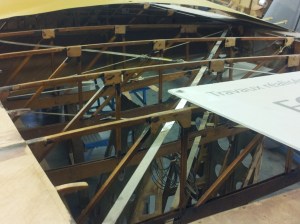
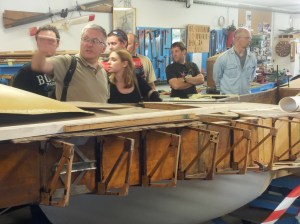
We also enjoyed the visit to the workshops where they restore the fuselages and the wings. Take a look at the pictures and notice the wood and the cloth. Forget about those pictures the next time you get onboard a general aviation airplane.

We were given a guided tour by two members of the association, their explanations, anecdotes, connection with French famous pilots (including former Airbus’ test pilots) were invaluable. On the other hand, the audience couldn’t have been more responsive. Take a look at the pictures above: scores of years of aerospace engineering experience (flight testing, training), thousands of flying hours as pilots, real aviation geeks at its best.

The museum also has playing area for children, a MH-1521 Broussard for children (an adults) to get on and play, and some other beautiful aircraft including a Caudron PC431 Rafale, a Morane Saulnier 505, a Piper L4H Grasshoper, or the car Marcel Leyat Helica… see them below:

This slideshow requires JavaScript.

(1) The other prototype is at  the Musée de l’Air et de l’Espace, at Le Bourget.

1 Comment

Filed under Aerospace & Defence

Fly Out: Les Châteaux de la Loire

Last weekend we took part together with my friend Raphaël and about 20 other members of the Airbus Aviation Society of Toulouse in a Fly Out (1) to Les Châteaux de la Loire. 7 aircraft departed from different airfields around Toulouse to reach Angers, some on Friday evening, some on Saturday morning. From then one we would enjoy some joint activities. In a nutshell:

  • On the way to Angers (LFJR, 2h50′ flight), we flew over some very beautiful villages such as Bruniquel, Saint Cirq Lapopie, etc.
  • On Saturday morning, in Angers we visited the castle and walked around the city. We then visited the museum Espace Air Passion.
  • We then took our aircraft and flew over dozens of castles along the Loire valley, from Angers to Chambord and back to Amboise (LFEF).
  • In Amboise we had an evening event with the local aeroclub.
  • The morning after and due to worsening meteorological conditions we decided to skip the “ground” visit to the Chenonceau castle (next time) and depart early back to Toulouse. In the way we stopped for lunch at Sarlat-Dome (LFDS) where we were very warmly welcome by some members of the local aeroclub.

I believe than rather than wandering with long texts explaining all of these experiences it is better to share some of the pictures we took and let you fly along with us with some captions:

Waiting for the departure time at Toulouse Lasbordes (LFCL)

Waiting for the departure time at Toulouse Lasbordes (LFCL).

Dashboard of the Robin DR-48 we flew (F-GGHT).

Dashboard of the Robin DR-48 we flew (F-GGHT). (2)

Bruniquel.

Bruniquel.

Saint Cirq Lapopie.

Saint Cirq Lapopie. (3)

La Roque Gageac.

La Roque Gageac.

Beynac et Cazenac.

Beynac et Cazenac.

Rapha, concentrated in his piloting.

Rapha, concentrated in his piloting.

Arriving at Angers (LFJR) rather late.

Arriving at Angers (LFJR) rather late.

If you arrive at Angers airport in the evening, you'd better know the theory if you want to get out.

If you arrive at Angers airport in the evening, you’d better know the theory if you want to get out.

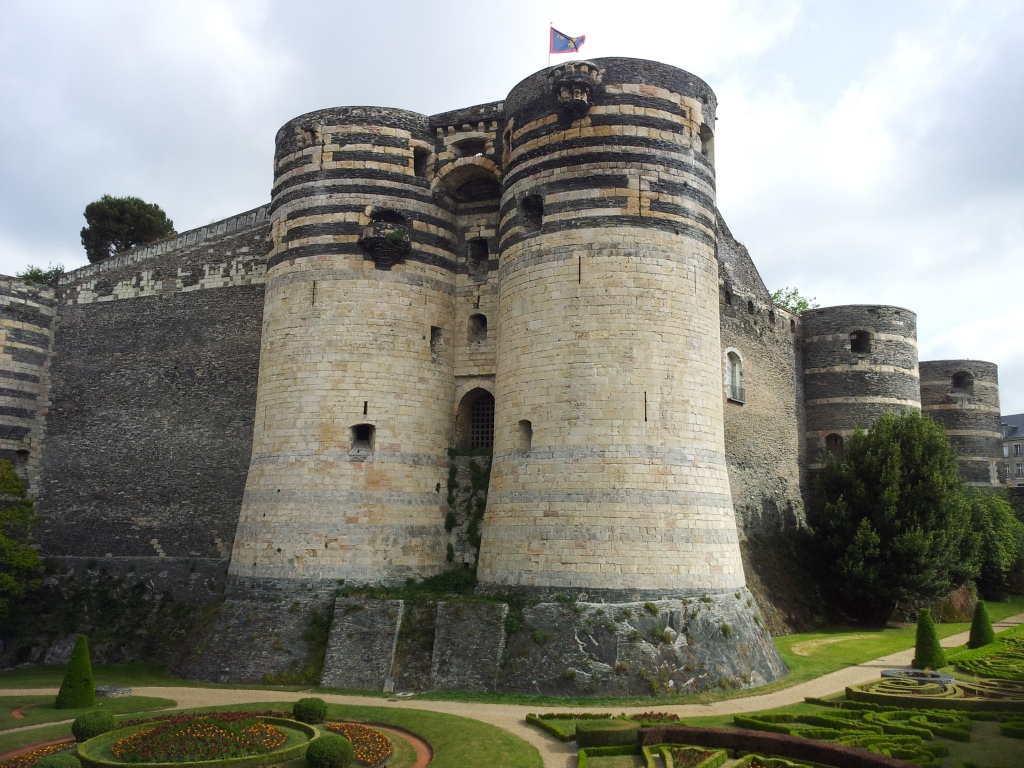
Château d'Angers, founded by the Counts of Anjou.

Château d’Angers, founded by the Counts of Anjou.

"Apocalypse Tapestry" at Angers castle.

“Apocalypse Tapestry” at Angers castle.

Visiting the museum "Espace Air Passion" at Angers airport.

Visiting the museum “Espace Air Passion” at Angers airport. (4)

"Why is Rapha at the controls again, daddy? When do I get to pilot?!"

“Why is Rapha at the controls again, daddy? When do I get to pilot?!”

Chenonceau.

Chenonceau.

Chambord.

Chambord.

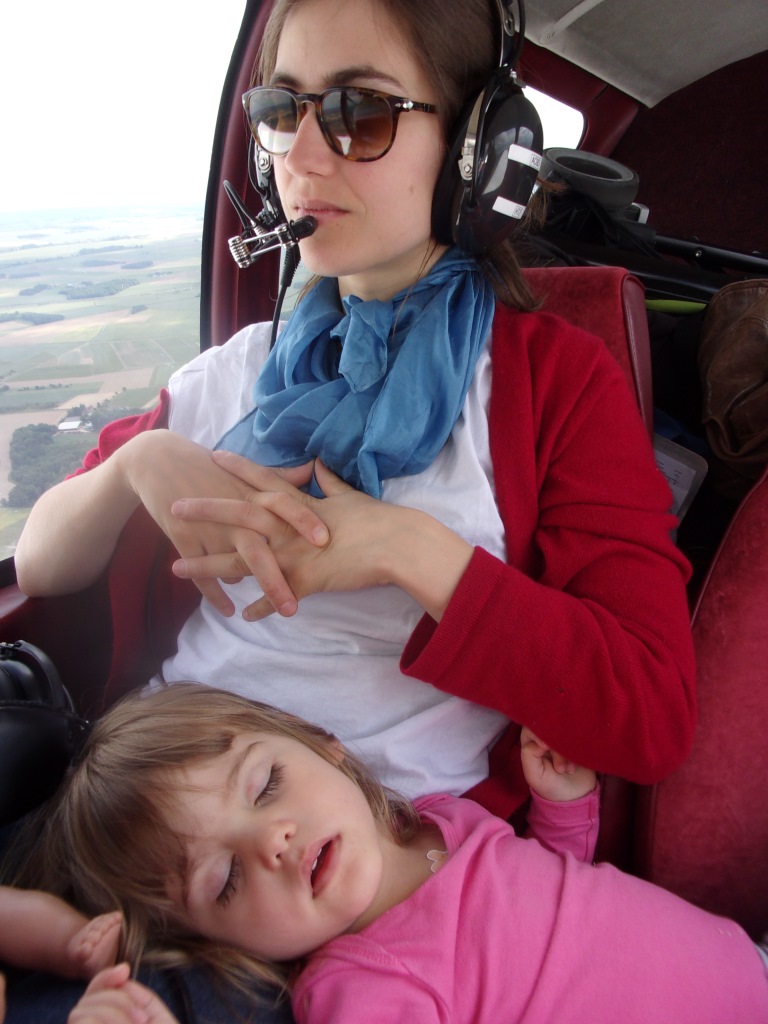
Andrea, a born flyer, and Luca, getting over it.

Andrea, a born flyer, and Luca, getting over it.

Great evening event organized by the "Aéro-club Les Ailes Tourangelles".

Great evening event organized by the “Aéro-club Les Ailes Tourangelles”. (5)

Our commandan de bord, Raphael preparing the next flight.

Our commandant de bord, Raphael preparing the next flight.

The fellows from the "Aeroclub du Sarladais" got out those table, parasols and chairs for us to have lunch with them.

The fellows from the “Aeroclub du Sarladais” got out those table, parasols and chairs for us to have lunch with them. (5)

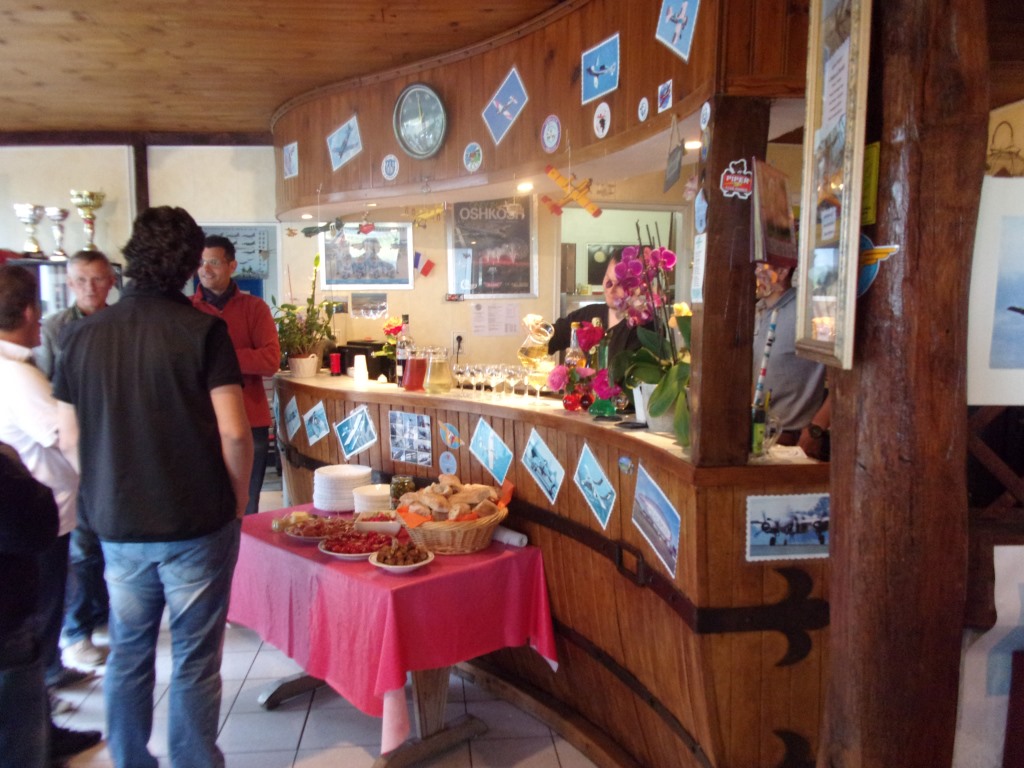
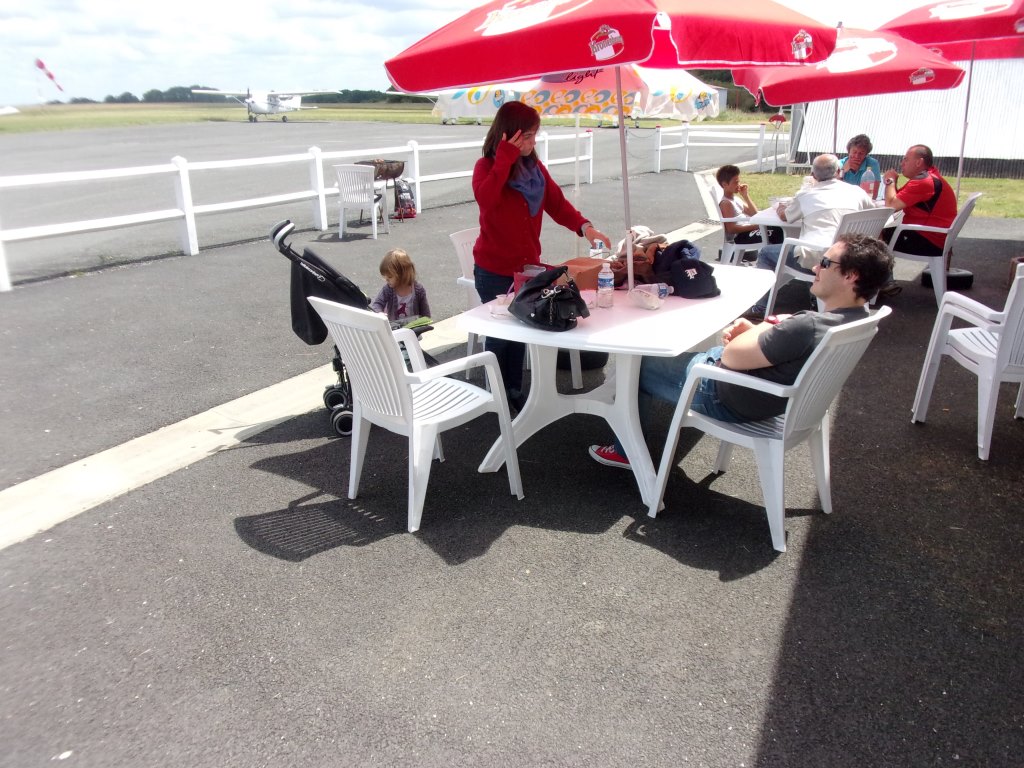
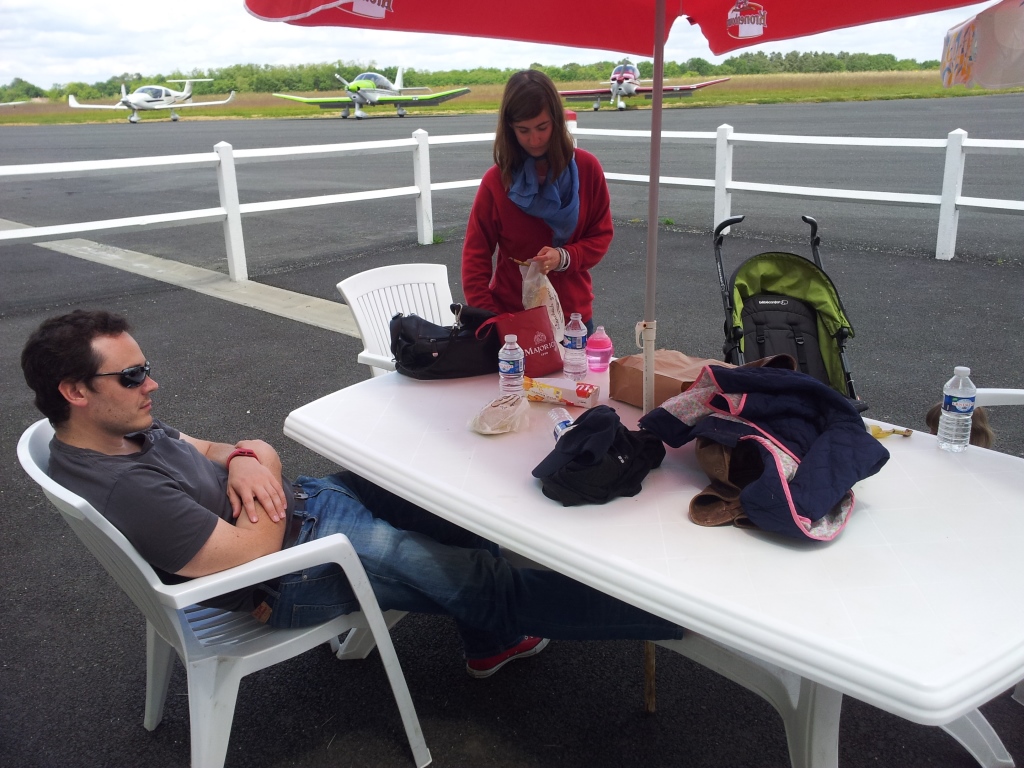
Relaxing at Sarlat-Dome aerodrome (LFDS).

Relaxing at Sarlat-Dome aerodrome (LFDS).

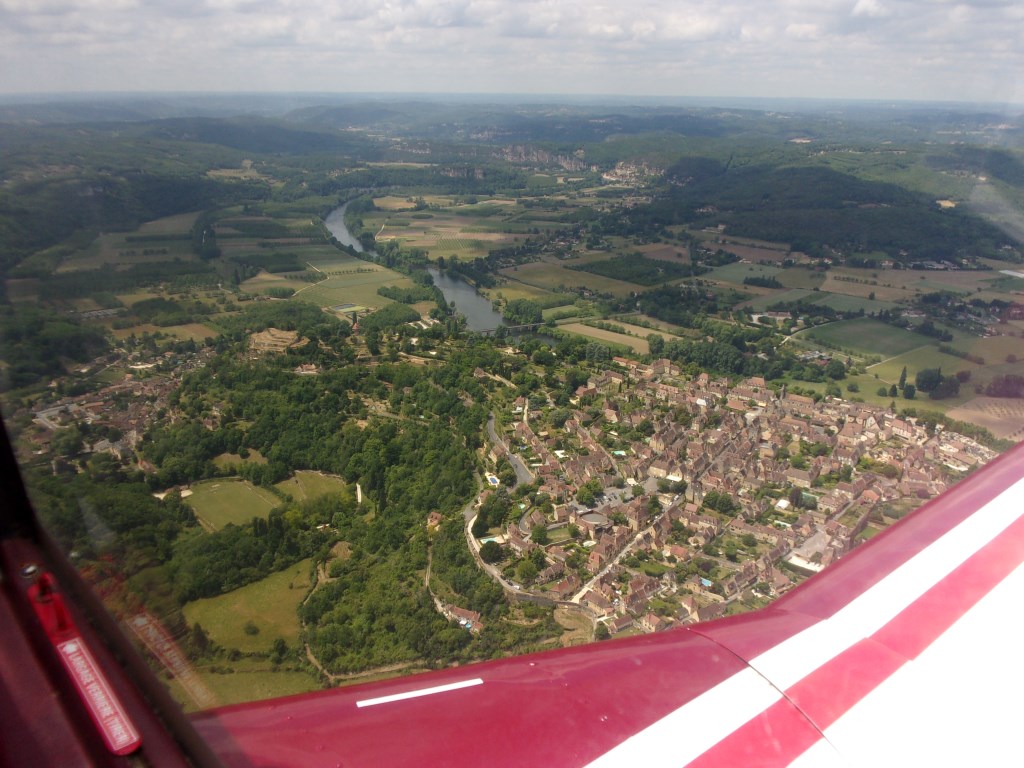
Initial climb at Sarlat-Dome (LFDS), wonderful view of the Dordogne valley and Dome village.

Initial climb at Sarlat-Dome (LFDS), wonderful view of the Dordogne valley and Dome village.

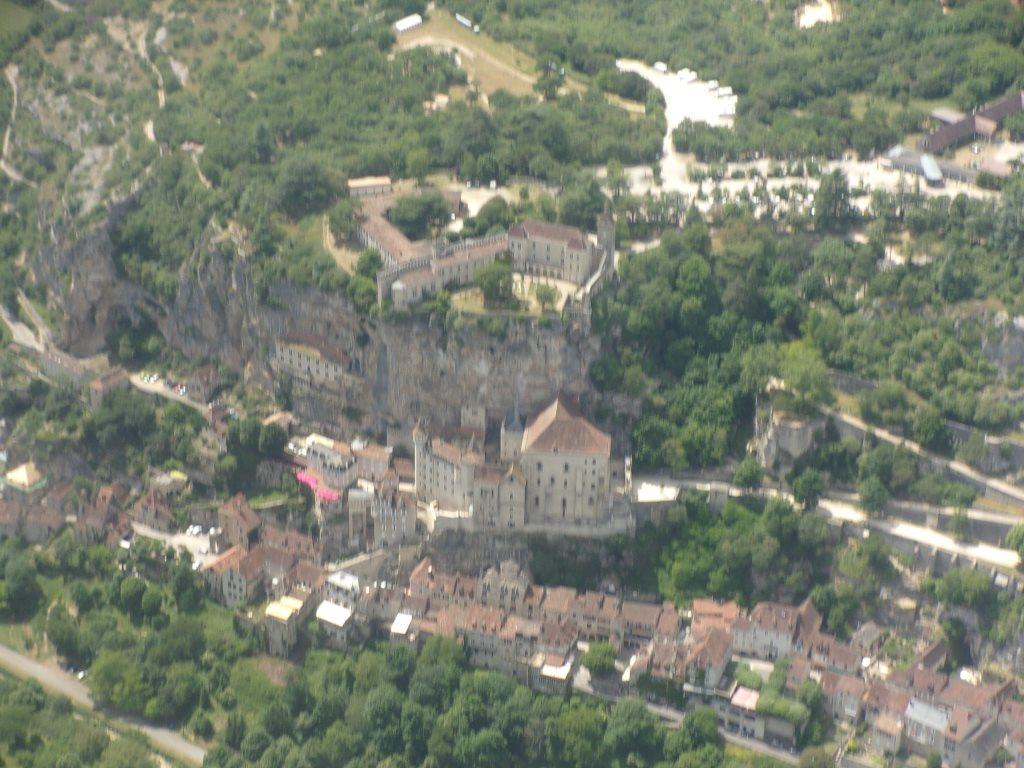
Rocamadour.

Rocamadour.

(1) The term we use for an organized activity in which several aircraft depart together with a common destination.

(2) Check out about the DR-48 here.

(3) Recently selected as the most beautiful village of France.

(4) Be sure that I will dedicate another post about this museum.

(5) If you plan to fly either to Amboise Dierre or Sarlat-Dome, do not hesitate in contacting the local aeroclubs (Les Ailes Tourangelles and Aeroclub du Sarladais, respectively), they will give you a more than warm welcome!

4 Comments

Filed under Aerospace & Defence, France, Travelling

Summary of (my) 2014

Brief recap of my 2014. (1)

In the last year recap I mentioned that in 2014 I wanted to give it a try to the processes’ approach at the time of setting goals. Trying to introduce new habits, settle others, etc. I started very focused: waking up earlier, studying Dutch first thing in the morning, arriving at the office earlier, training at lunch time, getting back home earlier, playing with Andrea, spend some family time, read and study at late evening/night. Some of the habits have stayed, some others not, and I have taken new ones along the year… let’s review the year.

The main events of this year:
  • AndreaFFVFRLuca passed the exams to become a lawyer in France, found a job in a law firm and finally sworn before the court as a lawyer.
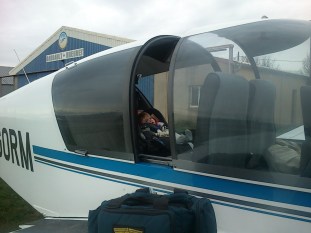
  • Andrea… many events in her front. From the first flight with me at the controls in February, to her first steps in the summer, to travelling first time to Africa and America…
  • We moved houses, though still living in Toulouse (from the flat in Saint-Cyprien to a house in Sept Deniers).

Avgeek. The stage we had in Paris for Luca’s exams allowed me to visit the Musée de l’Air et de l’Espace (Le Bourget) and to get to know the airfield of Issy-Les-Moulineaux. Our escapades to the Pyrenees made us discover Musée de l’Aéronautique of Luchon. The more recent trip to the USA allowed us to visit the Dayton, where the Wright Brothers originated and the National Museum of the US Air Force, for which I still have to write about, but you can see my brother’s post on the museum. We also had the chance to visit the Francazal air show.

VitrineThe moving to the new house gave me the opportunity to find a well deserved location for the model collection.

Flying. Apart of the mentioned first flight with Andrea on board, in this 2014 I managed to complete some 17 flights totalling almost 15 flight hours, 30 take-offs and landings and including 5 solo flights (one of them a navigation flight).
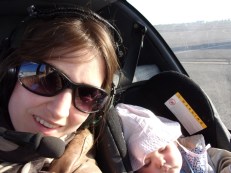
????????????????????????????????Not only Andrea had her baptism regarding flying with me at the controls in 2014, but Juan, Maicol, my mother, my sister Beatriz and brother Jaime had theirs too! Despite some exercise-related incidents (including a runway excursion, through during a solo flight), I am sure they enjoyed it and the experience made it to their 2014 memories.

Since the progress was good, just before the summer my instructor mentioned the taking of the exam! But first I had to pass the theoretical part, which I had postponed so far. I did a first attempt in November in which I cleared half of it, next attempt in a couple of months. Then, some more flight lessons (not having flown since September), flight hours and start thinking on the practical exam!

FinMarLearning. The balance between family, hobbies and work is always tricky. This year I started strong studying Dutch which I dropped after 3 months, and in the second half of the year I had to put hours to the study of the PPL theoretical part (in French), with partial success.

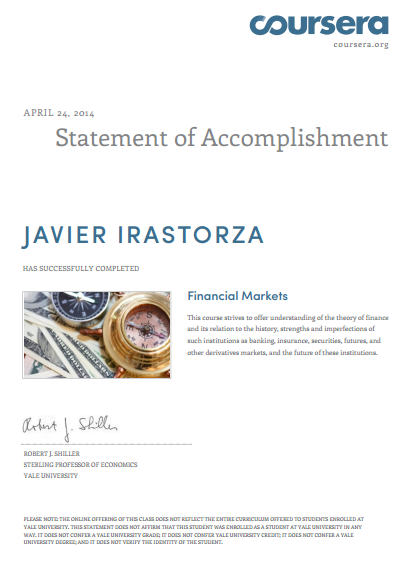
In between, I completed some other online courses (MOOCs): The Age of Sustainable Development (Columbia), An Introduction to Operations Management (Wharton) and Financial Markets (Yale). In parallel, I completed some other very interesting in-company trainings on Airline Engineering and Maintenance, Management of Conflicts and Time Management.

Reading. This year again I didn’t set any objectives in terms of number of books, but I only prepared a shelf with a selection of about 20 books that I wanted to prioritize. In the end I read the following 10 books (about half of them from the selected shelf):  Hot, Flat, and CrowdedThe Roaring NinetiesEl amor en los tiempos del cóleraThe Early History of the AirplaneSeeking Wisdom: From Darwin to MungerWhat management is, Sycamore Row, The Racketeer, Micro, Crime and Punishment (in Spanish). You can find here a brief review of each of them and references to longer reviews I made about them in the blog.

Family 2.0. Despite of the family life and different changes, I managed to write just a bit over 80 posts. Plus the blog received over 80,000 visits in 2014 (a 60% increase in relation to 2013) and is very close to surpassing the 200,000 since I started it in 2010.

On top of that, Luca went forward with her own blog, check it here, Jaime launched his new blog (with especially interesting post on aerospace topics!) and my mother launched a website to promote her therapy business (Terapias ArcoIris). I wonder whether Andrea will start a blog before speaking or writing! (2)
DSC_0161 - CopyTravelling. This year we visited Paris for a week (first time in Versailles and in the château de Chambord for me), made 3 escapades the Pyrenees (with Luca and Andrea alone, with my family and with friends), visited again the United States (NY and some new places for us: Boston, Gettysburg, Dayton, Pittsburgh, Philadelphia – with over 2,100 miles driven and 8 different hotels in less than 2 weeks!) in a very entertaining trip with lots of learning opportunities and experiences, the Dordogne, spent a half resting half discovery week in Mauritius, flew to the Netherlands (3 times, a week each time), five days in Sicily (Siracusa, Milazzo, Taormina; incredibly beautiful places) and these last days of the year in Madrid.
????????????????????????????????Again, those were the leisure trips; on top of that, the job made me go to Madrid another 20-25 times (?), that made it tiresome and difficult to combine with other things but gave my plenty of opportunities to see my family, friends and to run in the Retiro park…

Sports – Running. This year, due to the young age of Andrea, we did not manage to go skiing. We neither played some golf as we wished we had to, nor gave it a try with soccer. What I did was basically, guess… running.

In 2014 I ran well over 1,900 kilometres, which was a goal I set to myself at half way through the year (when I had completed just over 800). As I wanted to reduce the weekends’ agenda, I competed less and just took part in 9 races (3) (versus 16 in 2013) including: 2 marathons (Rotterdam and New York, both under my previous personal best time!), 2 half marathons (Blagnac and Toulouse, no personal best here though), 3 10k‘s (all of them under 45’, with two consecutive personal bests!) and a couple of trails: Cassoulet and Foies Gras. As you read, in 2014 I achieved personal bests in marathon and 10k thanks to the different training plans I combined (more variety), which was great. I did not so in half marathon, I think in 2015 I’ll try to improve the 3 marks.

IMG_0219Following the sentence “the running shoes, always in the suitcase”, the year 2014 caught me running in: Wijchen (9 times), The Hague, Rijswijk, Sevilla, Rotterdam, Paris (x6), New York (x2), Milazzo (x3), Montauban, Mauritius (x5), Madrid (x16), Dayton, Colomiers, Benasque, Barakaldo, Allentown, Verfeil, Mauvezin… plus the tens of times I trained in Toulouse and Blagnac.

This year, apart from the races, I managed to train plenty of long runs: 11 over 20km, including 6 over 25km and 2 over 30km; and did plenty of series’ sessions (too many to mention). That contributed a lot to the improvement of my times.

Other reasons for joy in 2014 have been:

  • My family: My sister moved to Odense (Denmark) to study a master in International Security & Law  (you can follow her in her blog), and once the classes were completed moved to Vilnius (Lithuania) to make a stage at the NATO Energy Security Centre of Excellence. We had the pleasure to have my mother over for a month in July-August. We enjoyed 2 weeks of holidays with Jaime in the States, apart enjoying several runs with him. My father is ever more engaged with NGOs teaching classes to disfavoured people in Madrid.
  • Some more friends got married: Alessandro, Erik, Simone.
  • And we welcome some newborns from family and friends: Guillermo, Cas, Nils, Amelie…

Now it’s time to rest, celebrate and soon to plan how we want the 2015 to turn out. It will again be a year full of personal and professional changes, with plenty of learning opportunities, kilometres to run, marathons to enjoy, airplanes to fly and flights to catch, museums to see, books to read, trips to make and parties to enjoy.

For now, I will close 2014 celebrating my sister’s birthday, running the San Silvestre Vallecana in Madrid with several friends and enjoying a last dinner with the family.

I wish you the best for 2015, enjoy it!

(1) You can see my 20102011, 2012 and 2013 recaps.

(2) I have to confess that at some point I considered the idea of opening a blog for her to register each of her flights… I dropped the idea, because I was incapable of registering all the desired data of so many flights! [over 20 flights in 2014 alone for her]

(3) That figure excludes the San Silvestre Vallecana that I will run the afternoon after this post is published.
14 Comments

Filed under Personal development & HR

Airbus vs. Boeing, comparison of market forecasts (2014)

Yesterday, Airbus released the new figures of the 2014-33 Airbus’ Global Market Forecast (GMF, PDF 7.5MB).

In previous years, I have published comparisons of both Airbus’ and Boeing’s forecasts (Current Market Outlook, CMO, PDF 5.3MB). You can find below the update of such comparison with the latest released figures from both companies.

Comparison of Airbus GMF and Boeing CMO 2014-2033.

Comparison of Airbus GMF and Boeing CMO 2014-2033.

Some comments about the comparison:

  • Boeing sees demand for 9% more passenger aircraft (excluding regional a/c) with a 10% more value (excluding freighters). The gap is closing, as in previous years Boeing forecasted up to 14% more aircraft.
  • In relation to last year studies, Airbus has increased demand by ~2,000 aircraft whereas Boeing by ~1,000.
  • Boeing continues to play down A380 niche potential (59% less a/c than Airbus’ GMF). This year, both companies have reduced in about 100 units their forecasted demand for the VLA segment.
  • Both companies’ forecast for the twin aisle segment is nearly identical: 7,260 aircraft. The mix between small and intermediate twins varies, 700 units up and down. However, Boeing’s wide-bodies mix is not to be taken as engraved in stone, see the erratic trend in the last years here.
  • On the other hand, Boeing forecasts about 3,600 single-aisle more than Airbus (the gap has closed in 800 units this year). The largest part of the difference comes in the single-aisles over 175 seats (A321, 737-9).
  • In terms of RPKs (“revenue passenger kilometer”), that is, the number of paying passenger by the distance they are transported, they see a similar future: Airbus forecasts for 2033 ~14.5 RPKs (in trillion) while Boeing forecasts 15.5 RPKs.

The main changes from last year’s forecasts are:

  • Both manufacturers have increased their passenger aircraft forecast, ~2,000 a/c Airbus and 1,000 a/c Boeing,.
  • Both manufacturers have increased the value of RPKs in 2033  (about 5-7%).
  • Both manufacturers have increased the volume (trn$) of the market in these 20 years, about 6.7% Airbus (to 4.4trn$) and 5.7% Boeing (to 4.86trn$) (excluding regionals and freighters).

Some lines to retain from this type of forecasts:

  • Passenger world traffic (RPK) will continue to grow about 4.7% per year (5.0% according to Boeing). This is, doubling every ~15 years.
  • Today there are about 16,855 passenger aircraft around the world (according to Airbus), this number will nearly double in the next 20 years to above 30,555 a/c in 2033 (over 33,000 as seen by Boeing).
  • Most deliveries to go to Asia Pacific, 39% or over 12,200 passenger aircraft
  • Domestic travel in China will be the largest traffic flow in 2033 with over 1,500bn RPK, or 11% of the World’s traffic.
  • Over 12,000 aircraft will be retired to be replaced by more eco-efficient type.
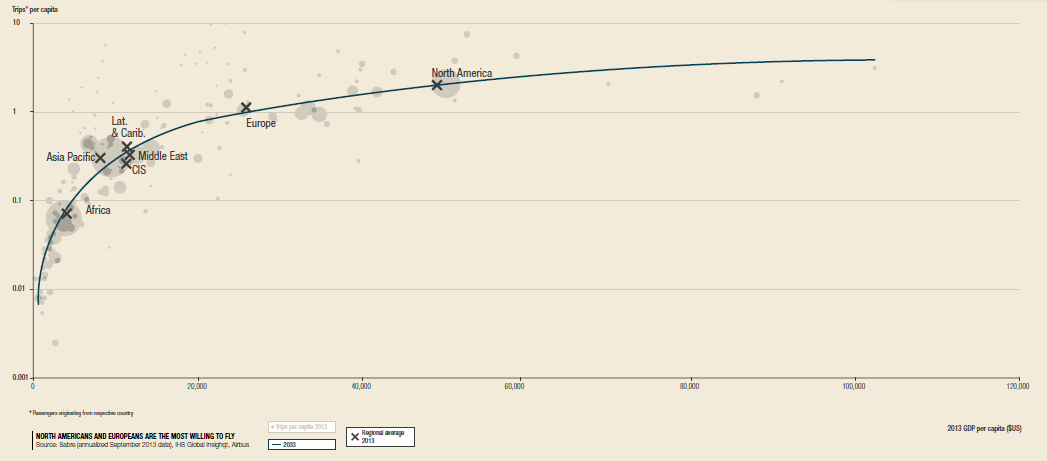
Trips per capita vs. GDP per capita (source: Airbus GMF).

Trips per capita vs. GDP per capita (source: Airbus GMF).

As I do every year, I strongly recommend both documents (GMF and CMO) which provide a wealth of information of market dynamics.

4 Comments

Filed under Aerospace & Defence

Aircraft market forecasts accuracy (update 2014)

About two years ago I wrote a post in which I analyzed the accuracy of commercial aircraft market forecasts. In particular, Boeing’s series of yearly Current Market Outlook (CMO). In that comparison, between the CMOs from 1997 and 2012, we could compare the predicted and the actual world fleets at 2011 year-end. Except for the twin-aisle segment and especially the large aircraft sector, the accuracy was remarkable, as the estimated global fleet only exceeded the actuals in 1%.

In this post, I just wanted to provide an update with the figures from the latest CMO (2014), released a few weeks ago, in comparison with 1999’s CMO. In that CMO from 1999 [PDF, 1.5MB], we find the following chart showing Boeing’s forecasted fleet size and distribution for 2003, 2008, 2013 and 2018 year-ends.

1999 Boeing CMO year-end fleet forecasts for 2003, 2008, 2013 & 2018.

1999 Boeing CMO year-end fleet forecasts for 2003, 2008, 2013 & 2018.

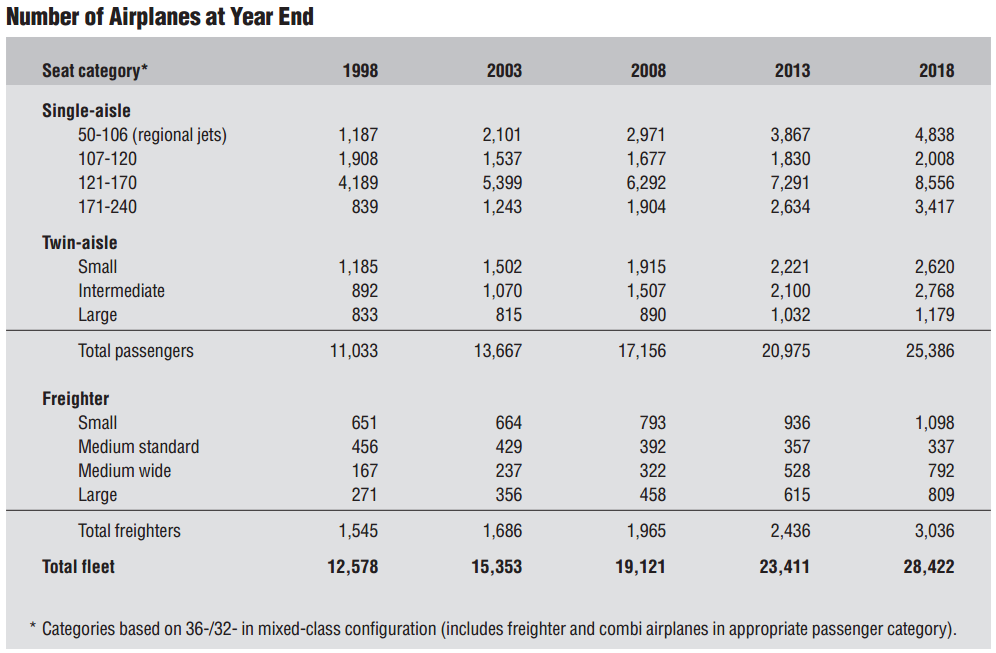
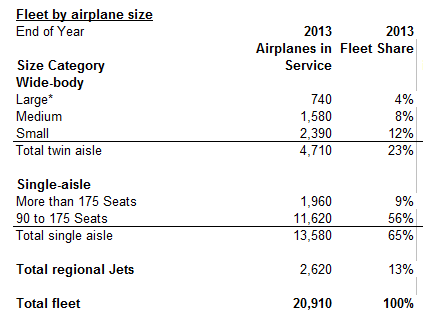
In 2014 CMO, Boeing offered figures of 2013 year-end fleet (1).

Fleet at year end 2013 - Boeing 2014 CMO.

Fleet at year-end 2013 – Boeing 2014 CMO.

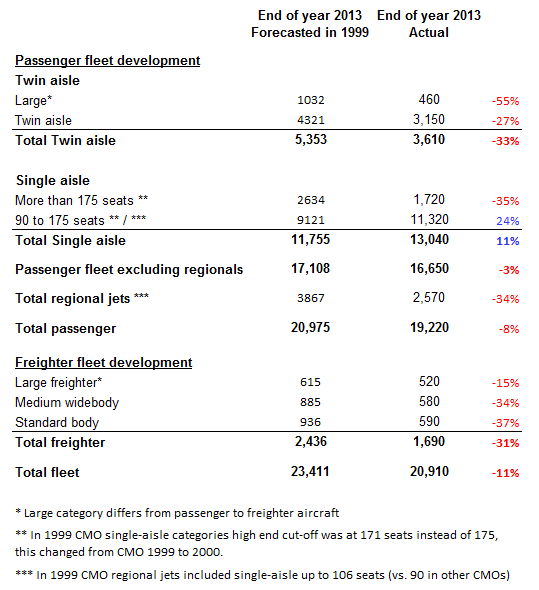
And now, the comparison is immediate:

Comparison of aircraft fleet at year-end 2013: 1999 forecast vs. actual (sources: Boeing CMO 1999 and 2014).

Comparison of aircraft fleet at year-end 2013: 1999 forecast vs. actual (sources: Boeing CMO 1999 and 2014).

Some reflections:

  • The forecasts for all segment except for single-aisle (737-800) predicted higher numbers of aircraft in the fleet than the actuals have shown 15 years later (2).
  • The total fleet figure was missed by 11%, a larger deviation than the 1% from two years ago.
  • The 737 has been the model outselling the forecasts, offsetting partially the lower demand in all other segments. In particular, even if deviations per segment have been higher, the global forecasted figure for passenger aircraft has been missed by only 3%.
  • The forecast is especially off mark the twin-aisle, where there are over 1,700 less aircraft in the current fleet than forecasted (3).

For the next such comparison we will need to wait some years, as from the year 2000 Boeing provided CMOs in a different fashion, offering a view of the forecasted fleet only 20 years from the date in question, instead of a view every 5 years. Therefore, we will have to wait until 2017, when we will be able to compare the 20-year forecast from 1997 CMO with the actuals of 2016 to be provided in 2017 CMO.

(1) In order to see the detailed split per segment differentiated between passenger and freighter aircraft, until the released of the full CMO, it is needed to use the exploring data tool offered in Boeing’s site.

(2) The differences in accuracy between the lower and higher end of the small-aisle segment should not be taken into account, as they are influenced by the different consideration of the cut off number of seats between a CMO and the other.

(3) Possibly a reason why Boeing plays down on the 747-8I and A380 segment.

4 Comments

Filed under Aerospace & Defence