Category Archives: Aerospace & Defence

Turboprop market vs. oil price (ATR figures 2017 update)

Few days ago, the Toulouse-based aircraft manufacturer ATR (Avions de Transport Régional) published a press release [PDF, 139 kB] reporting some of its numbers for the year 2017 (being a private company, owned by Airbus and Leonardo, it does not publish a complete financial annual report). Some of the key figures were:

  • Revenues: 1.8bn$.
  • 80 deliveries (including 2 second hand aircraft).
  • Orders: 113 firm plus 40 options (112 of the orders for its ATR-72).

With this post I just wanted to log the latest data and update the graphic in which I compare ATR yearly deliveries profile with World GPD growth and most importantly oil price.

ATR figures 2017

ATR deliveries vs. GDP growth and oil price (2017 update).

It is interesting to note the drop of the oil price from around 90$ to below 50$ since 2015. ATR deliveries correlated well with oil price with a lag of a few years time. The correlation up to date continues to be quite high.

So far, through 2017 aircraft production has kept up around 80 deliveries a year. In 2017, the book-to-bill was 1.45 (with the above-mentioned 113 firm orders), so ATR should be able to cope with high production for another couple of years.

We will see later on whether the oil price raises again, whether the correlation deliveries/oil price holds or breaks, and whether ATR manages to keep up production in response to the market.

Leave a comment

Filed under Aerospace & Defence

My forecast of Boeing Commercial Airplanes 2017 revenues

Next January 31st, Boeing will hold an earnings conference where it will announce its Q4 and full 2017 year financial results, including the revenues of each of its units.

Three weeks ago, on January 9th, Boeing already issued a press release where it announced its deliveries and orders for 2017, mainly:

  • 763 commercial aircraft delivered (including 529 of the 737 family, or 136 787).
  • 912 net orders (after cancellations) (including 745 of the 737 family).

The release mentions “912 net orders, valued at $134.8 billion at list prices“, however those list prices are discounted, nothing new, and with an estimate of that discount I’ll try to guess the figure of revenues for the Boeing Commercial Airplanes division, not so much trying to be accurate in itself, but to point in advance to the increasing of the discounts as we will see below.

Where can we find Boeing list prices? Boeing host them in their site, these have just bee raised 10 days ago about 4% (see this comment about it). The previous prices dated from March 2017, when Boeing raised them again, that time by about 2% from its 2015 prices (untouched in 2016). To compute 2017 revenues and estimate of discount I use 2017 prices, not the latest ones.

If Boeing didn’t apply those discounts, the value of the 763 aircraft delivered in 2017 would yield revenues of above 118 bn$. To come to a ballpark figure, I will take the latest figure of discounts that I had calculated with 2016 and earlier figures, being the latest ~46%.

Discount evolution_2016

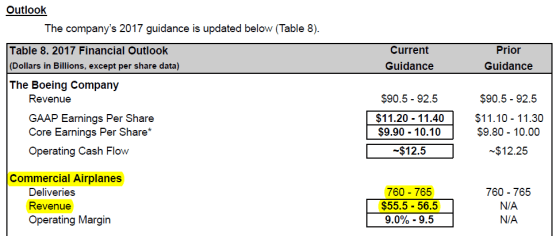
If I plug that discount into the 2017 list prices of the fleet mix of the 763 commercial aircraft that Boeing delivered we would come to a figure of revenues of 62.1 bn$. However, see below what was Boeing’s own guidance in their Q3 earnings release:

2017 Q3 Financial Outlook

Boeing’s 2017 Financial Outlook at Q3 2017 earnings press release.

At three months to the year end (Q3), they forecast between 760 and 765 deliveries, which turned in 763. At the same time they pointed to revenues between 55.5 – 56.5 bn$… and not above 62 bn$. I believe they will exceed their own estimate, but not by 5 bn$, that is why I see that their discounts have been greatly increased in the last 2017. They must have had a bad time in escalating prices of aircraft sold years ago, delivered in 2017 but with escalation conditions much lower than ongoing list prices.

With all these ingredients… my forecast is: 57.0 bn$.

Some comments to it:

  • My forecast is a bit more optimistic than their upper bracket (56.5) which may be slightly conservative.
  • The implied discount of my revenues forecast would be in the ~ 50% range.

(1) See here a couple of such forecasting revenues exercises that I did for Boeing’s 2014 and 2015 revenues.

(2) See here the latest detailed calculation of discounts that I posted in 2015.


2 Comments

Filed under Aerospace & Defence

El tráfico aéreo en Cataluña desde el 1 de Octubre

En los últimos 3 meses hemos visto muchas noticias al respecto de las empresas que están cambiando de sede de Cataluña a otras regiones como Madrid, Valencia, Baleares… Estas noticias suelen ir acompañadas de calurosos debates sobre lo grande que será el impacto, o si será nulo, si pagan sus impuestos aquí o allá, etc.

También hemos visto varias noticias sobre la desaceleración del crecimiento del empleo. Sobre el desempleo. La publicación de esos datos también conlleva animados debates.

Otros tantos debates surgen con motivo de si las reservas hoteleras en Barcelona bajan, suben o siguen igual que en otros años.

Cada vez que veo estos datos y los debates relacionados me cuesta ver negro sobre blanco el posible impacto de los resultados del 1-O, de la declaración unilateral de independencia del 27-O, etc.

Por otro lado, y sin dudar de la fiabilidad de la EPA (“Encuesta de Población Activa” aquí su metodología), o de los datos sobre capacidades hoteleras, el hecho de que se traten de encuestas me hizo plantearme el buscar un posible indicador basado en datos crudos más que en estimaciones. Datos fiables. Y eso me llevó, obviamente, a buscar datos publicados por ingenieros aeronáuticos. 😉

… Los datos sobre tráfico aéreo que publica AENA (Aeropuertos Españoles y Navegación Aérea) cada mes sobre los aeropuertos que gestiona en España.

El portal de estadísticas de AENA se puede encontrar en el siguiente enlace. En él AENA publica datos mensuales absolutos y relativos sobre el tráfico de cada aeropuerto medido en pasajeros, operaciones (despegues y aterrizajes) y en carga transportada (medido en su peso).

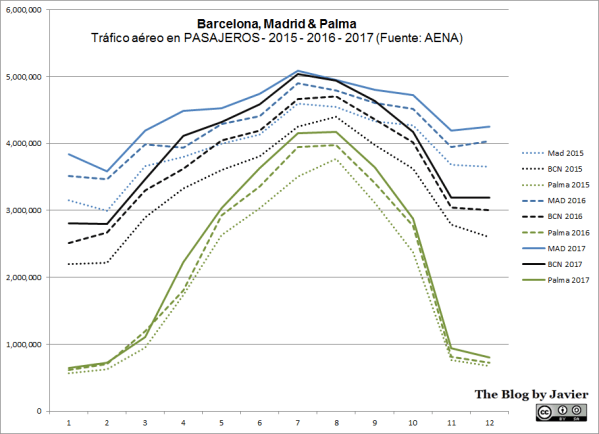
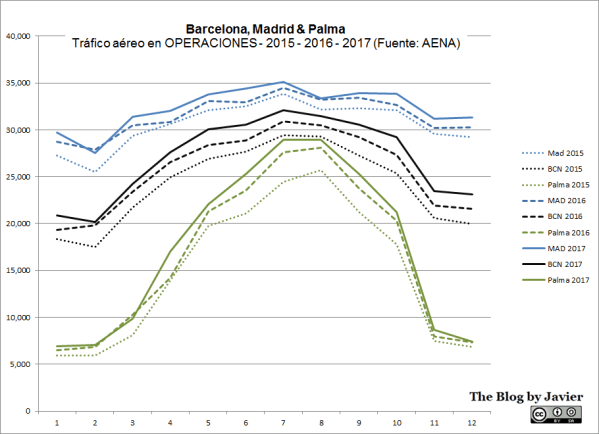
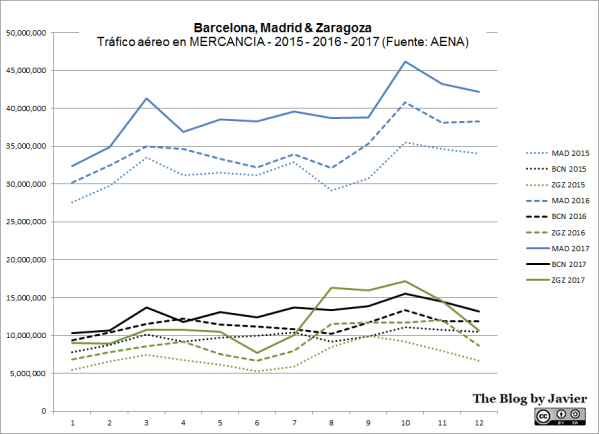
Para ver el posible impacto de los últimos eventos en Cataluña, compilé los datos de tráfico aéreo de los últimos tres años (2015, 2016 y 2017) en el aeropuerto de Barcelona El Prat y Gerona. Su evolución la comparo con aeropuertos con un tráfico similar: Madrid Barajas, Palma de Mallorca, Zaragoza (para el caso de carga) y Murcia (para comparar con Gerona). A continuación dejo aquí cuatro gráficas y una tabla resumen con algunos comentarios.

Tablas comparativas

Tabla comparativa con los crecimientos mensuales de Madrid Barajas y Barcelona El Prat.

Pax MAD - BCN - Palma

Pasajeros. El volumen de pasajeros en Barcelona disminuyó en los meses de octubre y noviembre con respecto a los meses de verano, como lo hace todos los años. La disminución es más acusada que en Madrid y menos que en Palma. En diciembre, de hecho, en 2017 el tráfico prácticamente ha sido el mismo que en noviembre y no descendido como en otros años. En el global del año El Prat ha crecido un 7.1%, más que Barajas (5.9%). En el último trimestre ha crecido menos. En el último mes, más.

En 2017 El Prat ha crecido menos (7.1%) que en 2016 (11.2%), pero también Barajas ha crecido menos (5.9% vs 7.7%). Se podría decir que la desaceleración es mayor, pero también lo es el crecimiento absoluto, y la mayor desaceleración también se dio en los meses anteriores al 1-O. Se hace difícil sacar una conclusión clara.

Veamos el tráfico medido en operaciones.

Ops MAD - BCN - Palma

Operaciones. En este caso el los perfiles de las curvas en 2017 vuelven a ser similares a los de los años precedentes. Hay crecimiento en prácticamente todos los meses en los 3 aeropuertos, y desde luego en los tres últimos meses. ¿Se desacelera el crecimiento en El Prat a partir del 1-O? No. En octubre, noviembre y diciembre el crecimiento es del 7.0% cada mes respecto a los mismos meses de 2016. Se podría decir que Barajas crece más en esos meses, pero el crecimiento en el último trimestre en El Prat es superior al crecimiento anual en El Prat (5.1%), por tanto, se acelera.

Sin embargo, el crecimiento en esos meses en 2016 respecto a 2015 fue mayor, y en Madrid el crecimiento en 2017 respecto a 2016 fue mayor que en 2016 respecto a 2015… pero en todos esos meses y en el global del año el crecimiento en El Prat fue mayor que en Barajas. De nuevo se hace difícil sacar una conclusión clara.

Veamos el tráfico medido en carga.

Mer MAD - BCN - ZGZ

Carga / Mercancía. En este caso los perfiles de las curvas son más complicados. Si acaso se distingue que no hay un mayor volumen en verano respecto a los meses de otoño e invierno. El pico en los tres aeropuertos (aquí Zaragoza sustituye a Palma como tercer aeropuerto en cuanto a carga) se produce en octubre y desciende en noviembre y diciembre. En carga, de nuevo El Prat crece más en el global del año (14.9% vs 13.1%) y en los últimos meses que Barajas.

Sin embargo, la desaceleración de ese crecimiento es mayor en El Prat en los tres meses del último cuarto (16.4%) con respecto a los tres anteriores (25.5%), aunque los crecimientos en absoluto sean mayores (16.4% en media en El Prat vs 12.2% en Barajas).

En 2016, sin embargo, el crecimiento se aceleró en el último cuarto del año (14.6% vs 11.4%) y en 2017 se desacelera, pero lo mismo sucede en Barajas. De nuevo se hace difícil sacar una conclusión clara y diferenciada para el aeropuerto de Barcelona El Prat.

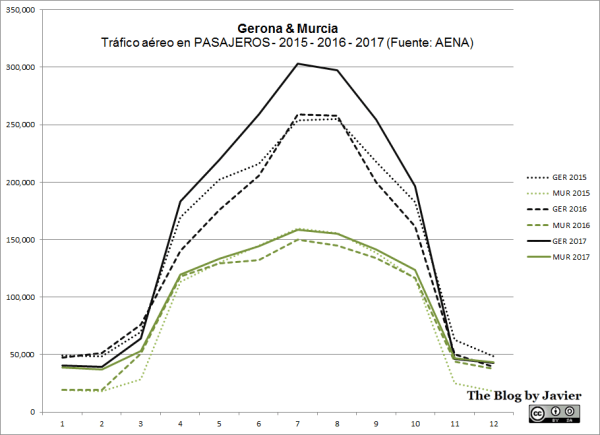
Pax GER - MUR

Si comparamos el tráfico de Gerona con Murcia, vemos el mismo pico en los meses de verano, y en el caso de Gerona vemos que en noviembre y diciembre el tráfico es menor que en los mismos meses de 2015 y 2016. Sin embargo, eso ya ocurrió en los tres primeros meses de 2017, con lo cual se hace difícil ligar ese descenso al 1-O y acontecimientos siguientes.

Como conclusión final a este post, solo puedo decir que sacar una conclusión clara de que hasta diciembre el 1-O o el 27-O hayan tenido un impacto en el tráfico aéreo de los aeropuertos en Cataluña se hace más difícil que leer los posos del café.


1 Comment

Filed under Aerospace & Defence, Economy

2017, the safest year in aviation history

In the last days, I have seen a wave of news and headlines mentioning that 2017 was the safest year in aviation history. The source of the information is the release of 2017 accidents figures made by the Aviation Safety Network a private initiative from the Flight Safety Foundation which curates an extensive database with aviation incidents, hijackings and accidents, from 1946 to nowadays.

The release of the figures can be found here: “ASN data show 2017 was safest year in aviation history“.

The tweet with which they made the announcement is below:

Following that publication, several specialized and generalist media echoed the information. Many of them went to say that there had not been any deaths in commercial aviation in 2017, which is not accurate. A few correctly reported the figures, e.g. Jon Ostrower from CNN. Some headlines reported that there had not been any death in “commercial passenger jet flights”, which is accurate, but misses the accidents and deaths of commercial aviation based on other aircraft than jets. Most of the headlines in the media that I have see in Spanish quickly copied the message but failed to note the word “jet”, and simply stated that there had not been any death in commercial aviation (the opposite would be private or military) or commercial passenger flights (this category would exclude cargo flights but not flights on turbo propellers for instance).

ASN_infographic_2017

If we take a look at the source of the information, we can have a quick look at the accidents:

  • there were 10 accidents in commercial aviation: 5 on passenger flights and 5 on cargo flights.
  • 44 occupants died as a consequence of those accidents. Moreover, 35 people died on ground as a consequence of those accidents.
  • there was 1 accident that involved what would be referred to as a “jet” aircraft, a Boeing 747, but this was on a cargo service. Involving four deaths.
  • there were several accidents involving commercial passenger aircraft, in this case turbo propellers, e.g. 4 Cessna 208 Caravan and Grand Caravan, or an ATR-42.

It is true that most of us rarely fly on those Cessnas, but about 2,500 have been built and they are operated by dozens of operators, including passenger commercial aviation (or FedEx, which flies over 200 of them), especially in regional aviation and inter-island flights.

ATR aircraft are also very successful in regional aviation, with over 400 ATR-42 built, and operated for example by the Air France subsidiary HOP! In this case, the ATR-42 that crashed, was operated by West Wind Aviation in Canada. After the crash investigation, Transport Canada removed the licence to the operator.

To conclude, yes, 2017 was the safest year in aviation history, but unfortunately there were 44 plus 35 fatal victims of commercial aviation.

Leave a comment

Filed under Aerospace & Defence

Airbus vs. Boeing, comparison of market forecasts (2017)

Two weeks ago, during Le Bourget air show in Paris, both Airbus and Boeing released their market forecasts for the following 20 years: Airbus’ Global Market Forecast (GMF, PDF 3.6 MB) and Boeing’s Current Market Outlook [PDF, 3.8 MB].

In previous years, I have published comparisons (1) of both Airbus’ and Boeing’s forecasts. You can find below the update of such comparison with the latest released figures from both companies.

Forecast2017

Comparison of Airbus GMF and Boeing CMO 2017-2036.

Some comments about the comparison:

  • The main comment for this year CMO is that after years of Boeing dowplaying the demand for the segment of the large aircraft (seen as mainly 747, A380 and some other high capacity aircraft, depending on the manufacturer), it has finally stopped to consider them a category by themselves and has merged that category with the “intermediate twin-aisle” (i.e. 777, A350…).
  • Excluding the large aircraft, both companies’ forecast for the twin aisle segment is nearly identical: ~8,175-8,210 aircraft (we may assume that about 100 of those 8,210 from Boeing’s CMO correspond to large aircraft, thus comparing apple to apples would be ~8,175-8,100). The mix between small and intermediate twins varies, ~400 units up and down.
  • On the other hand, Boeing forecasts about 4,700 single-aisle more than Airbus (the gap has widened in 100 units this year). Boeing doesn’t provide the split between more or less than 175 pax capacity airplanes since its 2015 CMO, nor does Airbus since 2016.
  • Alltogether, Boeing sees demand for 10% more passenger aircraft (excluding regional a/c and freighters) with a 9% more value. The gap is slightly lower than in 2016.
  • In relation to last year’s studies, Airbus has increased demand by ~1,700 aircraft (and ~ 190 Bn$) whereas Boeing has increased it by 1,400 (and ~ 130 Bn$).
  • In relation to traffic, measured in terms of RPKs (“revenue passenger kilometer”), that is, the number of paying passenger by the distance they are transported, they see a similar future: Airbus forecasts for 2036 16.5 RPKs (in trillion, 4.4% annual growth from today) while Boeing forecasts 17.8 RPKs (4.7% annual growth).

Some lines to retain from this type of forecasts:

  • Passenger world traffic (RPK) will continue to grow about 4.5% per year. This is, doubling every ~15 years.
  • Today there are about 18,890 passenger aircraft around the world (according to Airbus; 19,130 in Boeing’s CMO), this number is about 800 a/c more than the year before (5% increase) and will more than double over the next 20 years to 40,120 a/c in 2036 (41,320 as seen by Boeing, excluding regional jets).
  • Most deliveries will go to Asia-Pacific, 42% or ~17,000 passenger aircraft (according to Airbus).
  • Domestic travel in China will be the largest traffic flow in 2036 with over 2,000 bn RPK (according to Boeing, an annual growth of 6.1%), or 11.6% of the World’s traffic.
  • Nearly 13,000 aircraft will be retired to be replaced by more eco-efficient types.
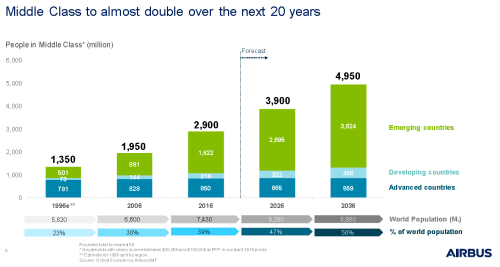
Middle_Class

The doubling of the world’s middle class over the next 20 years will fuel air traffic growth and new airplanes demand.

As I do every year, I strongly recommend both documents (GMF and CMO) which provide a wealth of information of market dynamics.


(1) Find here the posts with similar comparisons I made with the forecasts of previous years: 201020112012, 2013, 2014, 20152016.

2 Comments

Filed under Aerospace & Defence

Boeing vs. Airbus: CEO compensation (2016)

For the last 3 years I have been writting a small series of posts comparing the compensation of Airbus and Boeing CEOs (1). This series started out of conversation with colleagues and I keep it to have a record of the evolution and for quick reference in other conversations (2). Thus, this post is just the update with the information for the 2016 fiscal year.

As both Boeing and Airbus are public companies, the information about their CEOs compensation is public and can be found in the annual report and proxy statement from each one. I just share the information and sources below for comparison and future reference.

Airbus CEO, Tom Enders’ 2016 compensation (financial statements here, PDF, 1.0 MB, page 59):

Enders_2016

Airbus CEO Tom Enders 2016 compensation.

Enders saw its base salary increased in 100 k€ after 3 years at 1.4 M€. Variable pay also increased substancially, but share-based remmuneration decreased in a bigger amount. The overall compensation (6.25 M€) decreased, as it has been the case for the last 3 years.

Boeing CEO, Dennis Muilenburg’s 2016 compensation (proxy statement here, PDF, 4.2 MB, page 30):

Muilenburg_2016

Boeing’s CEO Dennis Muilenburg 2016 compensation.

Dennis Muilenburg saw its base salary increased in 50 k$, after a decrease of 330 k$ last year in the transition between McNerney and him. Incentive percentages were kept constant, has been the case in the last 4 years. The total compensation (15.18 M$) increased in relation to 2015 but it is still bellow the 2014 levels (17.8 M$).

Comparison. It is interesting to note that while the base salary is nearly the same, 1.5 m€ vs 1.65 m$ (more so taking into account average exchange rates in 2016 (~ 0.90 EUR/USD)), the incentive schemes at Boeing end up with a total remuneration for the CEO about the double (x2.2) of that in Airbus.


(1) See the previous comparisons for the years 2013, 2014 and 2015.

(2) From what I see in the stats of the visits to this blog, other people are having similar conversations as these posts with the compensation comparison have ranked among the top 10 most read ones the last years.

3 Comments

Filed under Aerospace & Defence

Aircraft market forecasts accuracy (update 2017)

About three years ago I wrote a post in which I analyzed the accuracy of commercial aircraft market forecasts. In particular, Boeing’s series of yearly Current Market Outlook (CMO). In that comparison, between the CMOs from 1999 and 2014, we could compare the predicted and the actual world fleets at 2013 year-end.

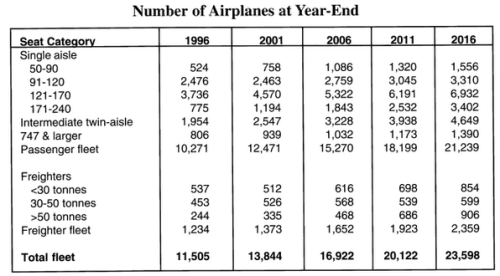
In this post, I just wanted to provide an update with the figures from the latest CMO (2017), released a couple of weeks ago, in comparison with 1997’s CMO. In that CMO from 1997, we find the following chart showing Boeing’s forecasted fleet size and distribution for 2001, 2006, 2011 and 2016 year-ends.

Fleet at year end - forecast 1997

1997 Boeing CMO year-end fleet forecasts for 2001, 2006, 2011 & 2016.

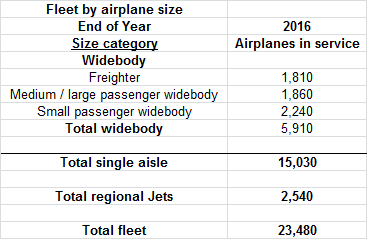
In 2017’s CMO, Boeing offered figures of 2016 year-end fleet.

Fleet at year end 2016 - Boeing 2017 CMO

Fleet at year-end 2016 – Boeing 2017 CMO.

Along these years, Boeing has simplified the segmentation with which it provides the fleet and aircraft demand. Single aisle segment is not divided in up to 4 sub-segments. Twin aisle aircraft have gone from two categories (747 and the rest) to three (small and intermediate widebody and large aircraft) and back to two (small widebody and larger), but slightly different. Freighters come with less sub-segments, too.

Despite of the difference in the presentation of the fleet we can try to make a comparison:

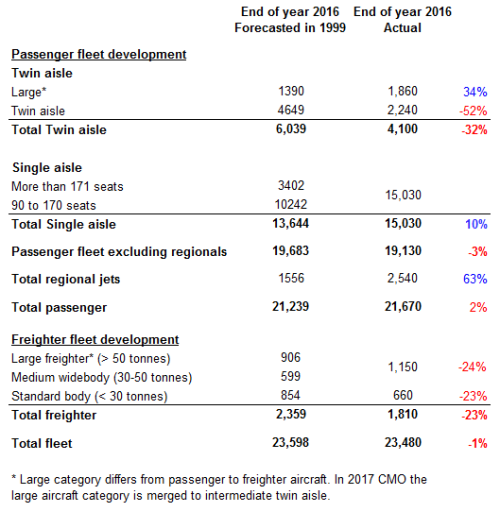
Comparison Fleet at year end 2016

Comparison of aircraft fleet at year-end 2016: 1997 forecast vs. actual (sources: Boeing CMO 1997 and 2017).

Some reflections:

  • The overall size of the fleet was quite well predicted, with a difference of 1%.
  • The forecasts for small aircraft was too conservative: both single aisle and regional fleets are today larger than forecasted.
  • The forecasts for larger aircraft was too optimistic: both widebody and freighter fleets are today smaller than forecasted.

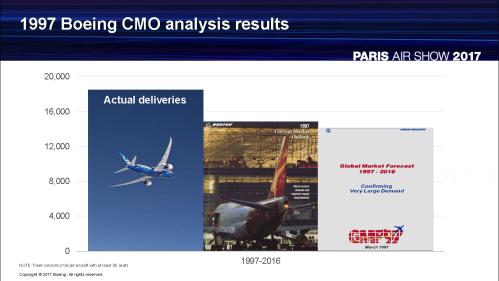
This year’s Boeing’s CMO presentation includes a couple of slides on the accuracy of 1997 CMO in relation to what would be the demand for new airplanes vs. what it has turned out to be 20 years later.

CMO_1997_2017

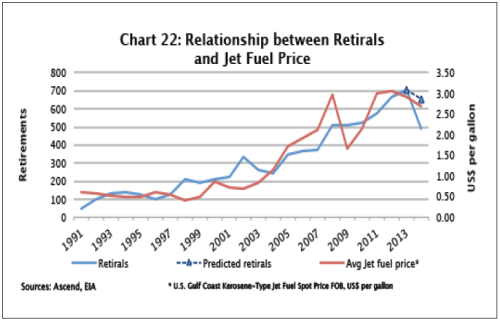
More aircraft have been delivered in relation to what had been forecasted. Retirement of aircraft also increased its pace with increases of oil price in the 2000s. See the chart below from Avolon’s paper “Aircraft retirement and storage trends” [PDF, 2 MB].

Retirement_vs_oil_Avolon.png

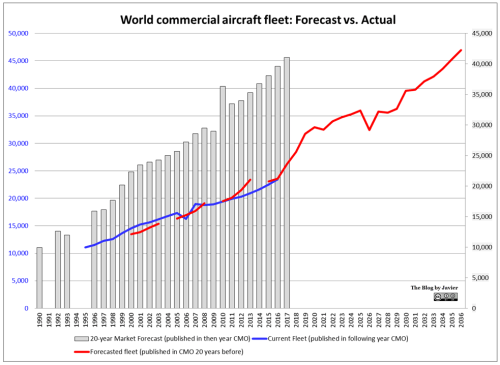
Now, having seen all this information, I can update this other graphic which I shared 5 years ago in a blog post titled “World commercial aircraft fleet: forecast vs. actual“:

Fleet evolution - forecast vs actual - 2017 CMO

World commercial aircraft fleet: past forecast vs. actual, and future demand (data source: Boeing CMOs up to 2017). Fleet (blue and red lines) in the left axis; market forecast (grey columns) in the right axis.

As you can see, actual fleets, forecasted fleets and forcasted fleet demand have all been increasing year by year . The compounded annual growth rate (CAGR) for each one has been:

  • Actual fleet growth: 3.65% from 1995 to 2016 (3.04% from 2000 to 2016).
  • Forecasted (15-20 years before) fleet growth: 3.52% from 2000 to 2036 (3.55% from 2000 to 2016).
  • 20-year market forecast: 4.82% from 1992 to 2017 (3.56% from 2001 to 2017).

The 20-year market forecasts have grown at a higher rate (4.82%) than fleets (3.65%), it is mainly because the first sets of data that I could retrieve come from the economic crisis of the beginning of the 1990’s, when Boeing trimmed down its forecasts. From the 2000’s the figures for market forecast have grown at a similar rate (3.56%) than those of fleets (3.04%). And so will be the growth of forecasted fleet from 2016 to 2036: 3.52%.


Notes:

  • 1990 CMO long-term market forecast is made for 15 years, not 20.
  • Forecast of fleet for the periods 2000-2003, 2005-2008 and 2010-2013 does not come from CMOs published 20 years before, but from 5, 10 and 15-year fleet forecasts included in the CMOs of 1996, 1997, 1998 and 1999.
  • Boeing does not publish 5, 10 and 15-year fleet forecasts anymore.
  • It would be interesting to have a per-segment graphic, however there is not consistent data to produce it for the same time span. Boeing has made different changes to the way it reports fleet and market segments.

Leave a comment

Filed under Aerospace & Defence

Review of Boeing Current Market Outlook 2017

Last week, on the first day of Le Bourget air show, Boeing Commercial published its yearly update of the Current Market Outlook (CMO) for the next 20 years of commercial aircraft market (2017-2036).

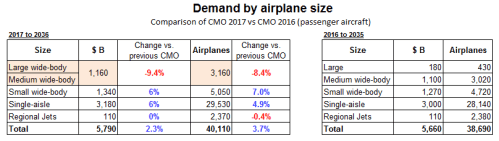
I have just compared the figures for passenger aircraft of the last two years’ CMOs:

CMO 2017 vs 2016 comparison

CMO 2017 vs. 2016 comparison.

Some comments to it:

  • You can see that the total number of new aircraft delivered has slightly increased from 38,690 to 40,110, a 3.7%, which is consistent with the 4.7% traffic increase (1) that Boeing predicts (2).
  • The volume (Bn$) increases by a lower percentage, 2.3% (130 Bn$) up to 5.79 Trn$… this, as it was the case with CMO 2016, is due mainly to the increase in (3):
    • single-aisle aircraft expected sales in volume (6%, +180 Bn$) and aircraft (+1,390), and
    • small wide-body segment with 70 more aircraft (+7%) and an increase in volume of 70 Bn$ (+6%).
  • Four years ago, I wrote about a sudden change between CMO 2013 and CMO 2012 of the mix in wide-bodies; in this respect, CMO 2016 is consistent with last year’s one.
  • For years, Boeing has been dowplaying in its CMO the demand for the segment of the large aircraft (seen as mainly 747, A380 and some other high capacity aircraft, depending on the manufacturer). This year, Boeing has finally stopped to consider them a category by themselves and has merged that category with the “intermediate twin-aisle” (i.e. 777, A350…).
    • It is interesting to see that, if in CMO 2016 both segments had a combined market forecast of 3,450 aircraft (430 large and 3,020 intermediate twin-aisle), in CMO 2017 the combined figure has diminished to 3,160, a reduction of about 300 aircraft or 8.4%.
    • If the demand for intermadiate twin aircraft was about constant, that would mean that the large segment is seen to almost disappear, in Boeing’s eyes, with not many more than 100 airplanes in 20 years (down from 430 forecasted last year).

This year presentation includes a couple of slides on the accuracy of 1997 CMO in relation to what is the fleet they forecasted for the end of 2016 vs. what has been the reality 20 years later. I will come back to that in a following post, as I wrote some blog posts years ago making similar comparisons and in the last such one, commenting on CMO 2014, I mentioned

For the next such comparison we will need to wait some years, as from the year 2000 Boeing provided CMOs in a different fashion, offering a view of the forecasted fleet only 20 years from the date in question, instead of a view every 5 years. Therefore, we will have to wait until 2017, when we will be able to compare the 20-year forecast from 1997 CMO with the actuals of 2016 to be provided in 2017 CMO.

See below a quick image about that forecast:

CMO_1997_2017

Find below the nice infographic [PDF, 539 KB] that the guys from Boeing have put up together:

BoeingCMOinfographic2017

Boeing Commercial Aviation Market Forecast 2017-2036 infographic.

As always, I recommend going through the CMO, as you can learn a lot about the business: from global numbers, to growth, traffic figures, fleet distributions, forecasts, etc… You may find the presentation [PDF, 3.8 MB], a file [XLS, 0.6 MB] with all the data or the full CMO report [PDF, 53.6 MB].

(1) Traffic increased measured in RPKS (revenue passenger kilometers) in billions.

(2) These two ratios, 3.7% fleet demand and 4.8% traffic growth, point to an implicit increase in the average size of the aircraft in fleet and / or a higher utilization of the aircraft (higher availability).

(3) These two segments (single-aisle and small wide-body) saw as well the largest increases in number of aircraft and volumes in the CMO of 2015 in relation to 2014.

(4) Find the reviews I wrote comparing 2016 CMO with 2015 CMO2015 CMO with 2014 CMO2014 CMO with 2013 CMO and 2013 CMO with 2012 CMO.

Leave a comment

Filed under Aerospace & Defence

Flight excursion to Malause’s phare aéronautique

Last Sunday, yet again, we took one of the aeroclub’s DR-400 airplanes to make another family flight excursion.

On the occasion of the previous excursion, last week, I introduced the phares aéronautiques, i.e., aeronautic lighthouses that were set up in 1920s to allow night flight navigation for l’Aéropostale courriers. Last week we spotted a couple of them to the South East of Toulouse. This time, we wanted to spot a couple of them to the North West of Toulouse, on the way to Bordeaux, in the villages of Canals and Malause.

Last week, we prepared quite well the spotting, checking in Google maps different views of what we would try to see from the airplane so that we could easily recognise them. This time, we prepared less, just marking a cross in the map with the approximate location of the phares and hoping that we would identify the lighthouses on the ground.

Well, the task proved as difficult as finding a needle in a haystack. We missed the phare of Canals in the first leg. We then continued over flying the Canal Lateral up to the water slop of Montech (1).

montech_1

The navigation of this flight was rather simple, as once over the Canal Lateral we kept flying over it northward up to the Pont-Canal to the East of Moissac (2).

Moissac

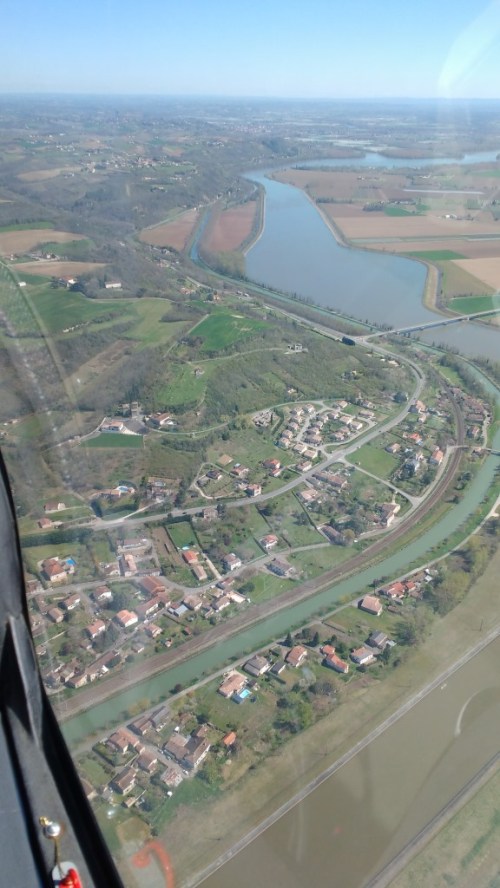
We then flew along the river Tarn until it flows into the Garonne and then the Garonne until Malause. We then knew that the phare would be to the North of the river, the canal, the railway and a secondary road. See it below.

Malause_1

If you haven’t been able to spot it, it’s OK. You’re not the only one. We didn’t spot it at first sight. We flew in circle to have a second chance. I reduced the speed from 190 km/h to 150 km/h, to see if at a slower speed we would see it better.

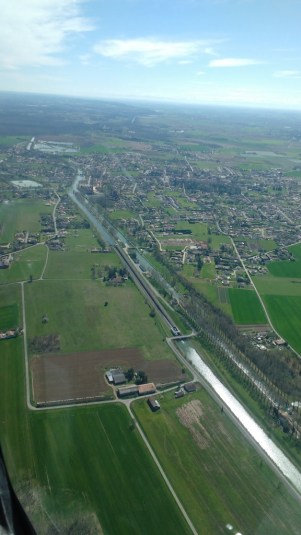
Malause_2

Saw it already? Not yet? Don’t worry, I didn’t either. But you see, I was at the controls, at the left side of the cockpit. But you… you have here a frozen picture, you’ve got no excuse not to see it. In fact, you’ve got the picture because Luca is starting to be a hell of a spotter.

Malause_3

Once at home, I researched a little bit and found this local website about the phare (in French), with a couple of pictures, some data, history of these phares and a nice chart from 1932. It explains that the lighthouses started to be built in 1923 and that by 1932 there were 140 of them across France. This one at Malause was operated by the family Jolly until 1948/1949.

2012_12_30_Cartographie_Phare_St_Exupery_01

On the way back to the aerodrome of Toulouse-Lasbordes we passed by Moissac and Montech again and failed to spot the lighthouse of Canals again. Next time.

Montech_2

Finally, see below the navigation chart with the route followed marked on it. The total engine running time of the excursion: 1h15′.

Mapa

(1) See here a post in which I described the concept of the water slope and a post about another flight excursion in which we took some more pictures of it.

(2) See a post about another flight excursion in which we took some more pictures of it.

Leave a comment

Filed under Aerospace & Defence

Flight excursion to Montferrand’s phare aeronautique and the Pyrenees

Last Sunday, we took one of the aeroclub’s DR-400 airplanes to make another family flight excursion.

This time the purpose of the flight was twofold: (1) we wanted to spot a couple of phares aéronautiques, i.e., aeronautic lighthouses that were set up in 1920s to allow night flight navigation for l’Aéropostale courriers, close to Toulouse, and (2) we wanted to take benefit from a sunny day around Occitanie to make a tour around the snow-covered Pyrenees, something we already did about a year ago when we completed the route of the Cathar castles (see here a post about it).

See below the quick reference paper navigation log prepared for the flight.

Nav_log_new

A few months ago, a friend of Luca, Tijmen, tipped us on the existence of these aeronautic lighthouses. See in this website a map with the precise location all of them had, including those still standing.

Map_phares

We succesfully spotted the 2 phares closest to the East of Toulouse-Lasbordes aerodrome, located in Montferrand (just to the East of the wind turbines by the A61) and Bazièges (just to the North of the silos marking the waypoint SB). See a picture of the first one below (2 houses to the left of the wing blue tip).

Wind turbines

IMG_20170319_112316917

Once we had spotted the phare in Montferrand, we took to the South to start the climb to above 10,000 ft in order to fly over the Pyrenees.

Pyrenees_afar_1Pyrenees_afar_2

Approaching the Pyrenees, we flew over the old castle of Montsegur, which we had already seen before when we flew over the Cathar castles. See below a couple of pictures, in context and in detail.

Montesegur_1

Montesegur_2

Once up there, we just enjoyed some minutes of flying around, spotting skiing stations, seeing possible routes through the mountains towards Andorra and Spain, enjoying the breathtaking views, taking a few pictures…

Detail_navigation

Over_wing

Over_dashboard

Selfie

Finally, see below the navigation chart with the route followed marked on it and the navigation log as used. The total engine running time of the excursion: 1h28′.

Nav_chart

Navigation_log_used

Leave a comment

Filed under Aerospace & Defence