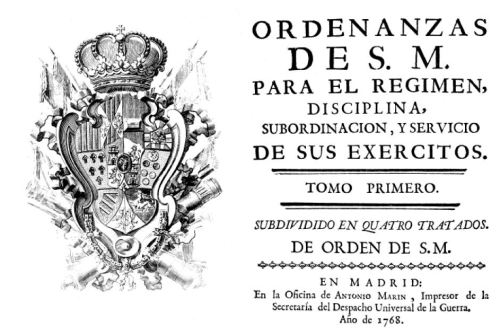
Reales Ordenanzas de Carlos III

Las Reales Ordenanzas son las normas que establecen el comportamiento, derechos y deberes de los militares de las Fuerzas Armadas de España. Las Reales Ordenanzas de Carlos III fueron realizadas en 1768 bajo su reinado (1759-1788) y estuvieron vigentes hasta 1978, siendo las más longevas de la historia de España.

Durante el MBA que cursé en 2006-2007 en la EOI, Emiliano Mata, quien entonces nos dio clases de estrategia, y más tarde fue compañero de trabajo, recomendaba en ocasiones la lectura de dichas Reales Ordenanzas.

A principio de este año las leí y en esta entrada quería comentarlas brevemente.

reales_ordenanzas

Las Reales Ordenanzas de Carlos III están estructuradas en títulos: “Del Soldado”, “Del Cabo”, “Obligaciones del Soldado”, “Del Sargento”, “Obligaciones del Sargento”… “Crímenes militares, y comunes, y penas que a ellos corresponden”. Cada uno de los títulos se estructura en artículos (entre menos de 10 hasta más de 100 por título).

A continuación quería compartir algunos de sus artículos:

Dentro del Título I,

  1. Desde que se le sienta su plaza, ha de enterársele de que el valor, prontitud en la obediencia, y grande exactitud en el servicio, son objetos a que nunca ha de faltar, y el verdadero espíritu de la profesión.
  1. En el esmero del cuidado de la ropa consiste la ventaja de que el Soldado no se empeñe, como que grangée el aprecio de sus Gefes; y para lograr uno, y otro, se labará, peynará, y vestirá con aseo diariamente, tendrá los zapatos, evillas, y botones delvestido limpios, las medias tiradas, el corbatín bien puesto, su casaca, chupa, y calzón sin manchas, rotura, ni mal remiendo, las caídas del pelo cortas, y con un solo bucle a cada lado, la gorra bien armada, y en todo su porte, y ayre marcial, dará a conocer su buena instrucción, y cuidado.
  1. No ha de llevar en su vestuario prenda alguna que no sea uniforme: nunca se le permitirá ir de capa, ni con redecilla, fumar por la calle; ni fuera de los Cuerpos de Guardia, sentarse en el suelo, en Calles, ni Plazas públicas, ni otra acción alguna, que pueda causar desprecio a su persona.
  1. Se prohibe, baxo de severo castigo, al Soldado, toda conversación, que manifieste tibieza, o desagrado en el servicio, ni sentimiento de la fatiga que exige sus obligación; teniendo entendido, que para merecer ascenso, son cualidades indispensables el invariable deseo de merecerlo, y un grande amor al oficio.
  1. Si, estando en la puerta de una Plaza, viere venir alguna Tropa armada, o pelotón de gente, llamará luego a su Cabo; y a proporción que se acercare, continuará su aviso; y en el caso de que el Cabo no le haya oído, o la celeridad de los que se acercan, no le haya dado tiempo para acudir, la misma Centinela cerrará la barrera, o puerta, si la hubiere, mandará hacer alto a los que se aproximen; y si, en desprecio de este aviso, pasasen adelante, defenderá su puesto con fuego y bayoneta, hasta perder la vida.
  1. Toda Centinela apostada en Muralla, puerta, o parage que pida precaución, desde la Retreta, hasta la Diana, dará el Quién vive a quantos llegaren a su inmediación: y respondiendo: España, preguntará: Qué gente? Y si fuere en Campaña Qué Regimiento? Si los preguntados respondiesen mal, o dexasen de responder, repetirá el Quién vive dos vezes, y sucediendo lo mismo, llamará la Guardia para arrestarle; y en caso de huir entonces, dando con este motivo de sospechar que sea persona malintencionada le hará fuego.

Dentro del Título II,

  1. El Cabo, como Gefe más inmediato del Soldado, se hará querer, y respetar de él, no le disimulará jamás las faltas de subordinación: infundirá en los de su Esquadra amor en el oficio, y mucha exactitud en el desempeño de sus obligaciones; será firme en el mando, graciable en lo que pueda, castigará sin cólera, y será medido en sus palabras, aun quando reprenda.
  1. Los Cabos en su trato con los Soldados serán sostenidos, y decentes; dará a todos el Usted; les llamará por su propio nombre, y nunca se valdrá de apodos, ni permitirán que los Soldados entre usen de vozes, ni chanzas de mala crianza.
  1. Toda tropa que marche sin Armas con qualquiera destino que lleve, cederá a la que vaya con ellas; y toda Tropa que no tuviere Vanderas, o Estandarte, cederá a los que tuviere.

Dentro del Titulo IV,

  1. El Sargento tendrá con los Soldados, y Cabos un trato sostenido, y decente; dará a todos el Usted: no usará, ni permitirá familiaridad alguna, ni permitirá familiaridad alguna, que ofenda a la subordinación: será exacto en el servicio, y se hará obedecer, y respetar.

Dentro del Título X,

El que blasfemare el santo nombre de Dios, de la Virgen, o de los Santos, será inmediatamente preso, y castigado, por la primera vez con la afrenta de ponerle una mordaza dentro del Cuartel, por el término de dos horas por la mañana, y dos por la tarde, en ocho días seguidos, atándole a un poste; y si reincidiere en esta culpa, se le atravesará irremisiblemente la lengua con un hierro caliente `por mano del Verdugo, y se le arrojará ignominiosamente del Regimiento, precediendo Consejo de Guerra.

3. […] los delincuentes en tan enorme delito, en cualquiera número que fueren sin que les releve de esta pena el raro accidente de que no sean Catholicos; pues teniendo prevenido, que no se admita en mi servicio Soldado, que no sea Catholico Apostólico Romano, es mi voluntad, que el que se delata, o se averigue ser de otra Religión, en el caso de hallarse reo, padezca (sin excepción) el castigo, que para el crimen en que incurriere, prescriben mis Ordenanzas.

  1. Todo Soldado, Cabo y Sargento, que en lo que precisamente fuere de mi Real servicio, no obedeciere a todos, y a cualquiera Oficiales de mis Exercitos, será castigado con pena de la vida.
  1. Los que emprendieren cualquiera sedición conspiración, o motín, o indugeren a cometer estos delitos contra mi Real Servicio, seguridad de las Plazas, y Países de mis Dominios, contra la Tropa, su Comandante, u Oficiales, serán ahorcados en cualquiera número que sean; y los que huvieren tenido noticia, y no lo delataran luego que puedan, sufrirán la misma pena.
  1. El Soldado que no se hallare en una al Arma, Campo de Batalla, u otra cualquiera función, con la misma prontitud que sus Oficiales, sin justificación de causa legítima, que se lo haya embarazado, será pasado por las Armas.
  2. Los Espías de ambos sexos serán ahorcados; y si lo fuere algún Paisano, (de cualquiera calidad, y estado que sea) se le aplicará por la Jurisdicción Militar (con inhibición de la de que penda) la pena de muerte, procediendo para el conocimiento de su causa el Comandante Militar, con dictamen del Auditor, o Asesor, si allí lo huviere.
  3. El que forzare a muger honrada, casada, viuda, o doncella, será pasado por las Armas; pero quando solo conste de la intención deliberada, y esfuerzos para conseguirlo, será desterrado a diez años de Presidio de África, o seis de Arsenales, debiendo justificarse, que no haya intervenido actual amenazas de Armas de qualquiera suerte; pues en este caso, o en el de que la muger ofendida haya padecido algún daño notable en su persona, será precisamente condenado a muerte el agresor.

***

Como queda claro al principio, las ordenanzas establecen un reglamento para militares, pero Emiliano recomendaba su lectura por la pertinencia de los principios subyacentes a algunos artículos en el mundo empresarial. El respeto en el trato, el aseo, la prohibición de fumar, el no hablar mal del empleador, el liderazgo de hecho, etc., son principios básicos contemplados en cualquier régimen interno hoy en día.

He querido dejar también como invitación a reflexión artículos relativos al acoso a las mujeres o la sedición,  que son siempre de actualidad debido a diferentes sucesos.

Finalmente, me llamó la atención el artículo sobre los espías, en contraposición con la estimación en que se les tiene en “El Arte de la Guerra” de Sun Tzu (ver esta entrada sobre ello), donde su uso, tanto de los espías propios como de aquellos del enemigo, es considerado esencial.

5 Comments

Filed under Books

The Importance of Being Earnest (Oscar Wilde)

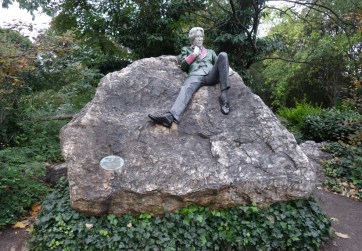
oscar-wildeOne of themes present at all times during a recent visit to Dublin was literature. The tourist guide offers you literary walking tours, a literary pub crawl, suggests to visit different libraries, book shops, major parks are adorned with statues dedicated to Irish writers, etc.Thus far, point taken. Already while in Dublin I was taking note of authors and books to be read in the near future.

During the stay in Dublin, our hotel was close to Merrion square, where Oscar Wilde lived as a child. I, therefore, decided to start with one of his plays, “The Importance of Being Earnest“, which was performed for the first time in 1895 in London.

The play, a critical satire of some of Victorian England social institutions and values (in particular marriage, literary press, religion, honesty, punctuality), is centered around two friends, Algernon and Jack (John Worthing), who go about from criticizing each other’s habits, to sharing each other’s faked relatives, to proposing to each other’s cousin and ward. After drawing several parallels between the two characters and their fiancées, and going about several absurd situations,  the play unravels in the most unexpected way.

The book is rather short (~45 pages in the digital version I read) though it’s full of surprising turns and punch lines. It has a memorable and quotable sentence in every other page. I will share some below:

“[…] I have come up to town expressly to propose to her” – “I thought you had come up for pleasure?”

“More than half of modern culture depends on what one shouldn’t read.”

“Literary criticism is not your forte, my dear fellow. Don’t try it. You should leave that to people who haven’t been at a University. They do it so well in the daily papers.”

“Do you smoke?” – “Well, yes. I must admit I smoke.” – “I am glad to hear it. A man should always have an occupation of some kind.”

“I have lost both my parents.” – “To lose one parent may be regarded as misfortune; to lose both looks like carelessness.”

“I would strongly advise you [..] to make a definite effort to produce at any rate one parent…” – “[…] I can produce the hand-bag at any moment.”

“All women become like their mothers. That is their tragedy. No man does. That’s his.”

“[…] Algernon. It is not at all a bad name. In fact, it is rather an aristocratic name. Half of the chaps who get into the Bankruptcy Court are called Algernon.”

“I never travel without my diary. One should always have something sensational to read in the train.”

“True in matters of grave importance, style, not sincerity is the vital thing.”

“Never speak disrespectfully of Society. Only people who can’t get into it do that.”

“He has nothing but he looks everything. What more can one desire?”

“I see no reason why our dear Cecily should not be even still more attractive at the age you mention (35) than she is at present (18). There will be a large accumulation of property.”

“I never change, except in my affections”.

I strongly recommend the reading of the play (it took me about 3 hours). You may find the ebook here at Guttenberg Project or you may watch below the play in Youtube:

1 Comment

Filed under Books

Glendalough

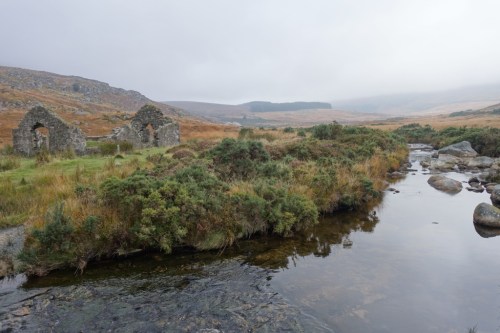
The first stop I made in my trip to Ireland last week was to visit Glendalough (Gleann Dá Loch, meaning “Valley of two lakes”), in the county of Wicklow, where there is a monastic settlement dating from the Middle Ages, when it was founded by St. Kevin.

The entry to the settlement it’s free and several routes are proposed to visit the place including some walking trails (from 1 to 11 km) around the lower and upper lakes.

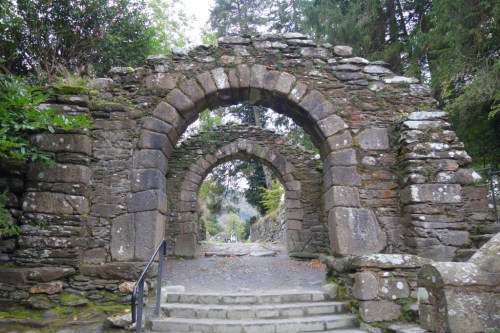
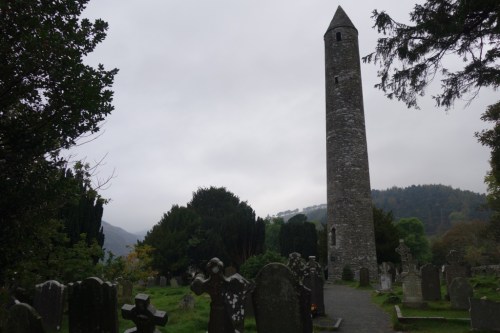
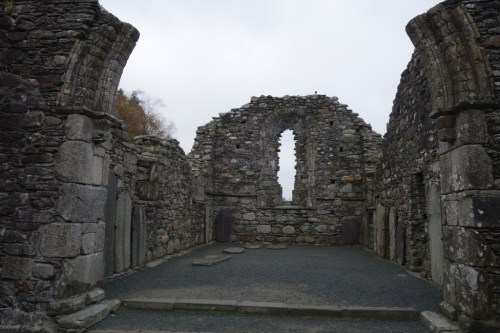
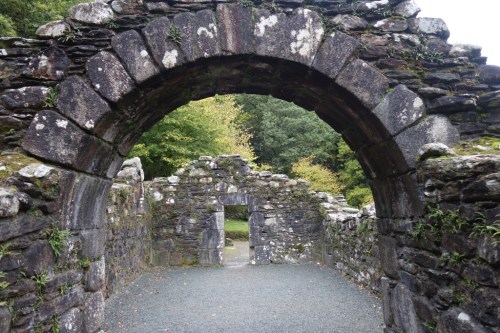
Some structures from the X to the XIII centuries remain today, such as the Gateway (unique in Ireland due to its two stories and double arch), the Round Tower (with over 30 m of height and an entrance at 3 m to protect it in case of attack), and the Cathedral.

Gateway

Gateway

Round Tower

Round Tower

Cathedral of St. Peter and St Paul.

Cathedral of St. Peter and St Paul.

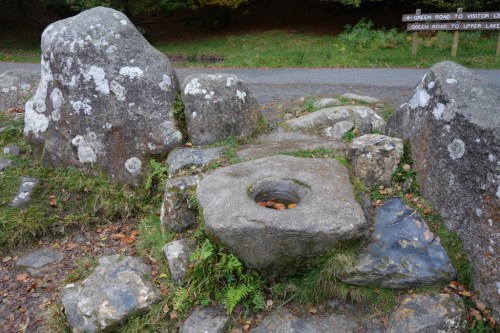
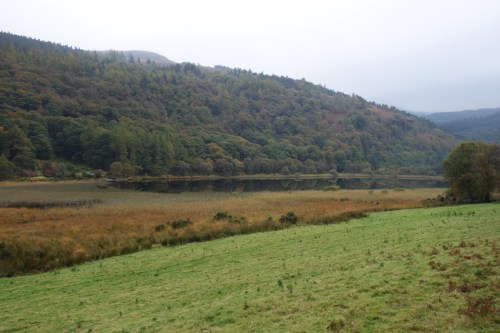
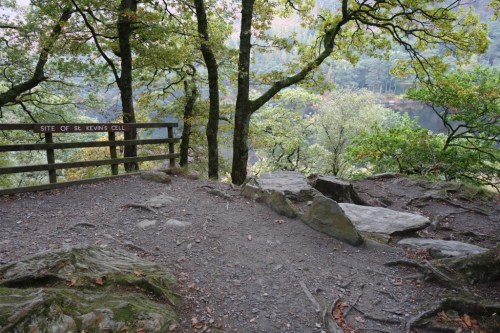
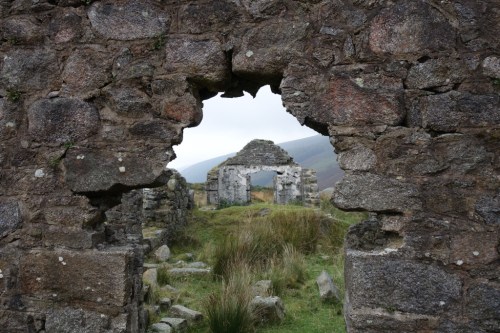
On the way to the upper lake, it is found the Deer Stone (where St Kevin would have fed some infants with milk from wild a deer), St. Kevin’s Cell (small circular structure where he retired to pray and meditate) and Reefert Church (Righ Fearta, the “burial place of the kings”, where members of the once important O’Toole family would have been buried).

dsc02306

Deer Stone.

Lower lake.

Lower lake.

St. Kevin's Cell.

St. Kevin’s Cell.

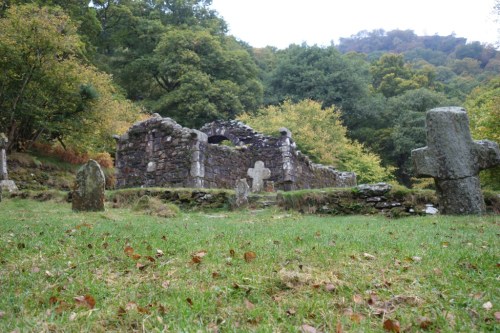
Reefert Church.

Reefert Church.

Reefert Church.

Reefert Church.

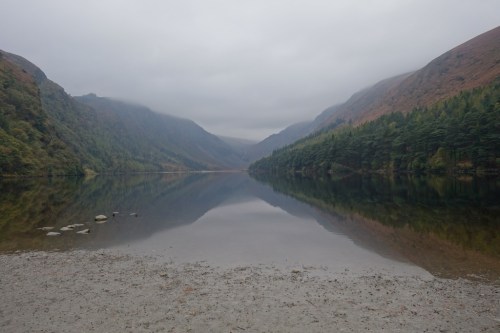
Upper lake.

Upper lake.

Leaving on my way to Kilkenny, I still had time to enjoy the views of the valley and find some other ruined churches along St. Kevin’s Way, a pilgrim path that starts at Hollywood and crosses the Wicklow Gap to arrive at Glendalough.

Wicklow Gap.

Wicklow Gap.

dsc02324

The previous night I stayed at the Trooperstown Wood Lodge just a few kilometres from the monastic site and more than recommended. The lodge is run by the same people who manage a nearby restaurant, The Wicklow Heather, which not only serves great food and has a good atmosphere but it’s decorated around Irish literature, especially its “Writers Room”, where customers may discover some of Irish authors and its writings.

This slideshow requires JavaScript.

In the morning I went for a short run from the lodge across the river and nearby forest, in the southern part of the Wicklow Mountains. Thus, you can imagine that the complete experience was wonderful and I can only recommend to visit the place.

Leave a comment

Filed under Travelling

Dublin marathon (2016)

Last Sunday October 30th, at the time that this post is being published, together with my friend Serna, I was in the departure line of the Dublin marathon, the “Friendly marathon” according to one of their lines, the 4th largest marathon in Europe with about 19,000 people registered, almost 17,000 finishers.

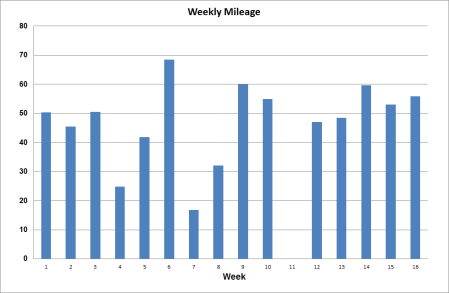
I subscribed to the marathon last July but I had it in mind sometime before, right after having completed the marathon in Albi, which didn’t go very well. This time I tried to follow more closely the training plan and I did it. If I arrived to Albi with just 530 km of training in the legs, I arrived to Dublin with above 660 km (in the previous 16 weeks), still a bit short but somewhat better. I had also managed more long runs and intervals sessions, even if I wasn’t doing them as fast as in previous years.

weekly-mileage

But not everything in the training period of 16 weeks had been rosy. Since late 2011 I use some insoles to compensate for a slight difference in the length of the legs, which normally doesn’t bother me, but when you’re clocking nearly 2,000 km a year hitting the streets you start to notice it. I hadn’t got new insoles since 4 years ago and the ones I used were rather worn out. I knew I had to change them but I kept postponing it, until I ran the Toulouse half marathon on September 18th, after which I simply couldn’t walk for two days. Visits to the doctor, podiatrist (x2), the physiotherapist (x6), plenty of pain killers, medicines, etc., and I managed to continue the training after a 10-day break (week 11-12 of the plan).

Having gone through that I was rather happy with just being able to be at the departure line of the marathon and running it without major problems, knowing that, despite of the injure, I had trained well enough.

dublin-route

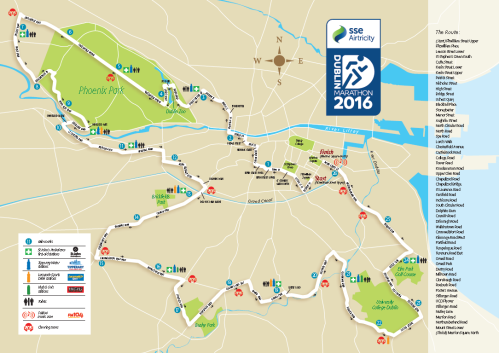
At first sight, the route of the race didn’t seem very appealing. It gave the impression that instead of taking the runners through the city centre, we were taken far away around the outskirts. Despite that, the atmosphere during most of the race was great, overwhelming. There were plenty of Dubliners almost in every street, crowds cheering at the runners, “Keep going!”.

The organization of the race was superb. From the management of the departure, with minimum waiting time, plenty of facilities, good spacing between starting waves so running was possible from the beginning, to supplies during the race, and a nice round medal at the end, or goodies that included a finisher t’shirt, a frontal lamp or a reflective running vest.

There were plenty of pacers. We decided to start with those of 3h50′ and see for how long we could keep up with them. The truth is that after about 7 km we took some metres of advantage and we kept running comfortably a bit faster for many kilometres. Some time after the half marathon my friend, who hadn’t managed to complete a moderate weekly mileage along the training season, dropped and I kept going forward. I was telling to myself to go on one more kilometre at pace (“run the kilometre you’re in“) until the moment when I would face the wall and then see how I could manage it. The fact is that I never faced it (“trust the training“).

dublin-pace

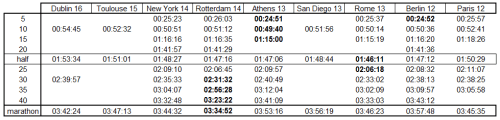
This marathon has been the first one in which I have managed to complete what is called a “negative split”, that is running the second half marathon faster than the first one. In my case, I completed the 1st half in 1h53’34” (not very fast, doubling for a 3h47 marathon) and the second half in 1h48’50” (doubling for a 3h37′). Every segment of 10k I did it faster than the previous one. This is something that you’re not fully aware while running, but you notice it. You push forward and the legs respond well. You say, let’s go for the 33rd km and see, for the 34th, 35th, 36th, 37th… at some point you think I am there, I’m not going to slow down at all.

marathon-comparison

It has not been the fastest marathon I have completed (that was in Rotterdam 2014, this one in Dublin has been my second fastest), as I started more conservatively, but I enjoyed every minute of it.

This slideshow requires JavaScript.


3 Comments

Filed under Sports

Kronborg castle and Hamlet

Kronborg castle.

Kronborg castle.

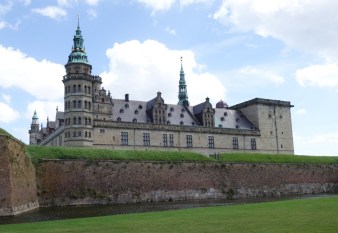
Last August I went together with my daughter Andrea on a trip to Denmark to visit my sister Beatriz, who lives there. Among the cultural visits that we made, we decided to go to the Kronborg castle, in Helsingør. This is known as well as the “Hamlet castle“, referred to in Shakespeare‘s play as Elsinore.

This year 2016 is the 400th anniversary of the death of William Shakespeare, which happened on April 23rd 1616. A series of activities are organized along the year and across the globe to commemorate it. As you can imagine some of those activities take place at the Kronborg castle, therefore in this year, once in Denmark, the visit of that castle was a must.

The visit was superb:

  • There were several actors impersonating the different characters of the play. You would find them at different spots of the castle.
  • There was as well a stage put in place at the courtyard of the castle where in the evenings Hamlet is played (this year produced by Peter Holst-Beck). During the day, the actors were rehearsing the play. An extra of the visit then was to watch some passages of the play. In fact, one exhibition at the castle displayed some of the many renowned actors that have played Hamlet at Kronborg along the years.
  • Other activity included the performing of a puppet show at a room in the castle, together with the characters of the king and the queen (similar to the Act 3 scene 2 of the play).
  • And, of course, another performance consisted of an actor impersonating Hamlet, skull in hand at the ballroom of the castle, acting his lines “To be, or not to be: that is the question…”

This slideshow requires JavaScript.

It was certainly a great visit which I strongly recommend, as for DKK 90 (or about 13 euros) you will spend a very entertaining couple of hours.

Hamlet, the play

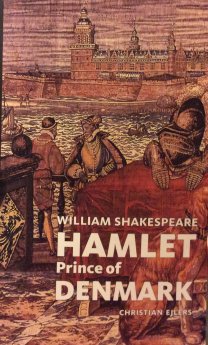
hamlet_bookAt the end of the visit, my sister and I bought copies of the book Hamlet at the castle shop: an edition by Christian Ejlers which includes some pictures of the tapestries with images of different kings of Denmark that can be found in the castle.

A few days after we concluded the trip, I started to read the book, which with 135 pages and despite its difficult old English language it reads in a few hours (spread in a few days in my case).

The plot of the book is rather well-known (no spoiler here): Hamlet’s father, the previous king, has recently died and Hamlet is profoundly affected by his death. A ghost of his father appears to him and this sets Hamlet into the search of who has killed his father.

I wanted to share some passages of the book that called my attention:

Do not, as some ungracious pastors do,

Show me the steep and thorny way to heaven;

Whiles, like a puff’d and reckless libertine,

Himself the primrose path of dalliance treads,

And recks not his own rede.” (Ophelia to her brother Laertes)


“And these few precepts in thy memory

See thou character. Give thy thoughts no tongue,

Not any unproportioned thought his act. […]

Give every man thy ear, but few thy voice;

Take each man’s censure, but reserve thy judgement. […]

Neither a borrower nor a lender be;

For loan oft loses both itself and friend,

And borrowing dulls the edge of husbandry…” (Polonius)


“Ay, sir; to be honest, as this world goes, is to be one man picked out of ten thousand.” (Hamlet)


To be, or not to be: that is the question:

Whether ’tis nobler in the mind to suffer

The slings and arrows of outrageous fortune,

Or to take arms against a sea of troubles,

And by opposing end them? To die: to sleep; […]

ay, there’s the rub;

For in that sleep of death what dreams may come

When we have shuffled off this mortal coil, […]

But that the dread of something after death,

The undiscover’d country from whose bourn

No traveller returns, puzzles the will

And makes rather bear those ills we have

Than fly to others that we know not of?

Thus conscience does make us cowards of us all;

And thus the native hue of resolution

Is sickled o’er with the pale cast of thought, […]” (Hamlet)


“Let me be cruel, not unnatural:

I will speak daggers to her but use none;

My tongue and soul in this be hypocrites; […]” (Hamlet)


“[…] May one be pardon’d and retain the offence? (King Claudius)


“[…] your fat king and your lean beggar is but

variable service, two dishes, but to one table; […]

A man may fish with the worm that hath eat of a

king, and cat of the fish that hath fed of that worm. […]

Nothing but to show you how a king may go a

progress through the guts of a beggar” (Hamlet)


“My words fly up, my thoughts remain below:

Words without thoughts never to heaven go.” (King Claudius)

A classic, a short book, at times quite entertaining and intriguing, even if it requires some effort, it is a must read, strongly recommend. May be in your own language or a version with a more modern language (I later picked up a Spanish version that I found at my parents’ which was much easier to read… and you could clearly see that translations were not literal).

Let this post be my particular homage to the figure of William Shakespeare in this 400th anniversary.

2 Comments

Filed under Books, Travelling

Yeager (book review)

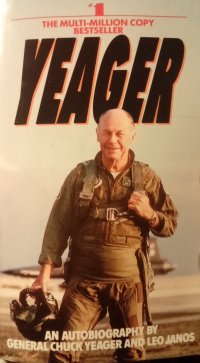
yeagerChuck Yeager was the US Air Force flight test pilot that broke the sound barrier for the first time on October 14, 1947, flying on board of the rocket-propelled Bell X-1. That part of his biography is widely known.

Reading his autobiography you discover that he went from being an uneducated child in rural West Virginia to retiring as a general of the US Air Force, acquainted with several US presidents and other dignitaries, he was the first pilot to become ace in a single day by shooting down 5 German fighters at World War II. Previously, he had been shot down by the enemy when flying over France near Angouleme, he escaped the Germans on ground with the help of the resistance and crossed the border to Spain via the mountains carrying the heavily injured body of a fellow American. He fought as well in Korea and Vietnam, he flight tested dozens of American aircraft and a MIG 15 taken from the North Korea, he set up and led the Air Force Space school which provided for plenty of astronauts for NASA initial space programmes, he became friends of female aviator legend Jackie Cochran, and altogether made him receive plenty of medals and recognitions. Plenty of remarkable achievements in a lifetime.

Many considered Yeager the best pilot in the Air Force at his time. What it seems clear is that he had a privileged eye sight which allowed him to spot enemies, trouble, etc., much earlier than others. He had a deep knowledge of the machines he flew despite of his initial lack of engineering education. He overcame that by eagerness to learn, by continuously asking to the best engineers available to him, and thanks to his experience in maintenance. And he flew a lot. He repeats several times throughout the book that experience, flying continuously, flying plenty of different aircraft, was what made him a great pilot. Despite of those assets, he recognizes as well that luck played a big role in shaping his career. From being born in a time when the flying over the speed of sound was something unknown to surviving various close calls both in war operations and during flight testing.

Let me quote some of the gems I had marked in his book:

“I got sick the first few flights […] like everyone else, I sweated through my first solo.”

“… most of us reached a point where, if a pilot borrowed our Mustang on our day off and was shot down, we became furious at the dead son of a bitch. The dead pilot might have been a friend, but he wasn’t as special as our own P-51…”

“I was still the most junior officer in our squadron […] there were several captains who were rubbed wrong being led by a new lieutenant. One of them was assigned to my flight of four, and refused to follow my orders. […] We were over Germany and this guy was flying as tail-end charlie, but lagging too far back in the rear, and ignoring my order to close up. […] I did a big barrel roll and came in behind him; he never saw me. Then, I fired a burst right over his canopy. The bastard saw that. He closed up immediately, and did what he was told.”

“Flying came with the marriage licence, and I had no problem with that.” (Glennis Yeager)

“I doubt whether there where many who loved to fly as much as I did.”

“Wright Field was a fun place to be, loaded with every airplane in the inventory…”

“[…] the real barrier wasn’t in the sky, but in our knowledge and experience of supersonic flight.”

Arrogance got more pilots in trouble than faulty equipment.”

“The real art to test flying was survival; maybe only a spoonful of more luck and more skill made the critical difference between a live test pilot and a street name.”

“The best pilots fly more often than the others; that’s why they’re the best. Experience is everything. The eagerness to learn how and why every piece of equipment is everything. And luck is everything, too.”

“And luck. The most precious commodity a pilot carries.”

“I was always afraid of dying. Always. It was my fear that made me learn everything I could about my airplane and my emergency equipment […]”

I strongly recommend the reading of this book (423 pages in the paperback edition).

4 Comments

Filed under Aerospace & Defence, Books

Boeing vs. Airbus: CEO compensation (2015)

Last year, I wrote a couple of post titled “Boeing vs. Airbus: CEO compensation (2014)” (and 2013) in which I compared the compensation of both CEOs. Yesterday, I saw that those posts received a larger than usual amount of visits which reminded me that now, at the end of the year 2016, we can find the same information for the 2015 fiscal year. Thus, this follow on post.

As both Boeing and Airbus are public companies, the information about their CEOs compensation is public and can be found in the annual report and proxy statement from each one. I will just copy the information below for comparison and future reference.

Airbus Group CEO, Tom Enders’ 2015 compensation (financial statements here, PDF, 1.7 MB, page 58).

Airbus Group’s Tom Enders 2015 compensation.

Airbus Group’s Tom Enders 2015 compensation.

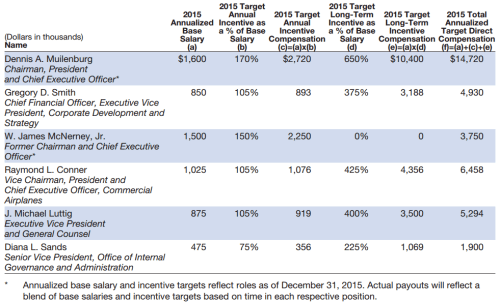
In the case of Boeing, 2015 was particular in the sense that Jim McNerney was the CEO for the first half of the year and since July 1st the position is held by Dennis A. Muilenburg. Find in the table below the figures for both (proxy statement here, PDF, 3.7 MB, page 30):

Boeing’s Jim McNerney and Dennis Muilenburg 2015 compensation.

Boeing’s Jim McNerney and Dennis Muilenburg 2015 compensation.

It is interesting to note that while the base salary is nearly the same (1.4 m€ vs 1.6 m$, which after taking into account current exchange rate is almost equivalent) the incentive schemes at Boeing end up with a total remuneration about the double of that in Airbus Group.

2 Comments

Filed under Aerospace & Defence

Flight excursion to San Sebastian

One of the goals that I had for this year as a recently qualified private pilot was to make a flight crossing the French border. For this purpose, last July I approached a colleague, Asier, who had obtained his license years ago and already had the experience of having flown to San Sebastian, the destination chosen for the flight.

We took a day off at the office to have time enough to make the return flight on a day and avoid constraints with the availability of airplanes. The weather was very good early in the morning all the way from Toulouse to San Sebastian, with only some wind, and a few gusts by the coast.

On the way to San Sebastian we would make a short stop over by Pau. On the way back we had planned another one by Tarbes, but in the end we skipped it. The outgoing flight took us 2h28′ (engine running time, including the stop over) for over 176 nautical miles; the return one, 2h04′.

The navigation went rather well even if we didn’t make use of the GPS and just navigated using the charts, compass and VOR… It basically consisted in departing from Toulouse Lasbordes and flying around the CTR of Toulouse via the southern itinerary. Once arrived at the SN way point we took a west heading towards the VOR of Tarbes (TBO) and from there we sought the integration in the CTR of Pau. At Pau we simply went to the general aviation parking, drank some water, refreshed ourselves, rearranged some papers, visualized the second part of the flight and got ready for departure. While at the holding point we had to wait for an airliner and a French Air Force CN-235, a nice view considering that both Asier and I used to work for Airbus Military.

chart-route-ss

Navigation log.

Navigation log.

It was when flying around Pau that we noticed that the temperature of the oil was rather high, almost in the red zone of the arc. As the pressure was OK we decided to simply reduce the rpm. The action was succesful in lowering the oil temperature back to the green area of the arc, but we were forced to fly for the rest of a very hot day at a somewhat slower speed (between 150-170 km/h vs. the planned 180-200).

Final approach at Pau airport.

Final approach at Pau airport.

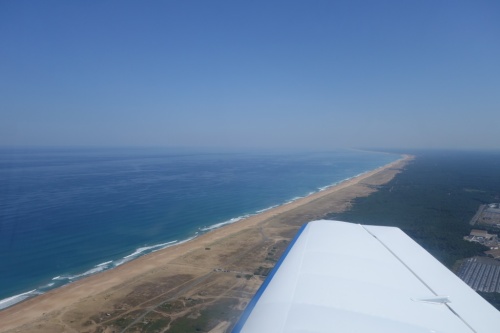
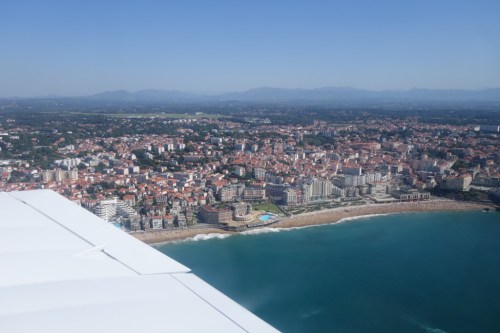
From Pau we followed the transit towards Biarritz via Orthez and Dax that follows more or less the high speed way and river Gave de Pau. We flew around Biarritz by the North and coastal transits. The bay and beach of Biarritz are wonderful on the ground, even more so from the air. In general it is a very recommendable experience to fly from Biarritz to San Sebastian, as despite of the turbulence that you may encounter the views are breathtaking. See the pictures and video below.

Atlantic coast.

Atlantic coast.

Biarritz

Biarritz

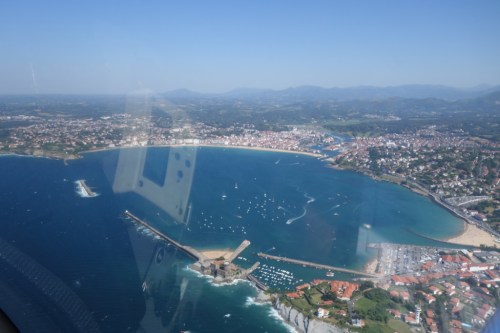
St Jean de Luz

St Jean de Luz

Leaving St Jean de Luz,the French air traffic controller bid us farewell in Spanish. Those were the first words in Spanish I ever exchanged in the radio as I obtained my license in France and the FCL055 to be qualified to speak in English when flying abroad, but I had never flown by myself to Spain. We then contacted the air traffic control at San Sebastian, who were waiting for us. While talking to the controller I felt very awkward, as despite of being a native Spanish and having reviewed aviation phraseology in Spanish the previous days, the terms and sentences didn’t come natural. I am sure that I used plenty of expressions that are either not correct or not in use. I noticed a couple of them by myself (“back track” the runway was employed by the controller in English, rather than a Spanish form I used or “Responde” for the transponder); there ought to be many more.

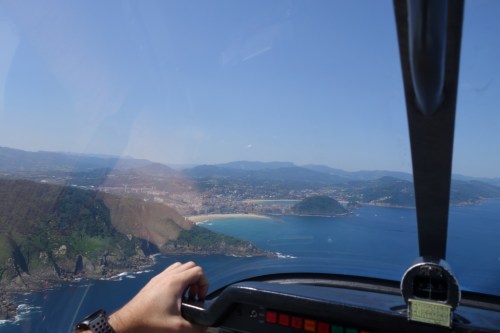
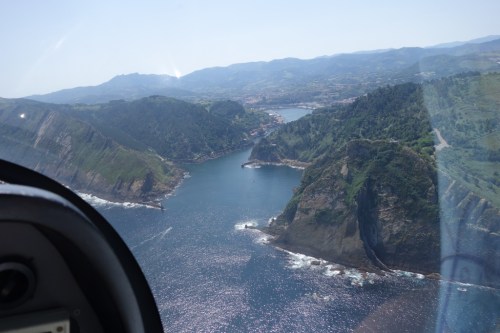
Air space around San Sebastian was very quiet. We demanded a clearance to make a detour by the bay of San Sebastian and come back to the airport in neighboring Fuenterrabia and it was granted without hesitation. Basically we could do as we pleased, we just needed to report when approaching the airport. After taking some pictures of the bay we headed back to the airport and we flew through the port of Pasajes, which I had visited on ground a few months before.

San Sebastian

San Sebastian

San Sebastian

San Sebastian

Entering Pasajes.

Entering Pasajes.

It took me a while to spot the runway in long final but the landing went smoothly.

Final approach to San Sebastian airport Fuenterrabia.

Final approach to San Sebastian airport at Fuenterrabia.

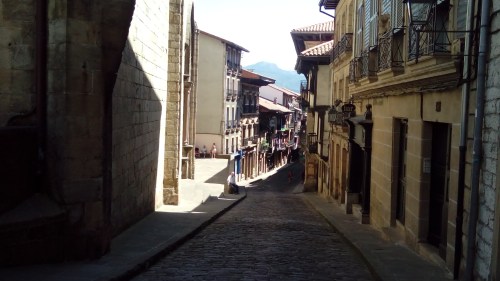
We then went to have lunch with a relative of Asier at a close by restaurant and later had a walk through the village centre (Fuenterrabia).

dsc_0130

About 3 hours later we came back to the airport. Just in time to take-off and leave before the weather deteriorated. Clouds were approaching the airport from Pasajes, thus we took off heading North (runway 04), with heavy cross wind (310 degrees, 15-20 kt) in what was the most difficult take-off I have experienced so far. Once on air, at Biarritz the controller adviced us (and any other aircraft around) to either land or fly inland as soon as possible as a front was approaching from the sea. So we did, turned east, inland, and continued our flight towards Toulouse.

Biarritz

Biarritz

The rest of the flight went very smoothly, even though we skipped flying over Tarbes after having slightly diverted from our planned route as demanded by controllers.

To conclude this post, find below:

  • a video we made during the flight. Despite having played with the camera for most of the flights, of having collected over 1 hour of footage, most of it is about flying in the countryside, not that interesting to watch. However, I rescued the approach and landing at Pau and the flying along the coast in the way back, which are worth seeing (~10′).
  • the navigation log as it was after using it during the flight.

Used navigation log.

Used navigation log.

If you liked this post, find in the page Flight excursions of this same blog, a list of posts describing similar experiences to other destinations.

1 Comment

Filed under Aerospace & Defence

My baptism on a Junkers Ju 52 at La Ferté Alais 2016 (video)

Last May, we had to travel by car from Toulouse to Paris. We took the opportunity to make some stop overs along the route, one of them at Cerny, a small village in the department of Essonne where the aerodrome “La Ferté Alais” is located. There, every month of May since over 40 years ago, the association L’Amicale Jean-Baptiste Salis organizes an air show dedicated to old aircraft with an impressive static and dynamic display.

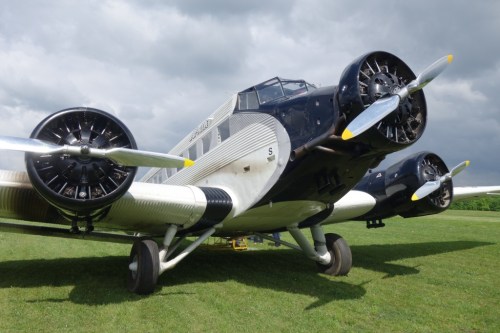
The air show in itself deserves a dedicated post which I will leave for another moment, as in this post I mainly wanted to share the video of my baptism on a Junkers Ju 52ju-52The aircraft in itself is iconic, mainly for its corrugated duraluminium skin. Over 4,000 airplanes of its different variants were built in Germany, France and Spain between 1931 and 1952. Only 8 remain airworthy today, 4 of them are operated by the Swiss company Ju Air. Ju Air brought its Ju 52/3m g4e registered HB-HOS to the air show “Le Temps des Helices” at La Ferté Alais to take part in the dynamic display and to give baptisms to aficionados, at a price of 180 euros per passenger.

When we got to know that we would attend the show I did not hesitate, I booked a place onboard the aircraft as soon as I could.

The flight lasted for about 40 minutes. We departed from Cerny and flew towards Fontainebleu, where we flew over the famous château. Find below an edited video I have made with the different clips and pictures I took in that flight.

Of the 17 passengers that we flew at that time, I believe only one made use of the headphones provided, the rest wanted to hear the roaring of those engines, therefore I left the sound unedited and I didn’t add any music to it; I wanted to leave audible the sound of the 3 engines.

I will leave for another post to provide further information and historical anecdotes of the Junkers Ju 52, as right after that flight I read a book by a former employee of CASA about it “El Junkers JU/52 3m CASA C.352. El avión y su historia” and I believe I will soon write a review of that book.

1 Comment

Filed under Aerospace & Defence

2016 Olympic Games medal table vs. population and GDP

Now that the 2016 Olympic Games of Rio de Janeiro have finished, I wanted to update and share here in the blog a couple of tables I produced a few days ago comparing the medal count per country and the ratios of such medal count in relation to the population and the size of the economy of each country.

To start with, find here the official medal count, which is ordered taking into account which national olympic committee has obtained the most gold medals, then most silver medals and finally most bronze medals (and not by the total tally).

Rio 2016 - medal table 2016.08.21

In the table I have only included the top 20 countries, but you can find here the complete list. There are 86 nations that have collected medals in the Games. This means that over a hundred nations have not collected a single medal.

Without doubt the most dominant nation in the Olympics has been the United States with 121 medals won, 46 of them of gold. That is over 50 more medals than China or the United Kingdom.

However, the United States has a population of about 5 times that of the United Kingdom, therefore the pool of talent where to search for olympians is much larger. This allows me to introduce the first ratio: Population / medal. I collected the figures of population from the Wikipedia (here). Find a table below with the results:

Rio 2016 - ratio population medal table 2016.08.21 selection

The table shows a selection of 44 countries not the complete list of 86. Find such complete list at the bottom of the post and find your country. These 44 countries help me to make the following remarks:

  • Small nations such as Grenada and Bahamas, despite of having collected only 1-2 medals lead the table.
  • In the top 20 we find nations such as New Zealand, Denmark, Australia, Netherlands and Sweden that tend to be in the lead pack of any positive ranking. They seem to be good as well in producing olympian talent.
  • The 4 bigger European Union nations find themselves in the upper third of the list, with between 1 and 2 million inhabitants per medal, with the UK leading the pack followed by France, Germany and Italy.
  • United States for all its dominance in the medal table is only the 43rd nation taking into account the size of its population. That is at the middle of the table. One would say that the average American doesn’t play any better at sports but the sheer size of the country allows it to find plenty of good olympians in different sports.
  • Funny enough, just above the USA we find Russia in this ranking. And just below, Spain. All 3 have about 1 medal for every 2.7 million inhabitants.
  • At the bottom of the table we find large nations such as India, Nigeria, Philippines or Indonesia that with over 100 million inhabitants have also collected only between 1-3 medals each.
  • Plenty of nations have not managed to collect a single medal, some of them large nations: Pakistan (~194 million inhabitants), Bangladesh (~160 m). Most African countries have not won a medal as many in the Middle East (e.g. Saudi Arabia). Some emerging nations from Latin America neither: Chile, Peru, Uruguay

As there are few developed countries at the bottom of the list I thought of producing a similar ranking but with the ratio “gross domestic product (GDP)” / medal. The guiding thought is that the larger the size of the economy of a given country the more resources it will have to recruit sportive talent, to train it, to send it to international competitions, to build sport infrastructures, etc. (1) (2) I collected the figures of GDP from the Wikipedia (here; the source for most of the figures is the International Monetary Fund whereas for about 5 of them is the World Bank). Find a table below with the results:

Rio 2016 - ratio nominal GDP medal table 2016.08.21 selection

The table shows a similar selection of ~45 countries not the complete list of 86. Find such complete list at the bottom of the post and find your country. These countries help me to make the following remarks:

  • Among the top 30 nations all are small economies. The first G20 economy we find is Russia in the 34th position. These small economies leading the table translate between 1 bn$ and 20 bn$ of GDP per medal.
  • We find Grenada, Jamaica and Bahamas in top 10 in both rankings.
  • African nations that do well in athletics show up here: Kenya (12th) and Ethiopia (24th).
  • Where are New Zealand, Denmark, Australia, Netherlands and Sweden in this ranking? They are between the 25th (New Zealand) and the 48th (Sweden) positions, converting between 9 bn$ and 46 bn$ of GDP into a medal.
  • Where are the 4 bigger European Union nations in this ranking? They are between the 44th (United Kingdom) and the 60th (Germany) positions, converting between 41 bn$ and 82 bn$ of GDP into a medal. That is at the second half of the ranking.
  • Where is the USA? At the bottom of the pack, in the 73rd position just followed by China. Both translating between 152 – 162 bn$ of GDP into a medal. That is an economy about the size of New Zealand (4.7 million inhabitants).
  • We find the richest economies of the Middle East (Qatar and United Arab Emirates) at the bottom of the table, not being able to translate petrodollars into medals, despite of signing some good athletes.
  • At the bottom of the table we find some of the same large nations: India, Nigeria, Indonesia… and Austria.
  • Even if plenty of nations have not collected a single medal, most of the larger economies have. The largest economy in failing to win a single medal at Rio was Saudi Arabia (20th by nominal GDP), followed by Hong Kong (33rd) , Pakistan (39th) and Chile (43rd).

Another discussion would be whether in itself it is indeed important or not to collect medals at the Olympic Games but that discussion is out of the scope of this post.

(1) I used GDP and not GDP per capita with the idea the GDP per capita would be more linked to the overall sports habits and fitness level of the nation, but the number of athletes that can be sent to the olympics is limited, thus GDP would show by itself whether the size of the economy of a given country would work efficiently in finding that talent and bringing it to the level required to win medals at the olympics.

(2) I used nominal GDP instead of “purchasing power parity” figures with the idea that sport talent of olympic worth needs to be trained and tested in several international events along the year, thus comparing the more local PPP figures wouldn’t do.

Complete table with medal tally ordered by the ration “Population / medal”:

Rio 2016 - ratio population medal table 2016.08.21 TOTAL

Complete table with medal tally ordered by the ration “GDP / medal”:

Rio 2016 - ratio nominal GDP medal table 2016.08.21 TOTAL

2 Comments

Filed under Sports