I was given the book “How Soccer Explains the World” as a present by Luca & her mother about 2 months ago. They bought it in the London bookshop Daunt Books, and it came with a bookmark of the shop… impressive. Take a virtual tour around the book shop, it definitely deserves a stop in the next visit to London.
The book… since I have been questioned about it many times: no, soccer does not explain the World. However, it is a very interesting book drawing parallels about historical moments in recent history and how they were connected with football issues going on at the moment in the same places.
The first chapter for example tells about Serbian paramilitary groups, their connection with football and how they were instrumental in the Yugoslavian wars. In that chapter you read lots of names that ring a bell from having followed football recently: Obilic, Arkan, the great Red Star of 1991 (Prosinecki), Ognjenovic (a singing of Real Madrid), Zvonimir Boban… all these names let the reader connect with the story. In my case, having been in these locations and having good friends from both Serbia and Croatia increased the interest of it.
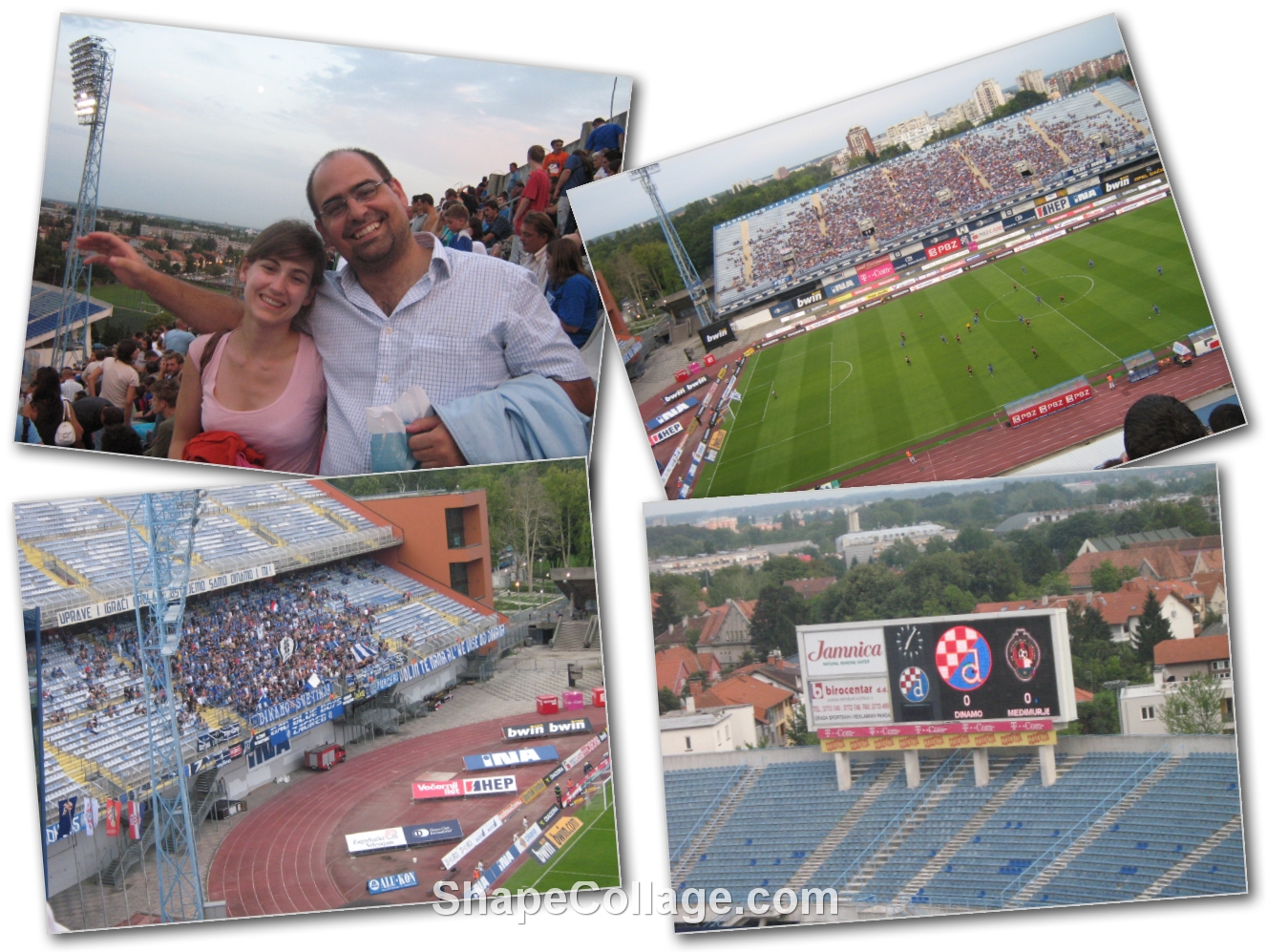
Luca & I attending the game Dinamo Zagreb vs. Medimurje (Croatian league) in 2007... because Dinamo offered an open-doors day after having made a good selling of tickets against Werder Bremen the previous week...
There are other chapters that may draw the attention of many: a whole chapter dedicated to F.C. Barcelona (the favourite team of the writer, Franklin Foer… an American, you see), other to Celtic-Rangers rivalry, disdain for soccer in the USA, Ajax, racism in football…
I recommend this book, especially in times of a World Cup.
I bought this book together with some others in the Books & News shop of Schiphol airport in Amsterdam in a recent trip to NL. I have read about this book sometime ago as it had been discovered in the computer files of Michael Crichton after his death.
I had read most of his last books so I was determined to buy this last one as soon as I would find it and so did I.
I found this book quite different from his last novels (Next, State of Fear, Prey…), but still, it was a quite entertaining reading about pirates in the Caribbean hunting treasures, fighting warships, storms, hurricanes, aborigines…
I would remark its very vivid descriptions everything related to sailing, firing cannons, the Caribbean, etc. One more thing I liked it about it is that it leaves the reader rested with all vengeances possible, well taken. I do recommend the book (387 pgs.).
Lastly, I found out in the Wikipedia that there will probably be a movie about this book by Steven Spielberg and even most intriguing: there is yet another novel by Crichton coming posthumously in 2012!
I used to go often to concerts with my parents when I was teen, when they would buy season tickets. From last Saturday’s experience, I wanted to comment on a feature of the theatre that I had never seen before: at the theatre, in The Hague, there was a screen displaying a Dutch translation of the dialogues sang by the opera singers at the play.
When I attended with my parents we had to previously read the programme in order to follow the plot as (1) it isn’t easy to follow dialogues when they are sung and (2) they sang in Italian. Now, all you have to do is to sit comfortably and listen to the music while reading the plot much as if you would watch a movie in original version with subtitles. Dutch society is one step beyond regarding pragmatism.
See in the scheme of the theatre where the screen is located (as you may imagine I couldn’t take pictures of the screen).
I visited La Alhambra in the Easter of 2009 and I was disappointed with it. I have always heard wonderful stories, descriptions… one day it was Bill Clinton bringing Hillary there, other day it was about the sunset… the case is that I didn’t find anything there that I hadn’t seen in the Reales Alcazares in Seville (where I spent a year studying and working) and in a better state of conservation.
Whenever I say this to someone, their reply is “but it’s not only the buildings, it’s the atmosphere, the location, the view…”… mmm… yes, sure, but I came there expecting to see one of the Seven Wonders in the World… and frankly, I have seen other breathtaking places (Machu Picchu, Iguaçu falls…) where you don’t need someone reminding you that “it’s not only this, you need also to take into account that…”.
Reading the a past issue of The Economist I came across the article “Planning for the sequel”, about how Pixar is preparing itself to continue with its creativity levels for the long-term.
The newspaper remarks two aspects of Pixar’s approach: the company puts people before projects and effort in getting people work together. Regarding the second reason, let me paste some of the sentences of the article:
“Employees show unfinished work to one another in daily meetings, so get used to giving and receiving constructive criticism.
[…] This system of constant feedback is designed to bring problems to the surface before they mutate into crises, and to provide creative teams with a source of inspiration.
[…] Pixar demands that each review identify at least five things that did not go well in the film, as well as five that did.”
Having been a member of the public speaking association Toastmasters for two years I have had the chance of seeing hundreds of evaluations. Evaluations of prepared speeches, of impromptu speeches, of meetings, of evaluators, of skilled and beginner speakers… it is not a so easy task to sit and think in a couple of minutes of 5 things that you really liked and some valuable points of improvement. It’s even less easy to speak them up in a structured, candid and, at the same time, encouraging way. And that is another thing that you can learn in Toastmasters: giving feedback through effective evaluations.
Yesterday I was reading an article in The Economist about the whisky industry, and I found a thread to follow: Spain being the third largest export market of Scotch whisky!
After having travelled through different European countries and seeing the drinking habits in each place I could almost predict that more whisky was consumed here than in other European countries.
I searched for the source of these data, the Scotch Whisky Association (SWA), which published a release in April 15th on the export data from 2009.
Despite the global crisis, whisky exports continued to rise both in terms of revenues and bottles. But let’s dig into the data.
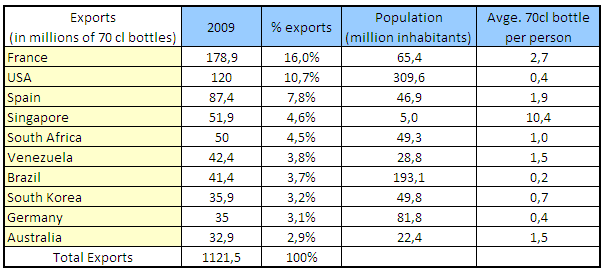
Looking first at the numbers of bottles exported we see that the leading country is France with almost 180 million 70cl bottles, followed by USA and Spain (with 87 million bottles). The first 10 countries account for 60% of the export market.
Because France and USA are more populated than Spain, I was interested in comparing the ratio number of bottles exported by inhabitant… and now the leading country was by far Singapore, with over 10 bottles per inhabitant per year… either there is something we miss in the picture or there is very heavy scotch drinking going on there (taking into account that not everyone drinks whisky, less people imported scotch). Among those 10 main markets Spain again came in third with an average of 1.9 bottles per inhabitant, though we should keep in mind that this number only reflects the bottles exported from Scotland; not whisky consumption in the country (Irish, US or Spanish whisky is not counted here).
Scotch whisky exports, by number of bottles.
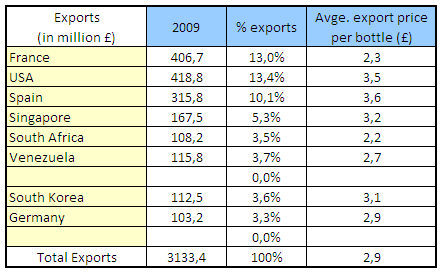
There is another statistic given in the same release: revenues. What I wanted to know with this was the export price per bottle. Not all top ten countries by number of bottles were among the top ten by revenues, but with those which were I did the calculation. The average price resulted 2.9 sterling pounds, around 3.37 €… so the other ~9€ up to the 12€ price you see in the shop are costs related to transportation, retail shops, etc.
Scotch whisky exports, by revenues and bottle price.
In the SWA site you may find very useful information such as distilleries to be visited in Scotland, etc.
The Stockholm International Peace Research Institute (SIPRI) is, in their own words, an independent international institute dedicated to research into conflict, armaments, arms control and disarmament. Every year they publish their famous SIPRI Yearbook with data about international conflicts, defence spending, defence companies…
In a previous post I showed cartograms of countries relative to their defence spending, etc. In this post I want to show a bit about the industry.
From the information of last year’s book, we find that of the 10 world biggest defence companies 6 are US companies and 4 European, though the biggest one is the British BAE Systems.
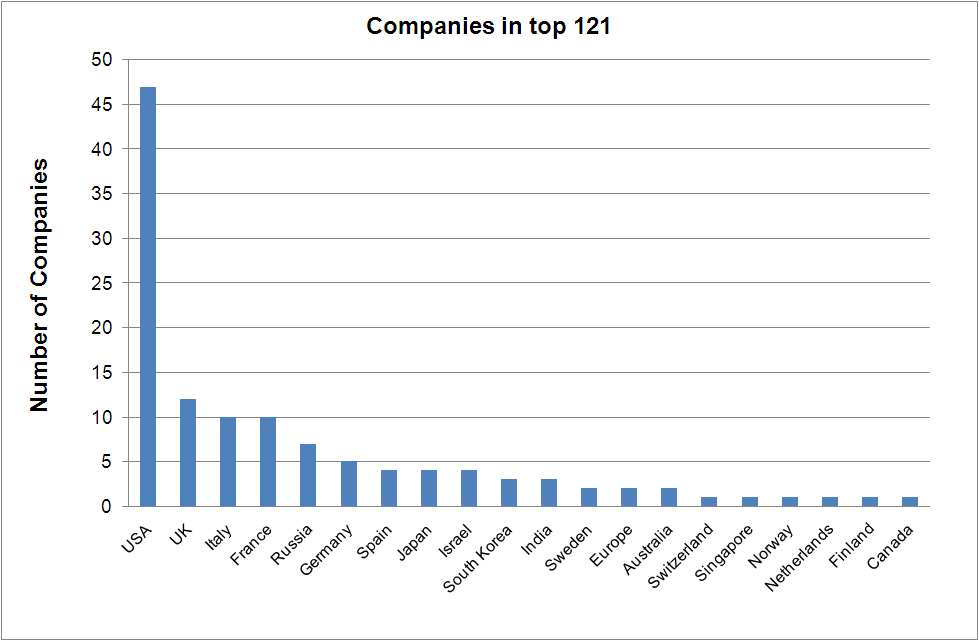
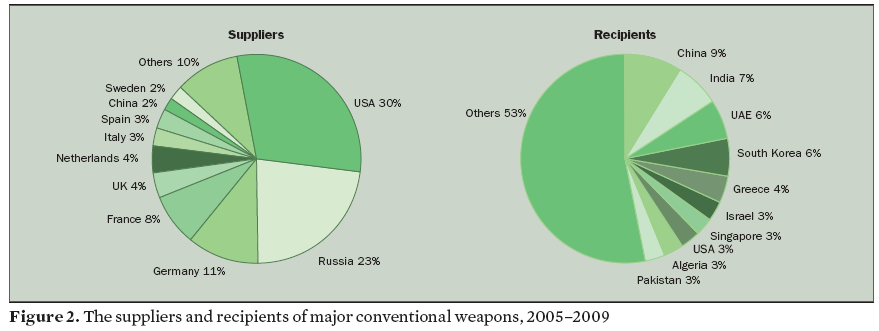
Among the first hundred companies (121 including subsidiaries) there are 4 Spanish: CASA (EADS), Navantia, Indra and Santa Barbara (General Dynamics). This places Spain as the 7th country by number of large defence companies. SIPRI publishes as well a fact sheet titled “Trends in International Arms Transfer”; in that one (data from 2005-2009) Spain is placed as the 8th country by arms exports.
Countries by number of large defence companies.
Countries by defence sales.
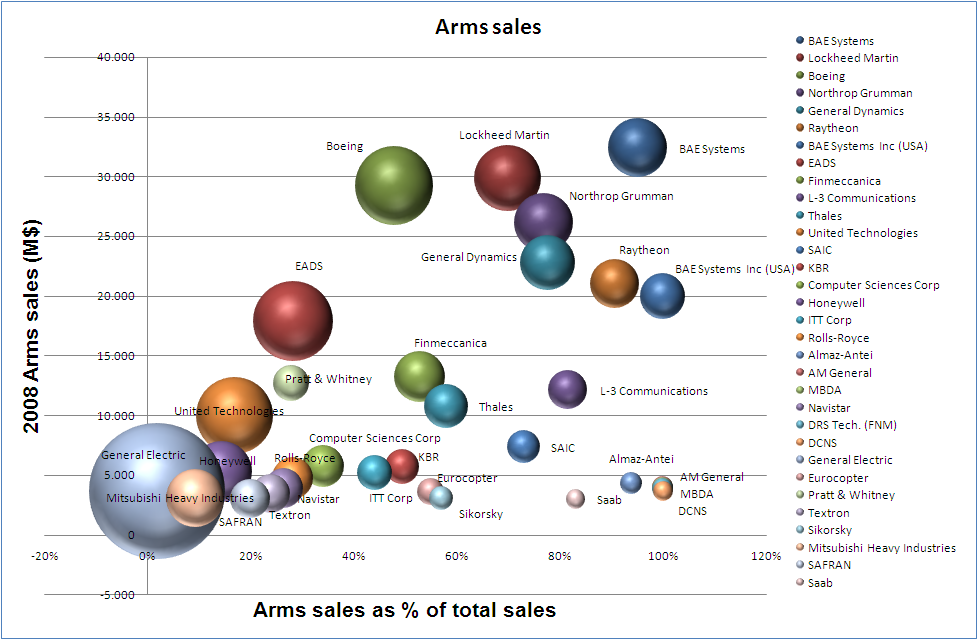
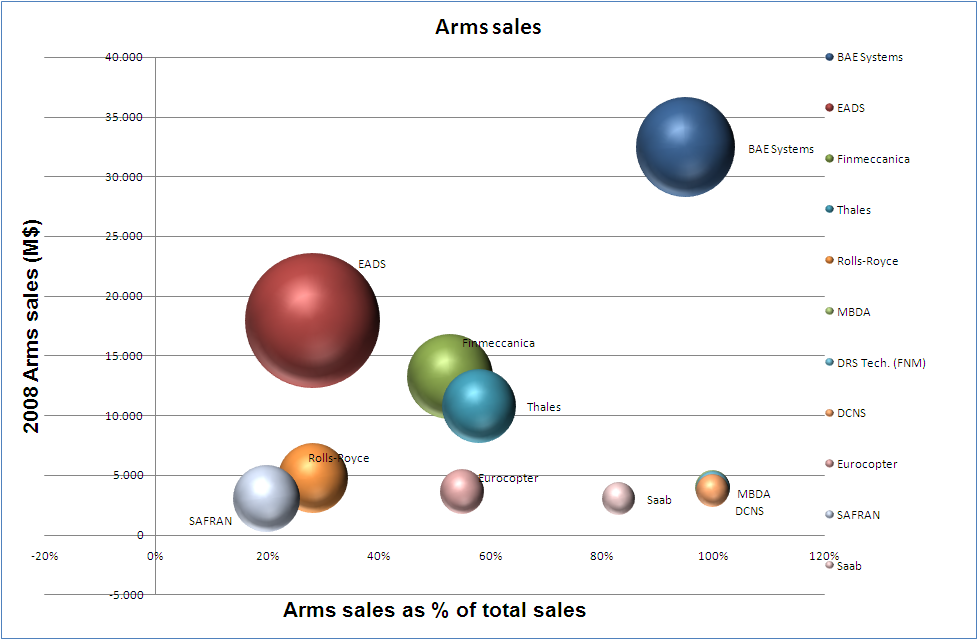
Finally, with the information provided by SIPRI I built the following (simplified) table where you may see which are the biggest defence companies by revenues and see how much of their business is relying on defence activities (big conglomerates like GE or UTC do not rely heavily on defence).
Defence companies by defence revenues and reliance on defence.
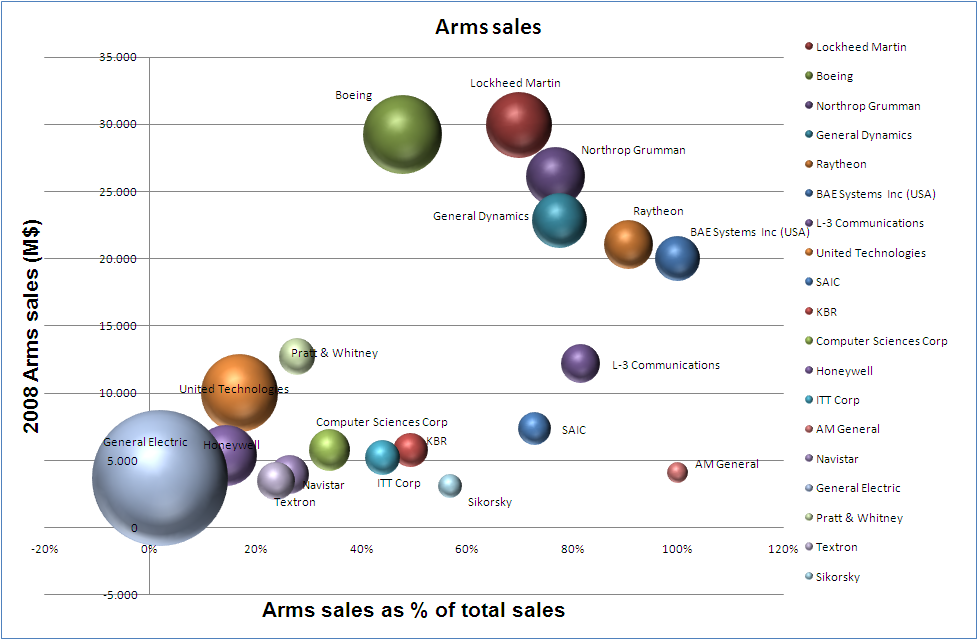
It is also interesting to look at the previous picture but isolating only the US companies…
US Defence companies by defence revenues and reliance on defence.
… and then taking a look at European ones:
European Defence companies by defence revenues and reliance on defence.
You may see that the top-right corner is almost exclusive domain of US companies, except for BAE, which has a big presence in the US defence market.
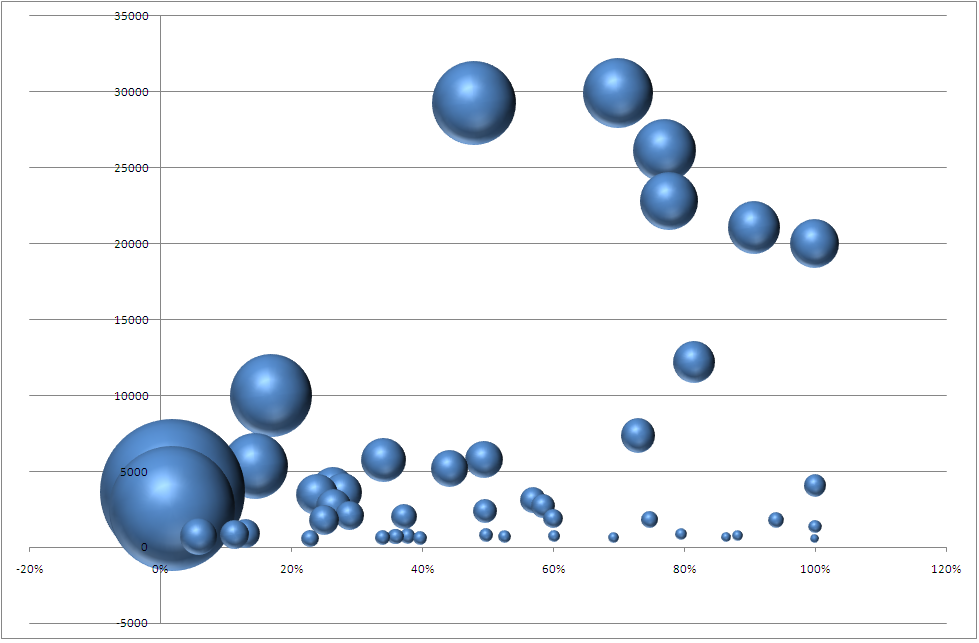
In this latest table you would see how the complete picture (with all 121 companies) would look like, with an atomization of smaller companies at the bottom.
On Wednesday 2nd June I attended Real Madrid – Caja Laboral basketball match at Vistalegre. Even in the case of winning, I was not going be able to attend the following match on Friday 4th and I had a gut feeling that it was going to be the last match I watched at Vistalegre since Real Madrid is moving to La Caja Mágica next season. Moreover, I am not sure whether next year I will take the season-ticket again, so I felt like taking pictures to remember the last 3 years of basket experience.
Even though the team has not won a single title since we started attending matches I must say that it has been a great fun. It all started on the late summer of 2007, when my two friends Pablo´s talked about taking those tickets, and I joined them.
We have had the chance to see great teams (CSKA Moscow, Panathinaikos, Barcelona, Maccabi, TAU…) and great players (Navarro, Rudy, Garbajosa, Papaloukas, Jasikevicius…).
Each year we had to learn about the new signings, which all seemed promising then they weren’t that good (Smith, Tunceri, Pelekanos, Tomas, Hosley, Massey, Papadopoulos, Velickovic, Lavrinovic, …) and the team had to rely mostly on the same players than years before.
This last year seemed even more promising than the previous two: we had signed the best coach in Europe, all new players seemed very effective from the start, the speaker of the stadium really cheered the audience, we were doing great in all competitions, the club even reinstated cheerleaders, when we had a setback an even flashier player would come (Jaric), but then, the year has ended as the previous ones.
One of the best things along these years have been the matches on Thursdays, meaning a break in the work week, a chance to meet friends and have a kebab for dinner where to continue talking about planes, the company, etc.
Maybe next year will be a better one, though I’m afraid I won’t be in the North side whistling rival attacks and referees decisions…
Two weeks ago I attended the Toastmasters District 59 Conference, “Springtime at the Beach”, in The Hague. This was the first time I attended such a conference, and I was impressed at the level of the speakers and the organization of the conference itself.
Being an Area Governor, for me the event lasted two days and half, starting on Friday June 4th afternoon with an executive committee meeting, following with the start of the conference, later the evaluation contest and a party with divisions showcase. That wasn’t a slow start.
On Saturday we had some workshops, the elections of new officers and the international speech contest. The way the conference, workshops and elections are held reminded me very much of my time at AEGEE and how there the Agorae were held; even some of the topics covered are similar, the way sometimes the focus is put on the procedure and not on listening at length to what the candidates plan to do if elected, etc…
On Sunday we had more workshops and the training for the new district officers (namely Division and Area Governors).
International Speech Contest. This is the main attraction of the event. We could say that we paid the 135€ fee of it to attend this contest. We had 10 speeches, one representing each division. As I wrote above, the level was very high. I couldn’t see a clear winner; a prove of that is that only one of my 3 favourites came among the 3 first ones. The winner, Na Elom Amouh, told us about his journey from Togo to Munich and how we should never give up in the pursuit of our dreams. A motivational speech. In general, most speeches in these competitions tend to call the audience for noble purposes, inspire good behaviours, etc. I must admit that some of those speeches do get to move you.
Evaluation Contest. Here, the participants had to evaluate a very good speech from former District Gov Christopher Magyar. This is not an easy task, as it is always more difficult to find points of improvement. Even though in this contest the level was very high as well, with very analytical and encouraging evaluations, this time my 3 favourites came in the first 3 positions, the winner being Tara Majumdar.
Miscellanea. There are many small details, side happenings, different situations that contribute to enlarge the baggage the one takes from the conference.
The landscape surrounding the conference letting members to relax.
The music being played in the plenary sessions, especially the banners parade bringing up the spirits of all attendees.
The chance to have meals in the terrace.
The wonderful garden for the gala party and the party at the beach.
The attentive organisers… the continuous availability of stroop waffles, coffees, etc.
The counting of votes behind the scenes… when each one is coming up with a different number!
The entertaining way in which chairs conducted the contests.
The experience of tweeting the event (from @TM_Madrid and @javierirastorza)…
This slideshow requires JavaScript.
Learning experience. Overall, the conference is an intense learning experience. You learn how others organise officers’ trainings, set up clubs, give recognition to members, set up workshops, and use different techniques and skills in public speaking… To end this post I wanted to remark two workshops that I attended and especially liked:
Pecha Kucha: this is a presentation technique originally from Japan that consists of preparing a presentation that consists of 20 slides, each one lasting 20 seconds and that will run automatically. You, the presenter, can’t stop it so you need to time yourself to precisely convey your different messages when each slide is being shown. It was very dynamic and I think it’s a nice challenge to try it one day. Check out the calendar of Pecha Kucha nights in different cities around the World.
Youth Leadership Program: this is Toastmasters program for youngsters. A couple of Toastmasters explained how they have carried it in a school with teenagers. From what I saw, it must be a very rewarding experience, a way to give back something to society and at the same time a way to help young students improve their skills. This is also another challenge I might try one day.
Next District conference… in Barcelona; I’ve already booked my place there!
Last weekend, Luca and I went to Casablanca. We had planned this trip together with two friends who could not come in the last-minute. Indeed the trip had been mainly planned by them, so we found ourselves in the plane reading some papers trying to discover what was to be seen in Casablanca (“Casa”), where we were staying, how to get there and so on (by the way, now that I mention the flight, the two Easyjet flights were with 1 hour delay each as have been 90% of the flights I have experience with them… by far this is the least reliable airline that I have ever used). I normally tend to thoroughly prepare my trips, so this was an unusual experience.
Casa is not one of the seven wonders but it is a nice city to spend a weekend out, especially if you have never been to Morocco as was our case.
Out of the comfort zone.
The main attraction is the Hasan II mosque, which is huge, located by the sea and surrounded by a wonderful park. It is very nicely illuminated by night as well. When we got there, guided visits were just finished… but the odds where that we were asking about visits to the right person in the right moment… a worker of the mosque who apparently earns some extra cash by opening the doors discretionarily and making “private” tours at will.
There we were, together with some other 4 tourists, visiting the interior, making pictures and wondering how much this would cost. When we were getting out I left a 20 dirham (~2€) note in the guy’s hand, he saw it and looked at me with smiley face a bit tilted down like saying “Javier, come on, you know this doesn’t make up for it”… well, this was the first experience I can recall of such a situation. I didn’t have a clue of how much I was supposed to give (the official visit cost 120 dirham per person, 240MAD in total) or how much others had given; the only thing I knew is that in my pocket I only had one more note of 20MAD and some others of 200MAD… so I took the 20MAD one, place it in his hand and left without ever turning my head back.
The previous anecdote clearly put us out of our comfort zone. We were out there in some other situations as well. I would say that in many of them you have the feeling that someone out there wants to cheat you. So you end up negotiating for everything which hasn’t got attached a price tag to it. So there I was bringing down prices (in my poor French!): a pair of babouches down 15MAD, a funny camel down 5MAD, a taxi down 7 MAD, another taxi down 30MAD… so much stress, so much effort to save 57MAD, less than 5.7€!! At least you get to practice negotiation skills…
The low prices that make you mad when seeing the outcome of the negotiations, on the other hand, have the positive effect that you can easily afford dining in very good places such as La Fibule and La Sqala, both by the sea; and both culinary experiences being part of the highlights of the visit.
Sightseeing. The other two main attractions for us were walking through the Medina Habous and the Ancienne Medina. We liked it more the architecture in Habous, though we had a deeper “cultural” immersion in the Ancienne one. Before going for dinner the first night, we decided to have a walk around, so we went into the Medina and took one street left, one right, then… we found ourselves walking without any sense of direction, in some crowded streets without any single tourist.
I then made the comment “it feels so safe to walk here without having read in a travel guide that we should not walk here after certain time and in these not well-lit streets”. As I said we hadn’t read anything in advance, and only now I have checked that indeed some sites make the point of it being a dangerous place by night… well, sometimes it may be better not to let that fear get into you by reading such things in advance.
There were plenty of other mosques that you may not visit, but that you notice especially when all of them call for the prayer time at once. Hear their choir recorded from the great terrace that our hotel had at the rooftop.
Finally, we also visited an old Christian cathedral that now is used as an art gallery.