Refuelling or not refuelling?

Last week, I took my brother and sister onboard of one of my flight lessons. Ahead of the flight I reminded my instructor that I would bring them along and asked what flight route should I prepare. His response: “prepare the weight and balance report, the destination will be a surprise”. And so I did.

For those not initiated, each aircraft has a defined maximum take off weight (MTOW). Before the flight, the pilot needs to ensure that the aircraft will be below that weight. On top of that, the centre of gravity must be within certain limits. That is the weight and balance (1).

For a small simple aircraft like the Robin DR-44 we flew, it is a rather easy calculation that can be done with a pencil. See in the image below two ways of calculating it: making the numbers or using the graphic at the bottom of the image.

Weight and balance report for Robin DR-44.

Weight and balance report for Robin DR-44.

Let’s review the numbers. We flew the DR-44 with immatriculation F-GSRR, which empty weight is 616kg. I estimated that the instructor and I, fully dressed and with headsets would weight ~160kg. My brother and sister behind, another 160kg. Baggages: I almost emptied mine and weighted it, 2.5kg. My instructor’s one is rather heavy, I assumed that together they would be 10kg. Principal fuel deposit: 110L of Avgas, with a density of 0.72kg/L, 79.2kg. Another 50L for the reserve deposit, 36kg.

Summing up: 1,061kg.

You can read in the image that the maximum take off weight for the plane is 1,000kg…

What to do then? Clearly, the aircraft is a given, so weight shall be reduced from somewhere else. But, from where? Either we left someone on ground or reduced baggage weight (my instructor left his and brought along only a book with aerodrome charts). However, baggage weight contributed only 10kg to the initial calculation. I then calculated: what is the maximum fuel we can carry?

Forget the reserve deposit: 36kg less. Let’s go with the principal deposit. What is the maximum fuel volume that would enable us to be within the 1,000kg limit? It would be somewhere about 80L (vs. the capacity of 110L of the deposit).

When I arrived to the aerodrome, I came with the message to my instructor: “Thierry, we can only carry 80L, if the plane is filled up with fuel, is there a way to purge it?” “No.” I then explained the numbers I had made and we went through them together.

Next step: check the fuel indicator of the plane… ~3/4… or about 80L, with the reserve deposit empty. We would be just within the limit!

We then proceeded with the preparation of the route, the pre-flight check, etc., and had good time with the flight (see report of the experience by my sister, in Spanish).

From this experience I learned a take away for future flights: when finishing your flight, it is normal etiquette towards the next pilot to refuel the aircraft if you see that the deposit is almost empty, however, it can be counter productive to fill it up completely if the next pilot is going to fly with passengers and close to the MTOW. I would then suggest that it is better to just fill it up to the volume where you know that the next pilot can have all choices open. For our DR-44 that would be filling it up to 3/4 of the main deposit (leaving reserve empty) (2). If the next pilot wants to travel along to a far distance needing more fuel he can always fill up more litres. This target weight will be different for each aircraft.

(1) See here another post I wrote two years ago about weight and balance calculations in the same plane model.

(2) Bear in mind that I found the airplane with precisely ~80L: coincidence or the previous pilot had come to the same conclusion at some point?
1 Comment

Filed under Aerospace & Defence

Mister India

I was reminded by the following tweet from a fellow Toastmaster from Finland of a funny anecdote from a few years ago.

In May 2011 Luca and I attended the annual shareholders’ meeting of Berkshire Hathaway (see here a post describing the experience). One of the activities for shareholders that we joined was to dine on Sunday evening at Piccolo’s, a steakhouse popularized by the taste of Warren Buffett, apparently a frequent customer (we indeed happen to have him dining together with Bill Gates two tables away).

The anecdote I wanted to share in this post stems from my rather strong Spanish accent when speaking English, together with the little vocalization effort that I put sometimes in my speech plus the use of the phonetic alphabet to spell words.

When I wanted to book a table at Piccolo’s to have that dinner, I was asked my surname, which is uncommon even in Spain, thus I spelled it: India, Romeo, Alfa, Sierra… Hours later, we arrived at the restaurant and informed the waiter that we had a reservation, at the name “Irastorza”. She went to check her registry. Swiftly and politely she said: “sure, come along with me”. I was close enough to her to see that in the book she had just noted: “India”.

2 Comments

Filed under Miscellanea, Toastmasters

Aircraft market forecasts accuracy (update 2014)

About two years ago I wrote a post in which I analyzed the accuracy of commercial aircraft market forecasts. In particular, Boeing’s series of yearly Current Market Outlook (CMO). In that comparison, between the CMOs from 1997 and 2012, we could compare the predicted and the actual world fleets at 2011 year-end. Except for the twin-aisle segment and especially the large aircraft sector, the accuracy was remarkable, as the estimated global fleet only exceeded the actuals in 1%.

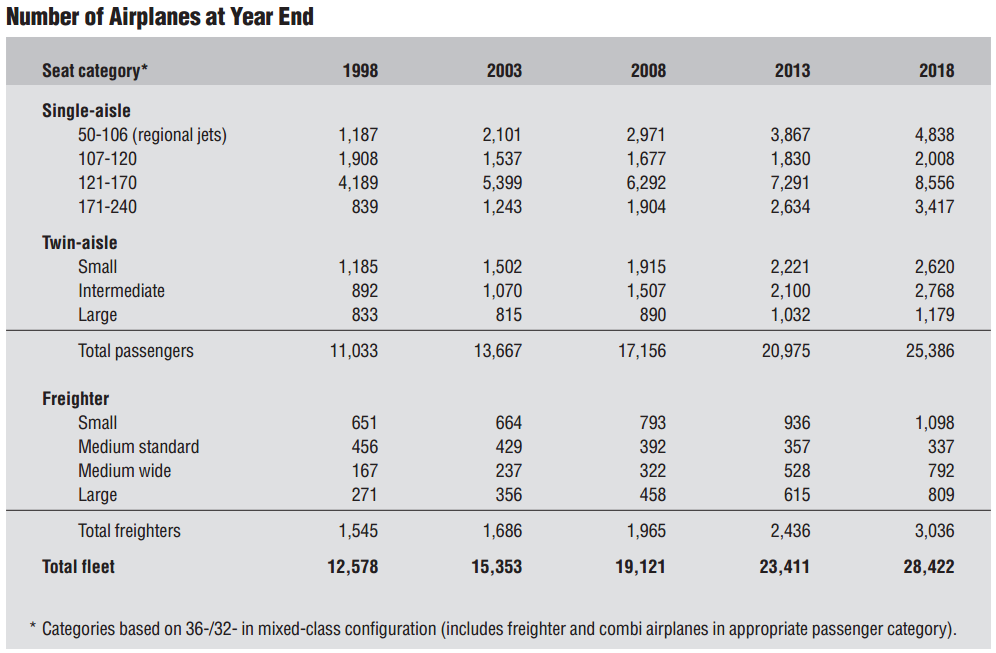
In this post, I just wanted to provide an update with the figures from the latest CMO (2014), released a few weeks ago, in comparison with 1999’s CMO. In that CMO from 1999 [PDF, 1.5MB], we find the following chart showing Boeing’s forecasted fleet size and distribution for 2003, 2008, 2013 and 2018 year-ends.

1999 Boeing CMO year-end fleet forecasts for 2003, 2008, 2013 & 2018.

1999 Boeing CMO year-end fleet forecasts for 2003, 2008, 2013 & 2018.

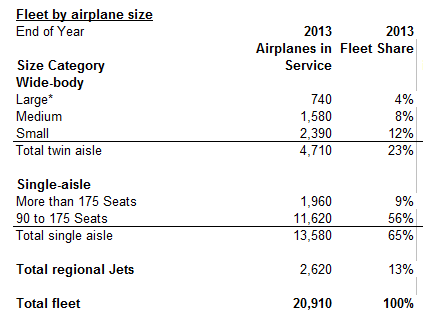
In 2014 CMO, Boeing offered figures of 2013 year-end fleet (1).

Fleet at year end 2013 - Boeing 2014 CMO.

Fleet at year-end 2013 – Boeing 2014 CMO.

And now, the comparison is immediate:

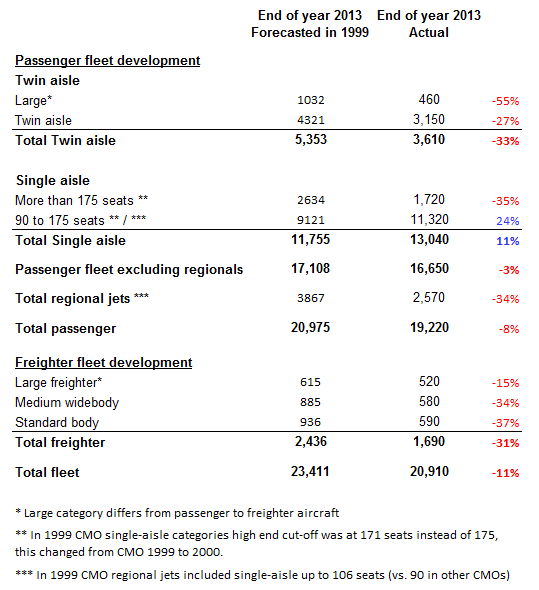
Comparison of aircraft fleet at year-end 2013: 1999 forecast vs. actual (sources: Boeing CMO 1999 and 2014).

Comparison of aircraft fleet at year-end 2013: 1999 forecast vs. actual (sources: Boeing CMO 1999 and 2014).

Some reflections:

  • The forecasts for all segment except for single-aisle (737-800) predicted higher numbers of aircraft in the fleet than the actuals have shown 15 years later (2).
  • The total fleet figure was missed by 11%, a larger deviation than the 1% from two years ago.
  • The 737 has been the model outselling the forecasts, offsetting partially the lower demand in all other segments. In particular, even if deviations per segment have been higher, the global forecasted figure for passenger aircraft has been missed by only 3%.
  • The forecast is especially off mark the twin-aisle, where there are over 1,700 less aircraft in the current fleet than forecasted (3).

For the next such comparison we will need to wait some years, as from the year 2000 Boeing provided CMOs in a different fashion, offering a view of the forecasted fleet only 20 years from the date in question, instead of a view every 5 years. Therefore, we will have to wait until 2017, when we will be able to compare the 20-year forecast from 1997 CMO with the actuals of 2016 to be provided in 2017 CMO.

(1) In order to see the detailed split per segment differentiated between passenger and freighter aircraft, until the released of the full CMO, it is needed to use the exploring data tool offered in Boeing’s site.

(2) The differences in accuracy between the lower and higher end of the small-aisle segment should not be taken into account, as they are influenced by the different consideration of the cut off number of seats between a CMO and the other.

(3) Possibly a reason why Boeing plays down on the 747-8I and A380 segment.

4 Comments

Filed under Aerospace & Defence

“A bird in the hand is worth two in the bush” (speech)

Thanks to the drive of some individuals (Sarah, EduardoDominique) a new Toastmasters corporate club (1) is being created within Airbus in Toulouse, where I work.

I joined Toastmasters in 2007 when I lived in Madrid and I have written often about Toastmasters in this blog, however I had become inactive in the last couple of years. This new initiative is very convenient and thanks to it I am engaging myself again in the association.

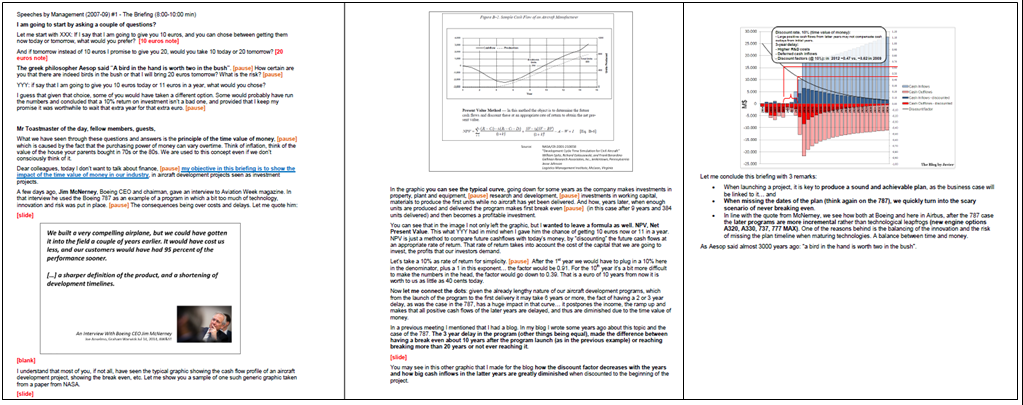
Today, I gave again a prepared speech in Toastmasters (2). In this post I just wanted to share it. Find it here, “A bird in the hand is worth two in the bush”, and below:

A bird in the hand is worth two in the bush

The topic of the speech is known for the reader of this blog: impact of delays in aircraft development projects seen as investment projects, the time value of money, discounting cash flows, break even, etc.

The feedback that I got: It was well received, especially the introduction, the interaction with the audience, the structure and how the topic was introduced and the main points called back in the end. However, I lost some individuals with the last slide, which needed some more explanation. I should have simplified the graphic. Some demanded more pauses and better vocalization.

(1) Up to now it is a prospect Toastmasters club.

(2) Project #1 of the “Speeches by Management” advanced manual: “The briefing”.

1 Comment

Filed under Aerospace & Defence, Investing, Toastmasters

Wide-body mix in 16 years of Boeing CMOs

Last year I wrote a post showing the puzzling change in Boeing’s predicted mix of twin-aisle sales, between small and medium wide-bodies (“Wide-body mix in 15 years of Boeing CMOs”). A few days ago I wrote a post about the publishing by Boeing of its Current Market Outlook for 2014-2033. This year’s CMO is more consistent with last years figures, i.e., the larger share of the forecasted market corresponds to small wide-bodies (787s from Boeing perspective). Recall the numbers:

  • small wide-bodies: 4,270 a/c in CMO2014 (passenger aircraft only),
  • medium wide-bodies: 2,990 a/c in CMO2014.

However, the trend is changed again in this year’s CMO in comparison with last year’s one: small wide-bodies market decreases while the medium wide-bodies’ one increases again. Since I keep a collection of CMOs from years back, I will include again a comparison going 16 years back…

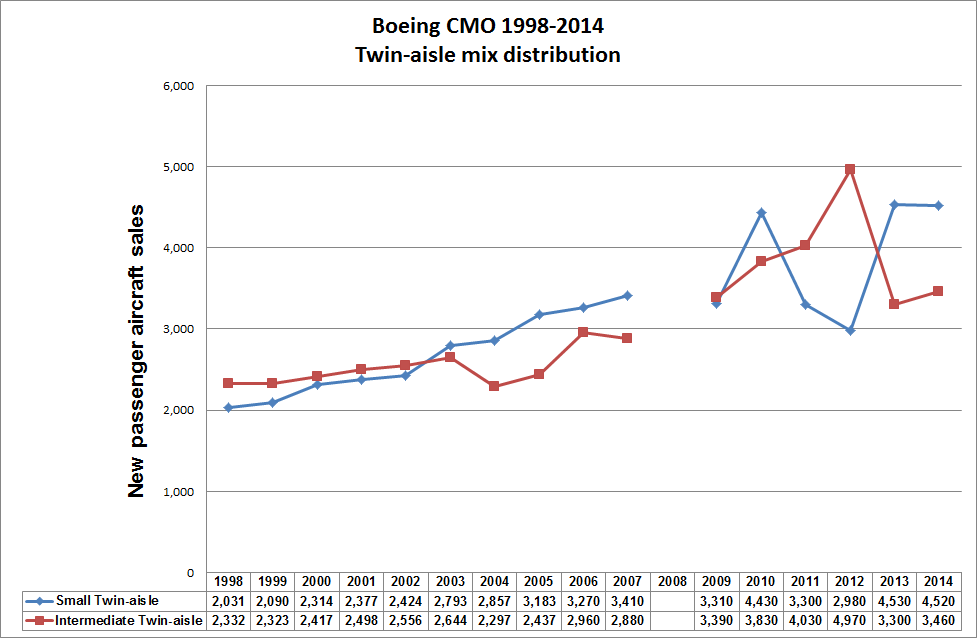
Twin-aisle mix distribution (Boeing CMO 1998-2014).

Twin-aisle mix distribution (Boeing CMO 1998-2014).

Seeing at the graphic (made using Boeing figures):

  • During the first 5 years (1998-2003) the trends are quite constant.,
  • From 2003 to 2007, the mix is reverted, possibly to favour the launch of the 787.
  • In 2008 the CMO did not provide the split.
  • From 2009 to 2014, you can see that both trends in the forecasts are erratic… why? Only Boeing knows.

4 Comments

Filed under Aerospace & Defence

Review of Boeing Current Market Outlook 2014

Just ahead of Farnborough air show, Boeing Commercial has published its yearly update of the Current Market Outlook (CMO) for the next 20 years of commercial aircraft market (2014-2033).

I have just compared the figures for passenger aircraft of the last two years’ CMOs:

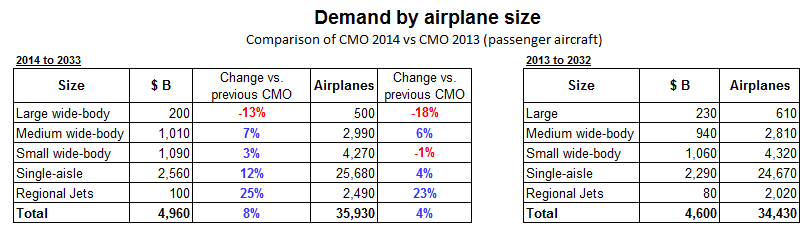
CMO 2014 vs 2013 comparison.

CMO 2014 vs 2013 comparison.

Some comments to it:

  • You can see that the total number of new aircraft delivered has slightly increased from 34,430 to 35,930, a 4%, which is consistent with the constant 5% traffic increase that Boeing predicts (1).
  • The volume (Bn$) increases by a larger percentage, 8% (360Bn$)… this is due mainly to the increase in:
    • single-aisle aircraft expected sales in volume (12%, +270Bn$) and aircraft (+1,010), and
    • medium wide-body segment with 180 more aircraft (+6%) and an increase in volume of 70Bn$ (+7%).
  • Last year I wrote about a sudden change between CMO 2013 and CMO 2012 of the mix in wide-bodies; CMO 2014 is more consistent with last year’s one even if the trend is reverted again.

This year study’s figures seem to push for the 737 and 777, which is backed by the presentation as well. It is curious how 777 market is increased whereas 787 is slightly decreased.

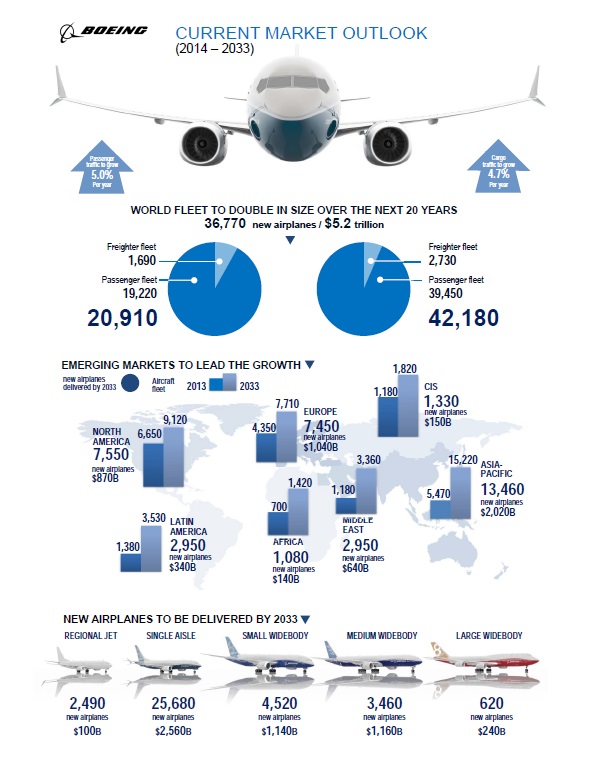
Find below the nice infographic [PDF, 0.1MB] that the guys from Boeing have put up together:

Boeing Commercial Aviation Market Forecast 2013-2032 infographic.

Boeing Commercial Aviation Market Forecast 2013-2032 infographic.

As always, I recommend going through the CMO, as you can learn a lot about the business: from global numbers, to growth, traffic figures, fleet distributions, forecasts, etc… You may find the presentation [PDF, 10.6 MB] and the file [XLS, 0.7 MB] with all the data.

For a comparison between this CMO and the respective Airbus’ GMF we will have to wait until after the summer, when Airbus publishes its update. Until then, find here the comparison based on 2013 market studies.

(1) These two ratios, 4% fleet growth and 5% traffic growth, point to an implicit increase in the average size of the aircraft in fleet.

(2) Find the review I wrote comparing 2013 CMO with 2012 CMO.

5 Comments

Filed under Aerospace & Defence

Sarajevo, Gavrilo Princip and the assassination of Archduke Franz Ferdinand

Yesterday, June 28th, marked 100 years since the assassination of Archduke Franz Ferdinand of Austria and his wife in Sarajevo. The event triggered the start of World War I. On this occasion, I wanted to read the Wikipedia article about the assassination to be refreshed the sequence of events.

The sequence of events and the ambush that was prepared are dramatic. A group of six terrorists waiting in the quay to kill the archduke with guns and bombs. A first bomb being thrown to the car but bouncing off from it to the ground and exploding seconds after under the following car of the convoy injuring about 20 people. After this first attempt the procession sped ahead and the killing was frustrated. However, at the time of returning from the Town Hall and in the way to the hospital which was the purpose of the visit of the archduke to Sarajevo, the events turned even more dramatic…

After learning that the first assassination attempt had been unsuccessful, Princip thought about a position to assassinate the Archduke on his return journey, and decided to move to a position in front of a nearby food shop (Schiller’s delicatessen), near the Latin Bridge. At this point the Archdukes’ motorcade turned off the Appel Quay, mistakenly following the original route which would have taken them to the National Museum. Governor Potiorek, who was sharing the second vehicle with the Imperial couple, called out to the driver to reverse and take the Quay to the hospital. Driver Lojka stopped the car close to where Princip was standing, prior to backing up. The latter stepped forward and fired two shots from a distance of about one and a half metres (5 feet) using a Belgian-made 9×17mm (.380 ACPFabrique Nationale model 1910 semi-automatic pistol

Gavrilo Princip was the Bosnian Serb who fired the gun in this conspiracy. He was sentenced to 20 years imprisonment together with many other conspirators, some of which were sentenced to death. The house where Princip lived could be visited as part of a museum for some time but in the subsequent war was destroyed. The ground from which Princip fired had some steps as memory, but they were also destroyed in the 90s. Today, there is only a plaque in the wall in the place from which Princip shot the archduke death. We visited the place back in the summer of 2007. I wanted to share 2 pictures from those iconic places.

Plaque at the point from which Gavilo Princip shot Franz Ferdinand.

Plaque at the point from which Gavrilo Princip shot Franz Ferdinand.

Latin Bridge.

Latin Bridge.

Sarajevo is a wonderful city despite of having been devastated by so many wars. However, at the time we visited the place, there was not much to see in relation to this historic event. Nevertheless, in different museums the different pieces of the story can be seen: the car and the gun can in Vienna, the bullet, in Czech Republic.

Leave a comment

Filed under Travelling

Musée de l’Aéronautique of Luchon

On July 19th of 1945, the British bomber Halifax Mk III Mz 981, from the 644th squadron of the Royal Air Force’s 38th transport command departed from Christchurch, in the South of England’s coast on a training mission that would take it all the way to the Cape d’Adge in the Mediterranean French coast.

Route followed by Halifax III MZ 981.

Route followed by Halifax III MZ 981.

On the way back, the aircraft would return to England crossing the South of France till the Atlantic ocean by way of Toulouse. With the fall of the night the pilot took a wrong heading (1) towards the Pyrenees, crashing against the Pic Lampau (2,543m).

About 50 years later, in the eighties, Léon Elissalde, an important figure of Luchon at the time, knowing about the crash of the Halifax III during WWII set out to look for lost parts of the aircraft. He found some of the engines, propellers, crankshafts, etc.

He knew about other crashes in the Pyrenees during WWII as well. A British Halifax II which crashed against the Pic Douluy when coming on a mission all the way from Algeria (see a description of that mission here, in French) and two German Dornier 217 equipped with BMW engines which allegedly were on the look out for the area where maquis were hidden in the mountains.

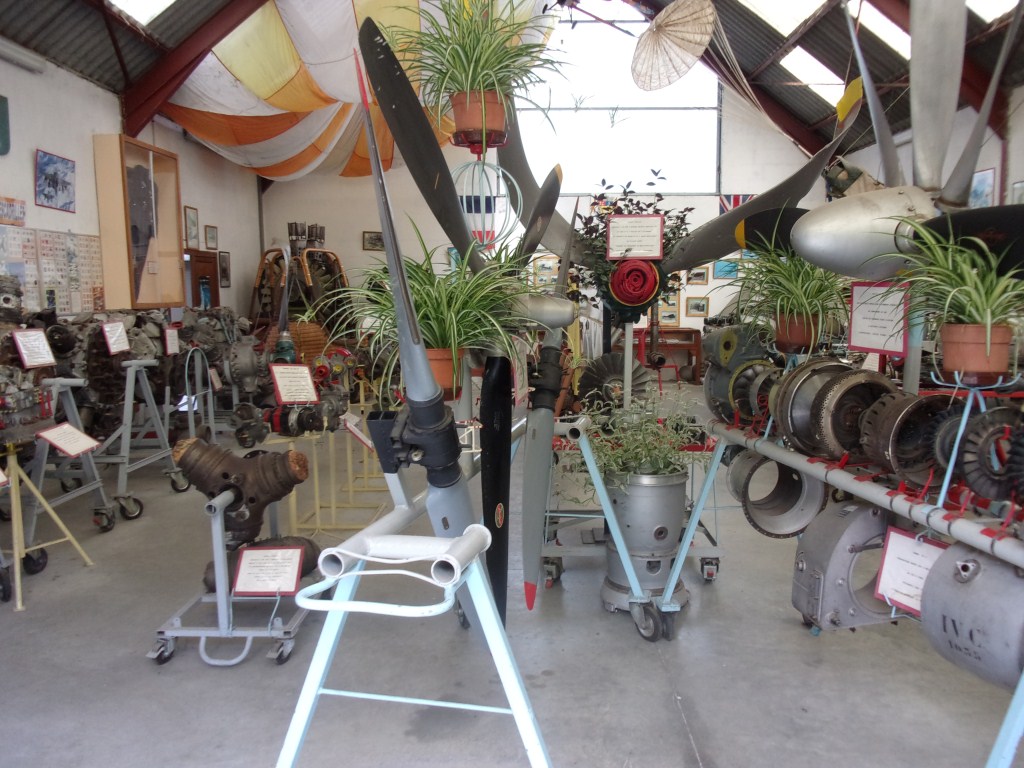
Elissalde, with all those parts created the Musée de l’Aéronautique of Luchon, located in a small hangar of village’s aerodrome.

Museum interior.

Musée de l’Aéronautique of Luchon.

We visited the museum last weekend. We counted with the guidance of a retired technician of the Armée de l’Air (French Air Force), who described the details of each of the engines, aircraft in which they were mounted and the mission the flew when they crashed. The visit lasted about an hour.

Breguet 941S preserved at Musée de l’Air et de l’Espace, image by PpPachy.

The museum includes some other engines, such as the turbojet Hispano Suiza Nene, which equipped the French Mistral, or the turboshaft Turmo III D3, which equipped the aircraft Breguet 941. The 941 was a short take-off and landing (STOL) aircraft with blown wings designed in the 1950s and which flew for the 1st time in 1961. One curiosity of this aircraft is that using 4 turboshaft engines (designed to power helicopters, not planes), all 4 engines’ turbines did not directly turn the propellers but rather powered a common shaft that ran along the leading edge of the wing powering the 4 propellers. A Breguet 941 is displayed at the Musée de l’Air et de l’Espace at Le Bourget, Paris.

Luchon is a nice village located at the heart of the Pyrenees, close to Super Bagneres skiing station, to some of the summits cycled in the Tour de France and has a great spa with water from natural sources. It is a great destination where to spend a few days. One hour of those days is well employed visiting the aviation museum.

This slideshow requires JavaScript.

(1) My flight instructor uses to say “Dans l’air, le cap est la vie” (“in the air, the heading is the life”).

1 Comment

Filed under Aerospace & Defence, France

Bill and Melinda Gates 2014 Stanford commencement speech

Steve Jobs’ Stanford’s 2005 commencement speech in which he talked how he pursued different things that interested him at a young age and later on these things enabled him achieve successful endeavours (connecting the dots). In that same speech he invited graduates to live their life not somebody else’s as the time we all have is limited.

Yesterday, Bill and Melinda Gates gave the 123rd Stanford commencement speech for the class of 2014 [~25′ from 1h04′].

Gates fortune and world fame is due to his founding of Microsoft and its subsequent success. Nevertheless, both Bill and Melinda were introduced to the audience and spoke mainly in relation to their experience as philanthropists.

My main takeaways from the speech:

  • What they appreciate most of Stanford: ingenuity, innovation, etc., but above all optimism.
  • Their quest to understanding what keeps people poor and how innovation could still solve most of the toughest problems.
  • The experiences they shared of meeting the poor and sick in Soweto (South Africa) and India.
  • “If you want to do the most, you have to see the worst”, Melinda Gates.
  • The great stigma suffered by disfavored women.
  • “We can help people if don’t lose hope… and if we don’t look away”, Melinda Gates.
  • The need for empathy to channel our optimism and innovation to solve the problems that affect millions of people.
  • The reference to luck as a main ingredient of the success we may have in life. Luck partly understood as what Warren Buffett refers to as the “ovarian lottery”. Acknowledging that we have been this lucky, the next step is to have empathy for those who were not as lucky. “That could be me”.

***

Last year, during our trip to the US West coast we spent a morning visiting Stanford University. Few months before I had completed 3 online courses from Stanford’s VentureLab platform and I wanted to visit the place.

I was very satisfied with what we saw during our visit: a campus in which any student would have loved to study. Plenty of parks, gardens, bikes, benches. Buildings, classes and labs open for anyone to come and see. Fully equipped classes with reduced groups of students. Open cafeterias with informal places to work. A huge library with study rooms and the flavour of an old place. An impressive book shop where we surely purchased some books… No need to enter into the excellence of the faculty, measured by Stanford in the number of Nobel prizes, Pulitzer prizes, National Medal of Sciences recipients, etc.

No wonder why the Gates proffer that admiration to Stanford and no wonder why students from it have that optimism.

This slideshow requires JavaScript.

Leave a comment

Filed under Education, Twitter & Media

Forecasting 2014 FIFA World Cup Brazil

I have a work colleague who not only is a tremendous negotiator and contracts’ drafter but also has a great sense of humor and manages in his free time late in the night to set up a contest for office staff to try to guess winners, matches’ scores, top scorers, etc., of major international soccer competitions. The 2014 FIFA World Cup in Brazil, which will start tomorrow, could not be missed. Nacho managed to set up the contest in time.

To set up the background as to how I have approached the game of forecasting this World Cup:

  • I had written a review of the book “Soccernomics“, which among other things advocates the use of data in order to make decisions in relation to football transfer market, forecasting, etc. This book relies somewhat heavily in “Moneyball” another book which I read some months ago with a similar scope but with baseball as the theme sport.
  • When the draw of the World Cup took place last December, I wrote a couple of blog posts discussing what was the so-called “group of death” basing the analysis on FIFA and ESPN rankings.
  • During the last year, I read a couple of books which approach how we make decisions and how to remove different kind of biases from the thought processes of making them: “Thinking Fast and Slow” (by the 2002 winner of the Nobel Prize in Economics Daniel Kahneman) and “Seeking Wisdom“.
  • Finally, last year I followed the open course “A Beginner’s Guide to Irrational Behavior” by Dan Ariely (though I missed the last exam due to my honeymoon and could not get credit for it).

Having shared this background, you may understand that I tried to remove all the beauty of guessing and my football “knowledge” to the forecasting process. I rather made use of  ESPN Soccer Power Index (SPI) ranking, introduced by the economist Nate Silver. I used its offensive and defensive scores plus the tip indicating that in competitive matches the defensive factor tends to be slightly more important (see “A Guide to ESPN’s SPI rankings”).

Once I plugged in the numbers from the index and used the referred tip on the defensive side, I built a simple model to guess each of the World Cup matches. Once you take this approach you will find that the model gives you plenty of results such as Nigeria 1.32 – 1.53 Bosnia… What to do with it? When the result was very tight I resolved it as a draw, otherwise a victory for the team with the highest score.

In very few instances I forecast that a team would score 3 or more goals in a match. I bore in mind that in the 2010 World Cup 80% of the matches ended up with scores of 1-0 (26% of the matches), 2-1 (15%), 0-0, 1-1 or 2-0 (each 13%).  That a team scores more than 3 goals in a match will certainly happen in some games, but I did not bother to guess in which ones, the odds are against.

The prize pot of the game organized by this colleague is not particularly big (few hundreds euros). The main point of the game is enjoying the chit-chat with work colleagues. My second main point is putting this rational approach to work and see how it fares.

Finally, what did I forecast?

A World Cup won by Brazil against Argentina in the final. With Spain beating Germany for the third place (in the penalties). For my English readers: England defeated by Colombia in the 1/8 of final. For the ones from USA, it doesn’t make the cut from the group phase. We will see along this month how well do I fare.

2014 FIFA World Cup Brazil forecast.

2014 FIFA World Cup Brazil forecast.

1 Comment

Filed under Sports