Derechos de TV: el Real Madrid subvenciona al Sevilla con 20 millones de euros

Ayer viendo por televisión, desde Francia, el partido de fútbol Valencia – Real Madrid recibí un mensaje de un amigo que me decía que él lo estaba viendo desde Costa Rica. Al rato otra amiga nos confirmaba que ellos lo estaban viendo desde Ecuador.

Esto viene a cuento de los muchos comentarios irónicos que he escrito en Twitter o Facebook al respecto de que Real Madrid y Barcelona reciban ingresos por derechos de televisión mayores que otros equipos, como por ejemplo el Sevilla. Y digo el Sevilla, por las declaraciones de su presidente Del Nido en varias ocasiones acerca de si el resto de equipos deberían percibir una mayor parte de la “tarta” y sus iniciativas al respecto.

A partir de datos publicados por El Mundo, he realizado la tabla de debajo con el reparto de derechos televisivos de la temporada 2010/2011:
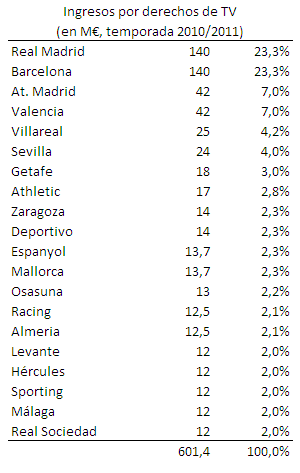
Reparto de derechos de TV 2010-2011: elaboración propia, fuente El Mundo.

El hecho de que Real Madrid y Barcelona reciban 140M€, o un 23,3% del total cada uno, hace que varios equipos se alcen y digan que el reparto es injusto. Se citan ejemplos como el reparto en otras ligas donde las diferencias entre los que más cobran y los que menos son menores, como si ese reparto fuese más justo. El reparto se podría hacer de muchas maneras y ello no tiene porque ser más justo. Hay gente que defiende que los derechos se deberían repartir a partes iguales, cada equipo recibiría ~30M€.

Mi opinión: el hecho de que el Sevilla u otros equipos reciban 24M€ significa que el Real Madrid y el Barcelona subvencionan año tras año al Sevilla y a otros equipos con hasta 20 millones de euros.

Los datos de los “pinchazos” del pay per view, hasta el 90% de los mismos se debían a Madrid y Barcelona.

Mi experiencia actual: en el Canal + francés televisan todos los partidos de Barcelona y Real Madrid (como del Manchester, Chelsea, Liverpool, Inter de Milán, Milán, etc.). Por ejemplo, del Sevilla televisan 4 partidos seguros: sus cuatro enfrentamientos contra Real Madrid y Barcelona. Cuando ni en Inglaterra, ni Italia, ni Francia, ni Alemania televisan ningún partido de equipos con tirón, la televisión se desmarca televisando algún partido sin interés que puede ser de cualquiera de esas ligas (podría ser un Sevilla-Valencia). Es por ello que para los siguientes cálculos, asumiré que a algunos equipos españoles no les televisan solo 4 partidos sino 5 en Francia.

Parrilla de TV de + Sport, de Canal + France, sábado 19 noviembre 2011.

Si el reparto del dinero se hiciese por el número de partidos que se televisan (contando ya los derechos de TV que se venden internacionalmente), me sale el siguiente ejemplo de reparto, donde Madrid y Barcelona cobran un poco más y el resto algo menos o algo más. Yo entiendo que esto sería un poco más justo, palabra que tanto gusta a usar a los que defienden otros repartos.
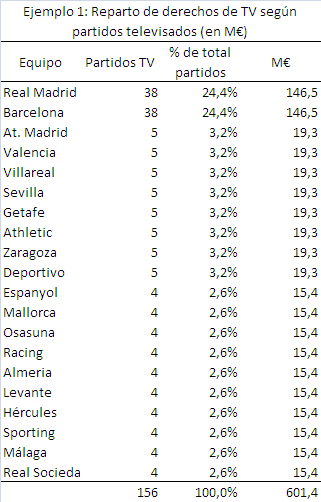
Ejemplo de reparto: según el número de partidos televisados internacionalmente.

Sin embargo, es llamativo que del Sevilla prácticamente solo sus partidos contra Madrid y Barcelona despierten interés internacionalmente. Y por tanto, solo por esos partidos Canal + Francia esté dispuesta a pagar dinero (o Pekín TV por televisar un partido a las 12:00…). Eso me lleva a pensar que hay que introducir otro factor que valore que en un Barcelona-Sevilla, quien trae dinero a la tarta es el Barcelona y no el Sevilla, luego la forma de contar ese partido de cara al reparto debería tener en cuenta que lo que la gente quería ver es al Barcelona indistintamente de si jugase contra Sevilla, Almería, L’Hospitalet, Esperance de Túnez o Al Sadd de Qatar. La gente paga por ver al Barcelona.

¿Cómo se podría medir ese factor que tenga cuenta el interés? Viendo la proporción de partidos que se le televisa frente a los que juega de nuevo. Sí al Barcelona le televisan el 100% de sus partidos y al Sevilla el 13%, en un Barcelona – Sevilla el dinero de los derechos de TV debería corresponder en esa proporción, en torno al 90% para el Barcelona y 10% al Sevilla. Dado que para la televisión el Sevilla es como un sparring, da igual quien esté enfrente del Barcelona.

En boxeo la bolsa de dinero por un combate se negocia según el interés que despierta cada boxeador. Si mañana yo luchase contra Mike Tyson, y el combate generase 1 millón de euros (y combates de Tyson han generado más de 100m$ en pay per view), todos entenderíais que es absurdo que yo exigiese 500.000 euros por el mismo, cuando es Tyson quien consigue que alguien pague por ese evento. Si Tyson además de knockearme me diese 100.000€ yo me debería sentir agradecido.

Ejemplo de reparto: según el número de partidos televisados e interés respectivo de cada equipo.

Con esta nueva forma de reparto, como se ve en la tabla con el segundo ejemplo de reparto arriba, Real Madrid y Barcelona recibirían bastante más de lo que reciben hoy y el Sevilla unos 20M€ menos de lo que recibe ahora. Por eso, sostengo que Real Madrid y Barcelona subvencionan al Sevilla con 20 millones de euros y a otros tantos equipos con diversas cantidades.

Alguien dirá: “pues que se vayan a jugar con otros equipos y dejen la liga al resto”. Esto Florentino Pérez lo comenzó a investigar con la creación del G-14 y solo consiguió ganarse enemistades en la Federación Española de fútbol y en la UEFA.

De todos modos, si sucediese que Real Madrid y Barcelona dejasen de jugar la Liga para jugar una liga europea con grandes equipos, no es que el Sevilla fuese a quedarse con una parte mayor del pastel o que el fútbol español fuese a ganar en interés porque no sería cosa de dos. No. Lo que probablemente sucedería es que las televisiones de todo el mundo posiblemente no pagarían más de 66M€ (la suma del resultado para los 18 equipos en el segundo ejemplo de reparto) por los derechos de TV a la Liga frente a los 600M€ que se pagan ahora, y esos 66 millones son 5 veces menos de los 321M€ que reciben los otros 18 equipos de primera. Esa medida haría que la práctica totalidad de equipos, sin la subvención actual del Real Madrid y Barcelona, estuviesen arruinados y en bancarrota antes de la segunda temporada.
5 Comments

Filed under Sports

German Debt

Yesterday, Spain issued debt at the highest yield in the last 14 years. One of the words most listened in the news lately is “spread”.

I recalled some words from my brother, months ago, pointing that absolute value of yields hadn’t changed that much as even though the spread was increasing German bonds’ yields were declining.

I wondered, how much are they declining?

Germany’s GDP is around 3,600 bn€. Its state debt is reportedly about 83.2% of its GDP, around 3,000bn€.

I checked German bond numbers in the German Finance Agency [PDF]. In the latest factsheet from end September, you may see the different auctions of different bonds and bills planned for the year and the volume of each one. You may get as well a glimpse of the debt structure. The factsheet shows how much of its 1,101bn€ in outstanding government securities are auctioned during 2011 in 1-year bills and how much in 10-year bonds (of the 1,101bn€, 275bn€ will be issued during 2011). Using that structure and the respective maturities, the composition for the whole outstanding securities can be estimated.

Note: When bonds are auctioned the coupon (interest) to be paid on them is fixed by the state, e.g., the 10-year notes have a coupon or interest paid on its face value of 2.25%. It is the yield what is variable because buyers will pay more or less for the bonds’ face value.

What are then German bond yields and latest prices paid for them? This information can be found at Bloomberg or at the Bundesbank (for a higher detail and historical yields). You may see there that 10-year bonds currently (as of yesterday) had yield of 1.78% and latest price was 104.19 euro cents, paid for a euro of face value (remember that the coupon is 2.25%, as it is stated in the German Finance Agency factsheet).

With all the previous inputs the next question is clear: How is the debt crisis affecting Germany? The fact that investors are running away from the debt of other countries (at the same time that they demand lower prices and thus increase yield of Spanish bonds) they see German bonds as a refuge: they are willing to pay more than 100 cents for a face value of one euro, making debt cheaper for Germany.

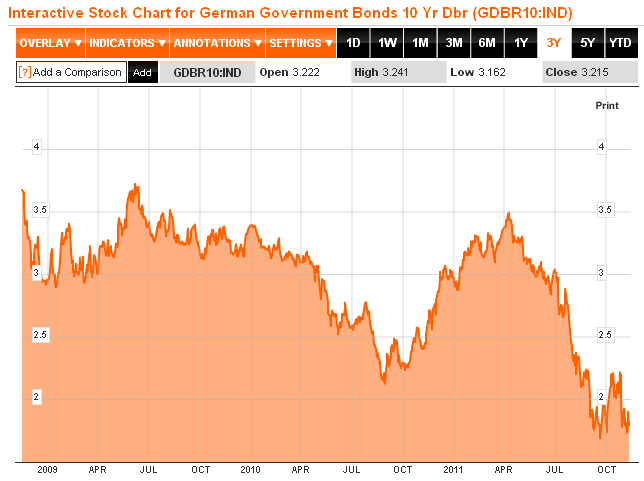
In the graphic below we can see the evolution of the 10-year bond during the last two years. It has had around 3% of average yield during that time (versus current yield of 1.78%). We can get an idea of how much Germany is saving during these troubled times.

German 10-year bonds evolution.

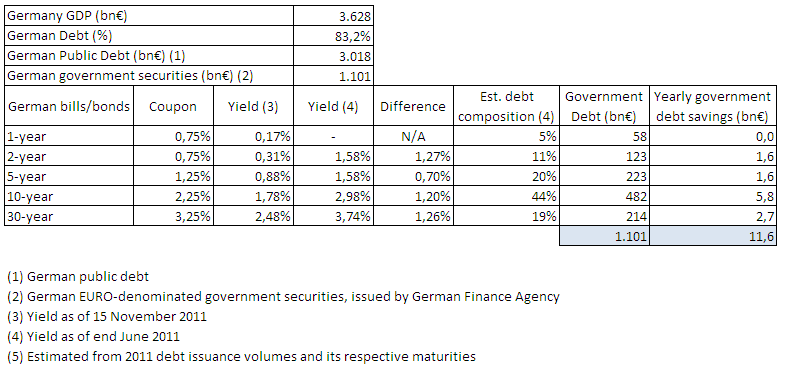
Let’s calculate those savings. You may see in the table below, that given the estimated structure of the German debt (based on this years’ proportion of auctions by the Finance Agency), the coupons paid for each kind of bond on their face value, the prices and yields, from end June and November, Germany has achieved what would be yearly savings of about 12 bn€.

German debt: securities structure, coupons, yields, savings from end June to November (data as of Nov. 15, 2011).

These yearly 12bn€ would be saved just by the government securities (1,101bn€ outstanding), not public debt from other German institutions (~3,000bn€ in total), and only if yields continued to stay at current levels during the next issuances of debt.

As a final note: the German contribution to the European Financial Stability Facility [PDF] (EFSF) is 211bn€. Wild guess:  How much of that contribution could be paid with the German debt savings if its yields stayed this low?

Leave a comment

Filed under Economy

Impuestos en Francia vs. España

Debido a la subida de impuestos aprobada por el gobierno a finales de 2011, la tabla de este post ha quedado desactualizada. En esta otra entrada (hacer click en el enlace) se encuentra la comparación con las nuevas tablas.

***

Desde que vine a Francia, varias veces me han hecho preguntas acerca de los impuestos. La última hace unos pocos días. Dado que hice la búsqueda recientemente para responder, en esta entrada simplemente voy a dejar una tabla comparativa a la que poder referirme en el futuro.

Tabla comparando tramos del impuesto sobre la renta en Francia y España (ref. 2011, ingresos de 2010)

Aclaración básica: la forma en que se interpretan los tramos es la siguiente. Por ejemplo, para un salario bruto de 35.000€, los primeros 5.983€ están exentos de retención (5.050€ en el caso de España), los siguientes 5.933€ (diferencia entre 11.896€ y 5.963€, en el caso francés) tienen una retención del 5,5%, los siguientes 14.524€ (diferencia entre 26.420€ y 11.896€, en el caso francés) tienen una retención del 14%, y así hasta llegar a los 35.000€.

En resumen, para un salario bruto de 35.000€, en Francia se pagarían 4.934€ (un 14,1%) y en España, 8.131€ (un 23,3%). En Francia se pagarían por tanto 3.198€ menos en impuestos sobre la renta.

Como veis, en Francia el impuesto sobre la renta (“IRPF”) es menor en cada tramo. La contribución que hacen los trabajadores a la Seguridad Social es sin embargo mayor (otro día pondré esa comparación), con lo que al final las cantidades son similares.

20 Comments

Filed under Economy, France

Flight lessons

About a month ago I started taking flight lessons at the ACAT aéro club, based in Lasbordes, a small aerodrome to the East of Toulouse.

I subscribed together with another Airbus colleague and both encouraged by a third colleague who had started some months beforehand.

Yesterday in the morning, the weather was not very good so we were not sure whether we would finally fly or not. Nevertheless, we had a theoretical lesson at first hour in the morning so we went to the aero club. At the break of the class, our instructor arrived and confirmed our flight. We took our stuff and skipped the second part of the class and headed towards the Robin DR-42 (F-GNNI) we flew.

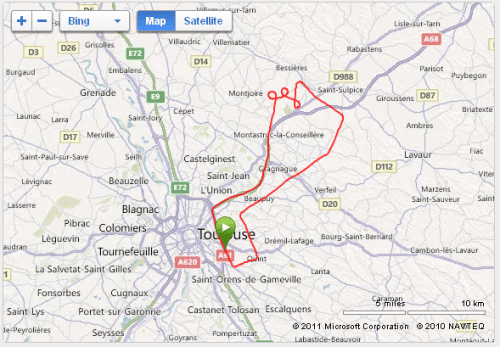
For this second flight I decided to bring my Garmin GPS, which normally I use for sport activities, in order to record our flight, so that my colleague and I could better know where we had been flying. This will hopefully help us in getting to know better the Toulouse area from the air and with the navigation in the near future.

The flight was short and simple: practising pitching up/down, some steady turns and approach.

If you click on the map below you will be redirected to the Garmin website where you can read further information about the flight (time of the activity between switching on and off the engine) such as take-off, cruise and landing speeds. Do not pay attention to altitude figures, those reflected by Garmin are the ones of the terrain below (our track footprint).

Route of our flight: LFCL-LFCL

Some more pictures taken in yesterday’s class:

This slideshow requires JavaScript.

Clarification: as we fly two pupils plus the instructor, each time we perform 2 flights, that is why I was siting at the back when I took pictures during flight.

4 Comments

Filed under Aerospace & Defence, Education, France

El Cosmonauta

Hace algo más de un año acudí con un amigo a la conferencia TEDxMadrid. Allí fue donde por primera vez escuché hablar de la película “El Cosmonauta”, por voz de su director, Nicolás Alcalá.

Desde entonces he escuchado y leído varias veces hablar sobre la película. Lo novedoso de la misma radica en su planteamiento como proyecto de crowdfunding. No me quiero extender sobre ello, ya que se ha escrito mucho sobre el asunto y podéis encontrar mejores explicaciones (por ejemplo aquí – PDF). En definitiva, como las palabras indican en inglés, el crowdfunding se trata de financiarse a través de muchos pequeños inversores que realizan pequeñas aportaciones y reciben contrapartidas en proporción a su inversión.

En aquel primer momento no invertí ninguna cantidad. Sin embargo, ya hace algo más de un año escribí en este blog también acerca de este proyecto, del crowdfunding y de otras iniciativas que había encontrado en internet (Kickstarter y GrowVC).

Desde hace meses le tenía perdida la pista al proyecto, pero ayer, por casualidad, vi un tweet donde se enlazaba el tráiler de la película.

No sé qué os parece a vosotros, pero a mí me causó una muy buena impresión. Volví a leer en su web acerca de la situación actual del proyecto, de la financiación que les queda por conseguir y de las formas que había de colaborar.

Esta vez no tuve que pensármelo mucho: me hice inversor y productor de la película aportando 132€.

De esta forma colaboro con una nueva forma de hacer cine, me inicio en el crowdfunding (aunque la experiencia de Kiva también es crowdfunding, aunque sin ánimo de lucro), me mantengo al corriente de una forma más directa con el proyecto, me acerco a un sueño de la infancia y cumplo uno de mis numerosos objetivos anuales (invertir en algún proyecto de crowdfunding – esta vez también con ánimo de lucro).

¿Os animáis a colaborar?

2 Comments

Filed under Investing, Movies, Twitter & Media

What actually happens when there is a default?

A couple of friends of mine used to point to me some months ago, jokingly or seriously, who knows,  whether it was a good time to buy Greek bonds due to the hight yield they had.

My response was always the same, I prefer not to meddle with state bonds, a lesson learnt from various sources and which I wrote about some weeks ago (“Inflation and assets” and “Hyperinflation and defaults in Europe”).

I guess that with all the recent turmoil in the markets and the news, one would feel less appetite for such bonds, but I still had a question: What actually happens when there is a debt default? Is the state not giving you a monthly coupon but re-starts paying the next month? Is the payment along a year postponed and re-started the coming year? Is the principal recovered?

Last week, while flying to Amsterdam I read an insightful article from The Economist about last Argentina’s debt default. The article is an eye-opener. It gives detailed account of the different difficulties and steps that creditors are going through to recover part of their money.

But as a point of reference, take the following passage:

“Argentina’s default, after a severe economic crisis, sparked social unrest and runs on banks. It subsequently presented creditors with a take-it-or-leave-it offer of 35 cents on the dollar. They considered this derisory: previously, delinquent countries had typically paid 50-60 cents. But the government stood firm and roughly three-quarters of the bondholders took part in a debt exchange in 2005. More joined in 2010, bringing the total to 93%.”

Then, what typically happens is that monthly coupon payments are stopped and creditors are presented with a take-it-or-leave-it offer of paying them back about 50-60% of what they had invested…

The 7% who didn’t join that deal are still going through legal battles. For you and I, that most probably are not going to enter into any legal dispute with a country, we are much better off far away from state debt bonds.

Leave a comment

Filed under Economy, Investing

787 Break Even for Dummies

My previous two posts on Boeing 787 break even (original and further discussion) were generally well received, as far as the insight they provided on the matter and the way they treated the different variables at play.

From the feedback, I understand they were quite dense regarding the amount of information they conveyed and not so easy to grasp for the general public.

In this post I will try to apply the old adage “A picture is worth a thousand words” and show everything which was mentioned in the previous posts in just four graphics.

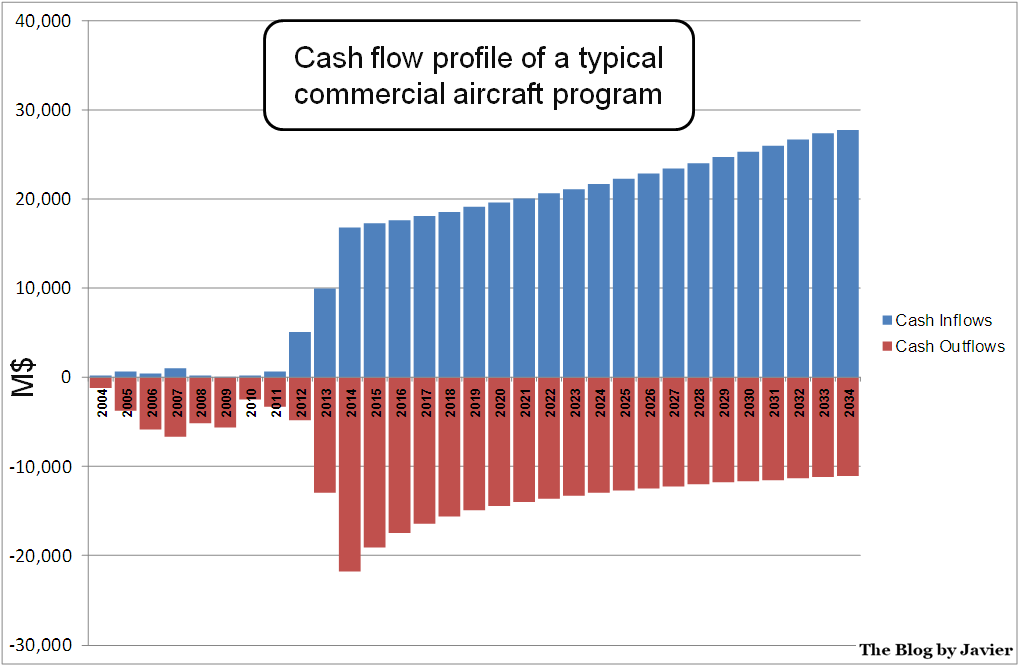
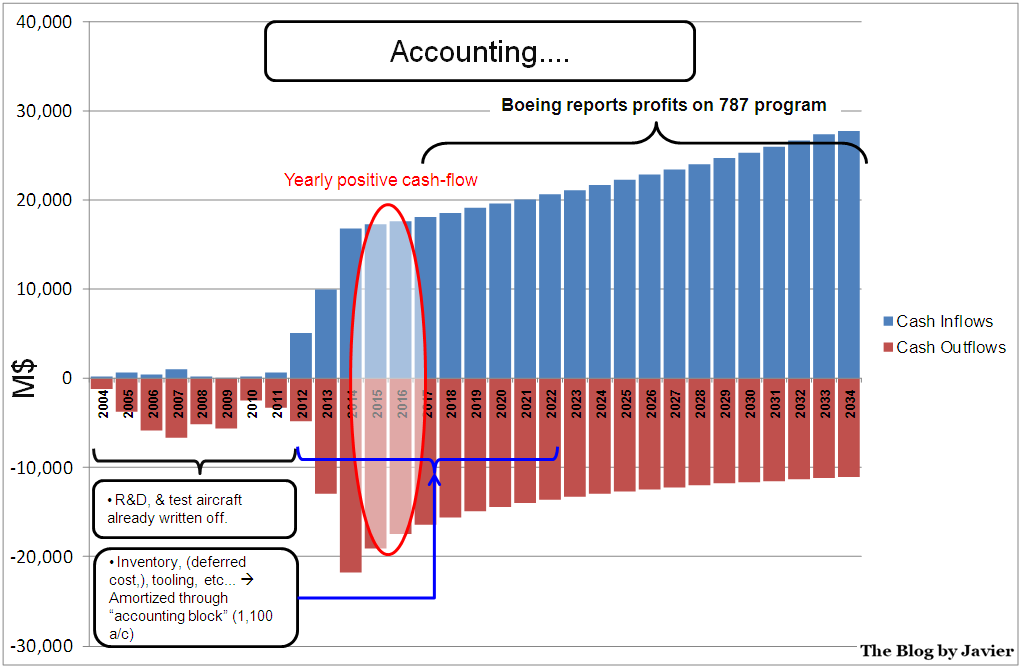
Forget the 787. Any new commercial aircraft program shows a similar cash flow profile, with initial cash outlays to cover the long the development period, a ramp-up of production and a learning curve effect once the series production advances.

Cash flow profile of a typical commercial aircraft program.

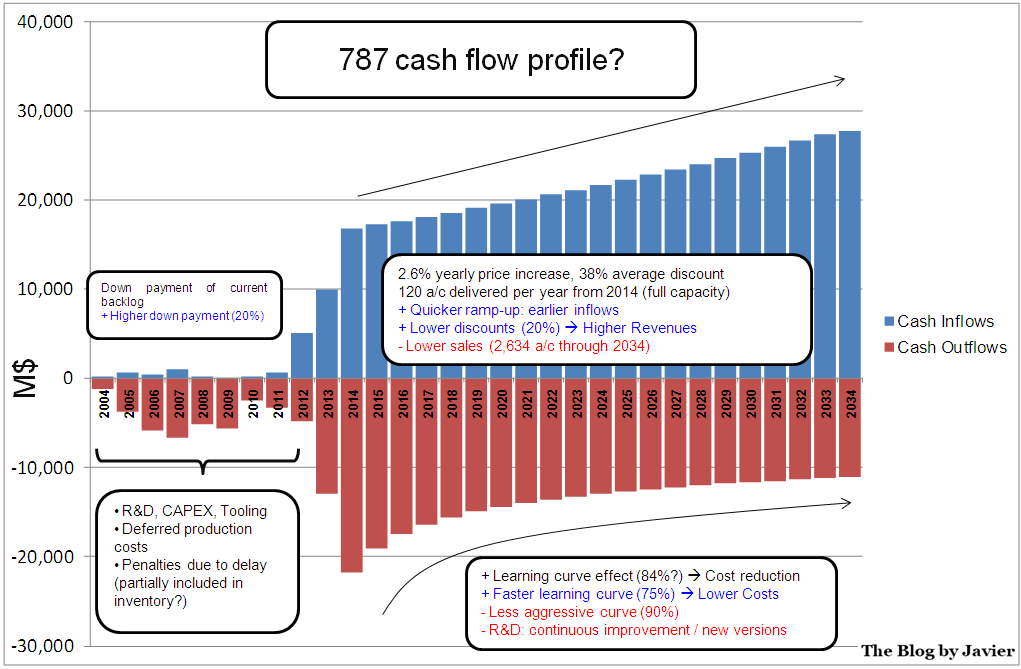
Take the case of the 787. The discussions made in the previous posts and the influence of the different variables are summarized in the different boxes of the next graphic.

787 cash flow profile?

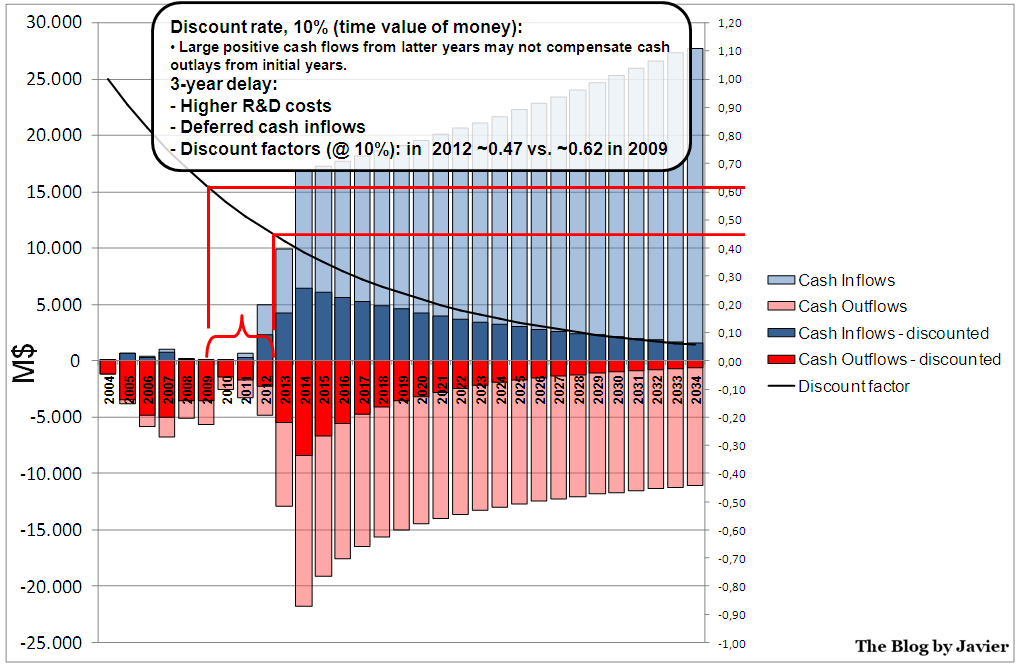
What is critical in a commercial aerospace program as an investment project? The long development period makes it difficult for the positive cash flows at the second half of the life cycle of the aircraft to compensate the initial cash outlays spent in R&D, capital investment and production of the first units. Why is that difficult? Due to the time value of money: A positive dollar of the tenth year will only compensate 39 cents of the first year (at a discount rate of 10%)…

787 cash flow profile affected by the time value of money.

Let’s get back to the “accounting block”, what was going to happen around 2015, and whether the 787 would make profits for Boeing. In the yearly accounting, revenues are not discounted, thus the above discussion doesn’t apply. As soon as production costs plus amortization of initial investments are balanced by revenues, the 787 will make a profit for Boeing.

787 accounting block, profits...

After having shared all these plays with numbers and hopefully having shed some light over the issue, it is important to remind that these are just models and that what will finally happen will only depend on Boeing’s engineers, shop floor workers and sales teams.

“Not everything that counts can be counted, and not everything that can be counted counts.”

(Sign hanging in Einstein’s office at Princeton)

25 Comments

Filed under Aerospace & Defence

With the Market’s swings, you lose

Stock markets have been very volatile recently. Mr. Market’s got a very fragile mood. One day is up, the next is down.

In this post, I just wanted to make an obvious remark for most of you but a small insight for those who are not very acquainted with numbers.

Whenever the market moves up and down in consecutive moves of the same percentage, no matter which move comes first, you lose.

Imagine you have 100$ in the stock market. One day your stock moves up 2%, so you end having 102$. If the following day your stock goes down again by the same 2%, you’ll end up with 99.96$. Less than what you had before day one.

Then take the reverse case. If your stock went down 2% in the first place, you’d have 98$. If the following day it went up again 2%, you’d end up with the same 99.96$ (nothing more than the commutative property of the product).

Anyway, with those consecutive moves you would end losing some cash. You may believe that 4 cents are not worth the comment.

Think then about your savings (e.g. 10,000$) and about possible yearly performances (e.g. +/- 20%)… now you will see that at the end of the second year instead of 10,000$, you would have 9,600$, down 4% from the beginning (about -2% per year).

I just wanted to leave this small note here in the blog, obvious for some and not so for others, as I will come to it at a later point in time.

1 Comment

Filed under Investing

More on Boeing 787 break even

After the post I wrote the last week with an analysis of when could Boeing 787 break even (Will Boeing 787 ever break even?), I received some feedback in the form of emails, comments in the blog and comments in Scott Hamilton’s blog (Leehamnews) as he mentioned the analysis and linked to it.

I wanted to address some of those comments in a single piece for the benefit of all. Please, find them below.

A leading aviation analyst hinted that:

“In the case of the 787, it increasingly looks like the -8 will be an up-front version with poor pricing, but the -9 (and -10) are planned to make this problem better. […] So, your assumption of a consistent 38% discount  won’t happen, unless either Boeing fails to improve the 787’s performance or if the market doesn’t like the 787.”

This could be built into the model by allowing aircraft sold after the current backlog appear in the model as sold at a lower discount (e.g. 20% instead of 38%). The cash inflows due to the down payments would be increased soon, but since producing the existing backlog will take until sometime in 2019, the cash inflows from deliveries will be untouched until then. Result: that would bring break even about 2 years forward (2021 vs. 2023, in the case of 75% learning curve and 10% discount rate – what I would call “Boeing’s baseline”).

Another leading analyst suggested:

“I think the 5,000 market forecast is for the middle twin-aisle market as a whole, which includes A330, A350 and 777 (and even the almost-but-not-quite-dead 767). If I’m correct, I disagree with your figure above as too high. Clarification of the 5,000 is required for everybody.”

I reviewed Boeing’s commercial market outlook. In the next 20 years (2011-2030) Boeing sees deliveries of 6,610 twin-aisle passenger aircraft: 3,020 small and 3,590 intermediate.

In the previous post I mentioned that 2,634 were included as 787 deliveries, though that includes deliveries from 2031 to 2034, later than the period covered by this year’s CMO (480 a/c between 2031-34).

To compare apples with apples, between 2011 and 2030 I included 2,154 787s delivered, all those that 787 assembly lines could produce. That is 43% of the “addressable” 5,000 market or 33% of the 6,610 total market, including A330s, 777s (70-90 produced a year now), 767s (12-15 a year) and A350s… This figure, 2,154, could be optimistic in my opinion as well. If a lower figure should be used the situation for the break even would be worse.

I received some comments via Leehamnews blog:

The user KDX125 mentioned:

“[…] the current inventory of 18bn is distributed over 58 aircraft that are assumed to be WIP. But the amount should be limited to deferred production cost and unamortized tooling, which according to the 10-Q is ‘just’ ~11bn.”

The 10Q says (emphasis is mine):

“As of September 30, 2011 and December 31, 2010, commercial aircraft programs inventory included the following amounts related to the 787 program: $14,423 and $9,461 of work in process (including deferred production costs), $1,775 and $1,956 of supplier advances, and $1,770 and $1,447 of unamortized tooling and other non-recurring costs. As of September 30, 2011, included in work in process were deferred production costs related to the 787 program totaling $9,699.”

Those are the ~18bn$ I mentioned, which were mentioned in the conference call as well. We need to distinguish here between accounting and cash flows. For the accounting of the profit behind each aircraft, it may be true that unamortized tooling could be distributed among 1,100 aircraft, however all those are costs that have already meant an outflow of cash. What I tried to do is to see how much costs of the about 50 aircraft which are in different stages of production was included in those 18n$ in order not to double count cash outflows related to costs of aircraft delivered. In other words, if from those 18bn$, 1.8bn$ refer to tooling and shouldn’t be distributed as WIP of those ~50 aircraft, that means the cash flow profile would look even worse, not better.

Normand Hamel and others have mentioned:

“[…] not taken into account the penalties to the customers and various suppliers.”

That’s correct and I acknowledge this is a shortcoming of the model. I tried to base all assumptions in public references appearing either in Boeing’s website or reports or news in the media. I couldn’t find anything related to value and structure of those penalties and thus didn’t include them. I would welcome references regarding this point. Anyway, as it was mentioned, including penalties in the model would worsen the cash flow profile and delay break even.

Slinger raised the point:

“For the learning curves to work in this model one must now the relationship between labour cost and material cost, since the learing curve only applies to labour time. […]

I don’t know if this is factored in into the model but if not, it would make the forecast even more pessimistic.”

While it is true that generally the concept of the learning curve is applied to labour, C. Lanier Benkard (professor of Economics at Standford Graduate School of Business), in his paper “Learning and Forgetting: The Dynamics of Aircraft Production” [PDF], describes the learning process as follows:

“Learning may take on many different forms depending on the particular nature of production. In more capital-intensive industries such as chemical processing and semiconductors, learning primarily results from the fine-tuning of production techniques. In such industries, engineers and managers analyze current output and constantly make small changes to the process, with the result that productivity gradually improves. In labor-intensive industries such as aircraft and shipbuilding, learning primarily results from workers becoming more efficient at the tasks the perform through multiple repetition. Many industries may be subject to both types of learning. […]”

Since I haven’t found any source referring to different types of learning for labour and materials for the case of Boeing, I made the same simplification that professor Benkard does in his paper (emphasis is mine):

“If the Leontieff assumption in equation (2) were relaxed and instead production was assumed to be Cobb-Douglas in all inputs, the production only at the unit level would imply a labor-requirements equation similar to (4) with the addition of both the wage rate and materials prices […]”.

If this assumption was optimistic or if the learning related to the materials production was capitalized mainly by Boeing’s suppliers and not by Boeing itself, this would only make the cash flow profile worse and delay the break even date.

Finally, Garry Reinhardt in the comments section to my post asked:

“[…] is Boeing profit, going forward, being decreased or increased by each 787 delivered? And if it’s negative now, when will it reach zero (leaving out the previously paid for expenses)?”

I do not give stock recommendations. Anyway, this cash flow analysis shows that most of the cash outflows that make the case of the 787 (viewed in isolation) such difficult, were made in the past years and didn’t derailed Boeing then. The 787 development was supported by other Boeing programs. From now on what is missing is that unit production cash outflows are lower than cash inflows related to deliveries (penalties not taken into account), and that is something that should happen at sometime between 2014 and 2016, depending on the learning curve that Boeing achieves. Nevertheless, whether this is something already reflected or not in current Boeing price share, and whether this price is cheap enough or not is left to the individual investor.

Finally, thanks again for all your feedback, comments, criticism and especially to Scott Hamilton for his linking the post so that I could get more feedback.

12 Comments

Filed under Aerospace & Defence

Active investment fund managers

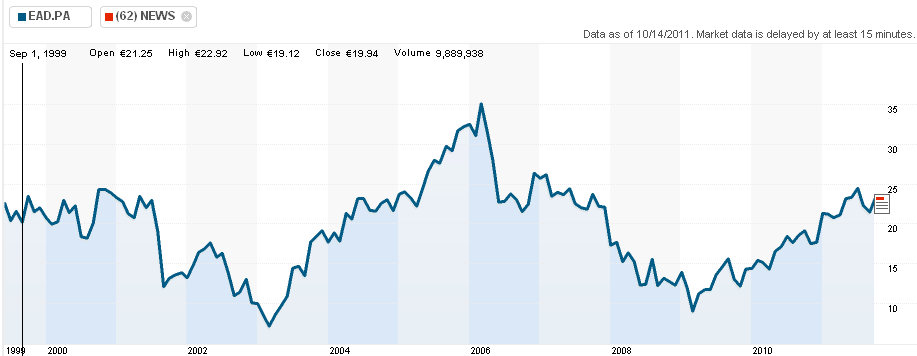
In a previous post I showed the evolution of stock price for EADS and the target price calculated by an investment bank along 34 months. I already stated the misguided recommendations that they provided. A truly “Buy high and sell low”, the quickest way to lose all your savings.

There are many advertisements of investment funds using the term “active” (active management). That’s truly dangerous regarding investing. It not only implies more expenses paid in commissions, but also implies a manager who is acting more.

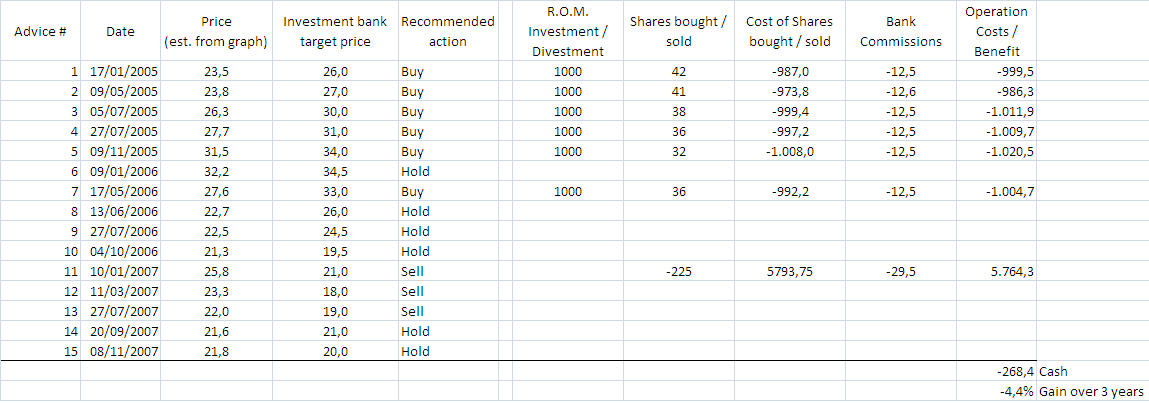
Imagine that the active fund manager was the same person who had produced the investment bank’s report of EADS that I showed in my previous post. If he had been as active as he recommended his clients to be, he would have bought shares in 6 different moments between 2005 and 2006 and sold them at the beginning of 2007 (*).

As an example, I made the calculation using around 1,000€ as the amount invested in each of those points in time (using the technique called “Dollar cost averaging“). You may see in the table below how many shares those 1,000€ afforded to. You may also see the amount it could cost in commissions (of course, professional brokerage firms would get lower fees – nevertheless, if you omit that commissions, the net result at the end would have been negative as well).

Quick way to lose your savings: follow the advice of an investment bank.

As you can see, after the 7 operations along 2 years, the manager would have lost 268€ on an investment of almost 6,000€, that is losing 4,4% or about 2% a year… It is much better then to leave your money in a savings account.

Nevertheless, what is more worrisome is the fact that in the period of 34 months, the bank produced 15 different target prices, changing its recommendation (i.e., from “buy” to “hold”, etc.) up to 5 times. This urge to produce new figures and even worse, to act upon those new figures is what makes most of professional investment fund managers a truly dangerous species. As Charlie T. Munger wisely says “Resist the natural human bias to act”.

(*) I would have loved to have performed the same analysis with a newer report, as the price of EADS stock went even below 9€ in the years that followed to reach over 24€ again in 2011… but the last report of EADS (or any other company) that I had with such detailed explanation of target prices was this one (and I’d never pay for such a paper).

EADS share price since its creation.

Note 1: You may think that the negative figures reached with this example are due to the case selected. If you think that is the case, I invite you to take another example and share it with us. I do not have many such reports available, and as I already stated, such a report is not something I would be willing to pay for, I can find many more useful ways to spend money.

Note 2: If you think I was biased by using frequent buys of 1,000€ each one and selling everything at once, I made the same calculation imposing that the manager used the technique “dollar cost averaging” also at the time of selling, that is selling about 1,000€ each time the recommendation was “sell”. The result: at the end of the period he would have 2,962.5€ in cash and 2,114.6€ in stock, having lost this time nearly 16% of the invested amount, even worse than in the first case.

Leave a comment

Filed under Investing