Category Archives: Sports

2016 Olympic Games medal table vs. population and GDP

Now that the 2016 Olympic Games of Rio de Janeiro have finished, I wanted to update and share here in the blog a couple of tables I produced a few days ago comparing the medal count per country and the ratios of such medal count in relation to the population and the size of the economy of each country.

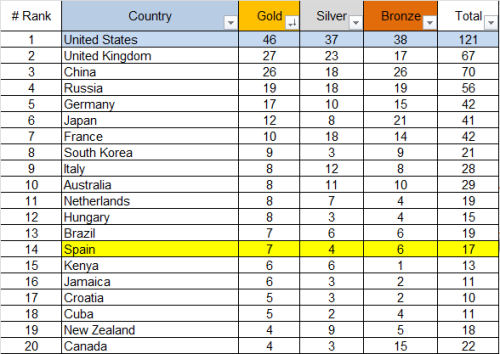
To start with, find here the official medal count, which is ordered taking into account which national olympic committee has obtained the most gold medals, then most silver medals and finally most bronze medals (and not by the total tally).

Rio 2016 - medal table 2016.08.21

In the table I have only included the top 20 countries, but you can find here the complete list. There are 86 nations that have collected medals in the Games. This means that over a hundred nations have not collected a single medal.

Without doubt the most dominant nation in the Olympics has been the United States with 121 medals won, 46 of them of gold. That is over 50 more medals than China or the United Kingdom.

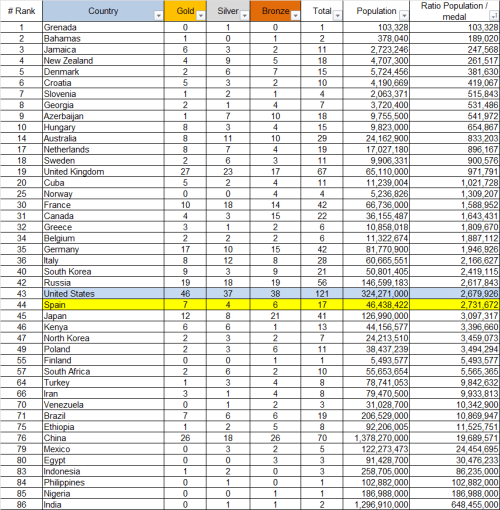
However, the United States has a population of about 5 times that of the United Kingdom, therefore the pool of talent where to search for olympians is much larger. This allows me to introduce the first ratio: Population / medal. I collected the figures of population from the Wikipedia (here). Find a table below with the results:

Rio 2016 - ratio population medal table 2016.08.21 selection

The table shows a selection of 44 countries not the complete list of 86. Find such complete list at the bottom of the post and find your country. These 44 countries help me to make the following remarks:

  • Small nations such as Grenada and Bahamas, despite of having collected only 1-2 medals lead the table.
  • In the top 20 we find nations such as New Zealand, Denmark, Australia, Netherlands and Sweden that tend to be in the lead pack of any positive ranking. They seem to be good as well in producing olympian talent.
  • The 4 bigger European Union nations find themselves in the upper third of the list, with between 1 and 2 million inhabitants per medal, with the UK leading the pack followed by France, Germany and Italy.
  • United States for all its dominance in the medal table is only the 43rd nation taking into account the size of its population. That is at the middle of the table. One would say that the average American doesn’t play any better at sports but the sheer size of the country allows it to find plenty of good olympians in different sports.
  • Funny enough, just above the USA we find Russia in this ranking. And just below, Spain. All 3 have about 1 medal for every 2.7 million inhabitants.
  • At the bottom of the table we find large nations such as India, Nigeria, Philippines or Indonesia that with over 100 million inhabitants have also collected only between 1-3 medals each.
  • Plenty of nations have not managed to collect a single medal, some of them large nations: Pakistan (~194 million inhabitants), Bangladesh (~160 m). Most African countries have not won a medal as many in the Middle East (e.g. Saudi Arabia). Some emerging nations from Latin America neither: Chile, Peru, Uruguay

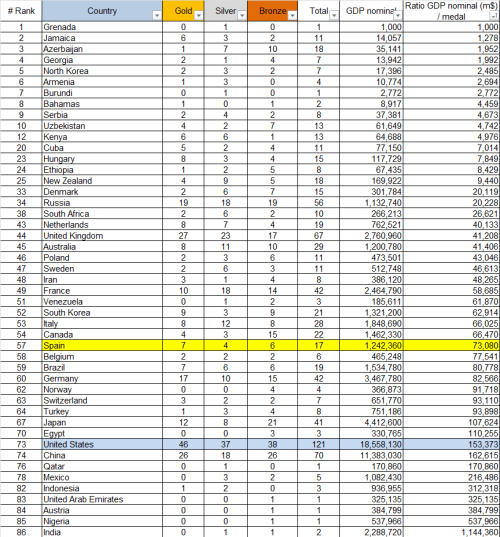
As there are few developed countries at the bottom of the list I thought of producing a similar ranking but with the ratio “gross domestic product (GDP)” / medal. The guiding thought is that the larger the size of the economy of a given country the more resources it will have to recruit sportive talent, to train it, to send it to international competitions, to build sport infrastructures, etc. (1) (2) I collected the figures of GDP from the Wikipedia (here; the source for most of the figures is the International Monetary Fund whereas for about 5 of them is the World Bank). Find a table below with the results:

Rio 2016 - ratio nominal GDP medal table 2016.08.21 selection

The table shows a similar selection of ~45 countries not the complete list of 86. Find such complete list at the bottom of the post and find your country. These countries help me to make the following remarks:

  • Among the top 30 nations all are small economies. The first G20 economy we find is Russia in the 34th position. These small economies leading the table translate between 1 bn$ and 20 bn$ of GDP per medal.
  • We find Grenada, Jamaica and Bahamas in top 10 in both rankings.
  • African nations that do well in athletics show up here: Kenya (12th) and Ethiopia (24th).
  • Where are New Zealand, Denmark, Australia, Netherlands and Sweden in this ranking? They are between the 25th (New Zealand) and the 48th (Sweden) positions, converting between 9 bn$ and 46 bn$ of GDP into a medal.
  • Where are the 4 bigger European Union nations in this ranking? They are between the 44th (United Kingdom) and the 60th (Germany) positions, converting between 41 bn$ and 82 bn$ of GDP into a medal. That is at the second half of the ranking.
  • Where is the USA? At the bottom of the pack, in the 73rd position just followed by China. Both translating between 152 – 162 bn$ of GDP into a medal. That is an economy about the size of New Zealand (4.7 million inhabitants).
  • We find the richest economies of the Middle East (Qatar and United Arab Emirates) at the bottom of the table, not being able to translate petrodollars into medals, despite of signing some good athletes.
  • At the bottom of the table we find some of the same large nations: India, Nigeria, Indonesia… and Austria.
  • Even if plenty of nations have not collected a single medal, most of the larger economies have. The largest economy in failing to win a single medal at Rio was Saudi Arabia (20th by nominal GDP), followed by Hong Kong (33rd) , Pakistan (39th) and Chile (43rd).

Another discussion would be whether in itself it is indeed important or not to collect medals at the Olympic Games but that discussion is out of the scope of this post.

(1) I used GDP and not GDP per capita with the idea the GDP per capita would be more linked to the overall sports habits and fitness level of the nation, but the number of athletes that can be sent to the olympics is limited, thus GDP would show by itself whether the size of the economy of a given country would work efficiently in finding that talent and bringing it to the level required to win medals at the olympics.

(2) I used nominal GDP instead of “purchasing power parity” figures with the idea that sport talent of olympic worth needs to be trained and tested in several international events along the year, thus comparing the more local PPP figures wouldn’t do.

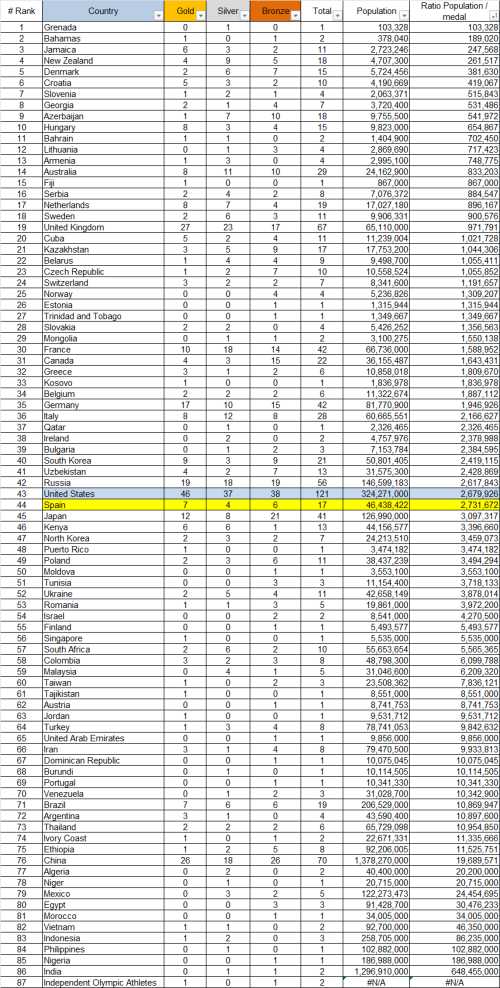
Complete table with medal tally ordered by the ration “Population / medal”:

Rio 2016 - ratio population medal table 2016.08.21 TOTAL

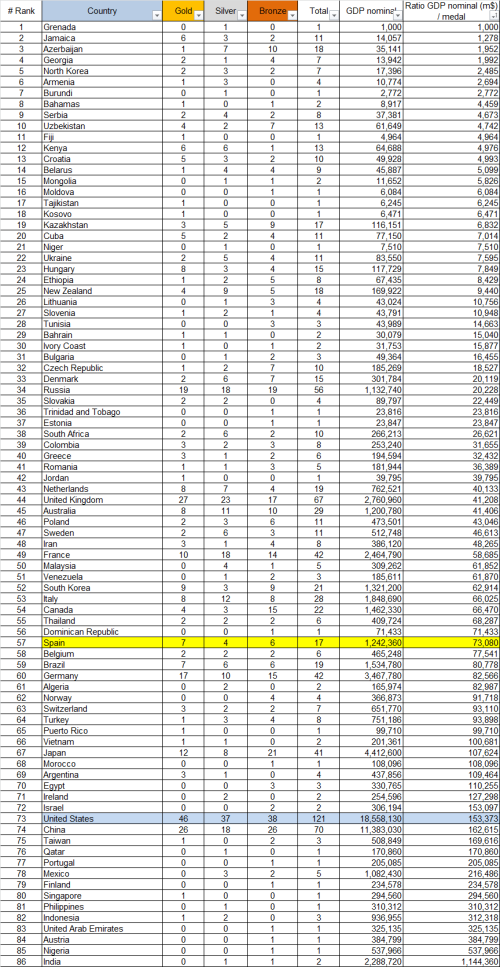
Complete table with medal tally ordered by the ration “GDP / medal”:

Rio 2016 - ratio nominal GDP medal table 2016.08.21 TOTAL

2 Comments

Filed under Sports

The penalty shoot-outs are a lottery

Recently, the 2016 UEFA Champions League final (between Real Madrid and Atletico de Madrid) was decided in a penalty shoot-out, so was the 2016 Copa America Centenario final (Chile – Argentina) and so have already been a couple of matches in the round of 16 and quarter finals of the ongoing UEFA Euro 2016 (Switzerland – Poland and yesterday’s Poland-Portugal). You could expect one or two more matches in that competition to be decided in such a way.

“The penalty shoot-outs are a lottery”

This is a mantra repeated once and again each time the extra time of a football match comes to an end and the score is still a draw. Yet penalty shoot-outs are not a lottery. However, asking TV or radio football commentators to describe this aspect of the game as “two-person zero-sum game that meets von Neumann’s Minimax theorem” would be too much.

Years ago, while reading the book “Soccernomics“, by Simon Kuper and Stefan Szymanski (book review here), I came to know a couple of papers on penalties and penalty shoot-outs published by the Spanish economist Ignacio Palacios Huerta (at the London School of Economics).

Penalties

In a first paper, Professionals Play Minimax (2002, and its annex) [PDF, 335 KB and 342 KB], by analyzing over 1,400 penalty kicks, he came to confirm that professionals do play Minimax, a game theory rule decision model in which they try to minimize the worst outcome not knowing the strategy of their opponent.

The object of the paper itself is to try to find a natural setting in which von Neumann’s theorem implication can be tested. Penalty kicks turns out to be such a natural setting, the reasons enabling the game to be so are: there are few strategies available to the players (basically shooting left or right for the kickers, or jumping to his left or right for the keepers), it is a two-player zero-sum game and the outcome of the game (goal or no goal) is immediate after a strategy is chosen.

Studying those over a thousand penalties and in particular those of 42 players (kickers and keepers) who have been each one involved in over 30 penalties in the time span of the study (1995-2000), the author came to the following findings:

  • Kickers have practically the same probability of scoring with different mix of strategies (being a strategy alternating between shooting left or right by a given proportion).
  • Players are capable of generating truly random sequences of choices (left – right). This is remarkable, as humans, when asked to produce a random sequence, normally over do it and shy away from what would be truly random.
  • Some figures: players shoot to their natural side (with the interior of the feet, shooting left to a right footed) just above 50% of the times, keepers jump to the natural side of the kicker slightly more often.
  • When the keeper “guesses” the side to which the kicker is shooting, the scoring probability greatly differs depending on whether it was the kicker’s “natural side”, 71%, or the non-natural side, 55%. When the keeper jumps to the wrong side the scoring probability is about 95% with no big difference between natural or non-natural side.
  • During a match the average scoring rate is about 80%, with the rate decreasing as the match comes to an end (73% for penalties in the last 10 minutes).
  • Some players during the years of the study (1995-2000) had significantly better scores; in particular Mendieta (91% and no matter whether he kicked to his natural (68% of the times) or non-natural side (32%)), Del Piero and Juninho (especially strong on their natural side (94%) and above average in their non-natural (87%)) or Bergkamp (91% and 88%).
  • Strategies between players varied greatly. As I said Mendieta had a 68/32 (natural / non-natural), whereas Batistuta had a 81/19 and Baggio a 45/55, all with above average scoring success. Other players like Zidane, Mihajlovic or Chiesa managed an undistinguishable 50/50.

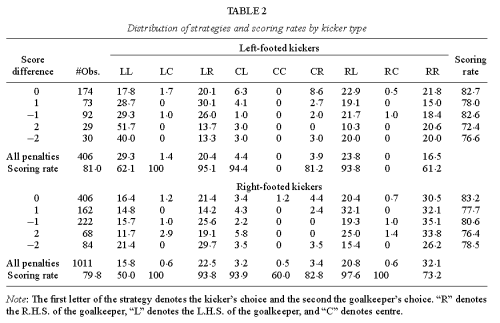
See a couple of interesting tables below:

Minimax table 1

Minimax table 2

Even more interesting is his second paper.

Penalty shoot-outs

In a second paper, “Psychological Pressure in Competitive Environments: Evidence from a Randomized Natural Experiment” (2009, with Jose Apesteguia) [PDF, 342 KB], Palacios Huerta wants to find out how emotions play a major effect on performance and to do so he takes a look at penalty shoot-outs from major football competitions.

For this study he reviewed over 2,800 penalty kicks in about 270 penalty shoot-outs. He divides the observations in two blocks, before and after FIFA changed the rules governing the shoot-outs in 2003. Before that date, the team of the captain winner of a toss of a coin started kicking first; after the change in the rules, the captain winner of the toss of a coin chooses which team kicks first.

Before 2003, the fact of kicking first or not was random, and after 1,343 kicks in 129 shoot-outs, the authors found out that the first in kicking in the sequence win the penalty shoot-out 60.5 percent of the time. (1)

As part of his study, Palacios Huerta made a survey questioning over 200 football players and coaches in Spain, professionals and amateurs, what would they choose if they had won the toss of a coin to decide which team kicks first in a penalty shoot-out. The results offer not doubt: over 95% of the cases chose to kick first. When asked why they would choose that option they indicated “to put pressure on the rivals”.

Experience matched the survey. After the change of FIFA rules in 2003, Palacios Huerta gathered data of another 140 penalty shoot-outs up to 2008 (just before writing his paper). Those were the first 140 penalty shoot-outs in which the winner of the toss of a coin had to choose whether he wanted his team to kick first or his opponent to kick first. In just a single case did the winner of the toss of a coin choose to let the opponent to kick first: Gianluigi Buffon playing for Italy the quarter-final of the Euro cup in 2008 against Spain, with the result that Spain won the penalty shoot-out and went to win the Euro, starting a streak of 3 consecutive major competitions at national level (Euro 2008, World Cup 2010 and Euro 2012).

Take a look at the following graphics and tables that let you read how the probabilities of scoring each penalty in a shoot-out evolve depending on previous outcomes (whether the team is behind, even or ahead) and the probability of winning the shoot-out (hence qualifying to the next phase or winning the competition) evolve.

ScoringProbabilitiesperRound

PenaltyShootOut_ScoringProbabilities

I highlighted in the previous table in blue and yellow the scoring probability for each kick and the winning percent of the shoot-out for a shoot-out in which both teams go about scoring each of the penalties. It is interesting, if not dramatic, to see how while the scoring probability for the first team is always between 72 and 78% (2), for the second team it drops from 82% to 62-66% for rounds 3 to 5. Similarly, the winning probability decreases for the second team down to 21-23% just before attempting kicks 3 and 4 if all previous penalties have been scored.

See below that 2008 penalty shoot-out between Spain and Italy.

After having commented on these two papers and its conclusions, let me share a few comments and anecdotes:

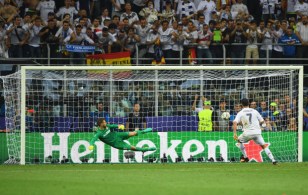
MILAN, ITALY - MAY 28: Cristiano Ronaldo of Real Madrid scores the winning penalty during the UEFA Champions League Final match between Real Madrid and Club Atletico de Madrid at Stadio Giuseppe Meazza on May 28, 2016 in Milan, Italy. (Photo by Shaun Botterill/Getty Images)

MILAN, ITALY – MAY 28: Cristiano Ronaldo of Real Madrid scores the winning penalty during the UEFA Champions League Final. (Photo by Shaun Botterill/Getty Images)

Toss of a coin. Both 2016 Copa America Centenario final and UEFA Champions League final were won by the team which kicked the first penalty, Chile and Real Madrid, respectively. In the draw, using the toss of a coin, to decide which team kicked first Chile chose to kick first (see here the video). However, in the Champions League final, Atletico de Madrid’s captain Gabi chose to let Real Madrid kick first. Apparently, he chose that as they had kicked second in the round of 16 of that same competition against PSV Eindhoven and passed. Somehow he tried to repeat the sequence thinking that this would bring them luck. Well, with that decision he put his team against about 60-40% odds backed by over 30 years of recorded experience and about 270 shootouts. Not a clever move. See this article “La buena mala suerte del Churu” by Manuel Jabois discussing this toss of a coin (in Spanish). See here the video.

“[…] we find a systematic first-mover advantage. Further, professionals are self-aware of their own psychological effects and, when given the chance, they rationally react by systematically taking advantage of these effects.” (Palacios-Huerta)

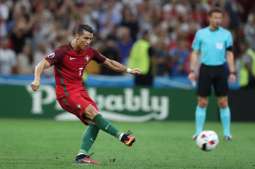
1024x1024As reflected above, in the paper, Palacios-Huerta indicates that between 2003 and 2008 only once in 140 samples did the winner of the toss chose to let the opponent kick first. That is why it was striking what Gabi did and why it called the attention of some football fans. Well, yesterday, during the first match of the Euro 2016 quarter finals between Poland and Portugal, we had yet another such example, another anomaly. This time it was Robert Lewandowski, the Polish captain, the perpetrator. He won the toss of the coin and chose that Portugal kicked first. I can imagine how Cristiano Ronaldo might have felt at that moment, the second time in just 6 weeks that he was being handed such a present. Portugal won the shoot-out.

Palacios Huerta and other analysts receive requests for dedicated reports about kicking patterns, records and data of different teams when playing knock-out phases. In Soccernomics, Simon Kuper and Stefan Szymanski, describe how that happened during the 2008 UEFA Champions League final between Manchester United and Chelsea. Palacios Huerta had given Chelsea some tips on Manchester kickers and keeper (van der Saar): “Van der Sar tends to dive to the kicker’s natural side”, “most of the penalties that Van der Sar stops are mid-height, thus is better to shoot low or high”, “if Cristiano Ronaldo stops half-way in the run-up to the ball chances are 85% that he shoots to his natural side”…, it is quite interesting to actually see that penalty shoot-out and how the different players acted. See below the video. Apparently Van der Saar saw how Cech, Chelsea’s keeper had some paper in his hands and also noticed how kickers were shooting to their non-natural side, until at the 7th penalty (~9’30” in the video) he defies Anelka by pointing to Anelka’s non-natural side, like saying “I know you have the tip to kick there”, then…

For the record, the final was won by Manchester, first in kicking.

Finally, ever since coming to know all this information I have enjoyed penalty shootouts more than before. I now entertain myself seeing the strategy taken by the keepers and kickers, whether the keeper jumps to the natural side of the kicker more or less than in 60% of the shots, if he changes his strategy depending on whether the kicker is left or right-footed, whether kickers shoot more or less than 60% of the shots to their natural side, etc.

Les grandes personnes aiment les chiffres“, Le Petit Prince.

(1) At the time of the Copa de America Centenario final, the Spanish journalist Alexis Sanchez (better know by his profile @2010MisterChip), expert in providing all kind of football statistics, tweeted that Chile, being the first in kicking in the penalty shootout against Argentina had a 55% chance of winning the tournament. Thus, it may be the case that he has a larger (not public) database including more penalty shootout.

(2) Note how probabilities in shoot-outs decrease from the average of 80% of penalties during the match.


Leave a comment

Filed under Sports

Forecasting France Euro 2016

I have a work colleague who not only is a tremendous negotiator and aircraft seller but also has a great sense of humor and manages in his free time late in the night to set up a contest for office staff to try to guess winners, matches’ scores, top scorers, etc., of major international soccer competitions. The France Euro 2016 which starts this afternoon could not be missed. Nacho managed to set up the contest in time.

In this post I am going to explain how I went about forecasting the results of the UEFA Euro 2016.

“when in doubt, build a model”, Nate Silver.

The readers of this blog may already know how much I do like to build models to produce forecasts, guesstimates, etc. In relation to forecasting this UEFA Euro 2016 there is some background that has shaped my mind in relation to the subject in the recent years, let me give you some hints:

Having shared this background, you may understand that I tried to remove all the beauty of guessing and my football knowledge out of the forecasting process (1).

I rather made use of:

  • ESPN Soccer Power Index (SPI) ranking, introduced by the economist Nate Silver. I used its offensive and defensive scores plus weight for each of the scores based on a tip indicating that in competitive matches the defensive factor tends to be slightly more important (see “A Guide to ESPN’s SPI rankings”) (2).
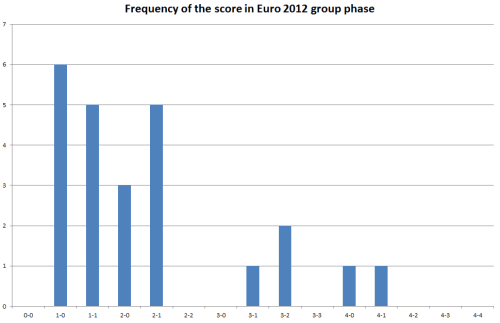
  • The frequency of different scores in the group phases of the Euro 2012 and the World Cup 2010, the in the round of 16, quarter finals and semi-finals.

Frenquency

  • A few simple rules about how to allocate results given the difference between SPI ratings of the two nations playing each match. (3)
  • The total number of goals during group phases the latest Euro and World Cup. In order to cross check that the total numbers of goals that my forecast yielded was in check with previous competitions.

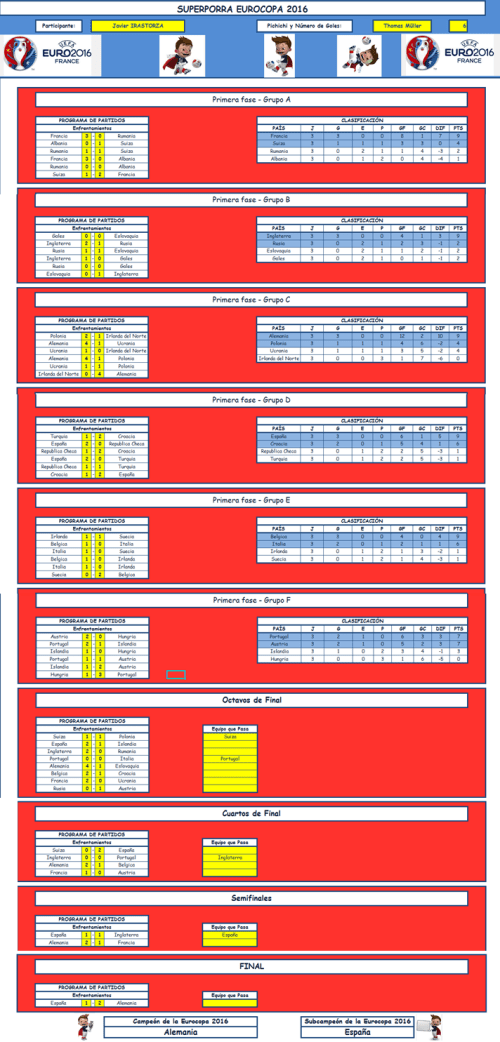
It may sound very complex. It is not. It requires a bit of reading (which most of it I did years ago), retrieving the latest ratings, giving it a bit of thought to set up the model and then, not even looking at the names of the teams, you go about allocating the scores based on raw figures. Let’s see how my forecast fares this time! (4)

Porra Euro 2016

Les grandes personnes aiment les chiffres” (5), the Little Prince.

(1) In fact I have not watched a single national team football match from any country since the World Cup in Brazil in 2014.

(2) See here the blog post I published yesterday in which I made a more thorough review of the ESPN SPI index.

(3) I set up rules like “if the difference of the combination of indices of the two nations is below this threshold, I take it as a draw, if it is between x and y as victory by 1 goal, if higher…”, etc.

(4) This way of forecasting allowed me to finish 4th out of 47 in 2010, 15th out of 87 in 2014. As it removes biases it allows to be better than the average, though it prevents you of guessing outliers, gut feelings, etc.

(5)”Adults love figures”.

Note: In the blog post from yesterday I mentioned that the latest complete ranking from the ESPN SPI index that I could retrieve dated from October 2015. That is the one I have used, therefore, Germany results as winner. Of the latest ranking, covering the Top 25 nations, only 13 countries of the 24 competing at the Euro 2016 are included. I could have set up an hybrid ranking taking the latest rankings and ratings for the top 13 from June and using the October figures for the lower 11 teams. I decided to go on with a single set of data. If I had done so, the maing changes would have come from the semifinals onwards. France would have appeared as winner instead of Germany. We’ll see if that was a good decision.

Leave a comment

Filed under Sports

France Euro 2016: “group of death”?

Tomorrow will start the UEFA Euro 2016. Fans all over Europe start getting excited by it. This year’s competition is played in France, with some matches taking place in Toulouse, one of them Spain – Czech Republic, which some friends and I will be able to watch live!

This post is intended to be a quick one to discuss, as I did for the 2014 World Cup in Brazil, which groups are the most difficult ones, the so-called “group of death“. Media all over Europe states that it is group E, with Belgium, Ireland, Italy and Sweden the one which is the toughest. To discover which is effectively such group I’ll focus on a couple of rankings: FIFA’s and ESPN’s Soccer Power Index, as I did in 2014.

Teams Euro 2016

FIFA world ranking.

In its website, FIFA explains the procedure which it uses to compute the ranking, which is based on the following formula:

M x I x T x C = P

M: winning, drawing or losing a match

I: importance of the match

T: strength of opposing team

C: confederation strength weights

P: points for a game

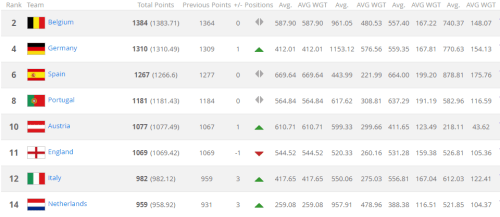
According to that formula, the latest ranking (June 2nd), filtered for European teams, has the following teams at its top:

FIFA ranking

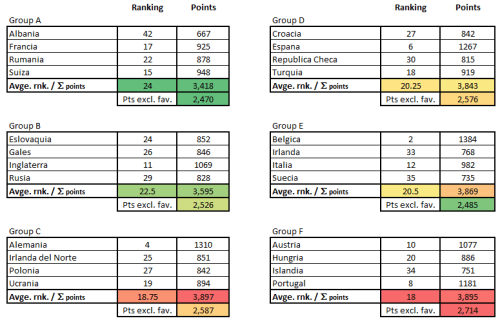
With the information of both the ranking and the points I went to check which of the groups of the Euro 2016 were the strongest, both taking a look at the overall group and looking from the perspective of the “favourite” team (the one with the highest ranking), which was the one facing a toughest group (total points of the other 3 teams composing the group). See the results below:

Group of death - FIFA ranking

As you can see the most difficult groups in terms of total points are:

  • C (Germany, Northern Ireland, Poland, Ukraine) with 3,897.
  • F (Austria, Hungary, Island, Portugal) with 3,895.
  • E (Belgium, Ireland, Italy, Sweden) with 3,869.

Looking at the average ranking, the most difficult groups are:

  • F (Austria, Hungary, Island, Portugal) with 18.
  • C (Germany, Northern Ireland, Poland, Ukraine) with 18,75.
  • D (Croatia, Spain, Czech Republic, Turkey) with 20,25.

And excluding the points of the favorite team in each group, which is the favorite facing the toughest group?

  • Portugal in group F, facing 2,714.
  • Germany in group C, facing 2,587.
  • Spain in group D, facing 2,576.

Then, combining the 3 approaches, to me, it becomes clear that the toughest group is F, with Austria, Hungary, Island and Portugal, by the total amount of points (2nd), ranking of the teams (1st) and in relation to what Portugal will face (1st).

The second most difficult group would be C, with Germany, Northern Ireland, Poland and Ukraine, by the total amount of points (1st), ranking of the teams (2nd) and in relation to what Germany will face (2nd).

You can see that, using FIFA ranking, and despite of conventional “wisdom” (press), group E would be nothing but the 3rd or 4th most difficult group, i.e. an average group out of 6.

ESPN Soccer Power Index (SPI) ranking.

ESPN Soccer Power Index (SPI) ranking was introduced by the economist Nate Silver of worldly fame, who many readers will know from his forecasts on elections in the USA (check his blog FiveThirtyEight).

In a post from 2009, when the SPI was introduced, just before the 2010 World Cup, he explained how the index was computed (“A Guide to ESPN’s SPI rankings”). As he explained, the process had 4 main steps:

  • Calculate competitiveness coefficients for all games in database.
  • Derive match-based ratings for all international and club teams.
  • Derive player-based ratings for all games in which detailed data is available.
  • Combine team and player data into a composite rating based on current rosters; use to predict future results.

The main difference in relation to FIFA ranking algorithm is that it takes player-based ratings for those players who play in clubs in the Big Four leagues (England, Spain, Italy, Germany) and the UEFA Champions’ League. The player-based rating is merged into the national team coefficient. The player-based rating weighs heavily in national teams with many players playing in the main leagues (e.g. England or Spain national teams) and less heavily in other nations which roster is composed of many players not playing in clubs of the 4 main leagues (e.g. Russia).

Other details of the ESPN’s approach are similar to those used by FIFA: e.g. giving weights to results depending on the opponent, measuring the competitiveness of the match, the different confederations, etc.

ESPN provides a daily update of its ranking, however it includes only the top 25 world-wide teams, out of which 15 are European and only 13 represented in the UEFA Euro 2016, that is about half of those 24 competing.

ESPN - daily rating June 08

In order to review which one would be the group of death using the ESPN SPI I took the latest available complete ranking I could find, dating from October 2015, which is half a year away, but reflected the situation at about the end of the qualifying phase for the Euro 2016. See the ranking below:

ESPN SPI Oct 2015

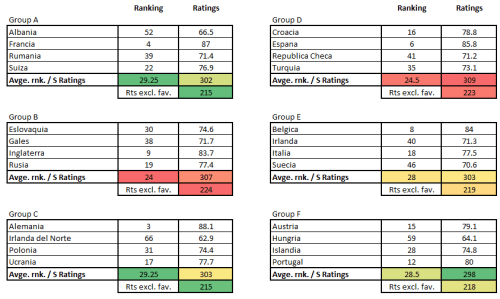
As I did with the FIFA ranking above, with the information of both the ranking and the ESPN SPI ratings I went to check which ones of the groups of the Euro 2016 were the strongest, both taking a look at the overall group and looking from the perspective of the “favourite” team (the one with the highest ranking), which was the one facing a toughest group (total ratings of the other 3 teams composing the group). See the results below:

Group of death - ESPN SPI ranking

As you can see the most difficult groups in terms of total ratings are:

  • D (Croatia, Spain, Czech Republic, Turkey) with 309.
  • B (Slovakia, Wales, England, Russia) with 307.
  • C and E with 303.

Looking at the average ranking, the most difficult groups are:

  • B (Slovakia, Wales, England, Russia) with 24.
  • D (Croatia, Spain, Czech Republic, Turkey) with 24.5.
  • E (Belgium, Ireland, Italy, Sweden) with 28.

And excluding the points of the favorite team in each group, which is the favorite facing the toughest group?

  • England in group B, facing 224.
  • Spain in group D, facing 223.
  • Belgium in group E, facing 219.

Then, combining the 3 approaches, to me, it becomes clear that the toughest group is B, with Slovakia, Wales, England and Russia, by the total amount of points (2nd), ranking of the teams (1st) and in relation to what England will face (1st).

The second most difficult group would be D, with Croatia, Spain, Czech Republic and Turkey, by the total amount of points (1st), ranking of the teams (2nd) and in relation to what Spain will face (2nd).

You can see that, using ESPN SPI ranking (from October), and despite of conventional “wisdom” (press), group E would be nothing but the 3rd most difficult group.

Some readers may be tempted to think that I arrived at this result because I used a ranking from half a year ago, that if we were to take the latest ratings (if fully available) group E would emerge as the toughest one… not so. See the preliminary table using the information available for those 12 teams:

Group of death - ESPN SPI ranking - June 2016

There you can see that with the latest ratings the most competitive group would be either D or C, very much like with FIFA rating (from June as well).

It is interesting to note how by using FIFA or ESPN SPI the weight given to the group F (Portugal) is completely different.

Finally, in both ratings the big absence in the tournament is the Netherlands, arguably about the 10-14th team in the world, the 6th in Europe. A pity for the competition.

1 Comment

Filed under Sports

Museu do Futebol (São Paulo)

Referring to the different waves and streaks that football teams experience, the Argentinean Jorge Valdano made popular the sentence “A team is just a mood (1).

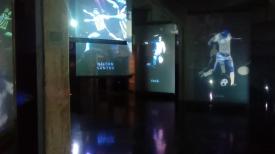
The Football Museum (Museu do Futebol) at the Sao Paulo‘s municipal Pacaembu stadium is an invitation to go through those moods, re-live some of those past moments anchored in the collective memory, by way of recorded sounds, cheering chants, radio excerpts of goals narrations, videos and interviews about the most important goals of Brazil history.

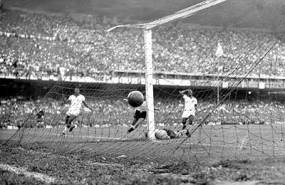
el-maracanazoYet, in my opinion, the most impacting mood, very well caught in the museum, is the transition from euphoria to depression, from music to complete silence, the tragedy of the losing the last match of 1950 World Cup between Brazil and Uruguay. A match that Brazil just needed to draw, started winning, yet lost it. The Maracanazo. In just 90 seconds, in a dark room you get submerged into the happiness of the day that would see Brazil win the first of many World Cups at the newly built Maracanã and then how the mood at the stadium changed with the first goal of Uruguay, then the second and at the end the final whistle from the referee.

Nevertheless, no matter how impacting the Maracanazo was for Brazil and football history, and how well captured it is at the museum, it would be unfair not to mention that in the museum there are many other very positive and happy moods of Brazilian football captured very well, too. If I went to think of Brazil, I would first think of happiness, football, music, dance; and those are experiences that accompany you along the museum.

The museum itself is centered around Brazil’s national football team, the only one which has won 5 World Cups to date, the country which practically at any point in time has one of the best 2 or 3 players of the World, the country of Pelé, Garrincha , Roberto Carlos, Ronaldo, Zico, Romario, Tostao, Rivaldo, Rai, Djalma Santos, Didi, Pepe, Gerson, Carlos Alberto, Rivellino, Socrates, Cafu, Bebeto, Rivaldo, Ronaldinho, Neymar… you name them.

DSC_0323The visit starts with a room where some players are picked as the most important to Brazil’s history; some images and biography of each one of them is offered.

The following room is dedicated to the goals, the main ingredient of the game. The 30 most celebrated goals in Brazil’s history are recorded and narrated by the authors or journalists (in Portuguese, English or Spanish). Several interactive screens are available for visitors to go through the different goals. There are also some desks where to listen to radio narrations recorded at the time of some of those goals.

See some of them in the video below (2).

The following rooms are dedicated to recordings of the chants of all the main teams competing at the Brasileirao; to Charles Miller, the man who introduced football in Brazil; and to a collection of pictures the years in which football was introduced in Brazil, showing life in Brazil at the time.

DSC_0326The largest space is dedicated to the World Cups, all of them, not only the ones won by Brazil. Some context of the society, cultural movements and events going on at the time are shown, together with images of the Brazilian team competing at the championship, the winners, some charismatic players and vivid images of the competition. That is another room where to wander with time enough to be captivated by the evolution of football, the players and events of the times.

There is another space dedicated to the couple Pele and Garrincha: with them playing together in the field, Brazil never lost a match (out of some 40 joint appearances). Some personal objects, pictures and videos of their best tricks are shown.

The last rooms are dedicated to football rules, some statistics, women in football and the chance to try a penalty kick against a featured Julio Cesar, where your shot’s speed is measured (and then compared to a Roberto Carlos’ shot).

DSC_0336

(1) “Un equipo es un estado de ánimo”.

(2) The video is unrelated to the museum but contains some of the goals among those 30.

1 Comment

Filed under Sports, Travelling

La mala suerte del Real Madrid en los sorteos de semifinales de Champions League

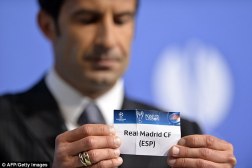
Figo drawUna de las tradiciones muy españolas que se repite una y otra vez tras cada sorteo de la Champions League de fútbol es el interpretar quién ha tenido más suerte en dicho sorteo: ya sea porque los rivales son presuntamente más sencillos (da igual que se trate de semifinales y el rival haya eliminado a grandes equipos en el camino) o porque se juegue la segunda vuelta en casa de un equipo en vez de “fuera” (en casa del rival).

En España la interpretación del sorteo no se queda ahí: rápidamente se comienza a sugerir que el sorteo está amañado, que hay bolas calientes, que a tal equipo siempre le toca equis, etc., y en cualquier conversación, en pocos intercambios se termina hablando del franquismo y las Copas de Europa del Madrid. No falla.

La semana pasada, unas horas antes del partido de ida de la semifinal entre Manchester City y Real Madrid, leí, en un artículo escrito por Míster Chip, que el Real Madrid había jugado en 8 semifinales el partido de vuelta en casa. Sabiendo que hasta entonces el Madrid había disputado 26 semifinales, eso indicaba que en las otras 18 disputó el partido de vuelta fuera. Acto seguido miré los números para el FC Barcelona en la página de récords y estadísticas de la Champions League en la Wikipedia. Y el resultado lo publiqué en este par de tuits.

tuits

Un día después, miré a ver cómo de aislados o dispares eran los dos casos en comparación con otros equipos. En toda la historia de la Copa de Europa y de la Champions League hay sólo 6 equipos que hayan alcanzado las semifinales en 10 o más ocasiones: dos españoles, el Real Madrid y el FC Barcelona, dos italianos, el AC Milán y la Juventus de Turín, el Bayern Munich y el Manchester United. El resultado de la búsqueda se ve en la tabla de debajo.

tablasemifinaleschampions

De los 6 equipos, el Real Madrid y luego la Juventus son los equipos que de largo presentan un peor balance en los sorteos en cuanto a las veces en que les ha tocado jugar la vuelta fuera de casa (hecho presúntamente desfavorable, comúnmente entendido así). En la zona templada se encuentran el Manchester y el Milan, que han jugado el mismo número de ocasiones la vuelta en casa o fuera. Y en el otro extremo se encuentran el Bayern Munich y el Barcelona, con una gran mayoría de semifinales cuya vuelta la jugaron en casa.

Habiendo comentado este hecho con un grupo de compañeros de la universidad, uno de ellos, Juan, indicaba cual era la probabilidad de que al Real Madrid en 27 sorteos le tocase jugar fuera de casa en 18 o más ocasiones. Para ello, se hace uso de la  distribución binomial; que es una distribución de probabilidad discreta que cuenta el número de éxitos en una secuencia de n ensayos de Bernoulli independientes entre sí.

Con el uso de este calculador de probabilidades para una distribución binomial se obtiene que la probabilidad de que al azar al Real Madrid en 27 sorteos le tocase jugar fuera de casa en 18 o más ocasiones es de 6.1%.

Haciendo el mismo ejercicio para el caso del Barcelona (1), la probabilidad de que al azar al Barcelona en 14 sorteos le tocase jugar fuera de casa en 5 o menos ocasiones es de 21.2%.

Una vez hecha esta revisión, creo que queda despejado cuál de los equipos ha tenido más suerte en los sorteos de semifinales en cuanto a si le toca jugar en casa o fuera el partido de vuelta.

Nota: tanto el Barcelona como el Milan jugaron cada uno dos “semifinales” entre los años 1992 y 1994 en los que el formato de competición fue un tanto singular (y diferente según el año).

En las ediciones de 1992 y 1993, las “semifinales” fueron una fase con 2 grupos, cuyos primeros clasificados se enfrentaron en la final (el último partido de dicha fase el Barcelona lo jugó en casa, contra el Benfica, lo que le permitió asegurar los puntos necesarios para quedar primero y jugar la final contra el Sampdoria).

La edición de 1994 tuvo una eliminatoria de semifinales, pero a partido único, que tanto Barcelona como Milan jugaron en casa y ganaron, enfrentándose después en la final. El hecho de jugar ese partido único en casa, estaba determinado no por un sorteo sino por la clasificación en una fase previa con dos grupos.

(1) Para este cálculo, no computo 16 semifinales, sino 14, dado que como se explica en la nota previa, en los años 1992 y 1994 las semifinales que el Barcelona jugó (una en casa, otra una fase de grupos) no fueron fruto de un sorteo.

Leave a comment

Filed under Sports

Marathon d’Albi (2016)

Last Sunday April 24th, at the time that this post is being published I was in the departing line of the marathon of Albi, a French town in the South West of France, famous for its cathedral and the museum dedicated to the painter Toulouse-Lautrec.

My brother Jaime came with me to the marathon as support team, but this time I would race alone. I had subscribed to the race a few months earlier in order to force myself to keep up with the training.

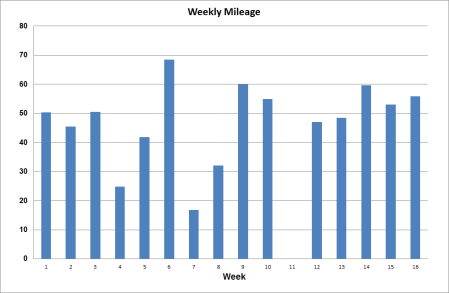
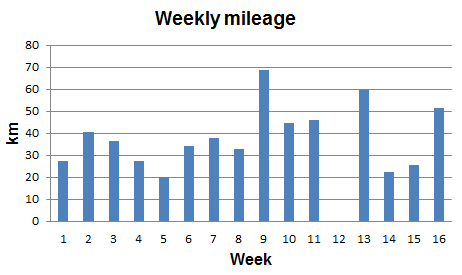
And it did force me, but not that much. The typical training plan that I use to train for marathons consists of 16 weeks, with series sessions during the week and a long run each weekend. This time, I lacked the motivation to start head on with the planning and it took me about a month to start with the series training. From then on I more or less tried to keep up with those sessions.

On the other hand, the long runs went even worse. I didn’t manage to complete single run of over 30 kilometres or even 2 hours. The longest ones I did were of 21.1 km, half marathons, one training and one in competition (Blagnac semi marathon on March 13, training calendar week number 11, in 1h40′, a moderately good time).

Apart from that, on April 3rd, David, our second child was born. And just before and after that (training calendar weeks 12 and 14) I fell heavily sick, having to drop running alltogether for 9 and 10 days each time. All in all, I arrived to the race with just 530 km of training in the legs. About 200 km less than if I would have met the plan at about 80% (a moderately good completion that I have managed previous times). I knew I would pay for it. The question was how much I would pay and since when.

Albi_training

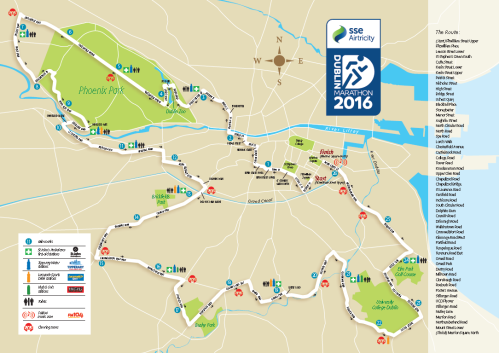
The marathon of Albi departs and finishes in the athletics stadium of the city. It makes an initial detour through the city center and then goes along the river Tarn for about 18 kilometres and back. Part of this route goes through small villages, part of it at the side of the river with wonderful views and part of it through 2 tunnels of 900 m and 400 m, both ways, a strange experience. Along the route there are some groups of villagers cheering the runners but the atmosphere is rather silent. There aren’t many runners neither: 362 at the departing line, a handful less at the finish line. This running event is mostly about you running by yourself along a small road by the river.

Albi The organization of the race had several pacers. I decided to start with the 3h45′ one, knowing that I would not be able to keep up with him until the end, but knowing as well that that pace (5’19” per km) was a comfortable one to start with for me (having finished several marathons in around 3h45′). And so I did. However, the pacer in question started running consistently below the target pace, despite of some remarks made to him by other runners in the pack. We went the first 12-13 kilometres at a pace of about 5’05” – 5’10” which is not much faster but enough to take its toll on you when you’re short of training. I therefore decided to let them go and soften my pace from the km 13. I still arrived at the half marathon at below 1h52’20”, the target pace for 3h45′. However, as you can see below from the kilometre 24 and especially the 29 I started to notice the lack of training, of long runs. The hill was coming.

Albi_pace

After having completed several marathons and a couple of ultra marathons, the difficulty in keeping a pace or seeing the pace deteriorating did not bother me especially. I knew I would finish. I just didn’t know whether I would make 3h55′, 4h, 4h05’… I especially softened the pace between the km 34 and 39, where we encountered a couple of small climbs and supply posts and in the end I clocked 4h10’14” of net time, which is the worst time I have managed in the last 15 years, about a minute worse than what I did in Toulouse in 2011. It didn’t matter. I already knew at the departing line that it would not be the best marathon nor the second best or… I came in order to complete another one, to keep up with the running and to collect the prize of having pushed myself to keep training for the last four months, even if I didn’t quite manage it as I wished I had.

The best part of the race were the last 3 km, already back in Albi, when I stepped up the pace, thinking about the children and the last lap at the stadium that was about to come, where I met my brother again, who took some nice pictures, one of them I share below, indicating that this was the 14th marathon that I have completed so far.

Albi

2 Comments

Filed under Sports

Santos, Pelé and the Memorial das Conquistas at Vila Belmiro

Santos is a port city about an hour drive from Sao Paulo, crucial for the development of the coffee industry in Brazil and the inflow of slaves from Africa in the XIX century. But Santos is mainly known today because of the Santos football club. The Santos football club is known because it was there where Pelé played for the most of his career. And Pelé…

Pele“My name is Ronald Reagan, I’m the President of the United States of America. But you don’t need to introduce yourself, because everyone knows who Pelé is.” Ronald Reagan (at a visit of Pelé to the White House)

In my third trip to Brazil, I wouldn’t let it pass away the opportunity to rent a car, drive from Sao Paulo to Santos and visit Vila Belmiro, the stadium of Santos FC and the museum “Memorial of the conquests” (Memorial das Conquistas).

Named the “Athlete of the Century” by the International Olympic Committee, Pelé joined Santos when he was 15 years old  (in the museum you can see his first contract as professional) and in his first complete season he finished as top scorer of the league with just 16 years. At age 17 he scored 58 goals in the league; a record that still stands today… With Pelé, Santos went to win:

Today, Santos it is neither the team with more Paulistas championships (Corinthians (27), Palmeiras (22) and Sao Paulo (21) are ahead in that ranking), it shares the lead in Brasileiraos with Palmeiras (both with 8), it is not the club with more Libertadores cups (8 teams are ahead in that ranking, led by the Argentinean Independiente (8), Boca Juniors (6), Peñarol (5)… including Brazil’s Sao Paulo with 3) nor is the American club with the most International Cup (Peñarol, Boca Juniors and Nacional de Montevideo won 3). And despite of all that, the club Santos was declared by FIFA as the best club of the XX century in the Americas (4). Because it was in Santos where Pelé played, and with him the team reached the summit in the 1960s when it lived a dream decade, the years of Os Santásticos who achieved 25 titles between 1959 and 1974. Santos, according to FIFA was the first team to reach the 10,000 goals scored and has plenty of other goal records (5). It was in that Santos that Pelé was the first attacker reaching the mark of 1,000 goals scored (6).

Those days are long gone. Nowadays the club, Santos, wanders around the 100th position of the World Best clubs (7), struggles in the Brasileirao (ending between 7th-9th in last 3 seasons) and most great players are continuously sold (8). However, Vila Belmiro still captures very well the essence of the good old times.

field

Vila Belmiro, or rather the Urbano Caldeira stadium, was built in 1916, close to the port of Santos. It is a small stadium with capacity for barely 17.000 spectators. Thus, for some important matches Santos plays in the bigger stadiums of Sao Paulo (mainly at Pacaembu (9)). Nevertheless, it’s a cozy stadium, where you have a good view of any spot of the field from anywhere. I liked especially the boxes at ground level named after the great players of the history of the club (10).

The tour of the stadium included a visit to the locker rooms (each locker in the local team room named after the club’s legends, with a special spot for Pelé), the tunnel to the field (well separated from the visitor’s tunnel, each at a different corner of the stadium), the field, the benches.

This slideshow requires JavaScript.

An anecdote for Spanish football fans: in the corridors at field’s level a poster with the following sentence from the Spanish football commentator, Julio Maldonado, can be seen:

“Silencio… juega el Santos”, Julio Maldonado, “Maldini” (Silence… Santos’ is playing)

Silencio

I definitely recommend the visit to the museum and the stadium. You will be submerged into the history of football for a couple of hours (if you chose to read everything) for just 13 R$ (about 3 euros).

FIFA

(1) Arguably the most important of Brazilian states’ tournaments.

(2) Competition founded in 1959.

(3) Created in 1960, is the South American equivalent to the then Europe Cup and nowadays’ European Champion’s League.

(4) The award was based on a vote by the subscribers of the bi-monthly FIFA World Magazine (see here). For the record, with over a 42% of the vote, Real Madrid was elected as best club of the century.

(5) The goal 10,000th was scored in 1998 (the club was founded in 1912). In the museum there is a digital counter updated with each goal scored. At the time of my visit it was above the 12,200 mark. For comparison, Real Madrid had scored about 8,800 goals in official competitions only up to January 2015.

(6) Pelé holds the Guinness World Record for being the player with most goals scored, 1,279.

(7) See here the 2015 IFFHS club world ranking.

(8) Unlike Pelé, who in 1961 was declared as a national treasure in order to prevent him from being transferred to richer European clubs.

(9) At the municipal stadium of Pacaembu there is another museum, the Museo do Futebol, which I also visited and about which I may write at a later point.

(10) I only referred to Pelé in this post but in Santos played at some point in time as well: Gilmar, Coutinho, Clodoaldo, Carlos Alberto (the latter two were part of Brazil’s 1970 World Cup final roster), and most recently Robinho, Ganso and Neymar.

Leave a comment

Filed under Sports, Travelling

San Silvestre 2015

Fifteenth participation (1) in the popular San Silvestre Vallecana on New Year’s Eve.

The team this time was composed by some 8 friends (Nacho, me, Pablo, Maicol, Carlos, Sara, Jaime and Alicia):

https://twitter.com/soler_bravo/status/682661492689342464

This year, we finished the race with a sprint over the last 200 meters, after having been joking about it all along the race. Even with that last rush, we added some more seconds to our record: this year it took us 1h12’17” to complete the 10km.

The time in this race is the less important aspect of it. As always, it is a pleasure to share a run through the centre of our home town with friends to give a healthy, funny and colorful farewell to the year. Be sure that next year we’ll be there to laugh, jog and beat our time!
(1) I took part in it for the first time in 1998, when less than 5,000 raced in it, and have always participated (not always inscribed though) except for 3 years (twice I spent New Year’s Eve in the Netherlands and other time I was injured).

Leave a comment

Filed under Sports

To my old GPS watch

photo (5)A few days ago I picked my new running watch which incorporates a GPS (1). The previous one, a Garmin 405 Forerunner was a present from Jaime and Luca back in the Christmas period of 2010 to 2011.

At that time, I had then just moved to Toulouse and they thought that it would be a good gift to incentivize the expressed wish to take on running again. And how it worked! With the new watch I started to measure some running tracks, track my heart beats, beat my personal records, record every run, run plenty of races, race and train with friends…

In just half a year I lost about 20 kilos and completed about 900km. Never before I had run so often so constantly. It helped me to run firstly slower focusing on the heart and then faster focusing on the pace. It helped to introduce tempo and series sessions in the training.

weight

In these 5 years, wearing the watch almost at every run (2), pacing myself with it, making numbers in my head about rhythms, times, kilometres, etc., I have completed over 9,000 km, more than 50 races, including 10 marathons and 2 ultras.

stats

Since the last summer it started to work faulty. Sometimes it switched itself off, it re-started by itself, it didn’t recharge the battery well… The last time it recorded well a complete activity was on October 29th, when we ran together 7km, just 4 days after having completed the Toulouse marathon. Maybe it needed more time to rest.

Rest in pace.

(1) A Garmin Forerunner 220.

(2) Except for having for some times in which I forgot it or its battery went out.

Leave a comment

Filed under Sports