First Take-Off

The 17th of December will always be an important day in the history of aviation for the following 2 reasons:

  1. The 17th of December 1903, Orville Wright performed the first flight aboard their Flyer I,
  2. Today, 17th December 2011, I made my first take-off aboard a Robin DR-400-120 :-).

As part of my training towards obtaining the PPL licence, today we performed the 5th flight, the first in which I was fully at the controls during take-off.

My colleague, Miguel, took the following video:

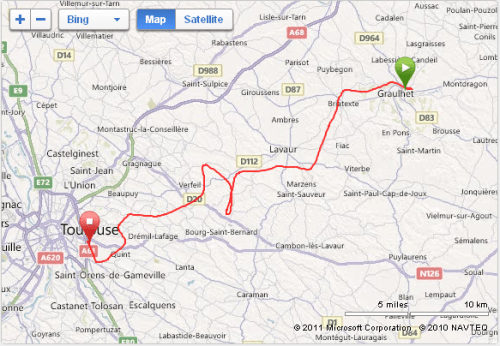
You may see the route we followed from Graulhet (LFCQ) to Toulouse-Lasbordes (LFCL) aboard the Robin DR-42 (F-GORM), as I recorded it with my Garmin GPS:

Flight route: LFCQ - LFCL

4 Comments

Filed under Aerospace & Defence

The British Museum

During the last trip to the United Kingdom I visited for the first time The British Museum (free). The museum itself is without any doubt amazing.

However I had conflicting ideas of whether the breadth of pieces mostly coming from other countries should have been better displayed at a museum in the country of origin or there in London.

I found it curious that the museum has a dedicated brochure explaining why the collection of Elgin Marbles from the Parthenon is hosted in London instead of Athens as the Greek Ministry of Culture claims they should be. The British Museum claims that the pieces were taken with permission of the then authority of those territories: the Ottoman Empire. It also gives account of an internal investigation carried by the Parliament. And even points at other 6 museums around the world hosting sculptures from the Parthenon as if trying to divert the attention.

The museum’s brochure concludes that the taking of the pieces was legal and its location in London is good as it believes the museum is a unique resource for the world, but offers the reader to check the counter opinion at the Greek ministry’s site.

I still haven’t made my mind yet: is it the World’s looting museum or most of the pieces are better off being conserved there that they would be in Greece, Egypt, Syria or elsewhere?

To end the discussion I found it comical that in order to introduce Stonehenge to the museum’s visitors a poster of it was deemed enough. In this case it wasn’t necessary to bring one or two stones from the site, as has been the case with pieces from many other places.

Besides that discussion I enjoyed seeing some items missing in previous trips. Find some pictures of some of the museum highlights below:

This slideshow requires JavaScript.

5 Comments

Filed under Travelling

The best (and the worst) of the first 200 posts

About a year ago, I wrote in the 100th post which were the most and least read of the first 100 posts. Today is another such occasion as this is the 200th post in the blog.

I started the blog in February 2010. Since then the blog has received over 29,000 visits, hundreds of comments while I have enjoyed thinking about what to write and structuring my thoughts to do so.

If a year ago I wasn’t yet sure which kind of posts were better received, now it is much clearer: those related to aviation.

Find below the list of the top 10 and bottom 10 posts:

1. Will Boeing 787 ever break-even?
2. 787 Break Even for Dummies
3. Airbus vs. Boeing, comparison of market forecasts
4. More on Boeing 787 break even
5. FC Barcelona copying Real Madrid
6. Algunas cifras de la industria cultural
7. Mi adiós a Ibercaja
8. An aircraft worth its weight in gold?
9. Boeing commercial aircraft discounts (update for 2010)
10. Beluga vs. Dreamlifter

190. Speech about Minifutbol
191. “Playas” in Lima
192. International Day of the Book
193. Bill Clinton endorsing Kiva (video)
194. Three centuries of confusion
195. De Feria en Feria
196. From climbing to merely walking
197. Nothing like a good red wine…
198. Opera with subtitles
199. Book review: Pirate Latitudes

I find it curious that only 3 posts of the 10 most read ones a year ago remain in the top 10 list, however 6 out of the 10 least read ones still remain in that list.

Let’s see what I’ll write in the next 100 posts…

NOTE: the box in the right showing “Current Top Posts” shows the most read ones in the last two days, not the all-time most read ones (the ones above).

4 Comments

Filed under Personal development

Wooden aircraft, cloth wings and pressure

Most of you, the readers of this blog, probably know that an airplane flies due to the difference in pressure between the upper (extrados) and lower (intrados) sides of its wing. This difference in pressure is due to the difference velocity of the airflow around both sides of the wing as you may see in the picture below:

Airflow around an airfoil (image from the Wikipedia, by Kraainnest).

As the speed above the wing is much higher, the difference in the pressure is mainly due to the lower pressure in the extrados. This can be seen in the following picture:

Pressure coefficient around an airfoil (by the Aircraft Aerodynamics and Design Group, Stanford University).

However, how could we see that in a real flight?

In commercial planes, of which wing skin is made of aluminium alloys this is not easily seen.

Two weeks ago, after my flight lesson was finished, I sat at the back of the plane to come back to Toulouse while my colleague had his lesson. It was then that I saw the image I captured in the following picture:

Wing extrados on air.

The aircraft we fly in our training lessons is a small Robin DR 400; a wooden aircraft of which wing skins are made of cloth. Not any cloth, but a type of polyester (PET) commonly used to build sailcloth, produced by Dupont and named Dacron. The surface is then lacquered with a polyurethane paint.

Robin DR 400 140

The air within the wing is at a higher pressure than the air in the extrados, and you can see how it expands and pushes up the cloth skin of the wing as you can see in the picture above.

You may see below the same wing on ground. Though the picture is of a lower quality, you can see that in this case the wing doesn’t look “inflated”.

Wing extrados on ground.

9 Comments

Filed under Aerospace & Defence, Education

The Unwritten Laws of Finance & Investment

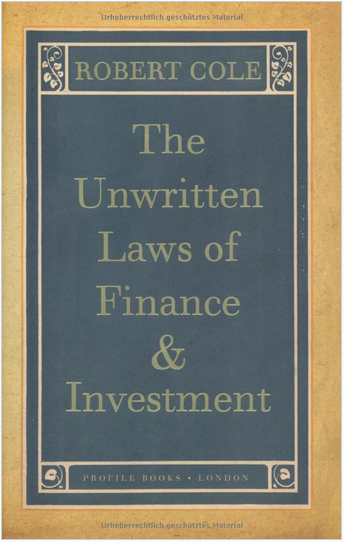
The Unwritten Laws of Finance and Investment, by Robert Cole.

I believe I have already mentioned at some point in the blog the ritual I have almost every time I get into an airport of going to one of the book shops to check whether I can find something to take with me.

I found “The Unwritten Laws of Finance & Investment”, by Robert Cole, at Frankfurt’s airport some months ago during a scale from Amsterdam to Toulouse.

The book is a collection of investment and finance maxims, advice, quotations, etc. It can be read in one shot (159 light pages).

If you are to read this book probably nothing of what you may find in it will be completely new to you, but the compilation and the witty style in which the “laws” are written make it an entertaining read and serve as repository where to find well established ideas.

Let me finish by quoting some passages from the laws that I enjoyed the most:

  • “I don’t want a lot of good investments; I want a few outstanding ones”, Philip Fisher.
  • It is impossible for investors to get their timing precisely right always. [I will come back to this in the future].
  • “In this business, if you’re good, you’re right six times out of ten. You’re never going to be right nine times out of ten”, Peter Lynch.
  • Before you go in, look for the way out. – This one is beautifully explained with a story from Winnie-the-Pooh. [I will come back to this in the future].
  • “Bull markets are born on pessimism, grow on scepticism, mature on optimism and die one euphoria”, Sir John Templeton. – This one reminds us to that of Warren Buffett “Be fearful when others are greedy and greedy when others are fearful”.
  • “There are huge mathematical advantages to doing nothing”, Warren Buffett (on compounding interest).
  • “The rich rules over the poor, and the borrower becomes the lender’s slave”, the Book of Proverbs 22:7, The Bible.
  • “The practice of contracting debt will almost infallibly be abused in every government. It would scarcely be more imprudent to give a prodigal son a credit in every banker’s shop in London, than to empower a statesman to draw bills, in this manner, upon posterity”, David Hume.
  • “The four most expensive words in English language are ‘This time is different'”, Sir John Templeton. [I will come to this in the future].
  • “Investment is most intelligent when it is most businesslike”, Warren Buffett.


Leave a comment

Filed under Books, Investing

The origins of football and The Freemasons Arms

As a fan of football (soccer) and having read in the book “366 Historias del Fútbol Mundial“, by Alfredo Relaño (in Spanish, 768 pages – I posted about it here), about the English pub in which the Football Association was founded on the 26th October 1863, I set out to visit that place in my last trip to London.

On that first day the first rules for the game were drafted, such as the ruling out of the use of hands for the field players. That moment marked the departure between football and rugby.

A view of what and how it happened can be seen in the documentary “Fútbol, el nacimiento de una pasión”,  by Jesús Sánchez (2005, in Spanish – an acquaintance of the family), which covers the origins of football from prehistoric games.

The explanation given by the book has an error. It states that the creation of the football association took place at The Freemasons Arms located at Great Queen Street. That pub in fact is not there but in other street: Long Acre street, about 100 metres away.

The Wikipedia provides a plausible explanation: the foundation of the Football Association took place at the Freemasons’ Tavern, but that pub apparently was demolished and to continue its business the Freemasons Arms was built, which is not the same but apparently claims the legacy of the former. The Freemasons’ Tavern would have been indeed located at Great Queen Street where the new Freemasons Hall is located today. If that is the case, the Wikipedia article or the book may have another error since one states the foundation took place in 1863 and the other says that the original pub was demolished in 1860

I went there to check the pub and to enjoy myself worshipping the origins of such a game as football.

I was quite disappointed with what I viewed; as there is only a small shrine in a wall with some pieces remembering the relation of the pub with football. I asked one of the bar tenders and she barely had an idea of what the relation was.

Sadly, a piece of history seems to be lost.

This slideshow requires JavaScript.

2 Comments

Filed under Sports, Travelling

Same Old Game! (Banking)

During our last trip to London, we visited the Bank of England’s Museum (free). We enjoyed very much that visit and I may post longer about it in the future. This time I just wanted to share with you the following comic strip on display at the museum:

Comic strip from "Punch" magazine found at Bank of England's Museum.

It was published by the weekly magazine “Punch, or the London Charivari” on the 8th November 1890 issue. In it you may see an old lady (representing the Bank of England, situated at the Threadneedle Street in London) reprimanding some young boys (commercial banks) for having played fool and got in trouble. Although the image is not very good you may read (the emphasis is mine):

Old Lady of Threadneedle Street. “You’ve got yourselves into a nice mess with your precious ‘speculation!’ Well – I’ll help you out of it, – for this once!!”

The rest is history… what is referred often as moral hazard.

3 Comments

Filed under Economy, Travelling

Mathematical beauty

Reading science books for the general public, you’ll often find physicists talking about elegance, beauty and words of the like describing laws or theories.

The Wikipedia has an entry for “Mathematical Beauty”. Another entry says “Many mathematicians talk about the elegance of mathematics, its intrinsic aesthetics and inner beauty. Simplicity and generality are valued. There is beauty in a simple and elegant proof […]”.

The Spanish journal El Pais is publishing each week a mathematical challenge to its readers to commemorate the 100th anniversary of the Spanish Royal Mathematics Society.

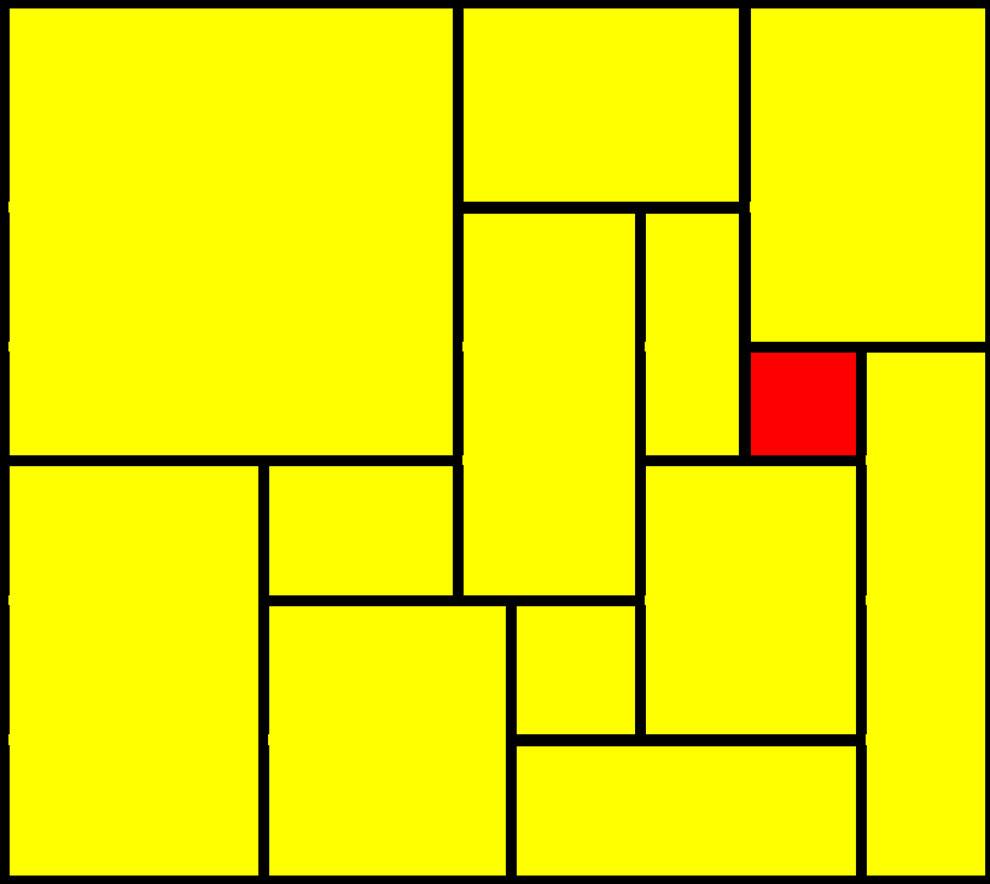
Last week’s challenge was to solve the sides of the different inner squares that compose the following rectangle, knowing that the red one has a side of 3.

Rectangle made of squares (the squares are deformed in the image).

You may argue that the inner figures are not squares but rectangles; this is because the sizes have been disguised to hide the solution to the problem. The relative positions however have not been twisted. You may read the explanation here.

How did I approach the problem?

I used as many unknown variables as needed, and related them with as many equations as needed, ending up with a linear system of 14 equations. Not difficult to solve with Excel. You may see the process and the solution below.

Rectangle with 14 variables

My approach to the problem...

When I watched the solution proposed by the mathematician I had an “aha” moment. I immediately recognized the beauty in the way she solved it. You may see a video with her solution in the here (in Spanish – 6 minutes).

Instead of filling the problem with variables and equations, as I did, she reduced them to really the minimum needed: 2 variables (x and y)  and 2 equations:

(3x -y + 3) + x = 3 + (2x + y + 12) or x = y + 6

(10y – x + 3) + (4y – x) = (3x -y + 3) + (2x – y + 3)

I guess that not being a mathematician I did not care much about the simplicity I employed, knowing that the tools I counted with would not have had any problem in dealing with the calculation… a different mindset :-).

Solution.

2 Comments

Filed under Miscellanea

¿Son las circunscripciones provinciales o la Ley D’Hondt?

Tras las elecciones de ayer, he leído en varios sitios simulaciones de cómo hubiese sido el resultado “si”…

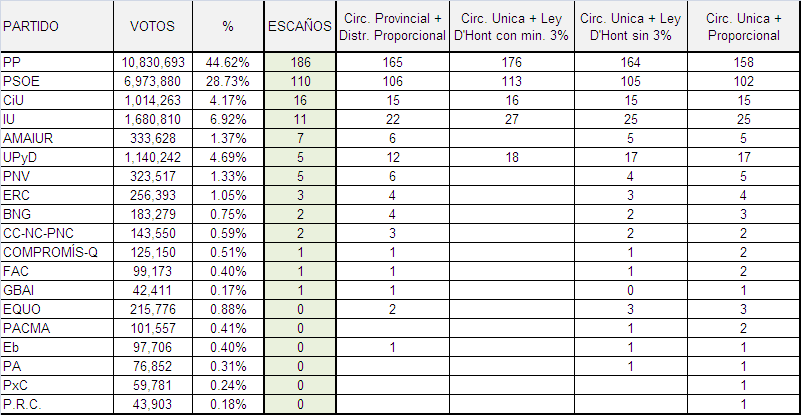
Las cifras que más han circulado por internet son las que resultarían si hubiese circunscripción única en vez de por provincias y si el reparto fuese proporcional, no según la Ley D’Hondt. Esta distribución es la que dejaría al PP con 158 escaños, al PSOE con 102, etc (*).

Me he puesto a hacer los números en detalle para ver el efecto de cada una de las variables, ya que pensaba que la circunscripción por provincias tendría mucha más influencia que la distribución proporcional. Y tiene más influencia, pero no mucha más.

En la tabla de debajo se pueden ver como quedarían los resultados si:

  • Las circunscripciones fuesen las que son, pero el reparto dentro de cada provincia fuese proporcional, no según la Ley D’Hondt.
  • Hubiese una circunscripción única, pero se mantuviese el mínimo de 3% y la aplicación de la Ley D’Hondt para el reparto de escaños.
  • Hubiese una circunscripción única, se retirase el mínimo de 3% y se mantuviese la aplicación de la Ley D’Hondt para el reparto de escaños.
  • Hubiese una circunscripción única y el reparto de escaños fuese proporcional, no según la Ley D’Hondt.

Variación del número de escaños según el método de reparto (elecciones 2011, Congreso).

Viendo la influencia de cada variable, se ve que lo que más perjudica a los partidos nacionales minoritarios (IU, UPyD, Equo, que entiendo que son por los que la gente pone el grito en el cielo) son las circunscripciones por provincias. Solo centralizando los votos ya tendrían la representación que las informaciones les adjudican (25, 17 y 3), se aplicase la Ley D’Hont o no.

Si por el contrario, se mantuviesen las circunscripciones provinciales (que son las que hacen que unos votos cuesten mucho y otros menos, ya que IU y UPyD obtienen muchos votos en provincias donde solo PP y PSOE obtienen representación) pero el reparto dentro de ellas fuese proporcional, los mismos partidos mejorarían sustancialmente respecto a cómo han quedado (22, 12, 2), pero se dejarían 9 escaños entre los 3.

Por último, aunque la gente suele hacer comparaciones con Amaiur, CiU, PNV, por razones obvias, no son estos los partidos que están muy sobrerrepresentados. En cualquiera de los casos CiU obtendría entre 15 y 16 escaños, Amaiur entre 5 y 7, PNV entre 4 y 6.

(*) En una versión de la misma aparece el PP con 160 y el PSOE con 103, debido a que han adjudicado esos 3 escaños arbitrariamente a esos partidos, en vez de a PACMA, FAC y GBAI como corresponde según sus votos.

9 Comments

Filed under Miscellanea

Derechos de TV: el Real Madrid subvenciona al Sevilla con 20 millones de euros

Ayer viendo por televisión, desde Francia, el partido de fútbol Valencia – Real Madrid recibí un mensaje de un amigo que me decía que él lo estaba viendo desde Costa Rica. Al rato otra amiga nos confirmaba que ellos lo estaban viendo desde Ecuador.

Esto viene a cuento de los muchos comentarios irónicos que he escrito en Twitter o Facebook al respecto de que Real Madrid y Barcelona reciban ingresos por derechos de televisión mayores que otros equipos, como por ejemplo el Sevilla. Y digo el Sevilla, por las declaraciones de su presidente Del Nido en varias ocasiones acerca de si el resto de equipos deberían percibir una mayor parte de la “tarta” y sus iniciativas al respecto.

A partir de datos publicados por El Mundo, he realizado la tabla de debajo con el reparto de derechos televisivos de la temporada 2010/2011:
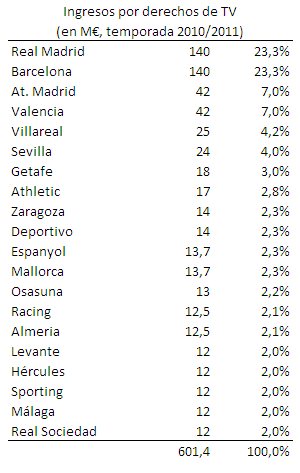
Reparto de derechos de TV 2010-2011: elaboración propia, fuente El Mundo.

El hecho de que Real Madrid y Barcelona reciban 140M€, o un 23,3% del total cada uno, hace que varios equipos se alcen y digan que el reparto es injusto. Se citan ejemplos como el reparto en otras ligas donde las diferencias entre los que más cobran y los que menos son menores, como si ese reparto fuese más justo. El reparto se podría hacer de muchas maneras y ello no tiene porque ser más justo. Hay gente que defiende que los derechos se deberían repartir a partes iguales, cada equipo recibiría ~30M€.

Mi opinión: el hecho de que el Sevilla u otros equipos reciban 24M€ significa que el Real Madrid y el Barcelona subvencionan año tras año al Sevilla y a otros equipos con hasta 20 millones de euros.

Los datos de los “pinchazos” del pay per view, hasta el 90% de los mismos se debían a Madrid y Barcelona.

Mi experiencia actual: en el Canal + francés televisan todos los partidos de Barcelona y Real Madrid (como del Manchester, Chelsea, Liverpool, Inter de Milán, Milán, etc.). Por ejemplo, del Sevilla televisan 4 partidos seguros: sus cuatro enfrentamientos contra Real Madrid y Barcelona. Cuando ni en Inglaterra, ni Italia, ni Francia, ni Alemania televisan ningún partido de equipos con tirón, la televisión se desmarca televisando algún partido sin interés que puede ser de cualquiera de esas ligas (podría ser un Sevilla-Valencia). Es por ello que para los siguientes cálculos, asumiré que a algunos equipos españoles no les televisan solo 4 partidos sino 5 en Francia.
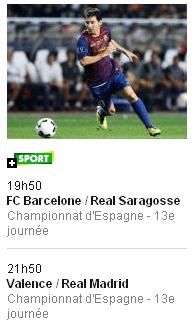
Parrilla de TV de + Sport, de Canal + France, sábado 19 noviembre 2011.

Si el reparto del dinero se hiciese por el número de partidos que se televisan (contando ya los derechos de TV que se venden internacionalmente), me sale el siguiente ejemplo de reparto, donde Madrid y Barcelona cobran un poco más y el resto algo menos o algo más. Yo entiendo que esto sería un poco más justo, palabra que tanto gusta a usar a los que defienden otros repartos.
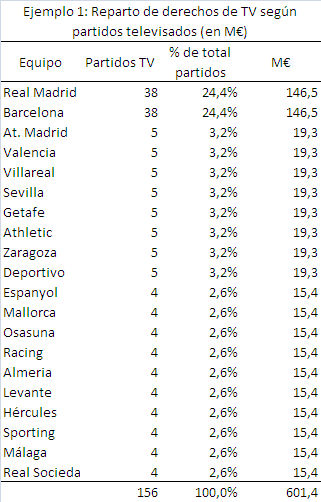
Ejemplo de reparto: según el número de partidos televisados internacionalmente.

Sin embargo, es llamativo que del Sevilla prácticamente solo sus partidos contra Madrid y Barcelona despierten interés internacionalmente. Y por tanto, solo por esos partidos Canal + Francia esté dispuesta a pagar dinero (o Pekín TV por televisar un partido a las 12:00…). Eso me lleva a pensar que hay que introducir otro factor que valore que en un Barcelona-Sevilla, quien trae dinero a la tarta es el Barcelona y no el Sevilla, luego la forma de contar ese partido de cara al reparto debería tener en cuenta que lo que la gente quería ver es al Barcelona indistintamente de si jugase contra Sevilla, Almería, L’Hospitalet, Esperance de Túnez o Al Sadd de Qatar. La gente paga por ver al Barcelona.

¿Cómo se podría medir ese factor que tenga cuenta el interés? Viendo la proporción de partidos que se le televisa frente a los que juega de nuevo. Sí al Barcelona le televisan el 100% de sus partidos y al Sevilla el 13%, en un Barcelona – Sevilla el dinero de los derechos de TV debería corresponder en esa proporción, en torno al 90% para el Barcelona y 10% al Sevilla. Dado que para la televisión el Sevilla es como un sparring, da igual quien esté enfrente del Barcelona.

En boxeo la bolsa de dinero por un combate se negocia según el interés que despierta cada boxeador. Si mañana yo luchase contra Mike Tyson, y el combate generase 1 millón de euros (y combates de Tyson han generado más de 100m$ en pay per view), todos entenderíais que es absurdo que yo exigiese 500.000 euros por el mismo, cuando es Tyson quien consigue que alguien pague por ese evento. Si Tyson además de knockearme me diese 100.000€ yo me debería sentir agradecido.

Ejemplo de reparto: según el número de partidos televisados e interés respectivo de cada equipo.

Con esta nueva forma de reparto, como se ve en la tabla con el segundo ejemplo de reparto arriba, Real Madrid y Barcelona recibirían bastante más de lo que reciben hoy y el Sevilla unos 20M€ menos de lo que recibe ahora. Por eso, sostengo que Real Madrid y Barcelona subvencionan al Sevilla con 20 millones de euros y a otros tantos equipos con diversas cantidades.

Alguien dirá: “pues que se vayan a jugar con otros equipos y dejen la liga al resto”. Esto Florentino Pérez lo comenzó a investigar con la creación del G-14 y solo consiguió ganarse enemistades en la Federación Española de fútbol y en la UEFA.

De todos modos, si sucediese que Real Madrid y Barcelona dejasen de jugar la Liga para jugar una liga europea con grandes equipos, no es que el Sevilla fuese a quedarse con una parte mayor del pastel o que el fútbol español fuese a ganar en interés porque no sería cosa de dos. No. Lo que probablemente sucedería es que las televisiones de todo el mundo posiblemente no pagarían más de 66M€ (la suma del resultado para los 18 equipos en el segundo ejemplo de reparto) por los derechos de TV a la Liga frente a los 600M€ que se pagan ahora, y esos 66 millones son 5 veces menos de los 321M€ que reciben los otros 18 equipos de primera. Esa medida haría que la práctica totalidad de equipos, sin la subvención actual del Real Madrid y Barcelona, estuviesen arruinados y en bancarrota antes de la segunda temporada.

5 Comments

Filed under Sports