Mi pronóstico de las elecciones generales de España del 26J 2016

De nuevo, con la ocasión de las elecciones generales en España el próximo domingo 26 de junio, quería aprovechar para hacer un pronóstico de las mismas como ejercicio de aprendizaje (1) y para ver si el acierto que tuve con las del 20 de diciembre (2) fue flor de un día.

La metodología es simple: me he construido una pequeña base de datos con los porcentajes de voto por partido y provincia a partir de los resultados de las últimas 2 elecciones generales (2015 y 2011) y de las últimas 2 elecciones autonómicas (2015, 2012-2011). Y, a partir de esos resultados, viendo las tendencias, he intentado pronosticar el porcentaje de voto de cada partido en cada provincia, lo que después, haciendo uso del sistema de reparto D’Hondt, proporciona los escaños.
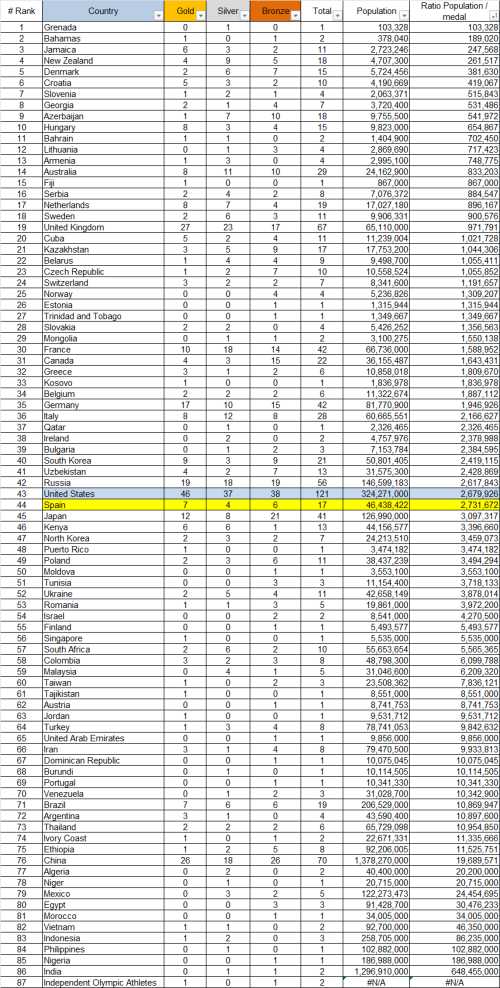
Para hacer ese pronóstico me he basado principalmente en mi “gut feeling” y para pocas provincias he mirado a ver qué decían las encuestas (y en algunos de esos casos ha sido para reafirmarme en mis números contra los otros… veremos). Debo aclarar que el ejercicio no se trata de una encuesta (no he ido llamando a nadie), ni de una media de encuestas (3).

Generalmente, cuando una encuesta a nivel nacional nos dice “el PP va a conseguir un 29% y entre 118-125 escaños” nos da un resultado que se compone de la suma de muchas provincias, que no nos sirve para ver qué va a pasar en nuestra provincia en particular. El CIS, sin embargo, ofrece una encuesta con más de 17 mil encuestados, donde indica su estimación de reparto de escaños por provincias y de porcentajes de voto globales (4). Y esa visión, mucho más completa, es la misma que quiero replicar con mi pronóstico.

Como recordatorio: en España tenemos 52 circunscripciones (provincias más Ceuta y Melilla) que aportan desde 1 diputado (Ceuta y Melilla) a 36 (Madrid) (5). El total son 350 y la mayoría absoluta se consigue con 176 escaños.
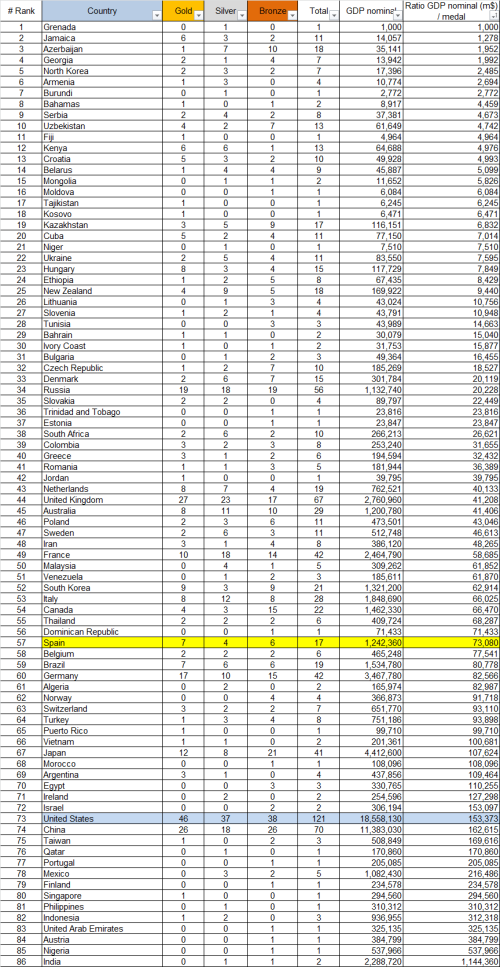
Dicho esto, la tabla y la gráfica siguientes resumen todo el trabajo:

Como quedaría el arco parlamentario.

Cómo quedaría el arco parlamentario.

Pronóstico detallado.

Pronóstico detallado.

Esta vez quería dejar, acompañando el pronóstico en escaños de arriba, también la tabla origen con los porcentajes debajo (para los 4 grandes partidos). Esta tabla, en combinación con la de escaños, permite al lector ver cómo de cerca están uno u otro partido según el pronóstico, y qué porcentaje de voto más tendría que sacar un partido para obtener ese último escaño que se lleva otro. (6)

Porcentajes pronosticados por provincia.

Porcentajes pronosticados por provincia.

Una vez compartido el pronóstico, no voy a hacer ningún análisis del mismo, dado que puede estar muy o poco equivocado; mejor esperar a tener los resultados reales.

(1) Ya en 2011, tras las elecciones generales hice el ejercicio de repartir con distintos métodos (proporcional vs D’Hondt, circunscripciones provinciales vs única…) y el ejercicio me resultó útil.

(2) Ver aquí un análisis de lo acertado de mi pronóstico para el 20D de 2015 con los resultados finales.

(3) Ver por ejemplo los que hace Kiko Llaneras aquí.

(4) Ver más abajo las tablas del CIS. La fuente aquí.

(5) En estas elecciones León pierde un escaño en favor de Valencia.

(6) Esta tabla puede tener muchos errores parciales (pequeñas desviaciones del porcentaje del resultado) sin que ello necesariamente haga que el pronóstico de escaños sea incorrecto.

CIS 26J tabla escanos

CIS 26J tabla resumen

1 Comment

Filed under Miscellanea

Forecasting France Euro 2016

I have a work colleague who not only is a tremendous negotiator and aircraft seller but also has a great sense of humor and manages in his free time late in the night to set up a contest for office staff to try to guess winners, matches’ scores, top scorers, etc., of major international soccer competitions. The France Euro 2016 which starts this afternoon could not be missed. Nacho managed to set up the contest in time.

In this post I am going to explain how I went about forecasting the results of the UEFA Euro 2016.

“when in doubt, build a model”, Nate Silver.

The readers of this blog may already know how much I do like to build models to produce forecasts, guesstimates, etc. In relation to forecasting this UEFA Euro 2016 there is some background that has shaped my mind in relation to the subject in the recent years, let me give you some hints:

Having shared this background, you may understand that I tried to remove all the beauty of guessing and my football knowledge out of the forecasting process (1).

I rather made use of:

  • ESPN Soccer Power Index (SPI) ranking, introduced by the economist Nate Silver. I used its offensive and defensive scores plus weight for each of the scores based on a tip indicating that in competitive matches the defensive factor tends to be slightly more important (see “A Guide to ESPN’s SPI rankings”) (2).
  • The frequency of different scores in the group phases of the Euro 2012 and the World Cup 2010, the in the round of 16, quarter finals and semi-finals.

Frenquency

  • A few simple rules about how to allocate results given the difference between SPI ratings of the two nations playing each match. (3)
  • The total number of goals during group phases the latest Euro and World Cup. In order to cross check that the total numbers of goals that my forecast yielded was in check with previous competitions.

It may sound very complex. It is not. It requires a bit of reading (which most of it I did years ago), retrieving the latest ratings, giving it a bit of thought to set up the model and then, not even looking at the names of the teams, you go about allocating the scores based on raw figures. Let’s see how my forecast fares this time! (4)

Porra Euro 2016

Les grandes personnes aiment les chiffres” (5), the Little Prince.

(1) In fact I have not watched a single national team football match from any country since the World Cup in Brazil in 2014.

(2) See here the blog post I published yesterday in which I made a more thorough review of the ESPN SPI index.

(3) I set up rules like “if the difference of the combination of indices of the two nations is below this threshold, I take it as a draw, if it is between x and y as victory by 1 goal, if higher…”, etc.

(4) This way of forecasting allowed me to finish 4th out of 47 in 2010, 15th out of 87 in 2014. As it removes biases it allows to be better than the average, though it prevents you of guessing outliers, gut feelings, etc.

(5)”Adults love figures”.

Note: In the blog post from yesterday I mentioned that the latest complete ranking from the ESPN SPI index that I could retrieve dated from October 2015. That is the one I have used, therefore, Germany results as winner. Of the latest ranking, covering the Top 25 nations, only 13 countries of the 24 competing at the Euro 2016 are included. I could have set up an hybrid ranking taking the latest rankings and ratings for the top 13 from June and using the October figures for the lower 11 teams. I decided to go on with a single set of data. If I had done so, the maing changes would have come from the semifinals onwards. France would have appeared as winner instead of Germany. We’ll see if that was a good decision.

Leave a comment

Filed under Sports

France Euro 2016: “group of death”?

Tomorrow will start the UEFA Euro 2016. Fans all over Europe start getting excited by it. This year’s competition is played in France, with some matches taking place in Toulouse, one of them Spain – Czech Republic, which some friends and I will be able to watch live!

This post is intended to be a quick one to discuss, as I did for the 2014 World Cup in Brazil, which groups are the most difficult ones, the so-called “group of death“. Media all over Europe states that it is group E, with Belgium, Ireland, Italy and Sweden the one which is the toughest. To discover which is effectively such group I’ll focus on a couple of rankings: FIFA’s and ESPN’s Soccer Power Index, as I did in 2014.

Teams Euro 2016

FIFA world ranking.

In its website, FIFA explains the procedure which it uses to compute the ranking, which is based on the following formula:

M x I x T x C = P

M: winning, drawing or losing a match

I: importance of the match

T: strength of opposing team

C: confederation strength weights

P: points for a game

According to that formula, the latest ranking (June 2nd), filtered for European teams, has the following teams at its top:

FIFA ranking

With the information of both the ranking and the points I went to check which of the groups of the Euro 2016 were the strongest, both taking a look at the overall group and looking from the perspective of the “favourite” team (the one with the highest ranking), which was the one facing a toughest group (total points of the other 3 teams composing the group). See the results below:

Group of death - FIFA ranking

As you can see the most difficult groups in terms of total points are:

  • C (Germany, Northern Ireland, Poland, Ukraine) with 3,897.
  • F (Austria, Hungary, Island, Portugal) with 3,895.
  • E (Belgium, Ireland, Italy, Sweden) with 3,869.

Looking at the average ranking, the most difficult groups are:

  • F (Austria, Hungary, Island, Portugal) with 18.
  • C (Germany, Northern Ireland, Poland, Ukraine) with 18,75.
  • D (Croatia, Spain, Czech Republic, Turkey) with 20,25.

And excluding the points of the favorite team in each group, which is the favorite facing the toughest group?

  • Portugal in group F, facing 2,714.
  • Germany in group C, facing 2,587.
  • Spain in group D, facing 2,576.

Then, combining the 3 approaches, to me, it becomes clear that the toughest group is F, with Austria, Hungary, Island and Portugal, by the total amount of points (2nd), ranking of the teams (1st) and in relation to what Portugal will face (1st).

The second most difficult group would be C, with Germany, Northern Ireland, Poland and Ukraine, by the total amount of points (1st), ranking of the teams (2nd) and in relation to what Germany will face (2nd).

You can see that, using FIFA ranking, and despite of conventional “wisdom” (press), group E would be nothing but the 3rd or 4th most difficult group, i.e. an average group out of 6.

ESPN Soccer Power Index (SPI) ranking.

ESPN Soccer Power Index (SPI) ranking was introduced by the economist Nate Silver of worldly fame, who many readers will know from his forecasts on elections in the USA (check his blog FiveThirtyEight).

In a post from 2009, when the SPI was introduced, just before the 2010 World Cup, he explained how the index was computed (“A Guide to ESPN’s SPI rankings”). As he explained, the process had 4 main steps:

  • Calculate competitiveness coefficients for all games in database.
  • Derive match-based ratings for all international and club teams.
  • Derive player-based ratings for all games in which detailed data is available.
  • Combine team and player data into a composite rating based on current rosters; use to predict future results.

The main difference in relation to FIFA ranking algorithm is that it takes player-based ratings for those players who play in clubs in the Big Four leagues (England, Spain, Italy, Germany) and the UEFA Champions’ League. The player-based rating is merged into the national team coefficient. The player-based rating weighs heavily in national teams with many players playing in the main leagues (e.g. England or Spain national teams) and less heavily in other nations which roster is composed of many players not playing in clubs of the 4 main leagues (e.g. Russia).

Other details of the ESPN’s approach are similar to those used by FIFA: e.g. giving weights to results depending on the opponent, measuring the competitiveness of the match, the different confederations, etc.

ESPN provides a daily update of its ranking, however it includes only the top 25 world-wide teams, out of which 15 are European and only 13 represented in the UEFA Euro 2016, that is about half of those 24 competing.

ESPN - daily rating June 08

In order to review which one would be the group of death using the ESPN SPI I took the latest available complete ranking I could find, dating from October 2015, which is half a year away, but reflected the situation at about the end of the qualifying phase for the Euro 2016. See the ranking below:

ESPN SPI Oct 2015

As I did with the FIFA ranking above, with the information of both the ranking and the ESPN SPI ratings I went to check which ones of the groups of the Euro 2016 were the strongest, both taking a look at the overall group and looking from the perspective of the “favourite” team (the one with the highest ranking), which was the one facing a toughest group (total ratings of the other 3 teams composing the group). See the results below:

Group of death - ESPN SPI ranking

As you can see the most difficult groups in terms of total ratings are:

  • D (Croatia, Spain, Czech Republic, Turkey) with 309.
  • B (Slovakia, Wales, England, Russia) with 307.
  • C and E with 303.

Looking at the average ranking, the most difficult groups are:

  • B (Slovakia, Wales, England, Russia) with 24.
  • D (Croatia, Spain, Czech Republic, Turkey) with 24.5.
  • E (Belgium, Ireland, Italy, Sweden) with 28.

And excluding the points of the favorite team in each group, which is the favorite facing the toughest group?

  • England in group B, facing 224.
  • Spain in group D, facing 223.
  • Belgium in group E, facing 219.

Then, combining the 3 approaches, to me, it becomes clear that the toughest group is B, with Slovakia, Wales, England and Russia, by the total amount of points (2nd), ranking of the teams (1st) and in relation to what England will face (1st).

The second most difficult group would be D, with Croatia, Spain, Czech Republic and Turkey, by the total amount of points (1st), ranking of the teams (2nd) and in relation to what Spain will face (2nd).

You can see that, using ESPN SPI ranking (from October), and despite of conventional “wisdom” (press), group E would be nothing but the 3rd most difficult group.

Some readers may be tempted to think that I arrived at this result because I used a ranking from half a year ago, that if we were to take the latest ratings (if fully available) group E would emerge as the toughest one… not so. See the preliminary table using the information available for those 12 teams:

Group of death - ESPN SPI ranking - June 2016

There you can see that with the latest ratings the most competitive group would be either D or C, very much like with FIFA rating (from June as well).

It is interesting to note how by using FIFA or ESPN SPI the weight given to the group F (Portugal) is completely different.

Finally, in both ratings the big absence in the tournament is the Netherlands, arguably about the 10-14th team in the world, the 6th in Europe. A pity for the competition.

1 Comment

Filed under Sports

Around the world in 80 days

VerneSome months ago, I purchased several books in French language in order to practice it. Among them I included a couple of Jules Verne, one of them being “Le Tour du monde en 80 jours” (“Around the world in 80 days“), published in 1873.

I was more or less acquainted with the story due to having watched back when I was a child in the 80s the animated TV series “Around the World with Willy Fog“, a Spanish and Japanese production in which the characters were played by animals (a lion, a dog, a cat, a mouse, a fox…). I loved that series. On the contrary, I don’t recall having ever watched the movies from 1956 or 2004, therefore when reading the book vivid images from the animated characters came continuously to my mind.

The plot of the story is rather simple: Willeas Fog, a character about whom not much is known, bets with his colleagues of the Reform Club in London that he is able to travel around the world in 80 days, and so he does embark himself in such endeavor with his assistant, Passepartout (“Rigodon” in the TV series).

A the same time,  there is an ongoing investigation of a robbery of the Bank of England which makes a police investigator, Fix (Dix in the TV series), to follow Fog all along the trip (as he is considered a suspect), waiting for an authorization coming from England to arrest him before he evades justice. The reader is conflicted by the suspicion laid upon Fog, as all the acts of the character in the story describe an orderly, honest, compassionate person; even if not much is known about him, his profession, origins or his past.

Several stories occur to the trio along the way that takes them to Paris, Egypt, India, Hong Kong, Japan and United States and these help to get to know a bit those different countries and its traditions. As the book draws to a close, the tension is increased…

… and there I leave my review in order to not spoil the book for future readers.

I marked a couple of passages which I liked (in French)…

L’imprévu n’existe pas”, Willeas Fog.

Les passeports ne servent jamais qu’à gêner les honnêtes et à favoriser la fuite des coquines”, agent Fix.

“Quant à voir la ville, il n’y pensait même pas, étant de cette race d’Anglais qui font visiter par leur domestique les pays qu’ils traversent”.

“- […] Vous avez garde l’heure de Londres, qui retarde de deux heures environ sur Suez. Il faut avoir soin de remettre votre montre au midi de chaque pays (Fix).

– Moi ! toucher à ma montre ! jamais ! (Passepartout)

-Eh bien, elle ne sera plus d’accord avec le soleil.

Tant pis pour le soleil, monsieur ! C’est lui qui aura tort !

“Il ne voyageait pas, il décrivait un circonférence”.

“- […] Mais vous êtes un homme de cœur ! (sir Francis Cromarty).

– Quelquefois, quand j’ai le temps” (Fog).

I recommend the book as I very much enjoyed the about 10 hours that took me to read it. And I could not finish this review without sharing a video of one of the chapters of that TV series of my childhood (in Spanish):

http://www.youtube.com/watch?v=2yPn3rqqb7k


1 Comment

Filed under Books

Museu do Futebol (São Paulo)

Referring to the different waves and streaks that football teams experience, the Argentinean Jorge Valdano made popular the sentence “A team is just a mood (1).

The Football Museum (Museu do Futebol) at the Sao Paulo‘s municipal Pacaembu stadium is an invitation to go through those moods, re-live some of those past moments anchored in the collective memory, by way of recorded sounds, cheering chants, radio excerpts of goals narrations, videos and interviews about the most important goals of Brazil history.

el-maracanazoYet, in my opinion, the most impacting mood, very well caught in the museum, is the transition from euphoria to depression, from music to complete silence, the tragedy of the losing the last match of 1950 World Cup between Brazil and Uruguay. A match that Brazil just needed to draw, started winning, yet lost it. The Maracanazo. In just 90 seconds, in a dark room you get submerged into the happiness of the day that would see Brazil win the first of many World Cups at the newly built Maracanã and then how the mood at the stadium changed with the first goal of Uruguay, then the second and at the end the final whistle from the referee.

Nevertheless, no matter how impacting the Maracanazo was for Brazil and football history, and how well captured it is at the museum, it would be unfair not to mention that in the museum there are many other very positive and happy moods of Brazilian football captured very well, too. If I went to think of Brazil, I would first think of happiness, football, music, dance; and those are experiences that accompany you along the museum.

The museum itself is centered around Brazil’s national football team, the only one which has won 5 World Cups to date, the country which practically at any point in time has one of the best 2 or 3 players of the World, the country of Pelé, Garrincha , Roberto Carlos, Ronaldo, Zico, Romario, Tostao, Rivaldo, Rai, Djalma Santos, Didi, Pepe, Gerson, Carlos Alberto, Rivellino, Socrates, Cafu, Bebeto, Rivaldo, Ronaldinho, Neymar… you name them.

DSC_0323The visit starts with a room where some players are picked as the most important to Brazil’s history; some images and biography of each one of them is offered.

The following room is dedicated to the goals, the main ingredient of the game. The 30 most celebrated goals in Brazil’s history are recorded and narrated by the authors or journalists (in Portuguese, English or Spanish). Several interactive screens are available for visitors to go through the different goals. There are also some desks where to listen to radio narrations recorded at the time of some of those goals.

See some of them in the video below (2).

http://www.youtube.com/watch?v=hqtpO6JWz0g

The following rooms are dedicated to recordings of the chants of all the main teams competing at the Brasileirao; to Charles Miller, the man who introduced football in Brazil; and to a collection of pictures the years in which football was introduced in Brazil, showing life in Brazil at the time.

DSC_0326The largest space is dedicated to the World Cups, all of them, not only the ones won by Brazil. Some context of the society, cultural movements and events going on at the time are shown, together with images of the Brazilian team competing at the championship, the winners, some charismatic players and vivid images of the competition. That is another room where to wander with time enough to be captivated by the evolution of football, the players and events of the times.

There is another space dedicated to the couple Pele and Garrincha: with them playing together in the field, Brazil never lost a match (out of some 40 joint appearances). Some personal objects, pictures and videos of their best tricks are shown.

http://www.youtube.com/watch?v=exDlr8ACsnE

The last rooms are dedicated to football rules, some statistics, women in football and the chance to try a penalty kick against a featured Julio Cesar, where your shot’s speed is measured (and then compared to a Roberto Carlos’ shot).

DSC_0336

(1) “Un equipo es un estado de ánimo”.

(2) The video is unrelated to the museum but contains some of the goals among those 30.

1 Comment

Filed under Sports, Travelling

La mala suerte del Real Madrid en los sorteos de semifinales de Champions League

Figo drawUna de las tradiciones muy españolas que se repite una y otra vez tras cada sorteo de la Champions League de fútbol es el interpretar quién ha tenido más suerte en dicho sorteo: ya sea porque los rivales son presuntamente más sencillos (da igual que se trate de semifinales y el rival haya eliminado a grandes equipos en el camino) o porque se juegue la segunda vuelta en casa de un equipo en vez de “fuera” (en casa del rival).

En España la interpretación del sorteo no se queda ahí: rápidamente se comienza a sugerir que el sorteo está amañado, que hay bolas calientes, que a tal equipo siempre le toca equis, etc., y en cualquier conversación, en pocos intercambios se termina hablando del franquismo y las Copas de Europa del Madrid. No falla.

La semana pasada, unas horas antes del partido de ida de la semifinal entre Manchester City y Real Madrid, leí, en un artículo escrito por Míster Chip, que el Real Madrid había jugado en 8 semifinales el partido de vuelta en casa. Sabiendo que hasta entonces el Madrid había disputado 26 semifinales, eso indicaba que en las otras 18 disputó el partido de vuelta fuera. Acto seguido miré los números para el FC Barcelona en la página de récords y estadísticas de la Champions League en la Wikipedia. Y el resultado lo publiqué en este par de tuits.

tuits

Un día después, miré a ver cómo de aislados o dispares eran los dos casos en comparación con otros equipos. En toda la historia de la Copa de Europa y de la Champions League hay sólo 6 equipos que hayan alcanzado las semifinales en 10 o más ocasiones: dos españoles, el Real Madrid y el FC Barcelona, dos italianos, el AC Milán y la Juventus de Turín, el Bayern Munich y el Manchester United. El resultado de la búsqueda se ve en la tabla de debajo.

tablasemifinaleschampions

De los 6 equipos, el Real Madrid y luego la Juventus son los equipos que de largo presentan un peor balance en los sorteos en cuanto a las veces en que les ha tocado jugar la vuelta fuera de casa (hecho presúntamente desfavorable, comúnmente entendido así). En la zona templada se encuentran el Manchester y el Milan, que han jugado el mismo número de ocasiones la vuelta en casa o fuera. Y en el otro extremo se encuentran el Bayern Munich y el Barcelona, con una gran mayoría de semifinales cuya vuelta la jugaron en casa.

Habiendo comentado este hecho con un grupo de compañeros de la universidad, uno de ellos, Juan, indicaba cual era la probabilidad de que al Real Madrid en 27 sorteos le tocase jugar fuera de casa en 18 o más ocasiones. Para ello, se hace uso de la  distribución binomial; que es una distribución de probabilidad discreta que cuenta el número de éxitos en una secuencia de n ensayos de Bernoulli independientes entre sí.

Con el uso de este calculador de probabilidades para una distribución binomial se obtiene que la probabilidad de que al azar al Real Madrid en 27 sorteos le tocase jugar fuera de casa en 18 o más ocasiones es de 6.1%.

Haciendo el mismo ejercicio para el caso del Barcelona (1), la probabilidad de que al azar al Barcelona en 14 sorteos le tocase jugar fuera de casa en 5 o menos ocasiones es de 21.2%.

Una vez hecha esta revisión, creo que queda despejado cuál de los equipos ha tenido más suerte en los sorteos de semifinales en cuanto a si le toca jugar en casa o fuera el partido de vuelta.

Nota: tanto el Barcelona como el Milan jugaron cada uno dos “semifinales” entre los años 1992 y 1994 en los que el formato de competición fue un tanto singular (y diferente según el año).

En las ediciones de 1992 y 1993, las “semifinales” fueron una fase con 2 grupos, cuyos primeros clasificados se enfrentaron en la final (el último partido de dicha fase el Barcelona lo jugó en casa, contra el Benfica, lo que le permitió asegurar los puntos necesarios para quedar primero y jugar la final contra el Sampdoria).

La edición de 1994 tuvo una eliminatoria de semifinales, pero a partido único, que tanto Barcelona como Milan jugaron en casa y ganaron, enfrentándose después en la final. El hecho de jugar ese partido único en casa, estaba determinado no por un sorteo sino por la clasificación en una fase previa con dos grupos.

(1) Para este cálculo, no computo 16 semifinales, sino 14, dado que como se explica en la nota previa, en los años 1992 y 1994 las semifinales que el Barcelona jugó (una en casa, otra una fase de grupos) no fueron fruto de un sorteo.

Leave a comment

Filed under Sports

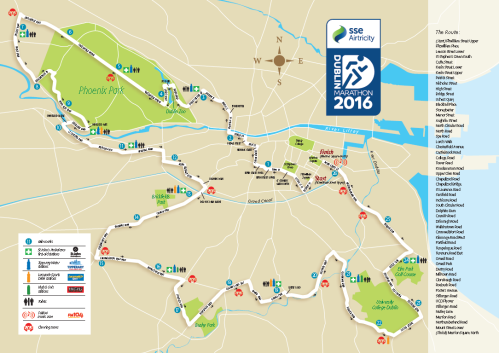
Marathon d’Albi (2016)

Last Sunday April 24th, at the time that this post is being published I was in the departing line of the marathon of Albi, a French town in the South West of France, famous for its cathedral and the museum dedicated to the painter Toulouse-Lautrec.

My brother Jaime came with me to the marathon as support team, but this time I would race alone. I had subscribed to the race a few months earlier in order to force myself to keep up with the training.

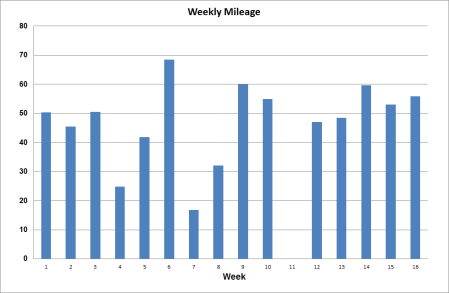
And it did force me, but not that much. The typical training plan that I use to train for marathons consists of 16 weeks, with series sessions during the week and a long run each weekend. This time, I lacked the motivation to start head on with the planning and it took me about a month to start with the series training. From then on I more or less tried to keep up with those sessions.

On the other hand, the long runs went even worse. I didn’t manage to complete single run of over 30 kilometres or even 2 hours. The longest ones I did were of 21.1 km, half marathons, one training and one in competition (Blagnac semi marathon on March 13, training calendar week number 11, in 1h40′, a moderately good time).

Apart from that, on April 3rd, David, our second child was born. And just before and after that (training calendar weeks 12 and 14) I fell heavily sick, having to drop running alltogether for 9 and 10 days each time. All in all, I arrived to the race with just 530 km of training in the legs. About 200 km less than if I would have met the plan at about 80% (a moderately good completion that I have managed previous times). I knew I would pay for it. The question was how much I would pay and since when.

Albi_training

The marathon of Albi departs and finishes in the athletics stadium of the city. It makes an initial detour through the city center and then goes along the river Tarn for about 18 kilometres and back. Part of this route goes through small villages, part of it at the side of the river with wonderful views and part of it through 2 tunnels of 900 m and 400 m, both ways, a strange experience. Along the route there are some groups of villagers cheering the runners but the atmosphere is rather silent. There aren’t many runners neither: 362 at the departing line, a handful less at the finish line. This running event is mostly about you running by yourself along a small road by the river.

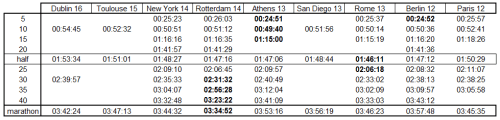
Albi The organization of the race had several pacers. I decided to start with the 3h45′ one, knowing that I would not be able to keep up with him until the end, but knowing as well that that pace (5’19” per km) was a comfortable one to start with for me (having finished several marathons in around 3h45′). And so I did. However, the pacer in question started running consistently below the target pace, despite of some remarks made to him by other runners in the pack. We went the first 12-13 kilometres at a pace of about 5’05” – 5’10” which is not much faster but enough to take its toll on you when you’re short of training. I therefore decided to let them go and soften my pace from the km 13. I still arrived at the half marathon at below 1h52’20”, the target pace for 3h45′. However, as you can see below from the kilometre 24 and especially the 29 I started to notice the lack of training, of long runs. The hill was coming.

Albi_pace

After having completed several marathons and a couple of ultra marathons, the difficulty in keeping a pace or seeing the pace deteriorating did not bother me especially. I knew I would finish. I just didn’t know whether I would make 3h55′, 4h, 4h05’… I especially softened the pace between the km 34 and 39, where we encountered a couple of small climbs and supply posts and in the end I clocked 4h10’14” of net time, which is the worst time I have managed in the last 15 years, about a minute worse than what I did in Toulouse in 2011. It didn’t matter. I already knew at the departing line that it would not be the best marathon nor the second best or… I came in order to complete another one, to keep up with the running and to collect the prize of having pushed myself to keep training for the last four months, even if I didn’t quite manage it as I wished I had.

The best part of the race were the last 3 km, already back in Albi, when I stepped up the pace, thinking about the children and the last lap at the stadium that was about to come, where I met my brother again, who took some nice pictures, one of them I share below, indicating that this was the 14th marathon that I have completed so far.

Albi

2 Comments

Filed under Sports

Warren Buffett’s 2015 letter to the shareholders of Berkshire Hathaway and 2016 annual shareholder meeting

Every last Saturday of February, a must read for the weekend comes out: Warren Buffett’s letter to the Shareholders of Berkshire Hathaway [PDF, 2.4 MB].

Me at BRK 2011 annual shareholders meeting.

Me at BRK 2011 annual shareholders meeting.

This year’s letter was published on February 27th, and despite the fact that I normally share some lines about it in the blog just after having read it (1), this year I wanted to wait a couple of months before writing this post in order to conveniently share it today, the day before the annual shareholders meeting, to be held tomorrow Saturday April 30th, as it will be streamed live for the first time ever. I had the chance to attend such shareholder meeting in 2011 (see my review here) and I strongly recommend to those who haven’t to take a look at the stream at Yahoo Finance, from 9am Central Daylight Time.

From this year’s letter, I wanted to bring attention to the description of the acquisition at the end of 2015 of Precision Castparts Corp (for 32bn$ cash), the highlight of the year, and to the following quotes or passages on their hands-off management style, on their flexibility to allocate capital, on what a 2% real GDP growth means, on mortgage risk retention on the side of lenders, the discussion on the linkage between productivity and prosperity (a bit too long to be transcribed as an excerpt – from the page 20 of the letter to the 22) and on the need to act on climate change.

***

On their hands-off management style:

After the purchase, our role is simply to create an environment in which these CEOs – and their eventual successors, who typically are like-minded – can maximize both their managerial effectiveness and the pleasure they derive from their jobs. (With this hands-off style, I am heeding a well-known Mungerism: “If you want to guarantee yourself a lifetime of misery, be sure to marry someone with the intent of changing their behavior.”)

On their flexibility to allocate capital:

Our flexibility in capital allocation – our willingness to invest large sums passively in non-controlled businesses – gives us a significant edge over companies that limit themselves to acquisitions they will operate. Woody Allen once explained that the advantage of being bi-sexual is that it doubles your chance of finding a date on Saturday night. In like manner – well, not exactly like manner – our appetite for either operating businesses or passive investments doubles our chances of finding sensible uses for Berkshire’s endless gusher of cash. Beyond that, having a huge portfolio of marketable securities gives us a stockpile of funds that can be tapped when an elephant-sized acquisition is offered to us.

On what a 2% real GDP growth means (2):

America’s population is growing about .8% per year (.5% from births minus deaths and .3% from net migration). Thus 2% of overall growth produces about 1.2% of per capita growth. That may not sound impressive. But in a single generation of, say, 25 years, that rate of growth leads to a gain of 34.4% in real GDP per capita. (Compounding’s effects produce the excess over the percentage that would result by simply multiplying 25 x 1.2%.) In turn, that 34.4% gain will produce a staggering $19,000 increase in real GDP per capita for the next generation. Were that to be distributed equally, the gain would be $76,000 annually for a family of four. Today’s politicians need not shed tears for tomorrow’s children.

On the different views to be taken of certain intangible assets amortization no matter what accounting rules say about them (3):

[…] serious investors should understand the disparate nature of intangible assets. Some truly deplete in value over time, while others in no way lose value. For software, as a big example, amortization charges are very real expenses. Conversely, the concept of recording charges against other intangibles, such as customer relationships, arises from purchase-accounting rules and clearly does not reflect economic reality. GAAP accounting draws no distinction between the two types of charges. Both, that is, are recorded as expenses when earnings are calculated – even though, from an investor’s viewpoint, they could not differ more.

[…] We now have $6.8 billion left of amortizable intangibles, of which $4.1 billion will be expensed over the next five years. Eventually, of course, every dollar of these “assets” will be charged off. When that happens, reported earnings increase even if true earnings are flat. (My gift to my successor.)

I suggest that you ignore a portion of GAAP amortization costs. But it is with some trepidation that I do that, knowing that it has become common for managers to tell their owners to ignore certain expense items that are all too real. “Stock-based compensation” is the most egregious example. The very name says it all: “compensation.” If compensation isn’t an expense, what is it? And, if real and recurring expenses don’t belong in the calculation of earnings, where in the world do they belong?

Wall Street analysts often play their part in this charade, too, parroting the phony, compensation-ignoring “earnings” figures fed them by managements. Maybe the offending analysts don’t know any better. Or maybe they fear losing “access” to management. Or maybe they are cynical, telling themselves that since everyone else is playing the game, why shouldn’t they go along with it. Whatever their reasoning, these analysts are guilty of propagating misleading numbers that can deceive investors.

Depreciation charges are a more complicated subject but are almost always true costs. Certainly they are at Berkshire. I wish we could keep our businesses competitive while spending less than our depreciation charge, but in 51 years I’ve yet to figure out how to do so. Indeed, the depreciation charge we record in our railroad business falls far short of the capital outlays needed to merely keep the railroad running properly, a mismatch that leads to GAAP earnings that are higher than true economic earnings. (This overstatement of earnings exists at all railroads.) When CEOs or investment bankers tout pre-depreciation figures such as EBITDA as a valuation guide, watch their noses lengthen while they speak.

On mortgage risk retention:

Barney Frank, perhaps the most financially-savvy member of Congress during the panic, recently assessed the 2010 Dodd-Frank Act, saying, “The one major weakness that I’ve seen in the implementation was this decision by the regulators not to impose risk retention on all residential mortgages.” Today, some legislators and commentators continue to advocate a 1%-to-5% retention by the originator as a way to align its interests with that of the ultimate lender or mortgage guarantor.

At Clayton, our risk retention was, and is, 100%. When we originate a mortgage we keep it (leaving aside the few that qualify for a government guarantee). When we make mistakes in granting credit, we therefore pay a price – a hefty price that dwarfs any profit we realized upon the original sale of the home. […]

Some borrowers, of course, will lose their jobs, and there will be divorces and deaths. Others will get overextended on credit cards and mishandle their finances. We will lose money then, and our borrower will lose his down payment (though his mortgage payments during his time of occupancy may have been well under rental rates for comparable quarters). Nevertheless, despite the low FICO scores and income of our borrowers, their payment behavior during the Great Recession was far better than that prevailing in many mortgage pools populated by people earning multiples of our typical borrower’s income.

On the need to act on climate change:

This issue bears a similarity to Pascal’s Wager on the Existence of God. Pascal, it may be recalled, argued that if there were only a tiny probability that God truly existed, it made sense to behave as if He did because the rewards could be infinite whereas the lack of belief risked eternal misery. Likewise, if there is only a 1% chance the planet is heading toward a truly major disaster and delay means passing a point of no return, inaction now is foolhardy. Call this Noah’s Law: If an ark may be essential for survival, begin building it today, no matter how cloudless the skies appear.

(1) See the review I made of 2009, 20122013 and 2014 letters.

(2) In relation to that I recommend reading Thomas Piketty’s “Capital in the 21st Century” (of which I may write a review at a later point in time). There he explains how for most of history, human kind has lived a small growth rate and we may well come back to that.

(3) Every year letter discusses that, always with some variation, I keep recommending a detailed look at it.

Leave a comment

Filed under Investing

El sol de Breda

ElSolDeBredaHace un par de semanas leí en la recién creada web Zenda libros, gracias a un retuit de Arturo Pérez Reverte, una entrevista que le hizo Miguel Munárriz en 1998 a Pérez Reverte con motivo de la publicación de “El sol de Breda”, la tercera entrega de la serie de libros sobre el personaje del Capitán Alatriste.

Dicha lectura no pudo ser más oportuna, dado que ese mismo día estaba terminando otro libro y en casa tenía un ejemplar de “El sol de Breda”, que no es mío, pero que había tomado prestado las últimas navidades de casa de mis padres. Así que me decidí a leerlo.

El sitio a la ciudad de Breda, actualmente en los Países Bajos, duró casi un año entre 1624 y 1625. Quizá el mayor testimonio del mismo se trata del cuadro del pintor Diego VelázquezLa rendición de Breda o “Las Lanzas”, que se exhibe en el Museo del Prado.

El libro de Perez Reverte ofrece una ficción basada en los hechos reales de dicha batalla. Mezcla personajes reales como el propio pintor, el escritor Francisco de Quevedo o el general italiano Ambrosio Spínola, al frente de los tercios de Flandes, con personajes ficticios como el Capitán Alatriste o Íñigo Balboa, un joven adolescente apadrinado por Alatriste a quien sirve en el tercio Viejo de Cartagena como mochilero aprendiendo el oficio de soldado.

El libro se supone basado en las memorias de Balboa, y establece una descripción del sitio y de las batallas con todo lujo de detalles, desde las inclemencias del tiempo, las condiciones en las trincheras, las heridas de guerra, el miedo, la incertidumbre, la falta de alimentos, etc.

Como curiosidad me llamó la atención la correspondencia ficticia entre Quevedo y Alatriste y Balboa, y la relación entre Balboa y Velázquez para describirle el sitio de Breda y que el pintor pudiese realizar su cuadro.

Por otro lado, me imagino que deberé leer algún otro libro de la serie de Alatriste para conocer mejor al personaje, dado que si bien es uno de los principales caracteres, tampoco se centra del todo en él.

Por último, quería compartir algunos pasajes del libro en los que Pérez Reverte vierte su siempre crítica visión de España, el carácter de los españoles y sus constantes luchas internas:

“[…] y a ello hemos de añadir la decadencia de la propia España, donde un rey bien intencionado e incapaz, un valido inteligente pero ambicioso, una aristocracia estéril, un funcionariado corrupto y un clero por igual estúpido y fanático, nos llevaban de cabeza al abismo y a la miseria, con Cataluña y Portugal a punto de separarse de la Corona, este último para siempre. Estancados entre reyes, aristócratas y curas, con usos religiosos y civiles que despreciaban a quienes pretendían ganar honradamente el pan con sus manos, los españoles preferíamos buscar fortuna peleando en Flandes o conquistando América, en busca del golpe de suerte que nos permitiese vivir como señores, sin pagar impuestos ni dar ni golpe.

“[…] y como de costumbre, según esas mismas lenguas y sus tierras de origen, tomaban partido unos contra otros, valencianos a una parte y andaluces de la otra, leoneses frente a castellanos y gallegos, catalanes, vascongados y aragoneses cerrando para sí mismos y por su cuenta, y los portugueses, que alguno teníamos, viéndolas venir agrupados y en rancho aparte. De modo que no había dos reinos o regiones de acuerdo; y mirando hacia atrás; uno no lograba explicarse lo de la Reconquista salvo por el hecho de que los moros también eran españoles.”

“Y pronunciada en castellano, la palabra reputación era entonces mucha palabra. No en balde los españoles peleamos siglo y medio en Europa arruinándonos por defender la verdadera religión y nuestra reputación; mientras que luteranos, calvinistas, anglicanos y otros condenados herejes, pese a especiar su olla con mucha Biblia y libertad de conciencia, lo hicieron en realidad para que sus comerciantes y sus compañías de Indias ganaran más dinero; y la reputación, si no gozaba de ventajas prácticas, los traía al fresco. Que siempre fue muy nuestro guiarse menos por el sentido práctico que por el orapronobis y el qué dirán. De modo que así le fue a Europa, y así nos fue a nosotros.”

“A ellos, españoles de lenguas y tierras diferentes entre sí, pero solidarios en la ambición, la soberbia y el sufrimiento, y no a los figurones retratados en primer término del lienzo, era a quien el holandés entregaba su maldita llave.”

LasLAnzas

Estos párrafos los escribió Perez Reverte en 1998 pretendiendo haber sido escritos en el siglo XVII pero son perfectamente aplicables a 2016.

Nota: este libro en la edición que yo tengo tiene unas 250 páginas, con letra grande, líneas espaciadas, cómodo de leer. En su lectura habré invertido unas 7 horas, ideal para unas cortas vacaciones.

2 Comments

Filed under Books

Ailes Anciennes Toulouse, Visites Cockpit (April 2016)

Ailes Anciennes Toulouse is an association that preserves and restores old airplanes and helicopters. It is located in Blagnac, close to the museumAeroscopia. In its collection has over 50 aircraft, some of which are being worked on, some are displayed in their field and others are ceded to Aeroscopia (e.g. the Super Guppy being one of them).
VisitesCockpitApril2016About three or four times a year, Ailes Anciennes organizes what they call Visites Cockpit events. In those days, most of the aircraft on display are opened for visitors to enter in them, sit in their cockpits, experience them, get explanations from enthusiast volunteers of the association, walk through their cabins and cargo hold compartments. Last year we went for the first time. See here the post I wrote then about it.

Last April 2nd, we went there again (as over 540 other enthusiasts), as it is always a nice experience to walk around those pieces of craft, plus this time we went with my father-in-law.

In relation to last year’s visit, this time there was a new restoration hangar, named “Ateliers Louis Breguet” after the aviation pioneer and it was possible to enter into the double decker (“Deux Ponts“) Breguet 765 Sahara, an antecessor to the Airbus A380, designed in the 1940s, introduced in service in the 1950s with 20 units built.

The best way to give some flavour of the place is sharing some pictures:

Facing Caravelle back door.

Facing Caravelle back door.

Seated on a Sud Aviation Caravelle.

Sitting onboard a Sud Aviation Caravelle.

Dassault Mirage III.

Dassault Mirage III.

Side view of Breguet 765 Sahara.

Side view of Breguet 765 Sahara.

Upper deck of Breguet 765 Sahara.

Upper deck of Breguet 765 Sahara.

Interior of Breguet 765 Sahara.

Interior of Breguet 765 Sahara.

Cockpit of Breguet 765 Sahara.

Cockpit of Breguet 765 Sahara.

Playing 1 Playing 2

Hangar Louis Breguet.

Hangar Louis Breguet.

De Havilland Vampire T11 built in France by SNCASE.

De Havilland Vampire T11 built in France by SNCASE.

Cargo hold of Nord 2501 Noratlas.

Cargo hold of Nord 2501 Noratlas.

I recommend the visit to Ailes Anciennes in its Cockpit days (10€ for adults). Take a look at their website to see when the next one is scheduled (normally in spring).

1 Comment

Filed under Aerospace & Defence