Mi pronóstico de las elecciones generales de España de 2015

Con la ocasión de las elecciones generales en España el próximo domingo 20 de diciembre, quería aprovechar para hacer un pronóstico de las mismas como ejercicio de aprendizaje (1).

En un principio quería haber producido el pronóstico a partir de utilizar, de chequear algunas encuestas de alguna empresa demoscópica en particular con las elecciones generales de 2011, contrastarlas después con los resultados, y sacar algún tipo de factores de corrección. Y hacer lo mismo con las autonómicas de 2011/2012 y 2015. Pero cuando me puse a ver las encuestas de las generales no se daba el detalle de porcentajes de voto por partido y circunscripción. Por ello tuve que desechar esa metodología.

Finalmente, he ido comparando los resultados de generales de 2011, y las dos últimas autonómicas, y viendo la tendencia me he ayudado de alguna encuesta en algunos casos (2). Aclarar que el ejercicio no se trata de una encuesta (no he ido llamando a nadie), ni de una media de encuestas (3).

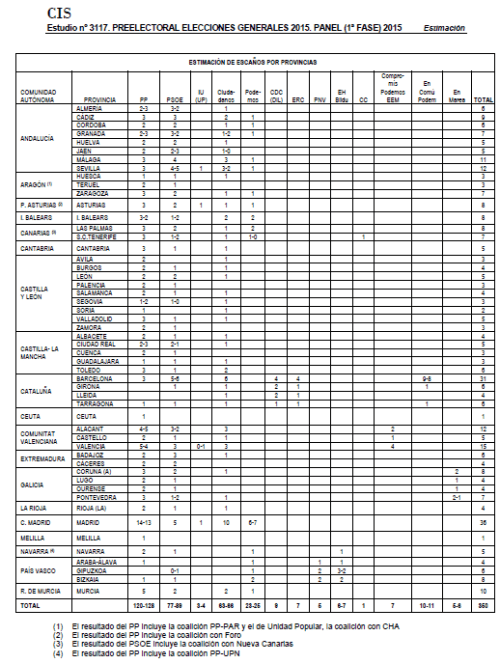
Como he dicho antes, cuando una encuesta nos dice “el PP va a conseguir un 26% y entre 110-116 escaños” nos da un resultado que se compone de la suma de muchas provincias, que no nos sirve para ver que va a pasar en nuestra provincia en particular. El CIS sin embargo, ofrece una encuesta con hasta 17 mil encuestados, donde indica su estimación de reparto de escaños por provincias y de porcentajes de voto globales (4). Y esa visión, mucho más completa es la que quería replicar con este ejercicio.

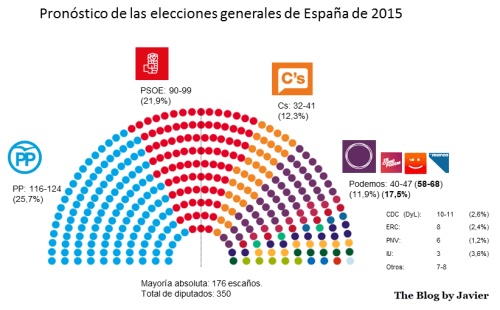
Como recordatorio: en España tenemos 52 circunscripciones (provincias más Ceuta y Melilla) que aportan desde 1 diputado (Ceuta y Melilla) a 36 (Madrid). El total son 350 y la mayoría absoluta se consigue con 176 escaños. Dicho esto, la tabla y la gráfica siguientes resumen todo el trabajo:

Como quedaría el arco parlamentario.

Como quedaría el arco parlamentario.

Pronóstico detallado.

Pronóstico detallado.

Por otro lado, el censo se compone de algo más de 36,4 millones de electores. De ellos 34,5 son residentes en España. De ellos, he supuesto que la participación es de un 75% (uniforme en todo el país por simplificación; aunque no lo será).

A los casi 2 millones de electores residentes en el extranjero los he despreciado para la estimación de números totales de votos obtenidos por cada partido. No los he despreciado porque lo haga el gobierno con el arduo tramite del voto rogado, sino porque la participación será mucho menor (fue menor del 10% en 2011) y como se reparte en las 52 circunscripciones es muy difícil que decida el signo de un escaño (5).

Con todo ello he supuesto que votan casi 26 millones de personas. Con unos 25.1 millones de votos a partidos (excluyendo blancos y nulos). Con los porcentajes de voto indicados arriba, los votos totales obtenidos por los principales partidos serían:

  • PP: 6,65 millones
  • PSOE: 5,67 millones
  • Podemos (6): 4,53 millones
  • Cs: 3,18 millones
  • IU/UP: 0,9 millones

Una vez compartido el pronóstico, no voy a hacer ningún análisis del mismo, dado que puede estar muy o poco equivocado; mejor esperar a tener los resultados reales.

(1) Ya en 2011, tras las elecciones generales hice el ejercicio de repartir con distintos métodos (proporcional vs D’Hondt, circunscripciones provinciales vs única…) y el ejercicio me resultó útil.

(2) Por ejemplo, en las dos Castillas parece no muy difícil hacer un pronóstico en cuanto reparto de escaños a partir de los últimos resultados y su evolución. Sin embargo, en Cataluña, Galicia o País Vasco no es nada sencillo.

(3) Ver por ejemplo los que hace Kiko Llaneras aquí.

(4) Ver más abajo las tablas del CIS. La fuente aquí.

(5) Sobre esto se ha escrito ya. En otro momento buscaré la referencia y la añadiré aquí.

(6) Incluyendo En Comú, Compromís y En Marea.

CIS_porcentajes CIS_detalle

4 Comments

Filed under Miscellanea

Toulouse marathon (2015)

Last October 25th, I ran the Toulouse marathon. It was the second time I completed this race; the first one being in 2011, then the first marathon I had run since 2001.

This year, like in 2011, I ran the Toulouse marathon after having run the 100 km of Millau one month before. In fact, I only decided to take part in it 2 months before the race. The main driver: within the programme I am working on in Airbus since July (A330neo), the marathon of Toulouse had been taken as a big collective well-being activity. Over 80 people from different teams ran the race; which can be completed in relays (teams of 4 runners where each one runs about 10km) (1) and individually.

At the end of August, running about 50 kilometres per week as training for Millau, even if not doing tempo and series training sessions, I decided that I could fairly run the Toulouse marathon after Millau, if I sustained no major injuries and did not care much about the time. So I subscribed.

The day before the marathon we had a photo session, distribution of A330neo t-shirts especially made for the occasion and the traditional pasta party on the eve of marathons. This one was a somewhat elegant dinner, consisting of buffet with different salad, pasta and desert options, organized at the top floor of the Mediatheque in Toulouse, with live performance of a flamenco group.

The race itself went rather well. In the weeks beforehand, I had been considering the starting pace: whether to go for a 5’20” per km or faster. The first pace leads to a marathon of about 3h45′ (a time around which I had already completed some and was comfortable with). After some testing training sessions I decided to be conservative and go with the 3h45′ pacers as long as I could keep up with them.

… and so I did until the kilometre 35. It was therefore a rather pleasant race. Always keeping myself to the rhythm set by the pacers, enjoying the route along the far North neighbourhoods of Toulouse, the music bands, etc. Entering back to the centre of the city, at about the km 33 I started to feel that the pace took more effort to keep and at the km 35 I decided to let go, and run the last 7 km, through the centre (the boulevards, the Jardin de plants, Alsace – Lorraine…) at a more comfortable pace. I estimated that in those last 7 kilometres I would not lose much more than a couple of minutes, that would not make any difference (it wouldn’t anyway be my best time nor the second in the distance).

Pace followed during the race.

Pace followed during the race.

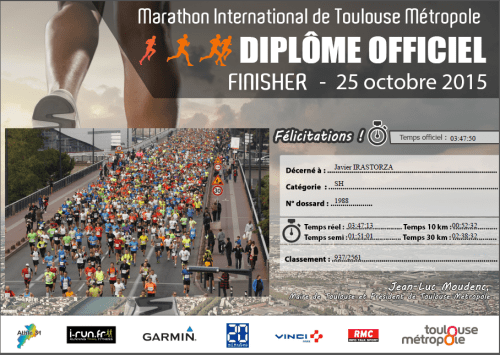
In the end I completed the marathon in 3h47’13”, my fifth best time, the 4th time I finished in the time bracket between 3h44’30” and 3h47’13”. Thirteenth marathon completed (2).

Finisher diplome.

Finisher diploma.

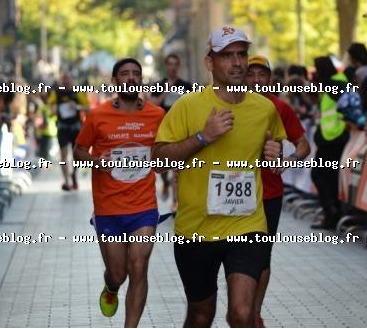
Find below pictures of myself and of the A330neo team:
TLS

EVE-957-03-20151025-AT-MARATHON DE TOULOUSE-158

(1) I took that option of running the marathon in relay in the year 2013 as a preparation towards Athens marathon.

(2) See all the others in the section Races from the blog.

2 Comments

Filed under Sports

Bárcenas, la película.

Hace una semana finalmente pude ver “B, la película”, que es la adaptación al cine de una obra de teatro del mismo nombre sobre el interrogatorio que el juez Pablo Ruz hizo al extesorero y exgerente del Partido Popular Luis Bárcenas el 15 de julio de 2013.

La película, dirigida por David Ilundain y protagonizada por Pedro Casablanc (Bárcenas) y Manolo Soto (Ruz), dura aproximadamente 1 hora y 20 minutos y está basada en hechos reales, la transcripción del propio interrogatorio. En ese interrogatorio Bárcenas se retracta de sus anteriores declaraciones y confiesa que los famosos “papeles de Bárcenas” publicados por El País y El Mundo son verídicos, se corresponden a apuntes contables suyos durante 20 años como tesorero y gerente del partido, reflejan los movimientos de la caja B del partido, la continua financiación ilegal del mismo, el pago ilegal de sobresueldos a los cargos del partido (incluyendo Mariano Rajoy), etc. Corrupción, corrupción, corrupción.

“B, la película” fue financiada a través de crowdfunding, vía con la que consiguieron obtener 56.000 €. Se puede ver en algunos cines, aunque tampoco ha tenido mucho éxito en cuanto a la proyección en salas (imagino el por qué), y a través de internet. Yo la “alquilé” para un visionado durante 48 horas por tan solo 3 euros en Vimeo a través de un enlace de la página web de la película (aquí).

Toda la película se desarrolla en la sala donde el interrogatorio tiene lugar (como si fuese “Doce hombres sin piedad”). No tiene desperdicio la interpretación de Casablanc (Bárcenas): su firmeza en el cambio de versión de la declaración, el lujo de detalles y memoria privilegiada para el recuerdo de algunas cifras, fechas y leyes de financiación de partidos, y el vago recuerdo en otras, su dignidad en el trato y descripción de algunos personajes y repugnancia hacia Maria Dolores de Cospedal. También Soto (Ruz) tiene una interpretación encomiable, en este caso su cara de estupefacción en varios momentos por lo que oye del acusado. Imagino que las caras que pondría el propio Ruz no serían muy diferentes.

Además de recomendar el ver la película, os dejo aquí debajo el tráiler de la misma:

Leave a comment

Filed under Movies

The Spirit of St. Louis (book review)

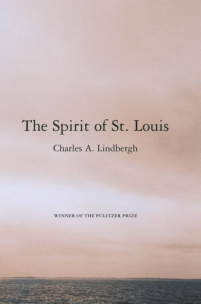
TheSpiritOfStLouisCharles A. Lindbergh is without a doubt one of the aviation (1) figures and legends of the XX century, being the first pilot to fly non-stop across the Atlantic ocean in May 1927, managing to win the Orteig Prize. Lindbergh wrote “The Spirit of St. Louis” in 1953, as an autobiography because he was not comfortable with the previous books written about the flight, especially “WE”, as it did not cover with enough exactitude the experience. For this book Lindbergh was awarded the Pulitzer prize on 1954 in the category biography.

I bought this book at the US Air Force museum in Dayton a place that without a doubt stimulates the passion for aviation and I read it in the months while I was completing the last stages of my training as a private pilot, which also contributed to the setting of the stage for the reading.

The beginning of the book covers the days of Lindbergh working for the postal service of the Robertson Aircraft Corporation, the flights along the USA from Saint Louis to Chicago, the incidents due to the weather or the fall of the night, the landings on fields at night with the help of cars’ lights, etc.

As an aviation enthusiast, Lindbergh gets interested in and then engaged into the race of who would be the first pilot(s) to cross the ocean. A crowded race at the time in which many of the great aviation aces were involved, including names like René Fonck or Charles Nungesser (two of the three top French WWI aces (2)).

He later describes the conception, development and testing of the aircraft by the Ryan Aircraft Company in San Diego, the purpose-built airplane he flew for the feat and how they managed to get a Whirlwind engine from the Wright company.

The author finally describes the days in New York before the departure, where up to 3 teams were getting ready to depart and how in the morning of the 20th May, having received positive weather reports from boats in the Atlantic, he takes off. The flight lasted 33h30′ which he describes hour by hour: how he is feeling at each moment, alone, squeezed in his seat, with scarce food and water supplies, cold, flying day (within the clouds at times) and night, thrilling at times and semi-unconscious (sleep), and how his mind is drifting. Until he sees land in Ireland, finds the route to Paris and lands in Le Bourget.

What I liked the most of the book were the description of the flying experiences as a postal service pilot and the development phase of the aircraft. Those are very interesting pages, full of concepts and anecdotes.

It took me months to complete the reading of the book. Why? I was stuck and I advanced very slowly in different parts of the narrative of the 33-hour-long flight. I would say that Lindbergh did that in purpose: writing hour by hour, a few pages per hour, describing what was going on, how his mind got distracted, how he began to remember memories from years back, how he suddenly found once and again that he had lost the bearing and needed to correct it, how he cursed himself for the lack of attention or being on the verge of falling sleep… I felt caught many nights in the same sleepy, somnolent mood. Unable to read more than one or two pages before falling asleep. If that was really the purpose of Lindbergh I cannot know, but, if it was, he was very skillful in conveying the length of those hours and the risk he went through. However, it goes against the readability of the book itself!

Some quick personal reflections I took from the book:

  • Observation. While crossing the ocean, he didn’t have any support information as to the direction or speed of the wind, therefore he descended to see close enough the waves and try to estimate them himself.
  • Bearing. My flying instructor used to say “in the air, the bearing is the life“. When he is flying over the ocean he finds himself sometimes having to correct up to 10 degrees. On top, due to lack of intermediate points of reference and that he is not sure about the speed and direction of the wind, hours before seeing the land in Ireland he finds himself estimating that he may either see the land in Norway or the gulf of Biscay in Spain.
  • Changing position within seat. In order to prevent falling asleep, at some times he goes systematically changing position within the seat: stretching a leg, then the other, grabbing the commands with a hand, then the other. This is something that we can do also while piloting or driving a car (though preferably mixing it with frequent stops!)

As I always do, I marked several pages and underlined different passages that trigger different thoughts. See some of them below:

“I have divided my reserves for the flight in two categories: reserves for success and reserves for failure.”

“[…] I don’t wish my competitors hard luck. Crashed planes and flyers in hospitals impair all of aviation, and destroy the joy of flight.

Landing on one wheel and a wing tip with a highly loaded plane isn’t very dangerous when a pilot is well acquainted with his craft. […] it has been done many times. The newspapers always make it seem a good deal worse than it really is.”

“On our mail route, the pilots expect forced landings. We don’t average a hundred hours between them.”

“Science, freedom, beauty, adventure: what more could you ask of life? Aviation combined all the elements I loved.”

“A pilot has the right to choose his battlefield – that is the strategy of the flight. But once the battlefield is attained, conflict should be welcomed, not avoided. If a pilot fears to test his skills with the elements, he has chosen the wrong profession.”

I wish I could take an aeronautical engineering course. […] I could work hard to understand the magic in the contours of a wing.”

Now pretty soon you fellows are going to think you’re pretty good. It happens to every pilot. Usually starts when he’s had about 25 or 30 hours solo. I just want you to remember this: in aviation, it may be all right to fool the other fellow about how good you are – if you can. But don’t try to fool yourself.” (advice from his instructor in the Army, Master Sergeant Winston)

“No matter how much training you’ve had, your first solo is far different from all other flights. You are completely independent, hopelessly beyond help, entirely responsible, and terribly alone in space.”

“One old Negro woman came up to me with serious face and asked, ‘Boss, how much you all charge fo’ to take me up to Heaven an’ leave me dah?‘ “

The book includes several very interesting appendices about the flights of the aircraft, technical data and maps, prizes collected…

After completing the flight, Lindbergh made some tours around the world until the airplane was finally retired after 174 flights and 489 hours of flying. Today it can be visited at the National Air and Space Museum in DC.

If you like aviation, I do recommend you the reading of the book.

(1) I would say that the size of his fame, legend and iconic figure is not restricted to the aviation world.

(2) The third of the trio, Guynemer, died in the war.
4 Comments

Filed under Aerospace & Defence, Books

My path to the private pilot licence (PPL)

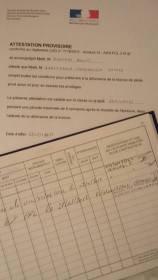
Provisional attestation and log book.

Provisional attestation and log book.

A week ago, on Friday 27th of November, I finally took and passed the practical exam towards obtaining the private pilot licence (PPL).

I have written several posts along these years of different experiences during the learning process: the start of the flight lessons, the first take off at the controls, about weight and balance calculations, the preparation of a flight to Corsica, the flying experience to Corsica, the first solo flight, about refuelling or not, the flying experience to the Loire Valley, and the grand navigation solo

In this post, I just wanted to share some figures of my educational path that may help readers form an idea if they are interested in pursuing the licence:

  • I arrived to the exam with 62.4 flight hours (FH) (1),
    • thereof 51.92 FH accompanied by an instructor.
    • thereof 10.48 FH flying solo (2), a 17% of the total amount,
      • thereof 6.31 FH flying solo in navigation flights (3).
  • To complete those flying hours I performed 71 flights,
    • thereof 14 flights flying solo, a 20% of the total amount.
  • In those flights I performed 123 landings (4)
    • thereof the first ~17 were performed by the instructor (4).
    • thereof 29 landings flying solo, a 24% of the total amount.

I didn’t fly often, therefore even if it has not taken many hours above the minimum requirement to obtain the licence it has taken a long time. Exactly 1503 days since the first flight, or 4 years, a month and 11 days.

Chronologically some dates to remember and as reference:

  • First flight: October 16, 2011.
  • First take off at the controls: December 17, 2011 (on the 5th flight).
  • First landing at the controls: not sure, about June / July 2012 (16-17th flight and about 14-15 FH).
  • First solo flight: August 30, 2013 (the 33th flight and after having completed almost 30FH).
  • First solo navigation flight (from A to B): May 16, 2014 (the 50th flight and after having completed almost 42 FH, of which almost 3 solo in the aerodrome circuit).
  • First solo navigation  flight (from A to B to A): August 19, 2014 (the 55th flight and after having completed 47 FH, of which 3.5 solo).
  • Grand navigation solo: July 23rd, 2015 (65th flight and after having completed 56 FH, of which almost 8 solo (3.6 in navigation)).
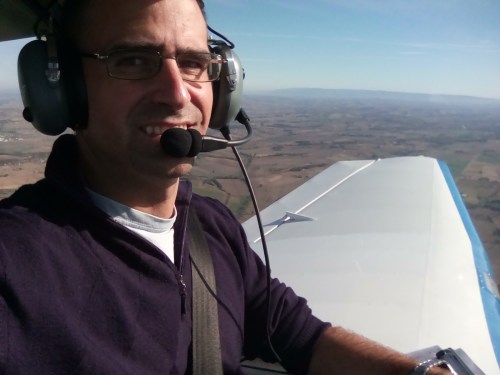
Flying in November 2015.

Flying in November 2015.

(1) Minimum requirement: 45 FH.

(2) Minimum requirement: 10 FH.

(3) Minimum requirement: 5 FH.

(4) Thus, about 106 landings, as I started doing the landings when I had cumulated about 14 FH.

5 Comments

Filed under Aerospace & Defence

Boeing vs. Airbus: CEO compensation (2014)

At the beginning of this year, I wrote a post titled “Boeing vs. Airbus: CEO compensation (2013)” in which I compared the compensation of both CEOs. Even if the post was published in 2015, as I wrote it at the beginning of the year the latest information available from both companies was the compensation of 2013.

A few days ago, I saw that this post received a larger than usual amount of visits which reminded me that now, at the end of the year 2015, we can find the same information for the 2014 fiscal year. Thus, this follow on post.

As both Boeing and Airbus are public companies, the information about their CEOs compensation is public and can be found in the annual report and proxy statement from each one. I will just copy the information below for comparison and future reference.

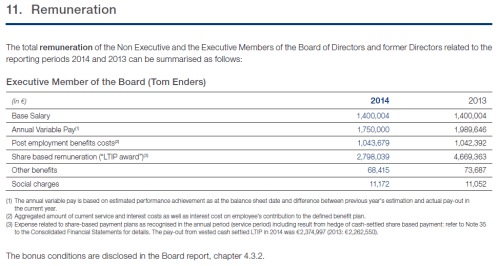
Airbus Group CEO, Tom Enders’ 2014 compensation (financial statements here, PDF, 4.2 MB).

Airbus Group’s Tom Enders 2014 compensation.

Airbus Group’s Tom Enders 2014 compensation.

Boeing CEO, Jim McNerney’s 2014 compensation (proxy statement here, PDF, 1.0MB)

Boeing’s Jim McNerney 2014 compensation.

Boeing’s Jim McNerney 2014 compensation.

Just as a reminder, from July 1st 2015, Dennis Muilenburg took over the position of Chief Executive Officer (he was at that moment the COO) from Jim McNerney.

3 Comments

Filed under Aerospace & Defence

“A good landing” (speech)

Over a year ago, I wrote a post about a speech I gave at the then prospective Toastmasters club that some colleagues were pushing to set up within Airbus in Toulouse. Yesterday, we had the 48th session of the club. And yesterday, the club president (Sarah) announced that the club, Airbus Speakers Toulouse, is now a chartered club (1). For this achievement, I wanted to congratulate our colleague Eduardo, who a few months ago left Toulouse for Seville:

Coincidentally, yesterday I was giving a speech at the club. It was the second project of the advanced manual “Speeches by Management” (2), that is “The Technical Speech”. I had to convert a technical paper into a speech, use a technique called “inverted-pyramid” and effectively read out the speech. This was a challenge in the sense that, since long time ago, I don’t use notes for the speeches I prepare. I don’t like it. And this time, I didn’t need them either. But as part of the exercise I forced myself to use them, in order to practice for a situation in which I might need them. That is Toastmasters: practice, practice, practice. (3)

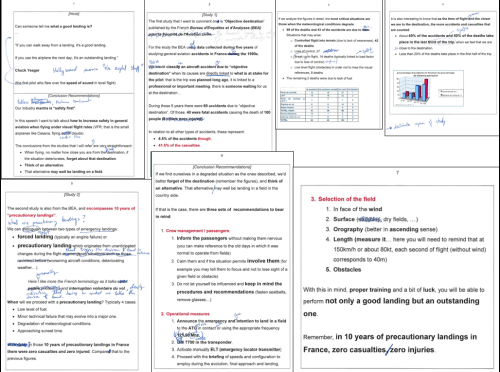
In order to read out the speech, the manual gave tips on how to write the speech in paper: large fonts, short sentences, bottom of each page blank, etc., very useful tips. See below how for a 10-minute speech, about 1,000 words (4), it took 7 pages, instead of about 2 that it would have normally taken (find here the speech) [PDF, 623 KB].

A good landing

Above you can see how I made some grammar corrections, how I deleted some sentences which did not sound well, how I annotated some instructions (e.g. to distribute copies of the paper), how I emphasized some words and… how I introduced some last-minute adaptations. In Toastmasters’ meetings we normally have a word of the day which speakers should strive to introduce in their speech. Yesterday’s one was split. You can see how upon discovering it at the beginning of the meeting, I scanned my speech and located the 3 places in which I would insert it (which I did in the delivery). 🙂

In our club, we not only have a word of the day but we have a theme of the day, picked by the Toastmaster of the day (5). Yesterday’s theme was Hollywood. You can see how, as soon as I learned about the theme, I decided to make reference of a movie which featured Chuck Yeager (6) as I was quoting a couple of sentences from him. Funny enough, I had learned about that movie thanks to my brother Jaime just a couple of days before.

The speech talks about safety in general aviation, putting the emphasis on precautionary landings when the situation deteriorates. The idea of the speech comes from a safety note published by my flying instructor, Thierry, some time ago in the internal bulletin of the aeroclub. He referred then, and I do so in my speech, to a couple of studies from the French Bureau d’Enquêtes et d’Analyses (BEA), principally one called “Objective: Destination” [PDF, 318 KB].

Finally, see below the video of the speech.

The recording starts about 30″ after the speech started and the quality is not very good. A good part of the image is taken by the table in which the camera rests and the light is not optimal. The sound is not great either, as neither is my vocalisation. In fact, that was one of the criticisms that I got, as part of a generally good feedback (7): I should vocalise more clearly. Nevertheless, I must say that I enjoyed delivering it.

(1) That is in Toastmasters language that we are an official club within the organization.

(2) From the version of 2009, as I have later learned that manual contents and organization have changed since then.

(3) By the way, for this speech: I had it written 4 days ahead of the meeting. I rehearsed it 8 times. Seven of them having Luca as an attentive mentor.

(4) At my speaking pace.

(5) The master of ceremonies in Toastmasters language.

(6) A NASA flight test pilot.

(7) Feel free to comment and provide feedback below :-).

Leave a comment

Filed under Aerospace & Defence, Movies, Toastmasters

Flight price comparison: Madrid-Sevilla in 1977 vs 2015

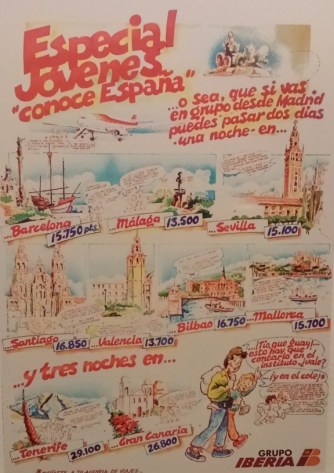
A the exhibition “Pasión por volar” I found the following poster from Iberia with information of some routes and prices in the late 1970s:

Iberia's poster (1977).

Iberia’s poster (1977).

That poster immediately triggered the idea of making the exercise of comparing the price of a same route then and nowadays.

Let’s take the flight Madrid – Sevilla:

  • In 1977, the price announced in the poster was 15,100 pesetas (then the currency in Spain).
  • Today, the price of that flight can be browsed at Iberia’s website. In order to avoid peak prices, I take for the comparison a flight over a weekend within a months from now and avoiding Christmas time. I get prices between 79.5 and 400 €. Let’s take the minimum.
Price flight Madrid - Sevilla (2015).

Price flight Madrid – Sevilla (2015).

Now we have to get inflation and peseta to euro exchange rate into the picture to compare apples to apples.

  • Following the Maastricht Treaty (signed on February 7th, 1992), the exchange rate was fixed on 1 January 1999 when the euro was introduced in non-physical form, fixing the exchange rates between the currencies from the countries that would form the Euro area and the euro itself. For the Spanish peseta the rate was 1 euro = 166.386 pesetas.
  • To account for inflation, we can check the site of the Spanish National Institute of Statistics here (INE, in its Spanish initials). The service provides data ranging from 1961 to 2012 (not 2015). We obtain that from 1977 to 2012 the cumulative inflation has been 769.2%. For the inflation between 2012 and 2015 we can check the site inflation.eu, and we obtain 0.25% for 2013 and -1.04% for 2014. Computing altogether, the cumulative inflation from 1977 to 2015 has been around 763%.

With all the data in place, let’s get the results:

  • Those 15,100 pesetas from 1977 would be worth today (2015) about 692 euros, that is almost 9 times more expensive than the cheapest option today (79.5 €) or almost twice as expensive than an expensive option (400 €).

On the other hand, one would say that the service is not exactly the same. Today, the flight is operated by an Airbus A320, less noisy, and more spacious than the Douglas DC-8 or DC-9 that it probably used then in that line. However, you won’t get drinks or food in that flight today (I suppose that back in the 1970s you did). Also, in the offer from 1977 it was required that you travel in a group to benefit from those prices.

Finally, in the blog post about the exhibition I mentioned that I purchased the book catalogue of it. Inside the book I discovered some images that were not displayed at the exhibition from a route book dating from ~1951. In any case, I leave such other comparison for another post (if any).

Iberia's flight schedules and prices applicable on 1951.

Iberia’s flight schedules and prices applicable on 1951.


3 Comments

Filed under Aerospace & Defence

Airbus vs. Boeing, comparison of market forecasts (2015)

Few days ago, Airbus released the new figures of the 2015-34 Airbus’ Global Market Forecast (GMF, PDF 7.2MB).

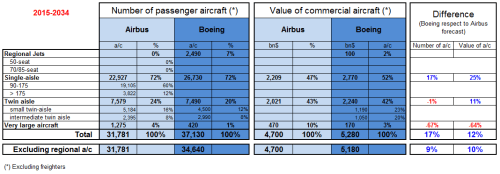
In previous years, I have published comparisons of both Airbus’ and Boeing’s forecasts (Current Market Outlook, CMO, PDF 6.5MB). You can find below the update of such comparison with the latest released figures from both companies.

Comparison of Airbus GMF and Boeing CMO 2015-2034.

Comparison of Airbus GMF and Boeing CMO 2015-2034.

Some comments about the comparison:

  • Boeing sees demand for 9% more passenger aircraft (excluding regional a/c) with a 10% more value (excluding freighters). The gap is the same as in 2014 (in previous years Boeing forecasted up to 14% more aircraft).
  • In relation to last year studies, Airbus has increased demand by ~1,200 aircraft about the same increase seen at Boeing’s.
  • Boeing continues to play down A380 niche potential (67% less a/c than Airbus’ GMF). This year, Airbus has increased in about 50 units its forecasted demand for the VLA segment.
  • Both companies’ forecast for the twin aisle segment is nearly identical: ~7,500 aircraft (Airbus sees demand for about a 100 more than Boeing). The mix between small and intermediate twins varies, 700 units up and down. However, Boeing’s wide-bodies mix is not to be taken as engraved in stone, see the erratic trend in the last years here.
  • On the other hand, Boeing forecasts about 3,800 single-aisle more than Airbus (the gap has widened in 200 units this year, lower than in 2013 forecasts though). Boeing doesn’t provide in 2015 CMO the split between more or less than 175 pax capacity airplanes.
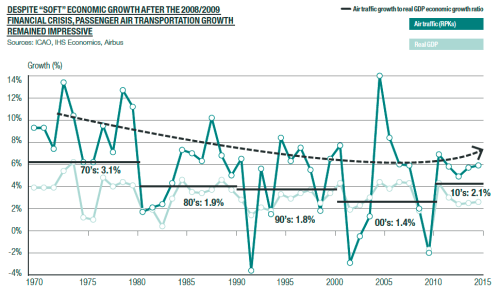
  • In terms of RPKs (“revenue passenger kilometer”), that is, the number of paying passenger by the distance they are transported, they see a similar future: Airbus forecasts for 2034 ~15.2 RPKs (in trillion, 4.6% annual growth from today) while Boeing forecasts 16.15 RPKs (4.9% annual growth).

The main changes from last year’s forecasts are:

  • Both manufacturers have increased their passenger aircraft forecast in ~1,200 a/c.
  • Both manufacturers have increased the volume (trn$) of the market in these 20 years, by about 300bn$ or 6.5%(excluding regional jets and freighters).

Some lines to retain from this type of forecasts:

  • Passenger world traffic (RPK) will continue to grow about 4.6% per year (4.9% according to Boeing). This is, doubling every ~15 years.
  • Today there are about 17,354 passenger aircraft around the world (according to Airbus; 17,350 in Boeing’s CMO), this number is about 500 a/c more than the year before (3% increase) and will more than double over the next 20 years to above 35,749 a/c in 2034 (over 37,990 as seen by Boeing, excluding regional jets).
  • Most deliveries will go to Asia-Pacific, 40% or 12,596 passenger aircraft (according to Airbus).
  • Domestic travel in China will be the largest traffic flow in 2034 with over 1,600bn RPK (according to Airbus (x 3.8 times more than today’s traffic), or 1,704bn RPK according to Boeing), or 11% of the World’s traffic.
  • About 13,400 aircraft will be retired to be replaced by more eco-efficient types.
GDP and traffic growth (source: Airbus 2015 GMF).

GDP and traffic growth (source: Airbus 2015 GMF).

As I do every year, I strongly recommend both documents (GMF and CMO) which provide a wealth of information of market dynamics.

4 Comments

Filed under Aerospace & Defence

Running a 10k a week before a marathon

A couple of months ago I discovered that there was a short race, 10km du Stade Toulousain, that was going to take place close to home. I decided to take part in it. Normally I have to travel or wake up early to arrive at the place where a race starts. This time I could stay longer in bed and I would go jogging from home. I could not skip this chance.

However, the date of the race was not the most suitable. It was just a week before Toulouse marathon. On top of it, I had run the 100km de Millau 3 weeks before, and in the following 4 weeks I was trying to train for the marathon and get an idea of how fit I was in order to see at what pace should I run it.

In races of 10km I normally try to run all out to see what is the best time I can achieve. In 2014 I collected some personal bests in the distance and several times under 45′. However, I knew I was slower from mid 2015, as the couple of 10k I run in June and July were in the range of 46 to 48 minutes.

Reading online in some forums I found people both in favor and against running a 10k all out just a week before a marathon. I found also an interesting idea: take it as a series training. The poster suggested to run it alternating 1 mile at marathon pace with 1 mile all out, 3 times. I found this idea interesting and decided to do something like that. I would run the 10k alternating kilometers running at all out and marathon pace (however, the latter ones I ran them faster than my best time in marathon… and faster than the intended pace for Toulouse marathon).

It was a good experience. I thought that it would take me more effort to go each time all out and also to not relax completely but to keep a good pace in between those all out kilometres.

I did the fast kilometres at in between 4’20” and 4’27”. The last half kilometre at below 4′ pace.

I did the slow kilometres at in between 4’50” and 5’00”. The previous to the last half kilometre at 4’33” pace.

[My best time in a 10k was at a pace of 4’24”]

[My best time in a marathon was at a pace of 5’04”]

Splits during the race.

Splits during the race.

Apart from the running experience, it was strange to overtake and be overtaken by the same runners once and again. I would pass them along the third kilometre, they would overtake me along the fourth, and so on… as the race advanced some of the runners I exchanged positions with during the race were not overtaking me anymore, until the last two kilometre, when I finished at a faster pace than the groups I had been running with.

Finally, we got a nice t-shirt with the logo the rugby club.

Leave a comment

Filed under Sports